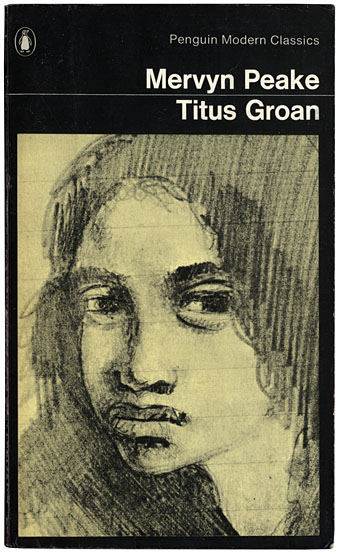
First paperback edition of Titus Groan, 1968.
If you’re British then, no, it isn’t what you think. Having mentioned my hometown of Blackpool yesterday there’s one detail about the town I usually regard as an annex of Hell which, if not quite a saving grace, raises it into some lesser locus of perdition.
There are many Coronation Streets in Britain (and Coronation Roads, Terraces, etc), Manchester has several real ones besides the fake one which provides the setting for the world’s longest-running soap opera. Most are named after a royal event, of course, although I don’t know when the one in Blackpool was built, possibly around 1911 which would mean it takes its name from the coronation of George V. I remember it as being a very undistinguished street of shops, and had no idea all the time I was in Blackpool that Mervyn Peake had lived for a short period in that street (no. 62) with wife Maeve Peake (later Gilmore) and son Sebastian in 1940. Mervyn was in the Royal Artillery in the early years of the war, and was posted to Blackpool as part of an Anti-Aircraft Training Regiment. Once established he found there was little for him to do so he continued work on the manuscript of Titus Groan, still at that point being referred to as Goremenghast (with an extra “e”). Later on the family moved to Bloomfield Road, the home of Blackpool’s football club, before Maeve and Sebastian returned to London.
All this detail can be found in G. Peter Winnington’s Peake biography, Vast Alchemies (2000), and came as something of a shock to me. One thinks of Peake as an inhabitant of Sarke and London, not Blackpool, however brief his stay. But I was stunned most of all to hear about him writing there as well. Peake noted on his manuscript where the chapters were written so Winnington can tell us that some of Titus Groan was set down on the town’s North Pier. The piers are one of the few things I liked about Blackpool, North Pier most of all for being the longest structure with the best views of the sea. It’s also notable for me in being the place where I began my first (and strongest) acid trip in 1980. That’s nothing to do with Peake, of course, but the significance of these separate events tangles in a curious and unexpected way, so that I can’t think of that pier now, or of the early chapters of the Gormenghast trilogy, without this knowledge coming to the surface.
This year is the Peake centenary, and I wrote at the beginning of the month about some of the events and exhibitions being staged in the UK. One of these, Mervyn Peake: A Celebration, will take place at the British Library, London, on Tuesday, 26th July. Described as “an evening of words, memories and images with Peake’s associates, experts and family members”, the speakers will include Fabian Peake, Sebastian Peake, Clare Penate, Brian Sibley, Hilary Spurling and others, with a specially filmed contribution by Michael Moorcock. Further details here. Don’t expect Peake’s presence in Blackpool to be acknowledged this year; the philistine nature of the place is one reason I escaped as soon as I could.
Update: Mervyn Peake’s war paintings unveiled by National Archives.
• G. Peter Winnington’s Peake Studies
Previously on { feuilleton }
• The Worlds of Mervyn Peake
• A profusion of Peake
• Joseph Cavalieri’s stained glass
• Mervyn Peake at Maison d’Ailleurs
• Peake’s Pan
• Buccaneers #1
• Mervyn Peake in Lilliput
• The Illustrators of Alice