Mind the doors!

andreev1.jpg

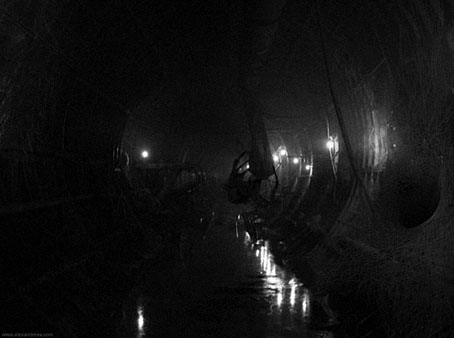
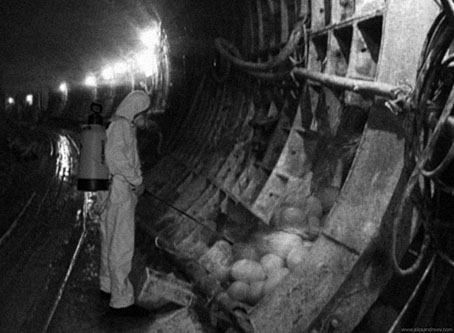
Russian artist Alexey Andreev populates the Moscow Metro with eldritch weirdness in a photo-collage series he calls Metronomicon. A couple of these pieces remind me of Clive Barker’s throat-grabbing story, The Midnight Meat Train, which was filmed a couple of years ago. For an earlier cinematic example of the horror inherent in underground transport systems there’s Gary Sherman’s Death Line, or Raw Meat as it was fatuously rebranded for the US, a very effective low-budget film from 1972. Fantastic Voyages reviews it here.

Andreev tip via MetaFilter.

andreev2.jpg

Previously on { feuilleton }
Subterrania
Tunnel 228

Constantinople, 1900

constantinople1.jpg

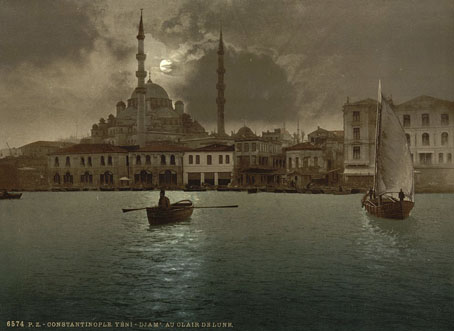
Yeni-Djama (ie, Yeni Cami) by moonlight, Constantinople.

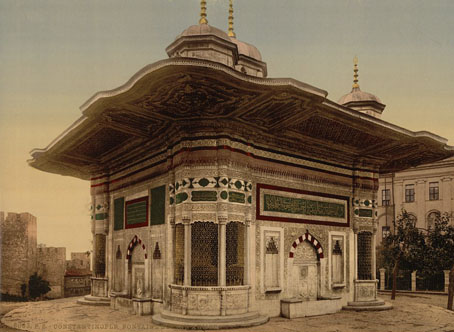
Fascinating views of the Turkish city circa 1890–1900 from the Photochrom collection of the Library of Congress. These are from the LoC Flickr selection; the library website has a lot more.

Published primarily from the 1890s to 1910s, these prints were created by the Photoglob Company in Zürich, Switzerland, and the Detroit Publishing Company in Michigan. The richly colored images look like photographs but are actually ink-based photolithographs, usually 6.5 x 9 inches.

constantinople2.jpg

The fountain of Sultan Ahmed, Constantinople.

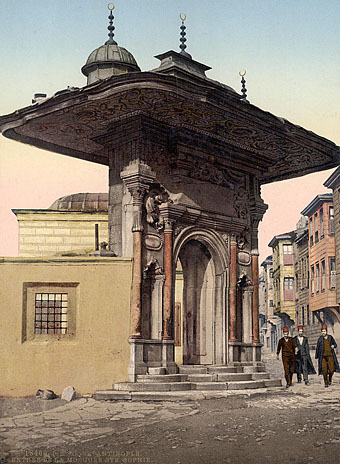
constantinople3.jpg

Entrée de la Mosque Ste. Sophie, Constantinople.

Previously on { feuilleton }
Albert Kahn’s Autochromes
The Dawn of the Autochrome

Weekend links 25

borgespesos

A commemorative Borges coin.

He says, “Two aesthetics exist: the passive aesthetic of mirrors and the active aesthetic of prisms. Guided by the former, art turns into a copy of the environment’s objectivity or the individual’s psychic history.” There, of course, he sums up all of realism, no? “Guided by the latter, art is redeemed, makes the world into its instrument and forges, beyond spatial and temporal prisons, a personal vision.” That’s Borges.

The Borges Behind the Fiction: Colin Marshall talks to translator Suzanne Jill Levine. Related: The Garden of Forking Paths.

• From The Quietus: Blondie in Conversation with William S. Burroughs by Victor Bockris, 1979; An Interview with Laurie Anderson by Robert Barry, 2010.

In 962 Abd-er Rahman III was succeeded by his son Al-Hakim. Owing to the peace which the Christians of Cordova then enjoyed […] the citizens of Cordova, Arabs, Christians, and Jews, enjoyed so high a degree of literary culture that the city was known as the New Athens. From all quarters came students eager to drink at its founts of knowledge. Among the men afterwards famous who studied at Cordova were the scholarly monk Gerbert, destined to sit on the Chair of Peter as Sylvester II (999–1003), the Jewish rabbis Moses and Maimonides, and the famous Spanish-Arabian commentator on Aristotle, Averroes.

Entry for The Diocese of Cordova from The Catholic Encyclopedia (1917).

Professor Newt’s Distorted History Lesson. A riposte to the ignorance of the wretched Gingrich. Related: the Mezquita de Córdoba.

borgeskat

Jorge Luis Borges and a cat. Via.

Joseph and His Friend—A Story of Pennsylvania (1870) by Bayard Taylor, America’s first (?) gay novel. Related: 20 classic works of gay literature.

Elegies For Angels, Punks and Raging Queens at the Shaw Theatre, London, from 10–28 August 2010.

• Tristan Perich’s 1-Bit Symphony is released later this month. Café Kaput’s first release, Electronic Music in the Classroom by DD Denham, appears in September.

• “Just relax and enjoy it.” k-punk on the ambition and vision of David Rudkin’s Artemis 81.

• Chris Watson explores Alan Lamb’s The Wires: three audio recordings to download.

• Jonathan Barnbrook: Tuxedomoon fan, 1988, and Tuxedomoon designer, 2007.

• Rob Young’s Electric Eden reviewed by Michel Faber.

Brian Eno gets the Warp factor.

No Tears (1978) by Tuxedomoon; Atomic (1979) by Blondie; Everything You Want (1980) by Tuxedomoon; Next One Is Real (1984) by Minimal Compact; Hologram (2010) by These New Puritans.

Schloss Falkenstein

falkenstein.jpg

Proposal for Schloss Falkenstein (c. 1883).

A slight return to Ludwig II. Schloss Falkenstein would have been another beetling edifice in the manner of Schloss Neuschwanstein had it ever been built, and judging by this view it might have been even more grandiose. The painting is one of the proposals by stage designer Christian Jank whose plans had already been used for Neuschwanstein. Philippe Jullian makes some scathing remarks about the Gothic interior of the earlier castle but he may have had more patience for the Byzantine interiors planned for Falkenstein. I’m not sure how these would be reconciled with Jank’s exterior, however, the style being Gothic enough to satisfy Viollet-le-Duc. Ludwig’s untimely death in 1886 drew a line under his architectural schemes but Bavaria’s loss eventually became Walt Disney’s gain as Jank’s fantasias provided the inspiration for the castle in Sleeping Beauty (1959) and all of the Disney theme park castles. What Ludwig would have made of this we can only guess. I suspect he’d be entranced by the fantasy but appalled by the vulgarisation. He was an elitist, after all, and the castles were always for him alone, not hordes of T-shirted proles.

Previously on { feuilleton }
Schloss Linderhof
Schloss Neuschwanstein
Pite’s West End folly
Viollet-le-Duc

Schloss Linderhof

linderhof1.jpg

More Ludwigiana. Schloss Linderhof was Ludwig II of Bavaria’s miniature Versailles at Oberammergau and is a key location in Visconti’s film about the King. The house itself is a riot of gilded rococo which isn’t really to my taste but you can make your own judgement by taking a tour at the palace website or browsing the photos at Wikimedia Commons.

linderhof2.jpg

Of greater interest is the Moorish Kiosk in the palace grounds, a small pavilion originally created for the Paris exposition of 1867. The outside is a typical piece of Orientalist architecture while inside there’s some beautiful stained glass and a splendid Peacock Throne. This doesn’t feature in Visconti’s film, unfortunately, but the Venus Grotto does.

linderhof3.jpg

Philippe Jullian’s Dreamers of Decadence (1971) contains some pages about Ludwig and the inspiration he gave to Symbolist artists and poets. Reports of places like the Venus Grotto were among those inspirations, and Jullian recounts a description by actor Joseph Kainz of his first visit to Linderhof. The scene is played out in Visconti’s film almost to the letter:

All of a sudden the rock moved; an opening appeared through which we entered a long corridor, brightly lit with a red light. Along the walls of the grotto the King’s servants stood in line.

Still following the servants who were leading the way, I walked to the end of the corridor, as far as what appeared to be a natural opening in the rock. Through this opening there poured a sea of blue light. The interior of the grotto looked like a huge, dazzling sapphire, whose flickering brilliance spread over the craggy walls, entered every tiny crack, and cast a sort of magic veil over every object. I had stopped on the threshold, behind an overhanging rock, dumbfounded by the grandiose splendour that surrounded me; I was breathless with amazement. The ceiling of the grotto was vaulted, like that of a cathedral. I was inside the Venusberg.

I took a step forward and stopped again. The rock which had concealed me until then. had prevented me from seeing on my right a lake of astonishingly limpid water, lit by a sky-blue light. On it there glided two snow-white swans, while on the shores stood a tall man, all alone, and apparently deep in thought: this was the King.

For a moment I gazed at his fine head, his broad shoulders, his remarkably white hands which were casually tossing pieces of bread to the two swans; I also noticed the bright star made up of sapphires which was fastened to his hat.

He shook me warmly by the hand, releasing me from the feeling of depression which had affected me till then. Then the King took me up a path leading to the top of a hill in front of us. On the top of this hill there was a table made of sea-shells which stood on a large conch supported by crystal feet. Near this table there was a seat made of the same materials, and the servants brought along another. The King invited me to sit down, and supper was served.

Every quarter of an hour the King gave a signal and the lighting of the grotto changed; it turned red, then green, then blue, then gold, and into my imagination came memories of ancient legends and fabulous fairy-tales.

360 Cities has some panoramas of the Linderhof grounds with a view of the palace and one of the entrance to the Moorish Kiosk. As you’d expect, Flickr has a large collection of Linderhof photos while there’s also a pool of over five hundred images devoted to Ludwig II.

Previously on { feuilleton }
Schloss Neuschwanstein