The Royal Greenhouses of Laeken

laeken1.jpg

The Winter Garden, photo by William Helsen.

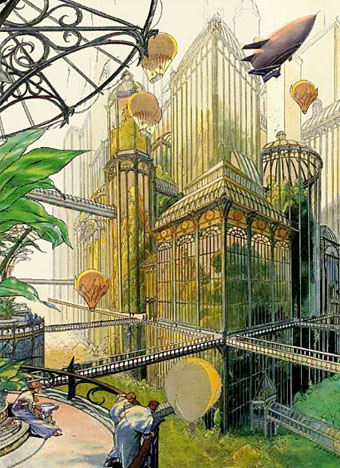
My arcades fetish has been aired here a few times to which one might add a complementary fetish for iron-and-glass structures in general, especially railway stations, palm houses and winter gardens. The Royal Greenhouses at Laeken, Brussels, are an impressive example of the latter, even if they happen to owe their existence to King Leopold II whose barbaric exploitation of the Congo is recounted in Joseph Conrad’s Heart of Darkness. Alphonse Balat was the architect of the central Winter Garden built between 1874 and 1876, and reading up on him it turns out that the celebrated Art Nouveau architect Victor Horta was one of Balat’s apprentices. Horta never had the opportunity to create anything this extravagant, unfortunately, but if he had the results may have resembled one of the structures created by François Schuiten for his greenhouse city of Calvani (below), a metropolis of the Obscure World. Schuiten is a resident of Brussels and we’re told that one of the earthly “Passages” to the Obscure World can be found at the Royal Greenhouses. The building is only open to the public during April and May each year, however, so anyone looking for a route to Schuiten’s world may be better off searching elsewhere.

• The Royal Greenhouses at Wikimedia Commons
• The Royal Greenhouses at Flickr
schuiten.jpg

Calvani by Schuiten.

laeken2.jpg

The Winter Garden dome, photo by Jean-Pol Grandmont.

laeken3.jpg

Photo by Roman Bonnefoy.

Previously on { feuilleton }
Arcades panoramas
Arcades
The art of François Schuiten
Passage des Panoramas
Passages 2
Passages

Weekend links 48

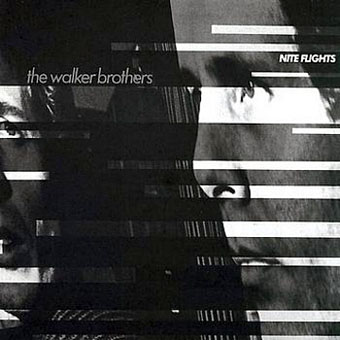
niteflights.jpg

Nite Flights (1978) by The Walker Brothers. Cover design by Hipgnosis.

something attacked the earth last nite
with a kick that man habit-eye
cut the sleep tight boys who dreamed and dreamed
of a city like the sky

Scott Walker quotes Brion Gysin (and who knows what else) in Shutout (see below), one of the four remarkable songs he wrote for the final Walker Brothers album, Nite Flights. That album cast a shadow over David Bowie’s Lodger a year later, and led Bowie to try his hand at a cover of the title track in 1993.

• Frédéric Chaubin’s photographs of what he calls Cosmic Communist Constructions. Also a new book from Taschen, and an exhibition at the Karlsruhe Museum of Contemporary Art. PingMag interviewed Chaubin back in 2006.

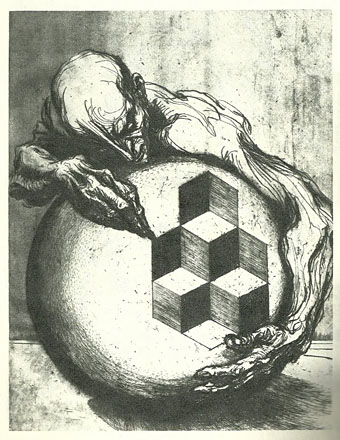
chirnoaga.jpg

From Disparate works by Romanian artist Marcel Chirnoaga (1930–2008). See also the Virtual Museum of Marcel Chirnoaga.

The immense size of modern databases gives us a feeling of meaninglessness. Information in such quantities reminds us of Borges’s library extending infinitely in all directions. It is our task as humans to bring meaning back into this wasteland.

Freeman Dyson on The Information: A History, a Theory, a Flood by James Gleick.

• In the Tumblr labyrinth this week: Mr Rossignol, the Elephant House for Edward Gorey, and Brion Gysin.

• Related to the last, Mutate or Die is “a bioart project being conceived of and executed by Tony Allard and Adam Zaretsky”.

• Barry Miles’s top 10 counterculture books. Related: Rick Poynor on Richard Neville’s Playpower.

“The sooner literary fiction recognises & accepts its generic identity, the sooner it can get help.”

• Is YouTube user “Kosinski” the ever-elusive Chris Marker? “All signs point to yes.”

• The Internet Archive is making its books available to US libraries.

• The Castle of Shadows at BLDGBLOG.

• The Light Painting Pool at Flickr.

• Scott Walker (with the Walker Brothers): Shutout |Nite Flights | The Electrician.

Pascal Sébah

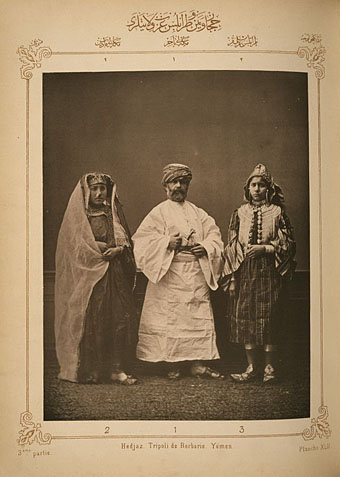
sebah1.jpg

Studio portrait of models wearing traditional clothing from the provinces of Hedjaz (Hejaz), Yemen and Tripoli, Ottoman Empire (1873).

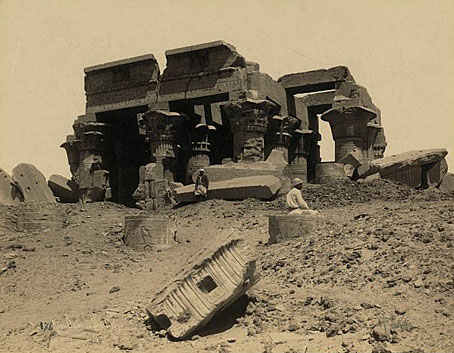
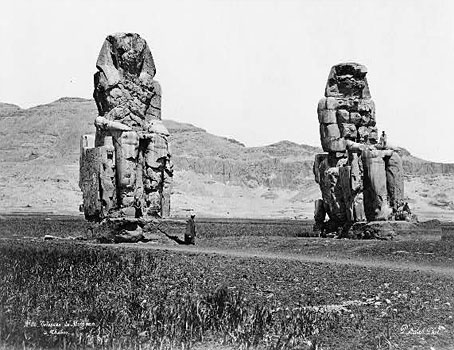
Photo prints by Turkish photographer Pascal Sébah (1823–1886) at the Library of Congress. I always like to see photos of ruins in the wild, so to speak, as they generally were in the 19th century before the imperatives of archaeology and mass tourism had cleaned, restored and reduced everything to the status of a museum exhibit or (in the case of the temple below) a shopping opportunity. There’s more of Pascal Sébah’s work at Wikimedia Commons.

sebah2.jpg

Kôm Ombo (Sud Est) (The ruins of the Temple of Sobek and Haroeris at Ombos, Egypt, between 1860 and 1886).

sebah3.jpg

Colosses de Memnon à Thèbes (between 1860 and 1890).

Previously on { feuilleton }
Alhambra cyanotypes
Constantinople, 1900
Edinburgh, 1929
Old Bunker Hill
Inondations 1910
Berenice Abbott
Eugene de Salignac
Luther Gerlach’s Los Angeles
The temples of Angkor
The Bradbury Building: Looking Backward from the Future
Edward Steichen
Karel Plicka’s views of Prague
Atget’s Paris
Downtown LA by Ansel Adams

Deutsche Kunst und Dekoration #9

dkd09-01.jpg

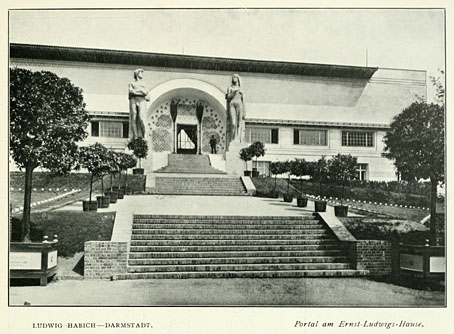
The Ludwig Habich building, Darmstadt.

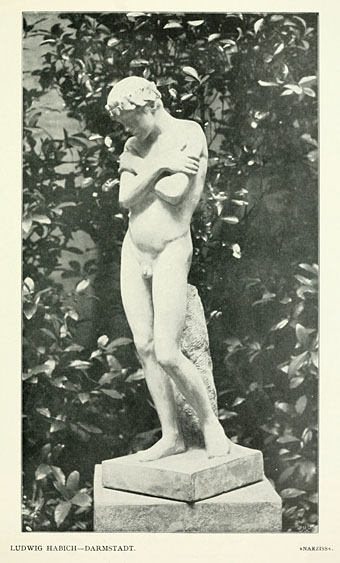
Continuing the delve into back numbers of Deutsche Kunst und Dekoration, the German periodical of art and decoration. Volume 9 covers the period from October 1901–March 1902. This edition continues the examination of the Darmstadt Artists’ Colony begun in the previous number. Despite the colony being very much an Art Nouveau venture the pictorial content is largely photographic, with many views of the show-homes built by the colony artists. Much of the other content is a disappointment compared to what’s gone before, the featured painters being the conservative types who were crowding Jugend magazine at this period with generic depictions of stolid German farmers. Unlike Jugend, however, this isn’t the end of the line. As usual, anyone wishing to see these samples in greater detail, or the rest of the edition, is advised to download the entire volume at the Internet Archive. There’ll be more DK&D next week.

dkd09-02.jpg

Continue reading “Deutsche Kunst und Dekoration #9”

Void City

hawkwind.jpg

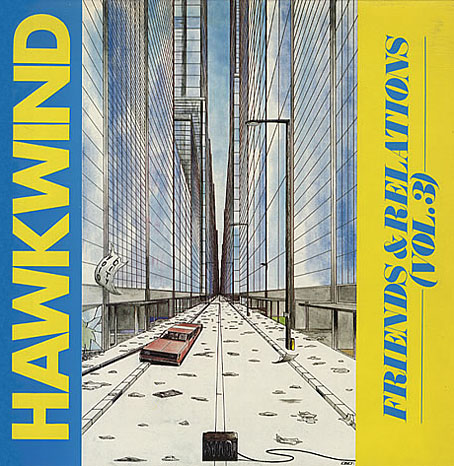
Friends & Relations Vol. 3 (1985) by Hawkwind.

Unless you assiduously collect everything you’ve ever worked on—which I don’t—you occasionally have to rely on the web to remind you of something you created years ago. This Hawkwind album is a good example, being one of the last releases by the band to use a piece of my artwork. (And I’ll quickly note that the accompanying type design was nothing to do with me; my design suggestions were always ignored, hence a growing frustration at that time with album cover work.) The album itself was the third in a series of odds and ends compilations gathering stray tracks by, yes, friends and relations of Mr Brock and co. Subsequent CD reissues used different packaging so the original vinyl is the only place you’ll see this illustration.

The reason I don’t have a copy is that the record label never sent me anything so unless Dave Brock put something in the post I had to buy them myself. (This happens more often than you’d expect.) I evidently didn’t think this one was worth it even though I much prefer the artwork to many of the earlier things of mine that were used. The drawing was a couple of years old, being inspired by the track Void City on the Choose Your Masques album from 1982. Void City is an atypical piece of electronica which I liked for its resemblance to some of the higher level synth pop and industrial music that was around in the early 1980s. 1982 to ’84 was the height of my JG Ballard obsession so Ballard is also a slight influence here. I had in mind his 1981 novel Hello America, which takes place in a post-apocalypse United States. And there’s also a trace influence from one of my early pieces of writing, a mercifully unpublished splurge of intense prose influenced by the New Worlds school of speculative fiction in which someone wanders around a vast and almost completely depopulated city. Looking at this drawing now it seems emblematic of my loss of interest in doing any kind of science fiction art; it also no longer seems futuristic. I produced my last album cover for Hawkind, The Chronicle of the Black Sword, in 1985; in January 1986 I started adapting HP Lovecraft’s The Haunter of the Dark. This took me out of the public eye for a few years but it was a more rewarding place to be for many other reasons.

Elsewhere on { feuilleton }
The album covers archive

Previously on { feuilleton }
Hawk things
The Sonic Assassins
New things for July