Der Orchideengarten illustrated

orchid_01.jpg

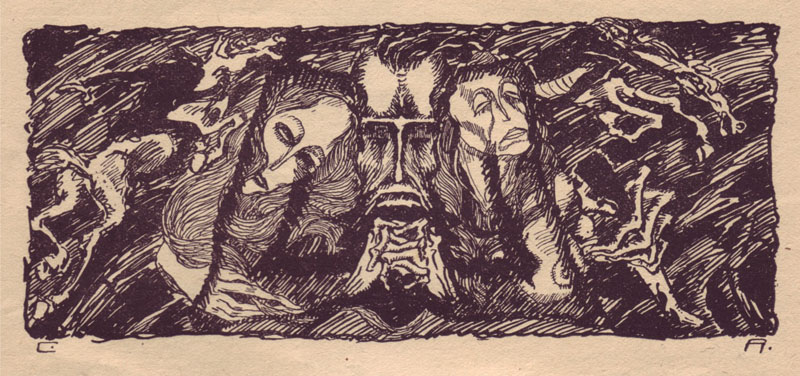
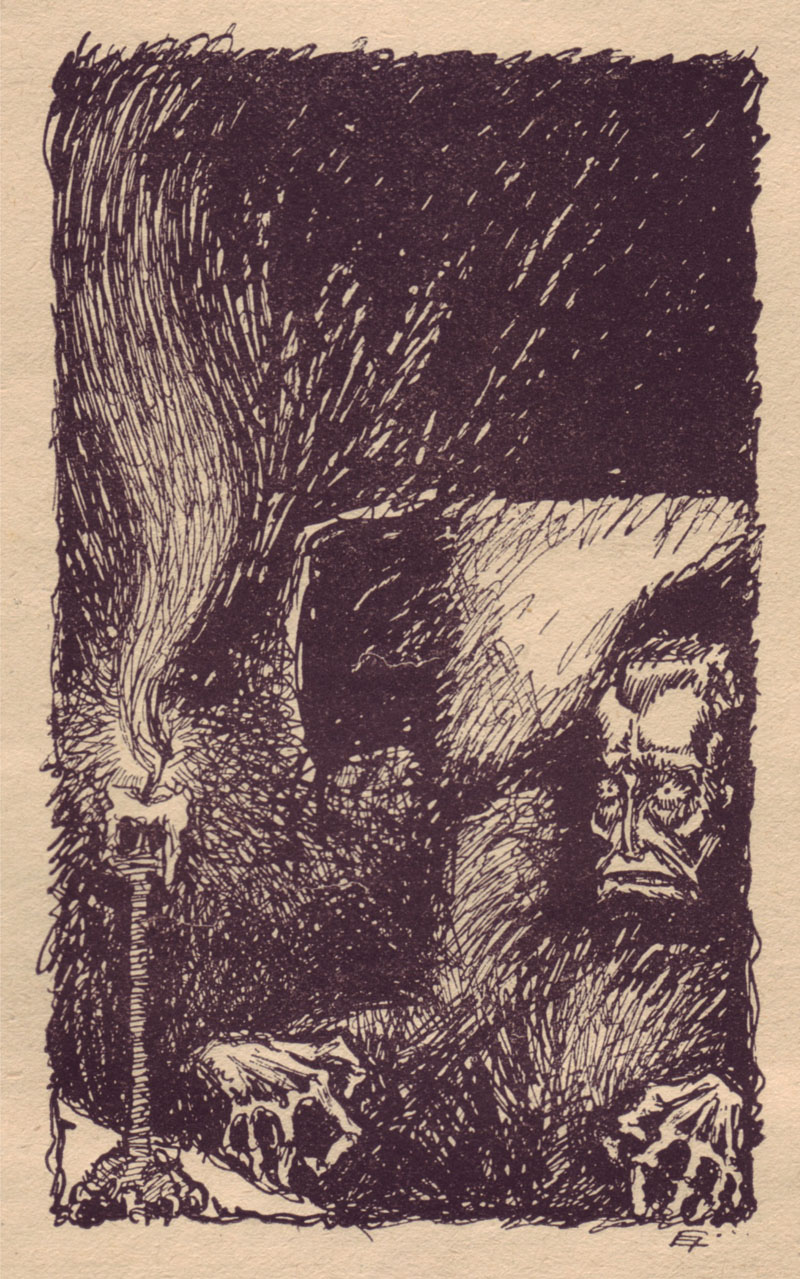
Halloween approaches and as a precursor it’s a great pleasure to be able to post a selection of interior illustrations from Der Orchideengarten, courtesy of Will at A Journey Round My Skull. Der Orchideengarten was a German magazine of weird fiction which ran for 51 issues from 1919 to 1921 and whose existence today is rarely acknowledged despite being credited as the world’s first fantasy magazine. Information is scarce and these scans come from Will’s own copies which is why I’ve posted fifteen more below the fold; you can’t see this stuff anywhere else. A Journey Round My Skull featured some covers and a different set of interior illustrations earlier this year, and there should be a new post complementing this one with more of the magazine’s stunning cover designs.

orchid_02.jpg

What strikes me about these black-and-white drawings is how different they are in tone to the pulp magazines which followed shortly after in America and elsewhere. They’re at once far more adult and frequently more original than the Gothic clichés which padded out Weird Tales and lesser titles for many years. Some are almost Expressionist in style, while the Wild Hunt series below shows a distinct Goya influence. I’d love to know how the written content matches the illustrations; I suspect there’s the same difference of atmosphere and emphasis to American weird fiction as there is in the drawings.

Update: Will’s new post is Watering the Toxic Garden which will be followed on Thursday by the results of his Evil Orchid Bookplate Contest.

Click on any of these pictures for a larger version.

Continue reading “Der Orchideengarten illustrated”

Equus and the Executionist

equus.jpg

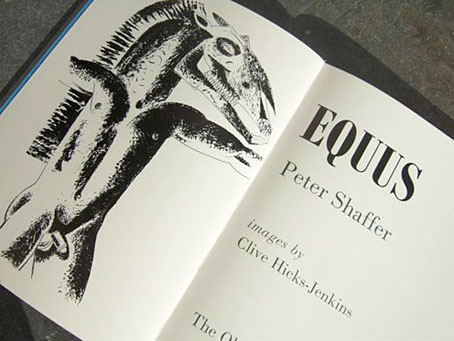
I wrote about Peter Shaffer’s fascinating play, Equus, in September last year, and in passing touched on the horse and Mari Lwyd-inspired paintings of Clive Hicks-Jenkins which seemed to complement the play’s themes of sexuality and passionate obsession. Callum James had been having similar thoughts about Clive’s art and urged his friends at The Old Stile Press to bring play and artist together. Clive was in touch last week to let me know that his illustrated edition of the play is now in print. The Old Stile Press produce limited collectors’ editions of books to the highest standard. Consequently these are expensive works but then they’re as much art pieces as books, as you can see from the care which has been lavished on this particular volume. Nice to see one of my favourite typefaces, Bodoni, used for the text.

scott.jpg

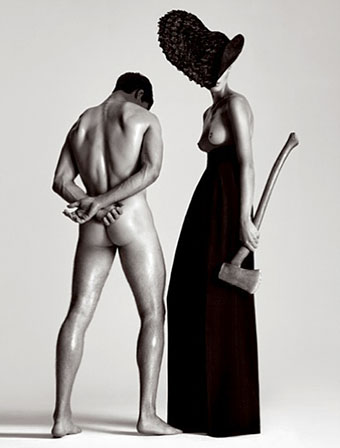
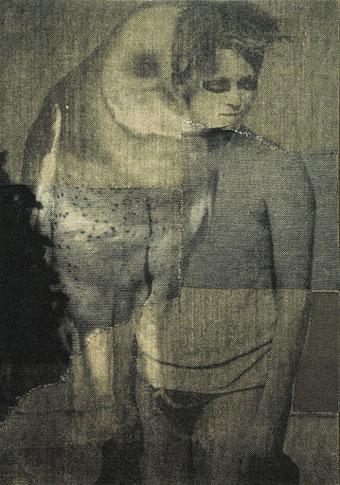
Also in touch last week was photographer Gray Scott with news of this striking picture entitled Executionist which also happens to be a limited edition print. This is another expensive piece—as limited prints tend to be—but there’s no law that says the best things have to be cheap, is there?

Elsewhere on { feuilleton }
The illustrators archive

Previously on { feuilleton }
Dark horses
Gray Scott

The Dark Monarch: Magic and Modernity in British Art

ayrton.jpg

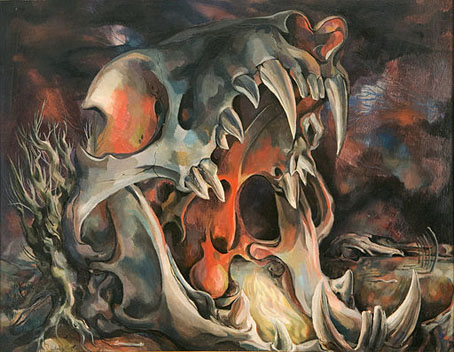
Skull Vision by Michael Ayrton (1943).

The Dark Monarch: Magic and Modernity in British Art: great title for an exhibition, a shame that it’s all the way down in Cornwall at Tate St Ives.

This group exhibition takes its title from the infamous 1962 book by St Ives artist Sven Berlin. It will explore the influence of folklore, mysticism, mythology and the occult on the development of art in Britain. Focusing on works from the beginning of the twentieth century to the present day it will consider, in particular, the relationship they have to the landscape and legends of the British Isles. (More.)

Artists featured include Graham Sutherland, Paul Nash, Barbara Hepworth, Henry Moore, Ithell Colquhoun, Cecil Collins, John Piper, Leslie Hurry and John Craxton. Among the contemporary artists there are Cerith Wyn Evans, Mark Titchner, Eva Rothschild, Simon Periton, Clare Woods, Steven Claydon, John Stezeker and Derek Jarman. Austin Osman Spare is notable by his absence but then that’s no surprise, the major occult artist of the 20th century never rates more that a passing mention from the art establishment. One nice surprise is seeing Ithell Colquhoun (1906–1988) featured in her second major British exhibition this year. (Her work is also present in the Angels of Anarchy exhibition running at the Manchester Art Gallery.) Colquhoun was a contemporary of Spare’s whose work turns up in occult encyclopaedias or overviews of the minor current of British Surrealism but she’s still largely unheard of outside those circles.

The Tate exhibition may be awkward to visit but there’s an illustrated catalogue available featuring contributions from quality writers including Brian Dillon, Philip Hoare, Jon Savage, Jennifer Higgie, Marina Warner, Michael Bracewell, Alun Rowlands and Martin Clark. Michael Bracewell has a piece about the exhibition at Tate Etc while Brian Dillon has an excellent essay in the Guardian connecting John Dee’s mysterious obsidian scrying mirror with some of the works on display.

noonan.jpg

Untitled by David Noonan (2009).

Artist of the week: David Noonan
Ithell Colquhoun at A Journey Round My Skull

Previously on { feuilleton }
Angels of Anarchy: Women Artists and Surrealism
A=P=P=A=R=I=T=I=O=N
In the Shadow of the Sun by Derek Jarman

Through the Wonderwall

wonderwall1.jpg

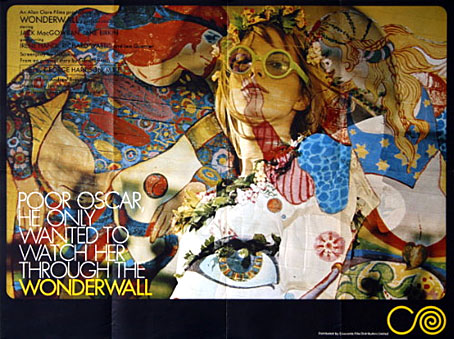
It’s taken me years but the recent obsession with UK psychedelia led me to finally watch Joe Massot’s piece of cinematic fluff from 1968, Wonderwall, a film distinguished primarily for its score by George Harrison (with Ringo Starr and Eric Clapton playing pseudonymously), and its title which was swiped years later by a bunch of Rutles-imitators from Manchester. The story is so slight it would have barely sustained an hour-long TV film: absent-minded scientist (Jack MacGowran) becomes intrigued by his glamorous neighbour (Jane Birkin playing “Penny Lane”; yeah, right…) and knocks holes in the walls of his flat in order to scrutinise her modelling, partying and frequent undressing. Unlike Blow Up (1966, and also featuring Jane Birkin) and the later Performance (1970), both of which attempted to accurately pin down some of the modish aspects of the period, this is a very kitsch piece. That wouldn’t be so bad if it was entertaining kitsch like, say, Smashing Time (1967), but Massott has to resort to scenes of limp comedy and some rather dull dream sequences in order to pad the thing out. Between the handful of actual dialogue scenes there’s a lot of gloating over Ms Birkin’s flesh which no doubt satisfied one half of the audience but by today’s standards is hardly thrilling. Iain Quarrier plays Penny’s duplicitous boyfriend (with a fake Liverpool accent) in his last screen role before he quit acting. Quarrier and MacGowran had appeared together in two of Roman Polanski’s British films, Cul-de-sac (1966) and Dance of the Vampires (1967). In the latter, MacGowran again plays an absent-minded scientist while Quarrier is cinema’s first (?) gay vampire.
wonderwall2.jpg

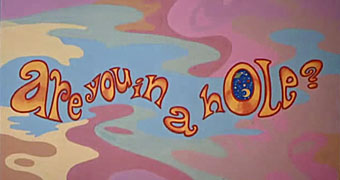
An interjection from The Fool.

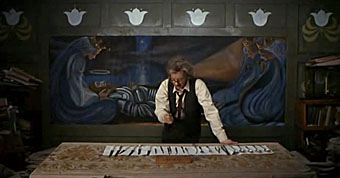
Of chief interest for me in Wonderwall was the decor and title card decorations by Dutch psychedelic collective, The Fool (who also appear in the party scene), famous for their earlier Beatles associations including the inner sleeve for Sgt Pepper and designs for the short-lived Apple Boutique in London’s Baker Street. I was also curious about the distinctive decor of MacGowran’s flat which contrasts with the psychedelia next door, all dark green walls embellished with Victorian murals and a Tennyson poem—very fittingly a piece called The Daydream—which circles the room.
wonderwall4.jpg

The professor prepares to attack the wall.

This was particularly interesting in that it made another connection between the psychedelic era and Victorian arts movements, especially from the Aesthetic/Arts & Crafts end of things, but it wasn’t at all obvious whether the connection was an intentional part of the film’s production design or an accident of location and budgetary convenience. Aside from the old-fashioned appearance of MacGowran’s rooms there seemed no reason why his otherwise cultureless character would have any interest in decorating his living space in this way.
wonderwall3.jpg

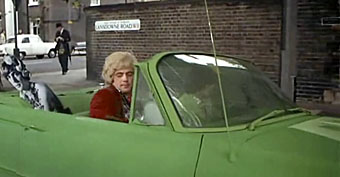
The street corner then…

google1.jpg

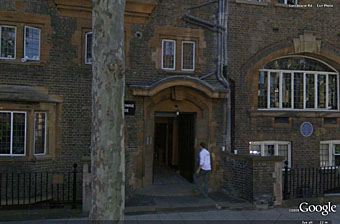
…and now.

google2.jpg

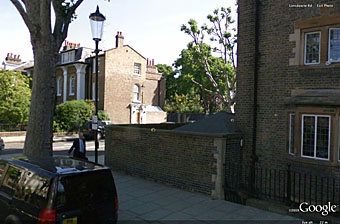
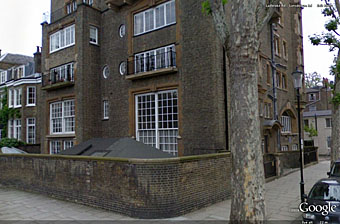
The building itself is equally distinctive and an exterior shot conveniently shows a street sign placing the location in Lansdowne House, a Victorian apartment block on the corner of Lansdowne Road and Ladbroke Road in the Notting Hill/Holland Park area of London.
google3.jpg

Lansdowne House.

What did the building look like today, I wondered? Google Earth proves indispensable at times like this and it was easy to find, in a street which looks more cramped than it does in the film. The presence of a blue plaque on the wall proved intriguing, a sign that the place once had famous residents. Googling for that revealed this photo which was a real surprise: Lansdowne House at one time contained studios for artists who included Charles Ricketts and Charles Shannon, a gay couple and leading lights of London’s fin de siècle art scene (also friends of Oscar Wilde), and another artist, James Pryde, who with William Nicholson worked as The Beggarstaffs. So my suspicion about the Arts & Crafts decor was correct, which means that MacGowran’s flat may have been decorated that way originally and remained untouched since the 1890s. I haven’t seen Rhino’s special edition of Wonderwall which contained additional information about the making of the film, so have no idea whether the history of the building is mentioned there. If anyone does know, please leave a comment. For now I’m quite happy to have stumbled upon another minor link between two of my favourite art decades.

For more visuals, this page has a host of screen grabs from the film as well as some gif animations, all of which manage to make Wonderwall seem more interesting than it is when you’re watching it.

Previously on { feuilleton }
Charles Ricketts’ Hero and Leander
Images by Robert Altman