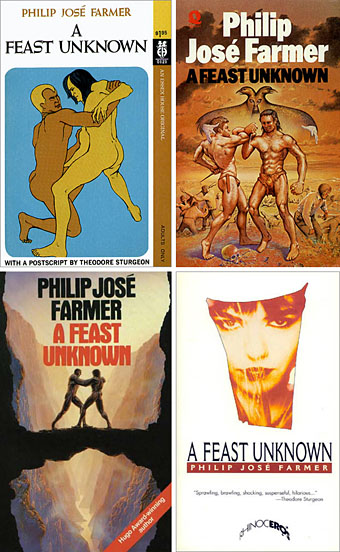
Philip José Farmer book covers

feast.jpg

top left: artist unknown (1969); top right: Patrick Woodroffe (1975)
bottom left: Peter Elson (1988); bottom right: artist unknown (1995)

The Men with snakes post at the weekend finished on a note of Freudian melodrama with a picture of Doc Savage battling a giant python. Lester Dent’s brazen hero has appeared a number of times in the work of Philip José Farmer, a writer who’s spent much of his career laying bare the psychosexual forces which give us stories of pulp heroes struggling with (among other things) enormous snakes.

Farmer is famous—notorious, even—for being the first writer to place sex centre stage in science fiction with his story of a human/alien encounter, The Lovers, in 1952. While subsequent writers have broadened the field in their own way, Farmer is somewhat unique in being equally adept at writing solidly successful sf adventure such as the World of Tiers or Riverworld books, yet with a mischievous and intellectual facility that could be upsetting to what used to be a very conservative sf establishment. Farmer was writing about sex at a time when few genre writers wanted to deal with the subject. He also loves pulp fiction in all its manifestations yet isn’t afraid of examining its characters with the objectivity of an anthropologist. Both these impulses came together (so to speak) in the late Sixties with the outrageous pulp pornography of Image of the Beast and A Feast Unknown. More about these in a minute.

Farmer has a particular enthusiasm for Tarzan and Doc Savage and eventually wrote “official biographies” of the pair with Tarzan Alive (1972) and the splendidly-titled Doc Savage: His Apocalyptic Life (1973). These books saw the beginning of his Wold Newton Universe which sought to connect all the heroes and villains of the late 19th and early 20th century into a vast, incestuous family tree, a scheme which predates similar exercises such as Alan Moore and Kevin O’Neill’s League of Extraordinary Gentlemen by three decades or more. His versatility and delight in pastiche was demonstrated in Jungle Rot Kid on the Nod (1968) which rewrote Edgar Rice Burroughs’ Tarzan in the style of William Burroughs. There aren’t many writers with a full-enough appreciation of both these authors to pull off such a challenge.
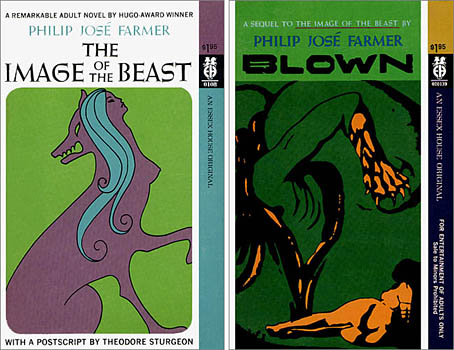
farmer2.jpg

Original Essex House editions, 1968 & 1969. Artist/designer unknown although the cover of Blown is based on Geopoliticus Child Watching the Birth of the New Man by Salvador Dalí.

Image of the Beast (1968), its sequel, Blown (1969), and A Feast Unknown (1969) were all written for sf-porn publisher Essex House, an opportunity which unleashed Farmer’s already fertile imagination. These took a while to be reprinted but are now considered among his best works; they’re certainly favourites of mine and I love the simple graphics of the original covers, such a change from the usual airbrushed sf fare. I produced a cover illustration for the Creation Books edition of Image/Blown in 2001 which, while okay, I now feel could have been better. A Feast Unknown is Farmer’s most gloriously excessive novel, and still surprises when read today. Illustrator Patrick Woodroffe, who painted the cover for the first UK printing, thought the book “dangerous” and complained in his Mythopoeikon collection that there was little he could safely illustrate. The story has a thinly-disguised Tarzan (Lord Grandrith) and Doc Savage (Doc Caliban) set against each other by a group of mysterious immortals. The pair discover that violence gives them erections and killing provokes an orgasm, the cue for a couple of hundred pages of eye-popping, ball-busting mayhem. It’s ironic that during the Seventies when general readers were looking for racy thrills in books by Harold Robbins or Jackie Collins, the real hardcore stuff was over on the science fiction shelves with Farmer’s work, Ballard’s Crash, Samuel Delany’s Equinox, aka The Tides of Lust, Charles Platt’s The Gas, and others.

Farmer wrote two equally crazy sequels to Feast in 1970, Lord of the Trees and The Mad Goblin but unfortunately stripped out the excesses of the former book. I’ve always been disappointed by this and continue to hope that one day the original versions of the sequels will see print. Science fiction may have calmed down a bit (or grown conservative again) since the Seventies but Farmer’s work still exerts an influence. His unveiling of the weird psychosis at the heart of pulp fiction certainly affected the approach I took with the Lord Horror series Reverbstorm, created with David Britton in the 1990s, a series I’ve referred to more than once as a psychopathology of heroic fantasy.

The covers above all come from the official PJF website which also includes my Image/Blown cover design. (And where they also spell my name wrong.)

Previously on { feuilleton }
Men with snakes
The book covers archive

Jack Kerouac book covers

ontheroad.jpg

left: Andre Deutsch (1958); right: Penguin (1972).

In a year filled with cultural anniversaries, here’s another. Jack Kerouac’s On the Road is fifty years old next month and to celebrate this Penguin is publishing the book in its original form for the first time. Although the cover of the first edition described the text as “complete and unexpurgated”, names were changed to protect the innocent and/or guilty and other aspects, such as some very mild gay sex references, were removed. The same site I linked to last year with a great selection of William Burroughs book covers has another section devoted to Kerouac’s magnum opus.

The challenge with this book is whether or not to feature a road as the main image; some designers rise to that challenge better than others. The Ukrainian cover crudely modelled on a Jack Daniel’s label is a particularly unfortunate choice considering that the author died prematurely from cirrhosis of the liver. As with William Burroughs, some translations of the title work better than others: Unterwegs (German) sounds clunky to English ears while Sulla Strada (Italian) has more poetry than the original.

The Observer on the book’s fiftieth anniversary
Beat Scene magazine
Kerouac’s bisexuality explored at GLBTQ

Elsewhere on { feuilleton }
The book covers archive

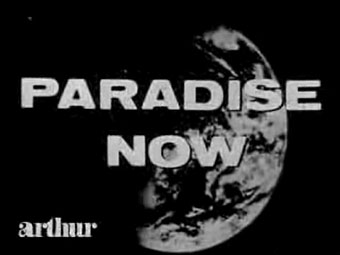
Paradise Now: The Living Theatre in Amerika DVD

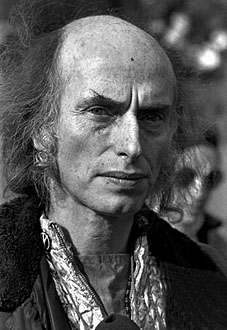
julian_beck.jpgMost people today know Julian Beck, if at all, for a small but unforgettable film role at the end of his career. In Poltergeist 2 (1986) Beck plays the nightmarishly sinister Reverend Henry Kane and his one full scene in that film is far more unnerving than the rest of its rubber monsters and special effects. Beck, a bisexual radical who makes most contemporary theatre directors seem as challenging as civil servants, started out as a painter but moved into theatre in the late Forties, founding the legendary Artaud-inspired Living Theatre in 1947. The Living Theatre was to the stage what the Beats were to literature, intent on shaking up the medium, the audience’s complacency and—by implication—society itself, to the fullest extent possible.

It’s the tragedy of theatre that its nature as a medium dependent on performance leaves so little record of its works behind. But there is one major film of the Living Theatre at its most provocative and it’s fitting that this should appear on a new DVD from Arthur Magazine in the year of the company’s sixtieth anniversary.

NEW FROM ARTHUR: PARADISE NOW: THE LIVING THEATRE IN AMERIKA DVD. LIMITED EDITION OF 1,000 – PRE-ORDER NOW – SHIPS OCT 1ST, 2007!

the screams
the unchained soarings of a sincerity which is on its way
to this revolution of the whole body without which nothing can
be changed. – Antonin Artaud
paradise.jpg

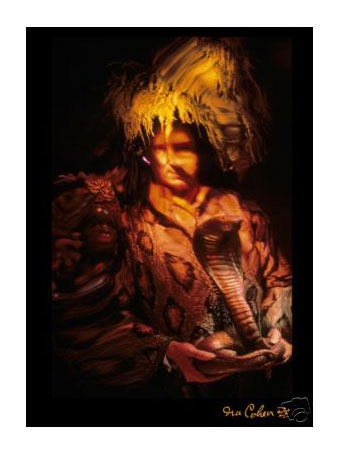
Arthur Magazine proudly presents our newest release PARADISE NOW: The Living Theatre in Amerika DVD featuring rare, never-before-distributed films and a bacchanal of revolutionary multimedia documents from The Living Theatre’s historic and influential ’68–’69 American tour. A fulminating art-meets-life installation brought to you in collaboration with The Living Theatre, The Ira Cohen Akashic Project and Saturnalia Media Rites of the Dreamweapon.

DVD INCLUDES – PARADISE NOW: The Living Theatre in Amerika (1969) a film by Marty Topp, produced by Ira Cohen for Universal Mutant

EMERGENCY (1968) a film by Gwen Brown, featuring precious footage of Living Theatre productions Mysteries and smaller pieces, Paradise Now, and Frankenstein

• RARE PHOTOGRAPHS of Paradise Now at Brooklyn Academy of Music by Don Snyder

• THE MAP OF PARADISE NOW, a 14″ x 19″ double-sided, commemorative poster + ‘zine including texts by Antonin Artaud, Julian Beck, Judith Malina, Ira Cohen and Don Snyder

ADDITIONAL SPECIAL FEATURES

• Slideshow / Installation, The full theatrical script

Paradise Now: A Collective Creation of The Living Theatre as written down by Julian Beck and Judith Malina

• Video Interviews with director Judith Malina, Hanon Reznikov, Steve Ben Israel, and producer Ira Cohen

The Spinning Wheel by Steve Ben Israel, soundtrack to EMERGENCY sourced from agit-prop radio broadcasts

• Akashic Video Gallery of excerpts from current and forthcoming Arthur DVD releases

WHAT IS PARADISE NOW?

In 1968 The Living Theatre, led by Julian Beck and Judith Malina, triumphantly returned to America from years of self-imposed exile in Europe with their theatrical breakthrough Paradise Now. The play introduces the practice of collective creation, dissolving the boundaries of human interactions and forging a harmony between the actors and audience. Of this process, Julian Beck writes, “Collective creation is the secret weapon of the people… This play is a voyage from the many to the one and from the one to the many. It’s a spiritual voyage and a political voyage, a voyage for the actors and the spectators. The play is a vertical ascent toward permanent revolution, leading to revolutionary action here and now. The revolution of which the play speaks is the beautiful, non-violent, anarchist revolution.The purpose of the play is to lead to a state of being in which non-violent revolutionary action is possible.”

The result of this shared voyage is the spontaneous creation of a temporary anarchist collective – free from the enslavements of war, violence, the State, money and the self.

CRITICAL PRAISE FOR PARADISE NOW

“Marty Topp’s beautiful film of Paradise Now reveals how the theories of revolutionary change and the experience of sexual liberation are not separate paths to the beautiful nonviolent anarchist revolution. Practiced together they are a single thrust, encompassing both political action and sensual joy, leading to the dreamed-of terrestrial paradise.” Judith Malina

“Paradise Now is possibly The Living Theatre’s greatest achievement – unsurpassable!” Ira Cohen

“This past spring, in a group art show at New York?s Swiss Institute, an old black-and-white television played a grainy print of bodies writhing to the tune of distant drumming. “As long as you have people working for money and not love, there will be violence,” intoned a tall, angular man on the screen. The bodies – women in scant bikinis and men in what looked like loincloths-piled together in an orgiastic tribal dance, some simulating (or perhaps actually having) sex as the voice continued: “Psycho-sexual repression is impeding the revolution.” What looked like an underworld-of the 1960’s counter-cultural variety, in this case- is the Living Theatre?s Paradise Now, as documented in the 1969 Ira Cohen-produced film Paradise Now: The Living Theatre in Amerika ? soon to be released on DVD from Arthur Magazine.” CAN THEATER STAGE A REVOLUTION – Traci Parks, Fall ’07 Preview, V MAGAZINE

“Joyous, brutal, exploding with the kinetic energies of psychic catharsis… Marty Topp’s PARADISE NOW: The Living Theatre in Amerika has captured the essence of this extraordinary theatrical experiment. It is unquestionably one of the finest artistic documentaries to come out of the United States cinema. Its heartfelt sincerity should be sheer inspiration to the many young people throughout the country who are struggling to make meaningful and influential work. It is the reverberation of a crucially important message that must not be neglected, for the consequences are too terrible to endure.

“Marty Topp’s achievement is not just in the making of a great film, but in making us remember again, Paradise as a reality.” PARADISE ON FILM – Don Snyder, July 1970, East Village Other

“Like an astonishing portion of the country’s popular music, the spectacles of The Living Theater proved to be in content and form outside the social system – not structured by it nor, except as outlet, implementing it: liberated territory.” Revolution at the Brooklyn Academy – Stefan Brecht, The Drama Review number 43: Spring 1969, The Living Theater Issue

Previously on { feuilleton }
William Burroughs by Ira Cohen, 1967
The Invasion of Thunderbolt Pagoda

The Realist

realist.jpg

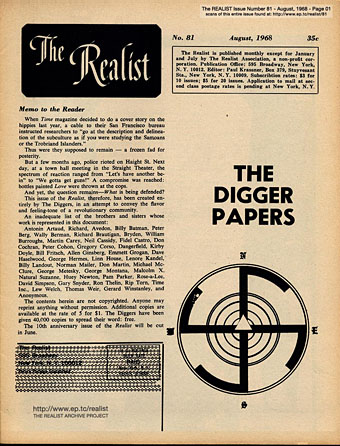
The Digger issue, August 1968.

Here’s something of major importance, The Realist Archive Project. Four complete issues online so far, with a promise of all 146 issues to be uploaded eventually. The Realist started out as a satirical magazine in the late Fifties and moved into the slipstream of the counter-culture as the Sixties progressed. Editor Paul Krassner is introduced in the RE/Search Pranks (1987) book thus:

Paul Krassner is famous for doing The Realist (1958-1974; now revived), described by OUI magazine as “the most satirical and irreverent journal to appear in America since the days of HL Mencken.” The Realist published explicit photos, outrageous cartoons, vicious satire, and extreme paranoid conspiracy theories on topics ranging from the Kennedy assassinations to Jonestown. When Mike Wallace asked him on a 60 Minutes interview about the difference between the underground press and mainstream media, he told him that Spiro Agnew was an anagram for Grow A Penis, adding, “The difference is that I could print that in the Realist, but it’ll be edited out of this program.” That prediction came true. Harry Reasoner said of Krassner that he “not only attacks establishment values; he attacks decency in general.”

During his lifetime of weird experiences and friendships with notables like Lenny Bruce and Timothy Leary, Krassner claims (among other things) to have taken LSD when he testified at the Chicago 8 trial, on the Johnny Carson show, with Groucho Marx, and with Squeaky Fromme and Sandra Good. In 1977 he became publisher of Hustler magazine for six months.

I first encountered the Realist from mentions in Robert Anton Wilson’s books (RAW was one of its writers) but, unlike UK undergrounds which often turned up secondhand, there was no way to ever see a copy over here. Hence the value of this archive. If you want an idea of Krassner’s outrageousness—which makes much of the political sniping of Private Eye seem very tame indeed—look no further than the May 1967 issue with its lead story describing Lyndon B Johnson fucking the dead John F Kennedy’s neck wound shortly before his being sworn in as president. And in the same issue there’s the notorious cartoon spread by Wally Wood depicting a host of Disney characters doing all the things that recently-deceased Uncle Walt wouldn’t allow them to do in the cartoons. That drawing was so scurrilous that it’s generally supposed Disney preferred not to sue for fear of giving it greater publicity.

The issue edited by the anarchist Diggers was altogether more serious, and the list of names involved shows a lineage connecting the Beats to the hippies:

Memo to the Reader

When Time magazine decided to do a cover story on the hippies last year, a cable to their San Francisco bureau instructed researchers to “go at the description and delineation of the subculture as if you were studying the Samoans or the Trobriand Islanders.”

Thus were they supposed to remain—a frozen fad for posterity.

But a few months ago, police rioted on Haight St. Next day, at a town hall meeting in the Straight Theater, the spectrum of reaction ranged from “Let’s have another be-in” to “We gotta get guns!” A compromise was reached: bottles painted Love were thrown at the cops.

And yet, the question remains—What is being defended?

This issue of the Realist, therefore, has been created entirely by The Diggers, in an attempt to convey the flavor and feeling-tone of a revolutionary community.

An inadequate list of the brothers and sisters whose work is represented in this document:

Antonin Artaud, Richard Avedon, Billy Batman, Peter Berg, Wally Berman, Richard Brautigan, Bryden, William Burroughs, Martin Carey, Neil Cassidy, Fidel Castro, Don Cochran, Peter Cohon, Gregory Corso, Dangerfield, Kirby Doyle, Bill Fritsch, Allen Ginsberg, Emmett Grogan, Dave Haselwood, George Hermes, Linn House, Lenore Kandel, Billy Landout, Norman Mailer, Don Martin, Michael McClure, George Metesky, George Montana, Malcolm X, Natural Suzanne, Huey Newton, Pam Parker, Rose-a-Lee, David Simpson, Gary Snyder, Ron Thelin, Rip Torn, Time Inc., Lew Welch, Thomas Weir, Gerard Winstanley, and Anonymous.

The contents herein are not copyrighted. Anyone may reprint anything without permission. Additional copies are available at the rate of 5 for $1. The Diggers have been given 40,000 copies to spread their word: free.

Many of those writers are no longer around but happily Paul Krassner is and he’s been writing regularly for The Huffington Post, the Arthur magazine weblog and other sites.

Via Boing Boing.

Previously on { feuilleton }
Ginsberg’s Howl and the view from the street
Simplicissimus
Revenant volumes: Bob Haberfield, New Worlds and others
Underground history
Wallace Burman and Semina
Robert Anton Wilson, 1932–2007
Barney Bubbles: artist and designer
100 Years of Magazine Covers
Oz magazine, 1967-73