Aubrey Beardsley and His World

beardsley.jpg

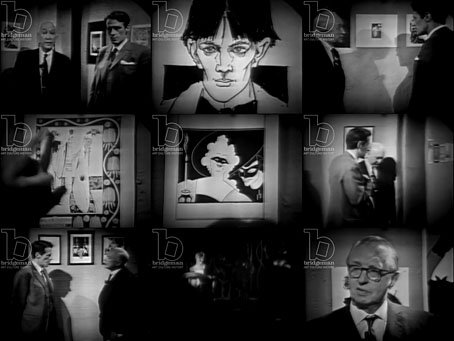
This US TV programme isn’t the greatest quality, and it’s blighted throughout with a large watermark, but it’s a revelatory piece both for Aubrey Beardsley enthusiasts and Oscar Wilde aficionados. Camera Three was a CBS arts show which presented Aubrey Beardsley and His World on 12th March, 1967, as a preview for the Beardsley exhibition which had just opened in New York. This was the same landmark exhibition that made such a splash the year before at the V&A in London, and V&A curator Brian Reade appears in the programme to discuss Beardsley’s importance with host James Macandrew. It’s good to see Reade again (he was also in a later BBC documentary) since his Beardsley monograph is a great favourite of mine; as is typical of the period, he looks and sounds very upper class but his scholarship is always authoritative.

Ordinarily this would be enough to satisfy me, even though the programme only runs for 27 minutes and doesn’t tell me anything about Aubrey that I didn’t know already. The great revelation comes near the end with the appearance of Vyvyan Holland, the younger son of Oscar Wilde. Holland not only admired Beardsley’s work but actually met him in 1895 shortly before the artist’s untimely death. Holland was 9 years old at the time, and was taken to visit Aubrey by his mother; he was 81 in 1967, and died himself later that year so we’re very fortunate that he was captured on tape at all. The programme also includes a short extract from Alla Nazimova’s 1923 film of Salomé, with costumes and decor all based on Beardsley’s drawings. Watch it here.

Elsewhere on { feuilleton }
The Aubrey Beardsley archive

Weekend links 406

tac.jpg

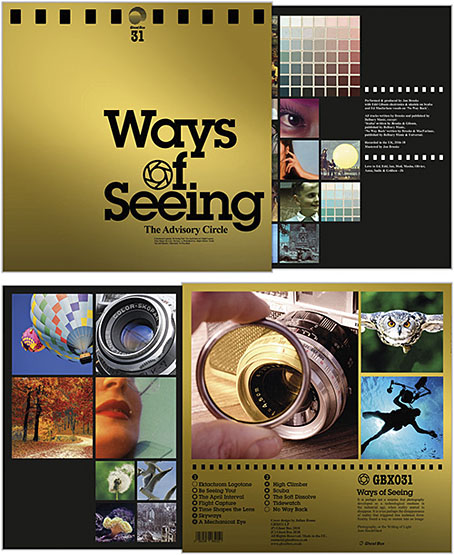
Ways Of Seeing will be the next release by The Advisory Circle on the Ghost Box label, and with metallic gold cover art by Julian House.

• “The structure came to Argento while he was tripping on some good acid, a fevered dream logic piecing everything together. […] ‘People came running out, screaming, telling people in the queue “Don’t go in! Don’t go in! It’s all witches!” It just made everyone in line want to get in even more… it was amazing.'” Ben Cobb talks to Dario Argento about the making of a horror masterpiece, Suspiria.

• Mixes of the week: The Wire Playlist by Mary Halvorson, XLR8R Podcast 535 by Sofie, and Out of the Wood Show 93 by Robin The Fog.

• Death by Balloon: Chris Mautner on the horrifying and hilarious world of comic artist Junji Ito.

Look, any honest estimation of the new translation, by Michael Hofmann, of Alfred Döblin’s Berlin Alexanderplatz from NYRB Classics is bound to begin with duteous piety, lauding it, since it is a one-and-done masterpiece that’s basically impossible to oversell, as (why not) the single biggest event in publishing in a lifetime, a crucial refurbishment of something English-language readers have been missing out on for a century, and a long-missing piece of Modernism’s ponderous jigsaw. All of which is the case of course. But when we’re talking about a dense, all-but-untranslatable Weimar-era novel, whose only point of reference for Anglophone audiences until now has been Rainer Werner Fassbinder’s meticulous fifteen-hour adaptation from 1980 (one heck of a tease) it feels important to attempt a slight rescue from its own forbidding reputation, because Alexanderplatz is less a book than a living thing, and one that joyously resists the dust heap of bourgeois literary scholarship with its every line.

JW McCormack on the new translation of Alfred Döblin’s Modernist classic

Section 28 protesters 30 years on: “We were arrested and put in a cell up by Big Ben”.

Angelique Kidjo talks reinventing Talking Heads’ Remain In Light on new LP.

• The hidden lives of gay men in the Middle East: photographs by Hoda Afshar.

Al Pacino’s journey with Wilde’s Salomé.

Tenebrous Kate

• Are You Seeing (1969) by Ora | Seeing Out The Angel (1981) by Simple Minds | Sine Seeing (2014) by The Advisory Circle

The poster art of Raymond Gid

gid-28.jpg

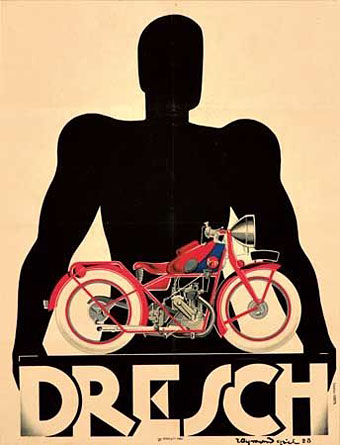
Dresch (1928).

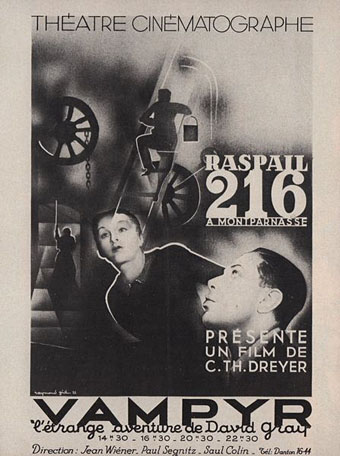
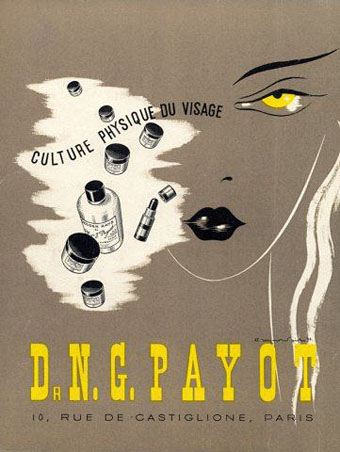
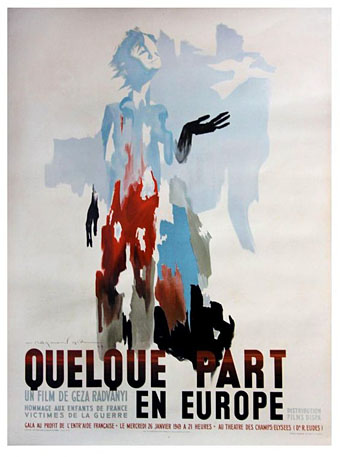
This weekend I was rewatching Henri-Georges Clouzot’s superb thriller, Les Diaboliques (1954) after which I went searching for the equally superb posters by Raymond Gid (1905–2000). I hadn’t really looked at the rest of Gid’s work before so this post remedies the situation with a selection from some of the many examples available online. Gid was something of a French equivalent to Saul Bass, working as a poster artist for feature films while also producing designs for advertising; like Bass he took charge of the typography as well as the illustration, always a useful thing for a poster artist. Typographies (1998), his book on the subject, is still in print.

gid-32.jpg

Vampyr (1932).

gid-38.jpg

Dr. NG Payot (1938).

gid-48.jpg

Quelque part en Europe (1948).

Continue reading “The poster art of Raymond Gid”

Weekend links 329

vyletal.jpg

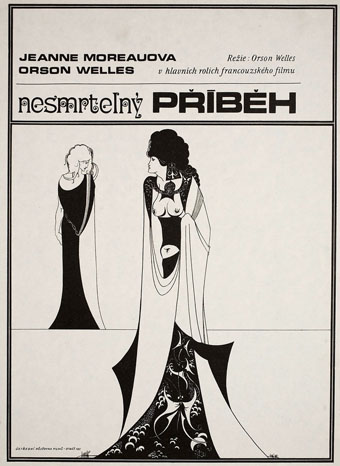
Josef Vyletal borrows figures from Aubrey Beardsley’s Salomé for a Czech poster promoting The Immortal Story (1969) by Orson Welles. Vyletal’s own paintings were often strange and surreal.

Pale Fire is Nabokov’s “great gay comic novel,” says Edmund White. A surprising but not inappropriate reappraisal. White has noted in the past that Nabokov “hated homosexuality” despite having a gay brother and uncle. The portrayal of Charles Kinbote in Pale Fire isn’t unsympathetic if you overlook his being delusional, and possibly insane…

• At Folk Horror Revival: details of the charity donations raised by sales of the Folk Horror Revival books, the first of which featured my David Rudkin essay. A one-day Folk Horror Revival event takes place later this month at the British Museum, London.

• Mixes of the week: The Bug presents Killing Sound Chapter 2: Inner Space, a 2-hour blend of “sci-fi scores, expansive atmospheres and synthesized psychedelia”; Decoded Sundays presents Scanner; Secret Thirteen Mix 197 is by LXV.

Stars Of The Lid unveil a James Plotkin remix of their Music For Twin Peaks Episode #30 Pt. 1. Related: the hype for the new Twin Peaks series gets into gear with a teaser.

• Robert Aickman’s only novel, The Late Breakfasters (1964), is being given its first US publication by Valancourt Books.

• “Don’t dream it, bet it.” Evan J. Peterson on 40 years of The Rocky Horror Picture Show.

• Anna von Hausswolff’s sister, Maria, directs a video for Come Wander With Me / Deliverance.

• RIP Michael O’Pray, film writer and curator of many festivals of experimental cinema.

• Oli Warwick talks to electronic musicians about the influence of the late Don Buchla.

Breakfast In Bed (1969) by Dusty Springfield | Alan’s Psychedelic Breakfast (1970) by Pink Floyd | Another Breakfast With You (2001) by Ladytron

The art of Paul Thévenaz, 1891–1921

thevenaz01.jpg

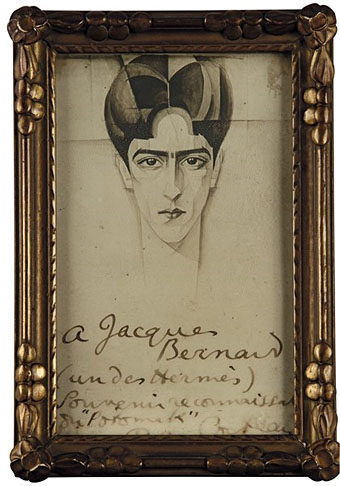
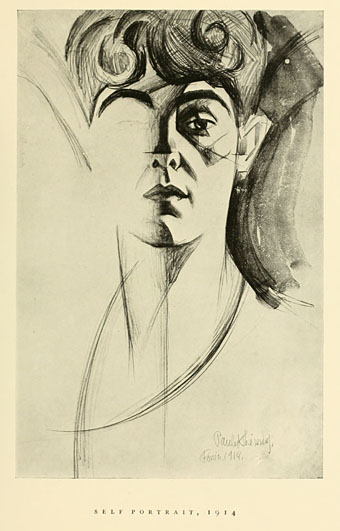
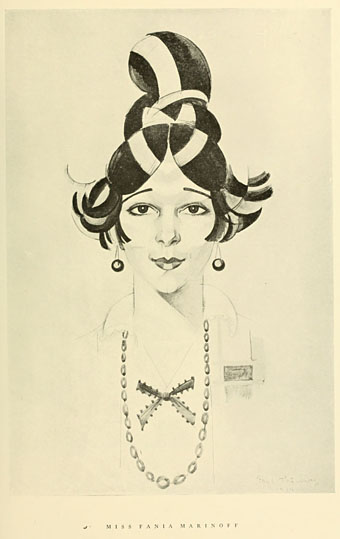
This portrait of Jean Cocteau by Swiss artist Paul Thévenaz isn’t included in the artist’s memorial book, Paul Thévenaz, A Record of His Life and Art (1922) which was published after Thévenaz died suddenly at the age of 30. Everything else in this post is, however, and there’s more in the book itself which shows Thévenaz ranging through society portraits (and self-portraits), designs for the theatre (I’ve included a Salomé below), murals and sketches.

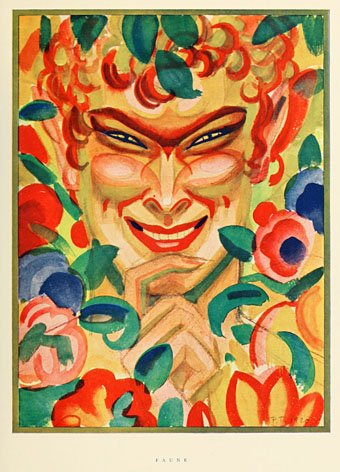
Thévenaz is another candidate for the pantheon of lost gay artists although the work in the book isn’t especially homoerotic. There are fauns, however, which might be connected to his romantic association with poet Witter Brynner. The latter’s A Canticle of Pan was written in 1918, and is one of the many manifestations of the horned god in the literature of the period. As for Thévenaz, I like his drawing style a great deal; in places it resembles Wyndham Lewis in its sweeping curves and stylisations. (Thanks to Callum for the tip!)

thevenaz02.jpg

thevenaz03.jpg

thevenaz04.jpg

Continue reading “The art of Paul Thévenaz, 1891–1921”