Elric 1: Le trône de rubis

elric1.jpg

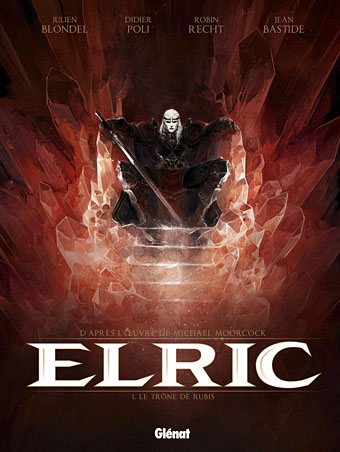
The closest I ever got to illustrating Michael Moorcock’s Elric character was the sleeve for The Chronicle of the Black Sword in 1985, a Hawkwind concept album based on the first couple of Elric books. That design favoured a decorative approach over anything illustrative, however. At the time I felt too intimidated by the renderings of Elric’s first illustrator, James Cawthorn, and subsequent depictions by book cover artists such as Michael Whelan, to attempt my own version of the character. These days I pay little attention to heroic fantasy of any kind but I do look out for new depictions of Moorcock’s anti-hero. Earlier this year the French bande dessinée publisher, Glénat, released the first album in a planned series of five comic-strip adaptations of the Elric books. Many creditable Elric comics have appeared since the 1970s, not least the Cawthorn version of Stormbringer, one of the earliest and best, and Philippe Druillet’s own somewhat eccentric production. Mike Moorcock very generously sent me a copy of the Glénat volume this week, and I’d say this is now the one to beat.
elric2.jpg

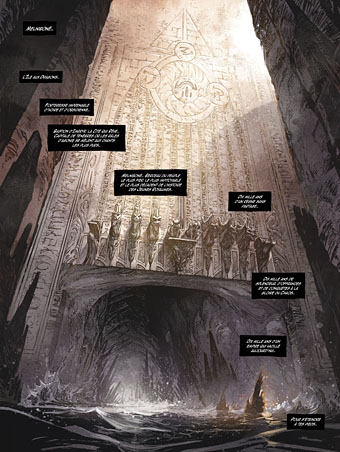
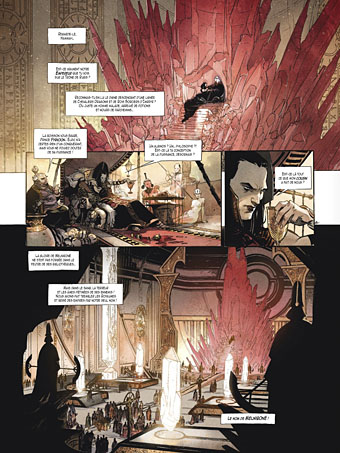
Writer Julien Blondel has adapted the books with the art duties being taken by Didier Poli and Robin Recht. Jean Bastide is the colourist. I’ve always preferred the French and Belgian approach to comic art over the American style so I’m naturally biased towards a book such as this. That said, the art is marvellous, and so many of the details feel just right. Moorcock portrays the Melnibonéans as decadent and cruel, something that Poli and Recht portray with scenes of naked slaves being bled, butchered, and even used as human torches for the blithe amusement of their masters. The general atmosphere in the opening pages is like something from Flaubert’s Salammbô with its combination of antique depravity and the massing of great armies prior to battle. They don’t slouch with the monstrosities, either, there’s a spot of Lovecraftian weirdness when Elric is rescued by Straasha, the Sea King. I look forward to seeing how they deal with Arioch (who puts in an appearance at the end) and the other Chaos Lords. The dialogue is all in French, of course, but if you know the books it’s easy to follow even with French as limited as mine.
elric3.jpg

The Glénat site has a few more page samples. Moorcock has been watching these books being adapated and re-adapted for decades, and he says this is among the very best. For anyone with more than a passing interest in the brooding albino prince it’s well worth seeking out.

Previously on { feuilleton }
Salammbô illustrated
Jim Cawthorn, 1929–2008

Tentacles #1: The Boats of the ‘Glen Carrig’

boats-1945.jpg

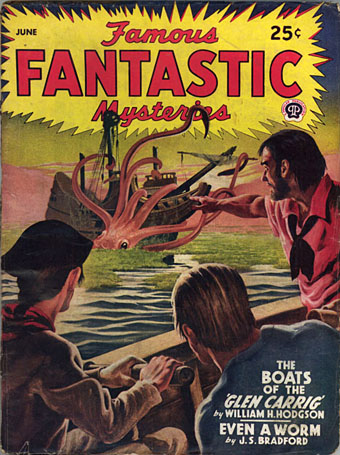
Famous Fantastic Mysteries, June 1945. Illustration by Lawrence (Sterne Stevens).

Following last week’s revelation of Lovecraftian horror, I thought it might be worth demonstrating just how much the tentacle-menacing-a-ship scenario is owned by William Hope Hodgson. The Boats of the ‘Glen Carrig’ (1907) is one of Hodgson’s lesser novels, overshadowed by the cosmic horrors of The House on the Borderland and The Night Land, but it’s a memorable work all the same. The narrative fits into his cycle of Sargasso Sea stories: a small band of 18th-century sailors, survivors of the wreck of the ‘Glen Carrig’, drift across the Atlantic into the weed-strewn “cemetery of the oceans” where they have to fight off giant octopuses and the predations of “weed men”, humanoid creatures with tentacular hands. As will be seen below, it’s the attack on a wrecked ship trapped in the weed that many of the illustrators have chosen to focus on.

tideless-1911.jpg

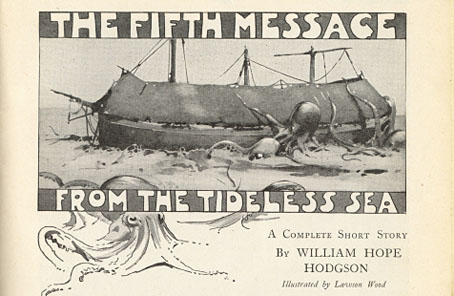
Illustration by Lawson Wood (1911).

This was something I hadn’t seen before: an illustration for a story with a scenario very similar to ‘Glen Carrig’ where the sailors journey under canvas in their lifeboats. Another tale of the sinister Sargasso:

This is the fifth message that I have sent abroad over the loathsome surface of this vast Weed-World, praying that it may come to the open sea ere the lifting power of my fire-balloon be gone, and yet, if it come there, how shall I be the better for it? Yet write I must, or go mad, and so I choose to write, though feeling as I write that no living creature, save it be some giant octopus that lives in the weed about me, will ever see the thing I write. (more)

boats-1971-1.jpg

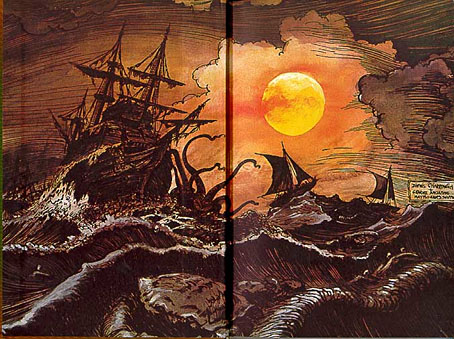
Les Canots du “Glen Carrig” / La Maison au bord du monde / Les pirates fantômes (1971). Illustration by Philippe Druillet.

A French Hodgson collection, the octopoid cover of which can be seen here. These were the endpapers; the rest of Druillet’s illustrations can be seen here.

Continue reading “Tentacles #1: The Boats of the ‘Glen Carrig’”

Raymond Bertrand’s science fiction covers

bertrand01.jpg

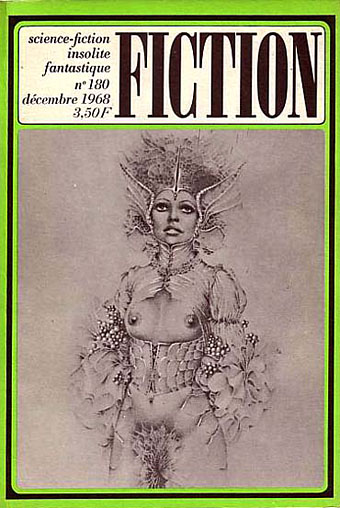
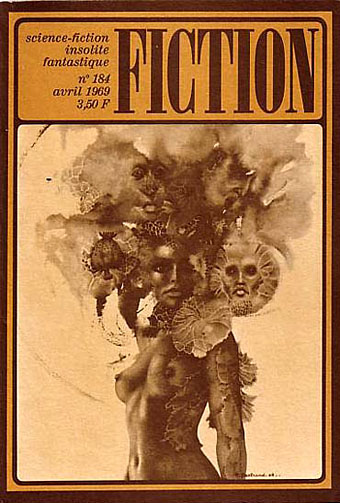
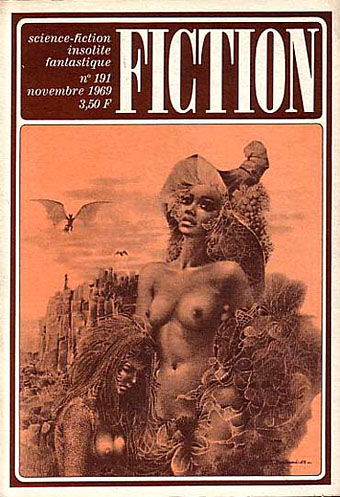
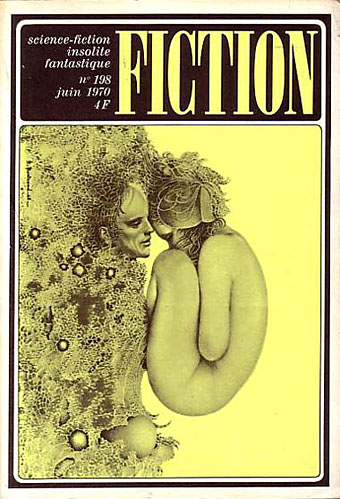
Work by the elusive French artist Raymond Bertrand has appeared here before although the art continues to be more visible (if obscure) than the man himself. Bertrand’s most famous drawings are the naked women that appeared on the cover of issue 28 of Oz magazine, the notorious School Kids Issue, but I don’t think he was credited for the usage and his name is never mentioned when the magazine is discussed. Looking for information about the Chute Libre books at French SF site Noosfere led me to an entry for Bertrand’s work. The list doesn’t include any of the book collections of his drawings but does have these magazine covers which feature some pieces I hadn’t seen before.

bertrand02.jpg

Fiction was the leading French SF magazine, and sported a fascinating range of cover art especially from the mid-60s on. Artists at that time included Philippe Druillet and Philippe Caza, both of whom would become big names in the comics world a few years later. Galaxie was the French edition of American magazine Galaxy, and featured unique material among its translations of Anglophone works. Being French, there’s a greater amount of flesh on display than you’d find on magazine covers in the US and UK; some of this is as salacious as anything else from the period although at least one of the artists drawing naked females was a woman, Sophie Busson. Naked females emerging from—or being absorbed by—strange vegetation, polyps or aquatic organisms were Bertrand’s métier so that’s mostly what one finds here. Few of the covers seem to relate to the magazine’s contents, the artists appear to have been free to draw what they liked; in the case of Druillet that means his usual Lovecraftian architecture. An exception is issue 198 of Fiction which has an article about Bertrand’s work by Jacques Chambon: Raymond Bertrand ou de l’amour de l’art à l’art de l’amour. I’m hoping now that someone might be good enough to translate that piece for us lazy Anglophones.

And speaking of former Oz artists, Renaud Leon left a message recently with news that YouTube now has a channel featuring many examples of Jim Leon’s remarkable paintings.

bertrand03.jpg

bertrand04.jpg

Continue reading “Raymond Bertrand’s science fiction covers”

Heavy Metal, October 1979: the Lovecraft special

hm1.jpg

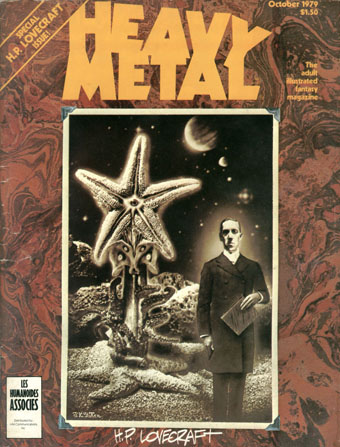
Mr Lovecraft by JK Potter.

HP Lovecraft died seventy-five years ago on 15th March, 1937. Twenty-five years ago I was halfway through drawing my comic strip adaptation of The Call of Cthulhu, conscious at the time that, yes, it was fifty years ago today… I mentioned at the weekend the special Lovecraft edition of Heavy Metal that was published in October 1979; of the many stimuli that led to the drawing of CoC, this magazine was by far the most important. Given the date, now seems as good a time as any to say something about it.

hm2.jpg

Illustration for the contents page by Stephen R. Bissette.

Heavy Metal was the US offshoot of Métal Hurlant, the sf/fantasy comics magazine founded by Jean Giraud (Moebius), Philippe Druillet and Jean-Pierre Dionnet in 1974. Copies of Métal Hurlant could be found in London but none ever made it further north. The advent of Heavy Metal provided an invaluable introduction to a generation of European artists whose work was otherwise difficult to find. Even better: their stories were being translated into English for the first time. The late 70s was a dizzying period for a Lovecraft reader: HR Giger appeared apparently out of nowhere in 1977 when Big O published the first UK collection of his art (which I couldn’t afford at the time), a book with Necronomicon in the title; a year later Thames & Hudson published Franz Rottensteiner‘s The Fantasy Book, an overview of the genre that devoted eight pages to Lovecraft and Arkham House, and which included many illustrations I’d never seen before; in 1979 Giger was all over the newspapers and magazines thanks to Alien; then in October the Lovecraft special dropped onto the shelves. I was stunned: this was that rare occasion when someone creates exactly the thing you want to see at precisely the right moment.

hm3.jpg

The Dunwich Horror by Alberto Breccia. A superb adaptation.

Looking back, the issue isn’t quite as good as it seemed at the time: many of the stories are slight, a couple have nothing whatever to do with Lovecraft, and, Breccia aside, none of the artists tackle the major works. What counted in the end was the idea of the issue, the implication that Lovecraft’s imagery was there to be seized and reworked in visual form. There were better issues of the magazine, before and after, but for the next six years this one remained for me a tantalising possibility. They hadn’t got it quite right…what if someone else did? After searching comic shop shelves in vain I eventually decided to have a go myself.

Continue reading “Heavy Metal, October 1979: the Lovecraft special”

Philippe Druillet album covers

druillet1.jpg

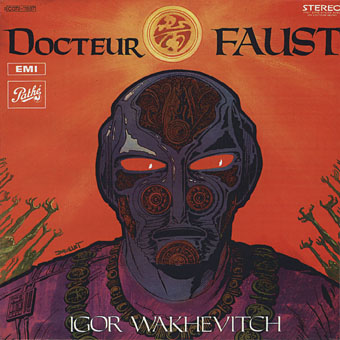
Docteur Faust (1971) by Igor Wakhévitch.

Philippe Druillet: album cover artist. As with John Martin, I’m surprised there aren’t more examples. Once again, Discogs.com proves incomplete so I’ve added a couple more including the first on this list, Docteur Faust. If you know of any others, please leave a comment.

Igor Wakhévitch’s berserk masterpiece is a cult item in this house, and something I’ve written about already. The cover art is the icing on an unclassifiable cake.

druillet10.jpg

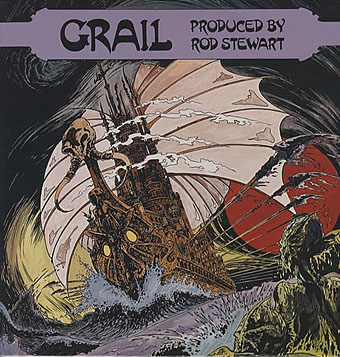
Grail (1970) by Grail.

The cover is the opening page of The Wild Wind Isles, one of Druillet’s Lone Sloane stories. Produced by Rod Stewart; did you notice? “We are sailing…”

druillet4.jpg

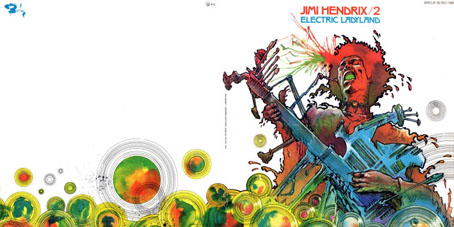
Electric Ladyland (1975) by The Jimi Hendrix Experience.

A gatefold sleeve for a series of four Hendrix reissues on the Barclay label. The other covers were provided by Moebius, Jean Solé and an artist unidentified on the link above but it looks to me like the work of Philippe Caza.

druillet3.jpg

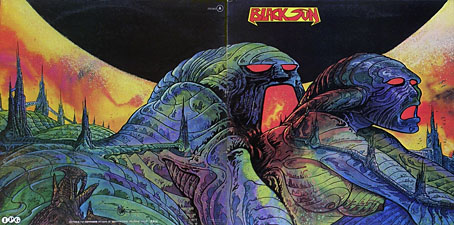
Black Sun (1978) by Black Sun.

Black suns are a regular feature of Druillet’s work (and mine, ahem) so the artist at least suits the title. The debut album of a short-lived French funk/soul group.

East/West (1980) by Richard Pinhas.

The French equivalent of Krautrock doesn’t have a name but Richard Pinhas is one of its leading practitioners. This is still my favourite among his solo works, not least because it’s more successfully musical than other albums which feature great slabs of guitar or synth doodling. In addition to a cover of David Bowie’s Sense Of Doubt there’s also science fiction author Norman Spinrad ranting through a vocoder on the opening and closing tracks. The great cover art is a page from Druillet’s 1980 adaptation of Flaubert’s Salammbô.

Continue reading “Philippe Druillet album covers”