The Bowmen by Arthur Machen

bowmen.jpg

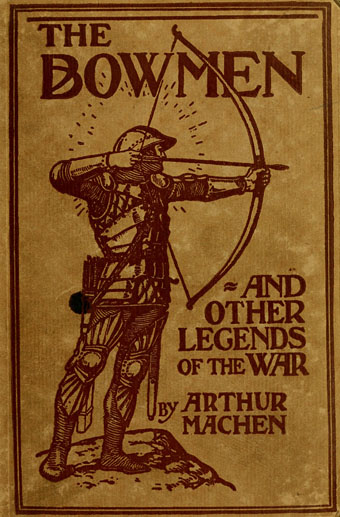
The Bowmen was a short piece of fiction by Arthur Machen published in a London newspaper, The Evening News, on the 29th September, 1914. By Machen’s standards it’s not one of his best pieces, written at a time when he was working at the paper as a journalist. The First World War was in its early days, and the story was conceived as a Kipling-like morale-boost following the retreat of British forces at Mons a few weeks before. The stories for which Machen is remembered today had never provided the success he hoped for so it must have been a surprise when his invention of angelic bowmen appearing during the battle gained him national attention:

On the last Sunday in August, 1914, Machen read in his morning paper of the retreat from Mons.

“I no longer recollect the details, but I have not forgotten the impression that was then made on my mind. I seemed to see a furnace of torment and death and agony and terror seven times heated, and in the midst of the burning was the British army: in the midst of the flame, consumed by it, scattered like ashes and yet triumphant, martyred and for ever glorious.”

That was the way, indeed, in which the English thought about the army at the beginning of the Great War; since then we have come to take a less romantic view of warfare. With this picture in his mind, Machen conceived and wrote a story called The Bowmen, told, as most stories are, as if it were true—that is, he did not begin by saying: “what you are about to read is all my own invention”—in which St. George with an army of English mediaeval bowmen appeared at the critical moment to cover the British retreat. Not, to be sure, a very probable story nor, as Oswald Barron pointed out, was it likely that the Agincourt bowmen, most of whom came from Wales, would use the French expressions Machen evokes from them: and Machen himself felt he had not done justice to his original conception.

“But if I had failed in the art of letters, I had succeeded, unwittingly, in the art of deceit.”

The Bowmen appeared in The Evening News on September 29th, 1914, at a moment when people were looking for a miracle, and many promptly embraced it as an account of one. That such journals as The Occult Review and Light should fasten on it, might have been anticipated; but it was taken up by parish magazines all over the country, and people came forward on every side to say that they had friends and relatives who had seen the “Angels of Mons” with their own eyes. As a result, Machen became, for the first time in his life, a man of nation-wide fame. To thousands of people, the idea, whether true or false, gave consolation or hope, but when Machen protested that his story was entirely the child of his own imagination, the fame threatened to turn to notoriety; he was rebuked for his impudence at claiming originality for the tale. Nevertheless a legend had been born and a shoal of publications appeared to satisfy public demand—On the Side of the Angels (Harold Begbie), Guardian Angels (GP Kerry—a sermon reprinted), Angels, Saints and Bowmen of Mons (IE Taylor, Theosophical Publishing Society).

Aidan Reynolds & William Charlton in Arthur Machen: A Short Account of His Life and Work (John Baker, 1963)
Continue reading “The Bowmen by Arthur Machen”

Salomé and Wilde Salomé

salome1.jpg

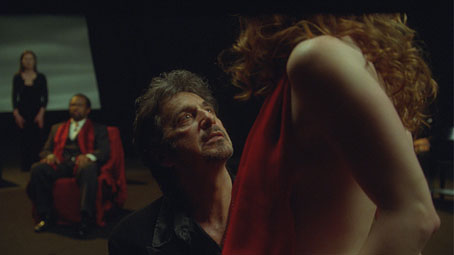
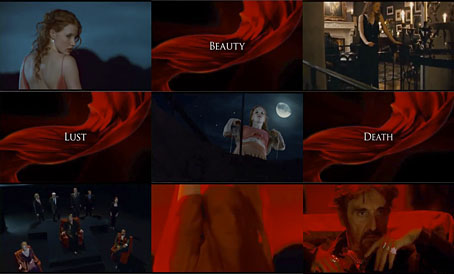
Three years on and Al Pacino’s recent pet projects—Salomé and Wilde Salomé—have yet to be given a general release. Salomé is the one I’m most eager to see, a filmed performance of the Oscar Wilde play with Jessica Chastain in the title role. There is at least a trailer now, which gives an intriguing taste of the production. Like Steven Berkoff, Pacino has opted for modern dress while making some of the details—the moon, Jokanaan’s well—more material. If Wilde’s Symbolist melodrama seems rather effete for a man known for playing gangsters it should be noted that the play features a suicide and two executions, as well as a strong theme of paternal incest and even necrophilia. Herod, of course, is notorious for being a child-murdering king.

salome2.jpg

Pacino and Jessica Chastain are in London on Sunday at BFI Southbank talking with Stephen Fry about Salomé and the feature-length production documentary, Wilde Salomé. Both films will also receive screenings. Here’s hoping the rest of us won’t have much longer to wait before we can see them.

Elsewhere on { feuilleton }
The Oscar Wilde archive
The Salomé archive

Flowers: A Pantomime for Jean Genet

flowers.jpg

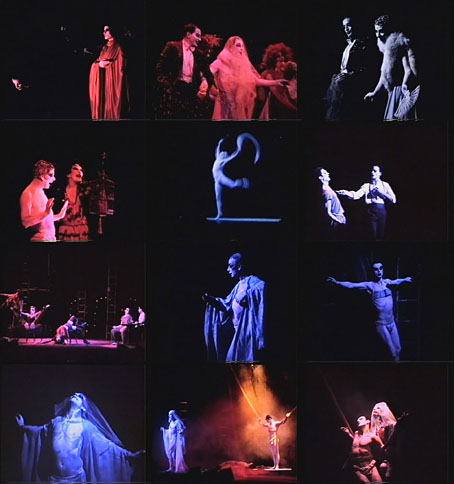
Flowers (1986) by the Lindsay Kemp Company. Photos by Maya Cusell.

Weidmann appeared before you in a five o’clock edition, his head swathed in white bands, a nun and yet a wounded pilot fallen into the rye one September day like the day when the world came to know the name of Our Lady of the Flowers. His handsome face, multiplied by the presses, swept down upon Paris and all of France, to the depths of the most out-of-the-way villages, in castles and cabins, revealing to the mirthless bourgeois that their daily lives are grazed by enchanting murderers, cunningly elevated to their sleep, which they will cross by some back stairway that has abetted them by not creaking. Beneath his picture burst the dawn of his crimes: murder one, murder two, murder three, up to six, bespeaking his secret glory and preparing his future glory.

A little earlier, the Negro Angel Sun had killed his mistress.

A little later, the soldier Maurice Pilorge killed his lover, Escudero, to rob him of something under a thousand francs, then, for his twentieth birthday, they cut off his head while, you will recall, he thumbed his nose at the enraged executioner.

Finally, a young ensign, still a child, committed treason for treason’s sake: he was shot. And it is in honour of their crimes that I am writing my book.

(Our Lady of the Flowers by Jean Genet. Translation by Bernard Frechtman, 1963)

Lindsay Kemp’s all-male version of Oscar Wilde’s Salomé has been the subject of several earlier posts, a production staged in the mid-70s with Kemp himself playing the part of Wilde’s femme fatale. Kemp’s company produced a related work in 1974, Flowers: A Pantomime for Jean Genet, a stage adaptation of Genet’s first novel, Our Lady of the Flowers (1942), in which Kemp played the part of drag queen Divine. Wilde and Genet aren’t so far removed from each other artistically although I can’t imagine them getting on in person. Both men were prisoners, of course, and Our Lady of the Flowers was famously written in prison, the first copy being discovered by a warder and destroyed. There’s a more direct connection in Fassbinder’s Querelle during the scenes where Lysiane (Jeanne Moreau) sings “Each man kills the thing he loves”, the most famous line from Wilde’s The Ballad of Reading Gaol which refers to (among other things) one of Genet’s obsessions: the prisoner condemned to death. Wilde would no doubt appreciate Genet’s poetic reimagining of his fellow prisoners, and his use of flowers as symbols; what Genet would have made of Lindsay Kemp’s typically extravagant and rather camp stage creation is anyone’s guess. He did write several plays but in later years evaded questions about them or his novels by claiming to have forgotten all his works. By the 1970s Genet was much more interested in the political struggles of the Black Panthers and the Palestinians.

Much as I like Wilde’s play, given the choice I think I’d prefer to see the Genet staging. Salomé is familiar enough from various stage and film adaptations whereas Flowers was unique. There is a video record of the latter from 1982 but the copy uploaded by Lindsay Kemp has had its soundtrack removed following the usual annoying copyright complaints about the music. So there’s the frustrating choice of watching the whole thing with no sound or watching this 28-minute video compilation of still photos by Maya Cusell from a 1986 performance with music that may be the original live score. One thing the photos show is how close in appearance is Kemp’s Divine to his dancer at the beginning of Derek Jarman’s Sebastiane (1976). In 2012 Kemp talked to Paul Gallagher about his film and stage career, Flowers included.

Update: As noted by radioShirley below, there is a copy of the 1982 performance with full soundtrack!

Previously on { feuilleton }
Querelle de Brest
Jean Genet, 1981
Un Chant d’Amour (nouveau)
Jean Genet… ‘The Courtesy of Objects’
Querelle again
Saint Genet
Emil Cadoo
Exterface
Penguin Labyrinths and the Thief’s Journal
Un Chant D’Amour by Jean Genet

Weekend links 219

balbusso.jpg

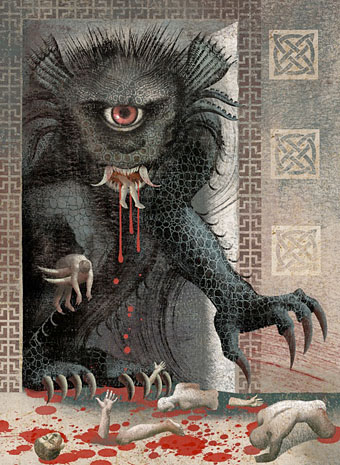
Grendel Monster (2013) by Anna & Elena Balbusso.

Rick Poynor looks at the Guide de la France mystérieuse (1964), a fantastic (in every sense) doorstop of a volume whose collage alphabet by Roman Cieślewicz can be seen on the cover of Carnival In Babylon (1972) by Amon Düül II.

• Boolean mathematics, Charles Howard Hinton, The Voynich Manuscript, and the effects of surveillance on the political process: Adam Curtis firing on all cylinders as usual.

• At Strange Flowers: The Picture of John Gray, remembering the minor fin de siècle figure who gave Oscar Wilde a surname for his most famous creation.

In “32 Cardinal Virtues of Dennis Cooper,” Wayne Koestenbaum remarks: “Cooper’s quest for the unseeable is virtually religious. I mean: sedulous, abstract, perpetual, unrewarded, unreasonable.” There’s much more to be said of Gone, its power, its pain, its odd intrigues, but perhaps it will suffice to say that it is revealing: unlike Burroughs’ scrapbooks hidden away by some private collector, never to see the light of day, Gone (and its sister texts at the Fales Library) illuminate in perpetuity Cooper’s obscure quest for the unseeable.

Diarmuid Hester looks at Dennis Cooper’s scrapbooks

The Sallow Tree, a single by Lutine. More music: An hour of Julia Holter‘s St John’s Sessions performance.

• At Dangerous Minds: Christian televangelists listen to Stairway To Heaven forwards.

• Cathy Camper reviews Fearful Hunter, a graphic novel by Jon Macy.

• Mix of the week: FACT mix 452 by Claude Speeed.

Roman Cieślewicz at Pinterest.

The Adobe Illustrator Story

The House of Julian

Unofficial Britain

• Amon Düül II singles: Rattlesnakeplumcake (1970) | Between The Eyes (1970) | Light (1971) | Lemmingmania (1971)

Wildeana 12

wilde.jpg

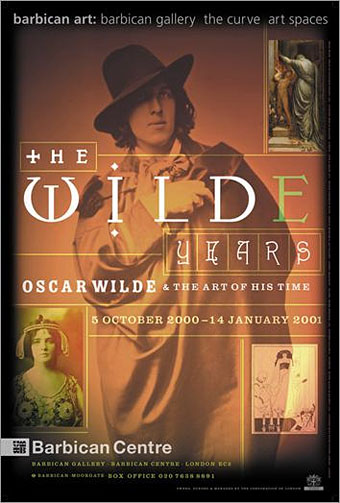
The Wilde Years (2000), a poster by Jonathan Barnbrook for an exhibition at the Barbican Centre, London.

Continuing an occasional series. Recent (and not-so-recent) Wildean links.

Sander Bink writes that Beardsley-esque artist Carel de Nerée tot Babberich was in Paris in the summer of 1900, the summer of the Exposition Universelle which has been a subject of many posts here. Did he meet Oscar Wilde? It’s a possibility.

• “Was Oscar Wilde’s outlandish personality more influential than his writing?” asks George Woodcock.

These were the years when Zola was at the height of his international fame but Wilde pans the fashionable Naturalist school by contrasting it with another phenomenon that was then sweeping through Europe: Russian fiction. One of the small gems of these volumes is a cluster of very interesting and little-known articles on modern Russian novels. Wilde rated Turgenev, Tolstoy and Dostoevsky far above “the obscene brood of pseudo-realists which roosts in the Cloaca maxima of France” and welcomed their influence on modern literature. He was certainly among the first critics to review the English translations of Crime and Punishment and Injury and Insult, praising Dostoevsky’s command of detail and ability to probe into “the most hidden springs of life”.

Stefano Evangelista on Wilde’s world of journalism

• “An idea that is not dangerous is not worthy of being called an idea at all.” A print by ObviousState.

Robert McCrum looks at The Picture of Dorian Gray for the Guardian‘s 100 Best Novels.

• Oscar Wilde provides the Pinterest legions with a thousand and one quotes.

Elsewhere on { feuilleton }
The Oscar Wilde archive