Weekend links 361

f1x-2.jpg

The Future Vol.2 (2016) by f1x-2.

• One of the notable things about the reaction to the original series of Twin Peaks was the way in which Americans were astonished that something so outré could be allowed on television. Here in the UK the response was a little more subdued; we had, after all been spoiled for years by The Prisoner, Sapphire and Steel, and numerous odd and challenging dramas by Dennis Potter and others. Pre-dating all of these was The Strange World of Gurney Slade (1960), a six-part series starring Anthony Newley that was unprecedented in its Surrealism. Andy Murray looks back at the series, and at the rest of Newley’s career.

Andrew Dickson on Peter Ackroyd whose latest book, Queer City: Gay London from the Romans to the Present Day, is published later this month.

Alyona Sokolnikova on a Soviet vision of the future: the legacy and influence of Tekhikia – Molodezhi (Technology for the Youth) magazine.

You know who weren’t cops? All the radicals and queers and artists and dreamers that were there while I grew up, my mom and dad’s old friends from New York and the wider bohemian world, the actors and the drag queens and the dilettantes and the ex junkies and the current junkies, the kind of queer people who wouldn’t get caught dead getting married, the people who actually made the “old New York” of the myth into what it was. They were smart and they were funny and they were tougher than I can imagine and they were possessed of an existential commitment to the idea that life is complicated and so we shouldn’t be quick to judge. They were tolerant, in the true sense, even while they were tireless advocates for actual justice. […] Now we’re Rudy Giuliani, trying to get offensive art pulled off the walls. Now we’re the book burners. Now we’re the censors. Now we attack the ACLU for defending free speech. Now we screech about community morals. Now we’re the prison camp screws. That’s us. Me, I could never be one of the good ones. Never. I can never live up to that ideal. I know I’m not good enough. I know when the judgment day comes, I go down. And so I decline. You can decline, too.

Planet of Cops by Freddie deBoer, or how inflexible morality makes everyone a cop

• Mixes of the week: FACT Mix 601 by Dark Entries, Secret Thirteen Mix 221 by Eli Keszler, and XLR8R Podcast 490 by Ben Lukas Boysen.

• At Dangerous Minds: Punk, Patti Smith, William Burroughs & capitalism: A “conceptual conversation” with RE/Search’s Vale.

Emily Wells on the strange, irreverent worlds of Down Below and The Complete Stories of Leonora Carrington.

Rick Poynor on Mike Halliwell’s montages based on JG Ballard’s The Atrocity Exhibition.

• “Why are the British so scared of cannabis?” asks Professor David Nutt.

Witchcraft and the Gay Counterculture (1978) by Arthur Evans.

• At Dennis Cooper’s: Jacques Rivette Day.

Designing Penguin Modern Classics

Future Dub (1994) by Mouse On Mars | Future Proof (2003) by Massive Attack | Future (2004) by Alva Noto


Weekend links 325

beeple.jpg

08-30-16 from the Everydays series by Beeple.

• “Monsieur de Bougrelon is a unique character: loquacious, proud, a leftover from an earlier age, wearing garish outfits and makeup that drips. To his speechless audience, he waxes nostalgic about his life as an exile in Holland, as well as what he calls “imaginary pleasures” – obsessions with incongruous people, animals, and objects. These obsessions are often sexual or border on the sexual, leading to shocking, surreal scenes. Monsieur de Bougrelon also enthuses over his beautiful friend Monsieur de Mortimer, making this novella one of the rare works of the nineteenth century to broach homosexuality in a meaningful way, years before Jean Cocteau and Jean Genet.” Monsieur de Bougrelon (1897) by Jean Lorrain will receive its first English publication by Spurl Editions in November.

• “…The Future seems in retrospect to have been no more than a spectacle, created by the optimistic few for the optimistic many, the readily gulled multitudes who had faith in technological seers just as an earlier generation had had faith in Great Men.” Jonathan Meades reviews Last Futures: Nature, Technology and the End of Architecture by Douglas Murphy.

In the Woods & On the Heath is a collection of 48 pieces of erotic prose and poetry by 24 writers, all of them illustrated by Van Rijn.

Borneman was widely read in European literature and, once settled in London, wasted no time bringing himself up to speed with developments in English-language writing, discovering a particular affinity with Hemingway and Joyce, not to mention American crime writers such as Carroll John Daly and Dashiell Hammett. This presumably explains the distinctive, sometimes highly eccentric style of The Face on the Cutting-Room Floor, which despite being set in an English film studio of the 1930s (which evokes images, perhaps, of genteel musical comedies performed in perfect RP accents), combines laconic, hardboiled dialogue with extended stream-of-consciousness passages, all filtered through the skewed phraseology of someone whose acquisition of English was still, to some extent, a work in progress.

Jonathan Coe on the mysteries of The Face on the Cutting-Room Floor, a novel by “Cameron McCabe” (Ernest Borneman)

• How Oscar Wilde paved the way for gay rights in the arts. Wilde will be honoured with a major exhibition in Paris later this month.

Noisy Rain is a free online publication dedicated to “artists working with the male figure and homo-eroticism”.

Dennis Cooper’s blog returns. The truth about Google’s deletion of the Blogspot account has finally emerged.

Peel Away The Ivy by The Pattern Forms will be release number 26 on the Ghost Box label in October.

• Glam Rock & Yorkshire Occult: Ben Myers on his novel Turning Blue.

• Mix of the week: Secret Thirteen Mix 195 by Jake Meginsky.

• At Phantasmaphile: Unarius: We Are Not Alone.

Blokdust is a browser-based musical instrument.

• Official trailer for David Lynch: The Art Life.

Future Dub (1994) by Mouse On Mars | Future Proof (2003) by Massive Attack | Future Past Perfect pt 01 by Carsten Nicolai

Weekend links 116

sherer.jpg

Ankle Deep, a pyrograph by Robert Sherer whose work is showcased at The Advocate.

• “Bertrand Russell wrote in 1932, during another period of economic distress, ‘that immense harm is caused by the belief that work is virtuous, and that what needs to be preached in modern industrial societies is quite different from what always has been preached.’ ” From The Devilishness Of Idleness by Alex Gallo-Brown. Related: Owen Hatherley says “It’s the 21st century – why are we working so much?”

Restoring James Joyce’s book of the night: Joyce biographer Gordon Bowker reviews the new edition of Finnegans Wake. Over at the NYRB Michael Chabon has a great piece about his own relationship with Joyce’s novel that manages to make some very un-NYRB references to Cthulhu, the Necronomicon and Michael Moorcock’s Elric. Related: Leopold’s Day, a limited edition (and expensive) map of Dublin using typography to depict the people and places of Bloomsday.

Verbally, it feels as though Burroughs, Joyce and Beckett are text messaging haikus back and forth: ‘beautiful/last/random fragments of poetry/finding syllables,/the waters fall/the waves fall/musical./pencil murmuring’.

James Kidd on A Humument by Tom Phillips.

The Expanding Universe (1980), an album of early computer music by American composer Laurie Spiegel, will be reissued with additional recordings in September.

• A previously unreleased remix by Surgeon of Teenage Lighting by Coil has been made public.

collard.jpg

Small Museum of Nature and Industry (2010) by Susan Collard.

Queer Kids In America, a photo project by M. Sharkey.

Walter Benjamin’s Grave: A Profane Illumination.

The Visual Art and Design of Famous Writers.

Nylon Sculptures by Rosa Verloop.

Froschroom (1994) by Mouse on Mars | Bib (1995) by Mouse on Mars | Cache Coeur Naïf (1997) by Mouse on Mars.

Weekend links 47

beksinski1.jpg

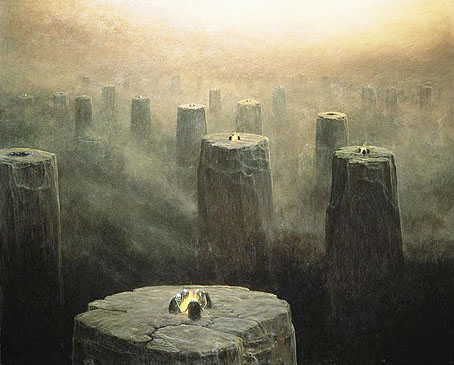
DG-2499 (1975) by the fantastic (in every sense of the word) Zdzisław Beksiński (1929–2005). See the Dmochowski Gallery for a comprehensive collection of the artist’s work. Thanks to BibliOdyssey for the tip.

• More ICA events: From Animism to Zos: Strange Attractor Salon will be “a series of weekly events, consisting of a talk and a film, exploring some lesser-known intersections of culture, history, mind and nature” running from 10 March–12 May, 2011.

• And on May 10, the London Word Festival presents a Dodgem Logic evening with entertainment provided by contributors to that magazine:

Alan Moore’s reinvigoration of the underground fanzine, Dodgem Logic, comes alive in the non-conformist surroundings of Hackney’s Round Chapel. A night of art, comedy, comment and put-something-back localism. (…) With Robin Ince heading up a colossal stand-up bill, artists Steve Aylett, Savage Pencil, Melinda Gebbie and Kevin O’Neill panel-up to talk about their comic work, while music comes from hyperactive racketeers The Retro Spankees. With an exhibition of artwork from the magazine, and conducted by editor-in-chief Alan Moore.

• Taschen publishes a collection of Dennis Hopper’s photographs this week. The Independent has a small selection here. Also new from Tachen, Alex Steinweiss, The Inventor of the Modern Album Cover.

Bass Notes: The Film Posters of Saul Bass at the Kemistry Gallery, London.

beksinski2.jpg

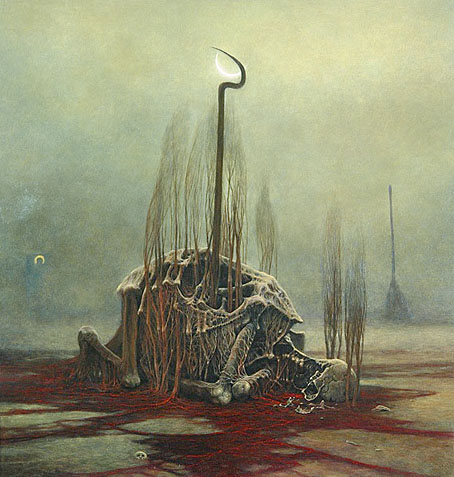
DG-2507 by Zdzisław Beksiński.

While riding through the bustling streets of London from 1603 to 1621, one was liable to hear the shout “Long live Queen James!” King James I of England and VI of Scotland was so open about his homosexual love affairs that an epigram had been circulated which roused much mirth and nodding of the heads: Rex fuit Elizabeth: nunc est regina Jacobus—”Elizabeth was King: now James is Queen.”

There’s more about the private life of the man who gave his name to the King James Bible here.

Addams and Evil, a Tumblr devoted to the great Charles Addams.

Hannes Bok again at Golden Age Comic Book Stories.

Caravaggio’s crimes exposed in Rome’s police files.

Deserted City, photographs by Kim Høltermand.

• The blue sand dunes of the planet Mars.

• A map of the ghost signs of Chicago.

The movie title stills collection.

The pitfalls of e-book buying.

Life On Mars? (1971) by David Bowie | Uncle Sam’s On Mars (1979) by Hawkwind | Eyes On Mars (1980) by Chrome | Cache Coeur Naif (1997) by Mouse on Mars.

Electric Seance by Pram

electric_seance.jpg

The (Electric Seance) concept was inspired by the discovery that many early pioneers and inventors of electrical apparatus and radiophonic equipment believed that they could use their inventions to contact ‘the other side’.

Scott Johnston

This month’s issue of The Wire has Birmingham group Pram on the cover. Inside they discuss working with filmmaker Scott Johnston whose Electric Seance production was used as part of the group’s Photophonic Experiment shows last year. I have to admit I was never much taken with Pram’s early work, preferring their Too Pure stablemates Laika and Mouse on Mars circa 1997. (Having said that, I’m listening to their Helium album now and it sounds better than I remembered.) I did appreciate the references, however, which encompassed a range of interests including White Noise, Maya Deren and the films of Karel Zeman, all of whom have been the subjects of previous posts here. The band were keen to produce an alternative soundtrack for Zeman’s Invention of Destruction but the Czech Film Archive refused their offer.

electric_seance2.jpg

Pram seem to have become more interesting in the intervening years, unlike their compatriots. Laika lost me when they got too poppy while Mouse on Mars abandoned melody for a blizzard of increasingly tiresome electronic abstraction. Electric Seance gives some idea of where Pram are at now which isn’t too far removed from the same world of retro-electronica and English spookiness being explored by the Ghost Box artists. The Wire has the soundtrack to Electric Seance as a free download.

And following from yesterday’s reference to Last Year in Marienbad, another film in Scott Johnston’s YouTube collection, The Arranged Time, is a tale of sinister recursion which he says is indebted to Resnais’s classic enigma.

Previously on { feuilleton }
White Noise: Electric Storms, Radiophonics and the Delian Mode
The Séance at Hobs Lane
New Delia Derbyshire
A playlist for Halloween
Ghost Box
The Photophonic Experiment