Weekend links 821

tevis.jpg

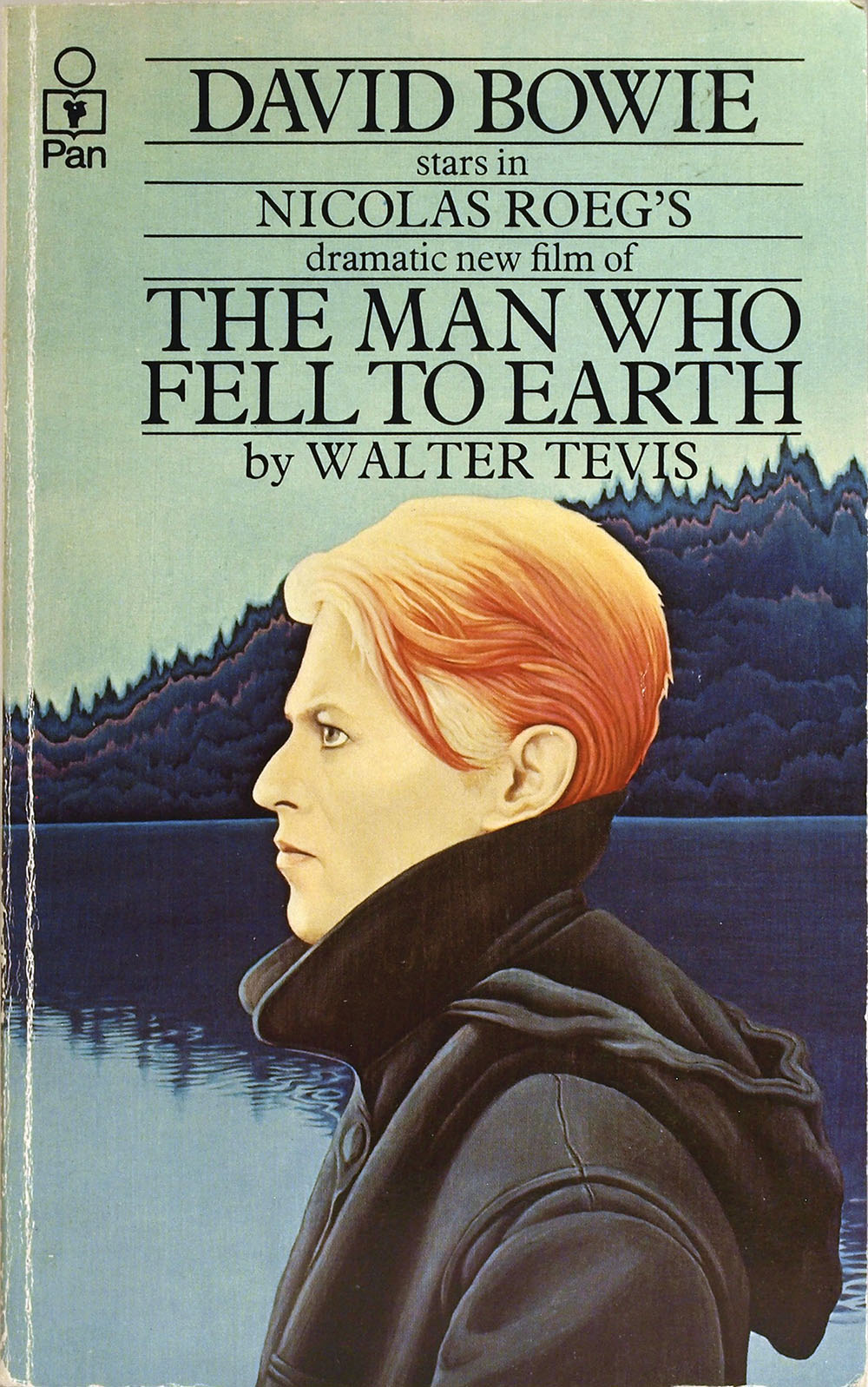
The first UK paperback edition, 1976. Cover art by David Bowie’s illustrator friend George Underwood.

• At the BFI: “Humanity, lost and found”. The original Sight and Sound review by Tom Milne of The Man Who Fell to Earth which was released 50 years ago this month. The film is another Nicolas Roeg project whose lofty reputation today has made everyone forget the bewildered or even hostile reaction it generated at the time, including from the US distributor, Paramount, who hated it. Milne, by contrast, had read the novel it was based on, and paid close attention to what the film’s writer, Paul Mayersberg, described as its “minefield of images”.

• Among the new titles at Standard Ebooks, the home of free, high-quality, public-domain texts: The Varieties of Religious Experience by William James.

• Issue 13 of Verbal magazine features an interview with Michael Moorcock, Iain Sinclair in the “Talking Books” section, and more.

• New music: 4 Hours (DVATION 2026 Version) by Clock DVA; -Music For Oriental Hotel Okinawa Resort & Spa- by Harikuyamaku.

• The Shaw Brothers Cinema YouTube channel has whole feature films from the studio’s huge archive free to view.

• At Colossal: “Historic architecture emerges from stone in Matthew Simmonds‘ ethereal sculptures”.

• “Music with Balls”: Terry Riley performing live with an arrangement of shiny silver spheres on KQED TV in 1969.

• Mixes of the week: DreamScenes – March 2026 at Ambientblog, and Motorik by Jon Savage.

• “What is electronic music?” Daphne Oram explains.

• RIP Country Joe MacDonald.

Stardust (1941) by Artie Shaw And His Orchestra | Stardust (1959) by Martin Denny | Stardust (1985) by Yasuaki Shimizu & Saxofonettes

Weekend links 754

picasso.jpg

The Remains of Minotaur in a Harlequin Costume (1936) by Pablo Picasso. Via.

• At Rarefilmm: Long Live the New Flesh: The Films of David Cronenberg, a TV documentary from 1987 which includes contributions from Martin Scorsese and Stephen King. I wrote about this one years ago but at the time the only available copy was chopped into 10-minute segments.

• Coming soon from Strange Attractor: Delinquent Elementals: A Pagan News Anthology, edited by Phil Hine & Rodney Orpheus.

• At Wormwoodiana: Mark Valentine explores the possible influence of the Sherlock Holmes stories on Arthur Machen’s early fiction.

Perhaps there was a Super-Sargasso Sea in the upper atmosphere into which were carried objects from earth—frogs, fish, leaves—and from which they later rained. Perhaps the universe was a living thing, rains of blood its bleeding. Perhaps in 1903 the earth, in its orbit about the sun, passed through the remains of a world destroyed in an interplanetary dispute, the particles falling as rains of dust and redness. Perhaps humanity was controlled. “I think we’re property”, Fort wrote. Or, perhaps not; so skeptical he could not accept even his own authority, he had given up theorizing. “We have expressions: we don’t call them explanations: we’ve discarded explanations with beliefs.”

Joshua Blu Buhs on how Charles Fort came to write The Book of the Damned

• More Alan Moore: “Magic is not this big, spooky, dark thing that’s full of nightmares,” he tells Séamas O’Reilly at the Irish Times.

High-resolution images of 14,000 woodblock illustrations and letterforms free to use at the Plantin-Moretus Museum, Antwerp.

• New music: Music For Bus Stations by Rod Modell; and Between Soil And Sky by Tarotplane.

• At Dennis Cooper’s: Spotlight on…Denton Welch In Youth is Pleasure (1945).

• At the Quietus: The Strange World of…Irena and Vojtech Havlovi.

Apollo Explorer

Pagan Love Song (1959) by Martin Denny | Pagan Lovesong (Vibeakimbo) (1982) by Virgin Prunes | Pagan Sun Temple (2022) by Hawksmoor

Weekend links 652

colquhoun.jpg

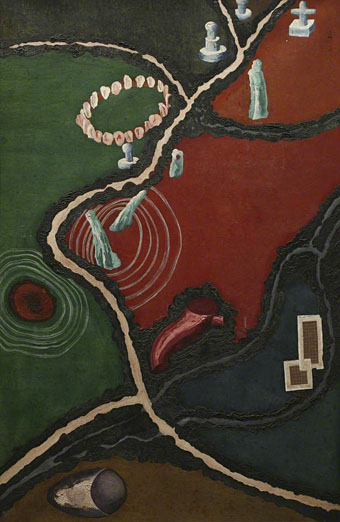
Landscape with Antiquities (1955) By Ithell Colquhoun.

• “The ontological horror at the core of these stories is that the stone–which represents the natural world and the uses we carve out for it–is unknowable. It’s been here, affecting the land, whether erected as a monument or laid as bricks, for longer than we can fathom, and its inaccessible past has some frightening bearing on the present.” Sean McGeady on 50 years of stone-tape theory, from Nigel Kneale to Ben Wheatley. Also a reminder that Christmas ghosts on TV could be more than another adaptation of MR James.

• “Midnight is the time when one can recall, with ribald delight, the names of all the Great Works which every gentleman ought to have read but which some of us have not. For there is almost as much clotted nonsense written about literature as there is about theology.” At Wormwoodiana: That Black-Edged Light: A Note on HM Tomlinson.

• “Anxious but stubborn herself, she was a lucid observer of social awkwardness, her subject matter in her books being primarily worry: at disasters real and imagined (comet-fall, floods, unplanned chaos), but also at small-scale domestic panics (such as how to mollify unwanted guests).” Mark Sinker reviewing Tove Jansson, a new biography by Paul Gravett.

Dennis Cooper’s favourite fiction, poetry, non-fiction, film, art, and internet of 2022. Thanks again for the link here!

• “A is for Alphabet and Architecture.” Public Domain Review now has an index. Rather slight but still useful.

Ju-on: The Curse and four other Y2K J-Horror movies you may have missed: a list by James Balmont.

• At Smithsonian Magazine: Listen to the sound of a dust devil swirling around on Mars.

• Unquiet Things offers the latest accumulation of Intermittent Eyeball Fodder.

Stone God (1957) by Martin Denny | Sanctuary Stone (1973) by Midwinter | Children Of Stone (2006) by Espers

Weekend links 585

bertha_lum.jpg

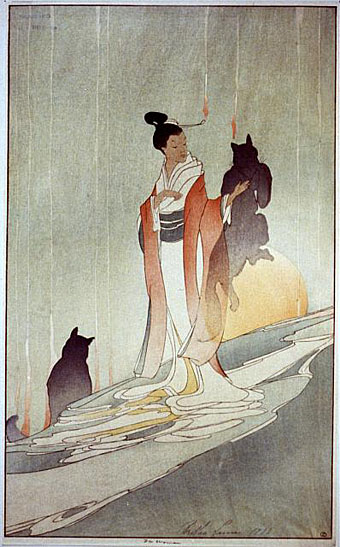
Fox Woman (c. 1916) by Bertha Lum.

• “Apparently he had been walking though customs/arrivals with a large cube of weed stuck on the end of his silver Dr Martens and a foot long silver flashlight full of seed, but when they realised who he was, and that today was his 60th birthday, he was released with just a warning.” Radio Lancashire DJ Steve Barker remembers the late Lee “Scratch” Perry, and links to one of his shows with Perry (and Roger Eagle) here.

• “…it’s the chase itself that shapes the film’s distinctive aesthetic—the under-lit interiors and the sunless and frigid exteriors of the many locations across the city, sites that take the cops well beyond their usual beat, to places both above and below ground.” Chris McGinley explains how William Friedkin’s The French Connection reinvented (and exploded) the police procedural.

• “Toibin, who is himself gay, has always extended historical sympathy to sexual outsiders. As he’s written elsewhere, ‘There are no 19th-century ballads about being gay.'” Dwight Garner reviews Colm Toibin’s The Magician, a novel about Thomas Mann.

Here is the key point: to experience such marvels you have to risk an unsophisticated, even credulous love for corn, and part of that love involves a willingness to submit to what [Phil] Ford calls a “magical hermeneutics” capable of transforming marginal chunks of pop culture. As he writes in the wonderful 2008 essay that inspired the episode, exotica is “less a genre of music than a class of cultural objects that share a characteristic projection of the self across boundaries of space and time.” This makes it essentially psychedelic—“film music for daydreams”—and Ford draws out that historical connection in his essay, which argues that while the hippie movement that Nature Boys like Ahbez prophesied looks like a radical rejection of the space-age bachelor pad of ’50s consumerism, tendrils of transcendent yearning link the exotica imaginary to the earnest if stoned mysterioso to come.

Erik Davis on Eden Ahbez and Californian exotica

Edgar Froese interviewed on WSHU radio in 1974 where he talks about Tangerine Dream, live performance and the future of electronic music.

• At Dangerous Minds: A momentary lapse of reason…when Dario Argento interviewed Pink Floyd in 1987.

• It’s that man again: John Doran interviews Kevin Martin, aka The Bug.

David McKenna on The Strange World of France, La Nòvia & friends.

• At Dennis Cooper’s: Tape deck.

Exotica (1958) by Martin Denny | Exotica Lullaby (1976) by Harry “The Crown” Hosono | Exotica (1979) by Throbbing Gristle

Weekend links 563

tonto.jpg

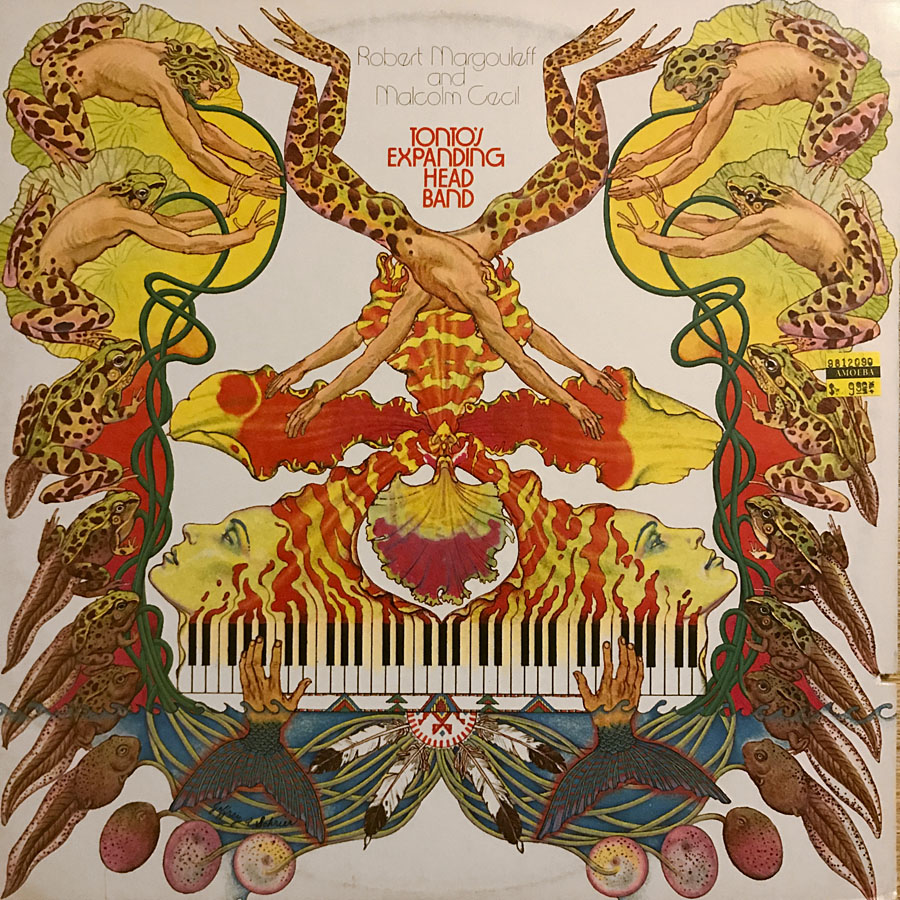
Cover art by Jeffrey Schrier for the 1975 reissue of Zero Time by Tonto’s Expanding Head Band.

• RIP Malcolm Cecil, electronic musician, and producer of Stevie Wonder, among many others. The term pioneer is over-used when discussing electronic artists, but it’s an accurate one when applied to Cecil and his partner in Tonto’s Expanding Head Band, Robert Margouleff. The first Tonto album, Zero Time (1971), was a collection of fully-realised all-electronic compositions recorded in the days when “electronic music” in the rock sphere usually meant rock-band-plus-synth-burbles. As I said in a post about Tonto’s debut album a few years ago, “Jetsex sounds like an outtake from Kraftwerk’s Autobahn (albeit three years early) while Timewhys wouldn’t have been out of place on The Human League’s Travelogue album almost a decade later”. Cecil may be seen in this short film showing off the bespoke synth gear that comprised The Original New Timbral Orchestra (aka TONTO), while he talks at length about his career in issue 4 of Synapse magazine here. Cecil and Margouleff parted company in the mid-70s shortly after releasing a second album, It’s About Time (1974), a collection of jazzy instrumentals that’s overdue a proper reissue.

• “Every film production company they showed it to said it was ‘too weird’ to ever be made. ” Next month Strange Attractor publishes The Otherwise, a script by Mark E. Smith and Graham Duff for an unmade horror film.

• More horror: Predator’s Ball by Uni; music video as horror scenario in which you can play spot-the-reference: Alice in Wonderland, Rocky Horror, Leigh Bowery (?), Pasolini’s Salò (?)…

• At Bibliothèque Gay: Narkiss by Jean Lorrain, another homoerotic classic newly translated into Spanish, and with new illustrations.

• The week in Gary Panter: Nicole Rudick on Gary Panter’s Punk Everyman, and the man himself writing about his life and art.

• At Wormwoodiana: Mark Valentine investigates the connections between Charles Williams and Sax Rohmer.

• At Dangerous Minds: New Age Steppers, “the only ever post-punk supergroup”.

• Mix of the week: XLR8R Podcast 689, a feast of funk compiled by Steve Arrington.

• At Public Domain Review: Agostino Ramelli’s Theatre of Machines (1588).

• At Dennis Cooper’s: Pier Paolo Pasolini Day.

Valentina Magaletti’s favourite music.

Louvre site des collections

Narcissus Queen (1958) by Martin Denny | Narciso (1974) by Pierrot Lunaire | Narkissos (2006) by Sadistic Mikaela Band