A Clockwork Orange: The Complete Original Score

aco_sleeve.jpg

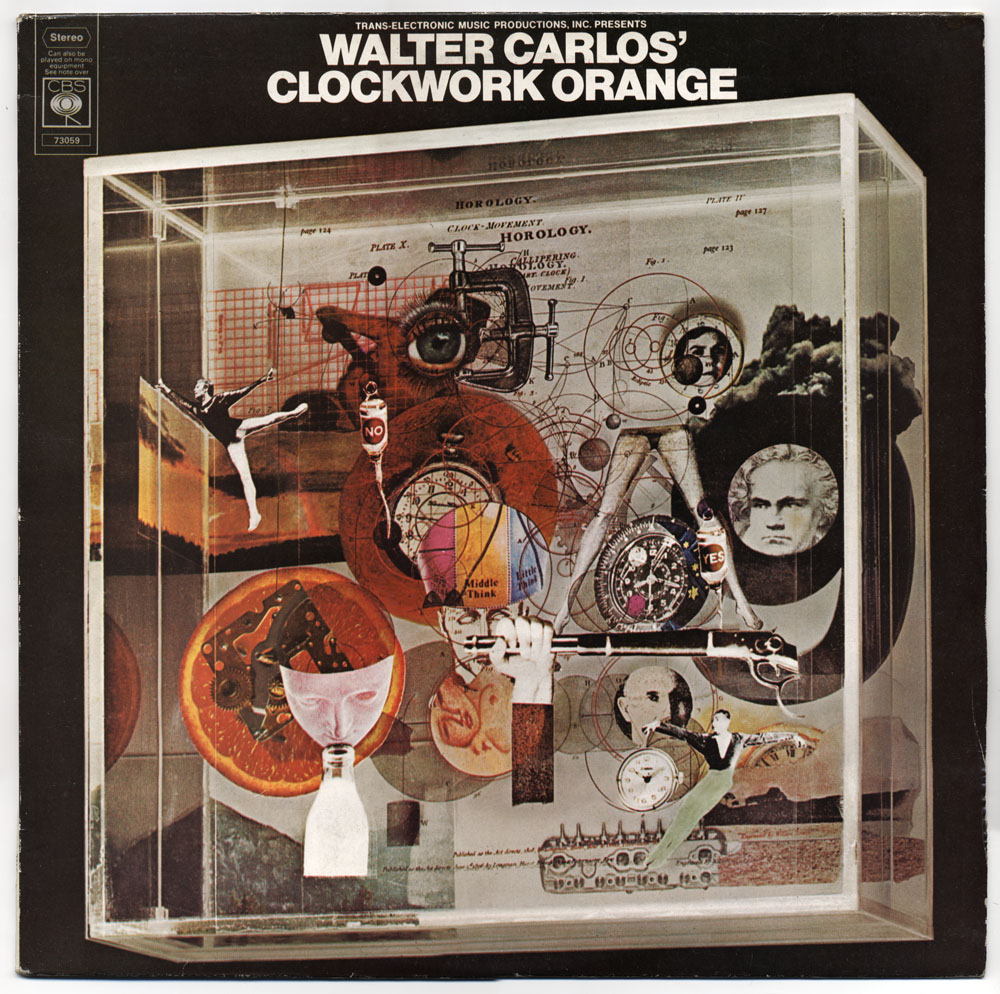
CBS 73059; construction by Karenlee Grant, photo by David Vine (1972).

A1 Timesteps (13:50)
A2 March From A Clockwork Orange (7:00)
B1 Title Music From A Clockwork Orange (2:21)
B2 La Gazza Ladra (5:50)
B3 Theme From A Clockwork Orange (1:44)
B4 Ninth Symphony: Second Movement (4:52)
B5 William Tell Overture (1:17)
B6 Country Lane (4:43)

Viddy well the stuff of obsessions, O my brothers: Kubrick, cover design and electronic music in one convenient 12-inch package. Those of us in Britain who were too young to see A Clockwork Orange during its initial run had to wait a long time for its re-release after Stanley K withdrew the film from circulation. Until bootleg VHS copies started to turn up in the 80s I knew the film mostly from the MAD Magazine parody and the soundtrack album which was ubiquitous in secondhand record shops. Having become familiar with the score, an additional layer of frustration was added when it became apparent that two soundtrack albums had appeared in the 1970s, the “official” one, which was a mix of the orchestral and electronic music used in the film, and another which contained all the music Walter (later Wendy) Carlos recorded.

The Wendy Carlos music was the principal attraction for this electronic music obsessive and I fretted for a long while trying to find a copy of her Complete Original Score album which was paraded in all its elusive glory on old CBS vinyl inner sleeves. Half the tracks are present on the official release but the omissions are crucial: Timesteps, the incredible composition which accompanies Alex’s first deprogramming session was edited down from thirteen to five minutes, there was Carlos’s Moog version of Rossini’s La Gazza Ladra (an orchestral version is used in the film) and also an original piece, Country Lane, intended to accompany Alex’s police brutality session at the hands of his former droogs. The score was one of the first projects to successfully incorporate a vocoder into electronic compositions; Rachel Elkind, Carlos’s regular collaborator, provided the vocalisations. Finally securing a copy was no disappointment, in fact I was overwhelmed. This is still my favourite Wendy Carlos album and one of my top five favourite analogue synth albums. The transcription of La Gazza Ladra is nothing short of miraculous, thundering away with the power of a full orchestra yet created by laboriously recording one note at a time. (Wendy Carlos’s very thorough website goes into detail about the recording process.)

Continue reading “A Clockwork Orange: The Complete Original Score”
A cluster of Cluster

harmonia.jpg

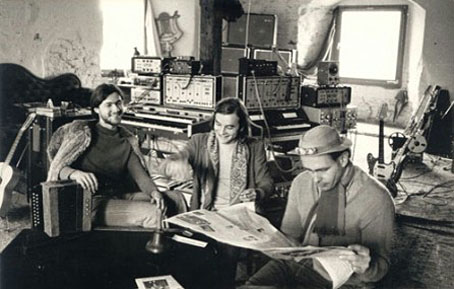
Harmonia somewhere in the 1970s: Michael Rother, Dieter Moebius, Hans-Joachim Roedelius.

Continuing the occasional { feuilleton } series exploring the byways of musical culture, this month it’s the turn of German group Cluster, prompted by their current US tour. News of their re-emergence sent me back to the albums and I’ve been listening to little else for the past week or two.

cluster.jpgMark Pilkington has very conveniently saved me the trouble of summing up the wandering history of Dieter Moebius and Hans-Joachim Roedelius in their various incarnations with his introductory piece, Cosmic Outriders: the music of Cluster & Harmonia. Unlike many of their Krautrock contemporaries, Moebius and Roedelius have remained very active, Roedelius particularly has an extensive solo discography. I’ve never been very taken with their work since the early Eighties, however. I have an inordinate fondness for the analogue keyboards which contribute to their early sound; as the Eighties progressed they took to using digital keyboards and their music lost much of its earlier charm as a result.
The Cluster discography is very long and confused, encompassing Kluster (pre-Cluster line-up with Conrad Schnitzler), Cluster, Harmonia (Cluster with Michael Rother from Neu!), Cluster with Brian Eno, then Moebius and Roedelius’s numerous solo works and collaborations with other artists. As a result, a guide such as this is useful for the curious. So here we go with another blog list…

ClusterCluster 71 (1971)
A timeless racket. Three long noisy slabs of synth distortion that make the first two noisy Kraftwerk albums seem positively melodic. This could easily be passed off as an unreleased Throbbing Gristle or Cabaret Voltaire album.

ClusterCluster II (1972)
The second album continues the granular challenge but lets some light and music into the mix.

HarmoniaDeluxe (1975)
I prefer the second Harmonia album to the first, and prefer both to Cluster’s third opus, Zuckerzeit, recorded around the same time as this. Michael Rother’s involvement in Harmonia pushes the sound very close to Neu! in places, especially the more melodic strains of Neu! 75.

HarmoniaHarmonia 76: Tracks & Traces (1976)
Albums of studio outtakes are usually for die-hard listeners only but this one is surprisingly good with an outstanding long atmospheric piece, Sometimes In Autumn. Brian Eno was hanging out with Cluster by this point and he contributes a vocal on Luneberg Heath.

ClusterSowiesoso (1976)
The most melodic and relaxed of all the Cluster albums and the one which birthed a host of inferior copyists on the Sky label.

Cluster & Eno (1977)
Recorded at around the same time as By This River on Eno’s Before And After Science. Holger Czukay from Can is a guest on the Eno albums.

Eno, Moebius & Roedelius—After The Heat (1978)
Of the two Cluster & Eno albums this is probably the best and ends with three Eno songs which turned out to be his last vocal works until Nerve Net in 1992. Note that the CD reissue has a different (and in my view, inferior) track ordering to the vinyl original.

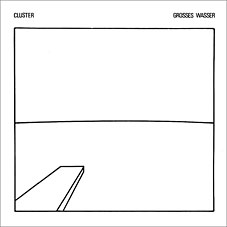
ClusterGrosses Wasser (1979)
Produced by ex-Tangerine Dream member Peter Baumann and recorded at his studio which gave the Cluster guys the opportunity to use his superior synth equipment. As a result a couple of the tracks here are very similar to Baumann’s solo work.

Moebius & PlankRastakraut Pasta (1980)
This album and its follow-up should be added to the list of works which influenced Eno & Byrne’s My Life in the Bush of Ghosts. The opening track News, features sampled radio voices (as per later Eno & Byrne) mixed with a plodding rhythm that includes a recurrent synth note that’s the spit of similar sounds used on My Life.

Moebius & Plank—Material (1981)
Genius producer Conny Plank brought out the best in many of the artists he worked with and these two collaborations with Moebius are a great example of that. He had a similar effect with Roedelius on an early solo album, Durch die Wüste, moving Roedelius out of his ambient keyboards comfort zone. The tone on Material is more strident and uptempo than Rastakraut Pasta, especially on Tollkühn which is like some mad techno synth run ten years too early.

Cluster and co. on YouTube
Cluster 71
Harmonia—Deluxe (Immer Wieder)
Cluster—Sowiesoso
Cluster & Eno—Für Luise
Brian Eno—By This River

Previously on { feuilleton }
The Avant Garde Project
White Noise: Electric Storms, Radiophonics and the Delian Mode
Chrome: Perfumed Metal
Metabolist: Goatmanauts, Drömm-heads and the Zuehl Axis
The music of Igor Wakhévitch
My Life in the Bush of Ghosts

Klaus Dinger, 1946–2008

dingers.jpg

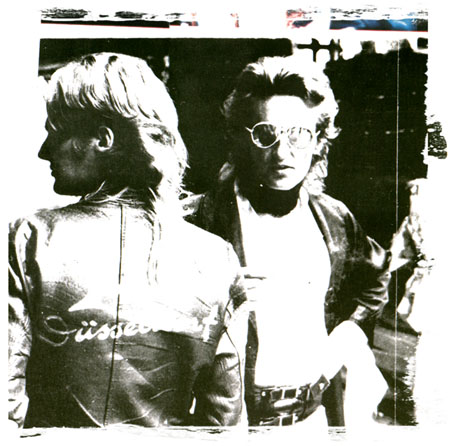
Klaus Dinger (right) with brother Thomas, circa 1978. From the sleeve of Viva by La Düsseldorf.

“There were three great beats in the ’70s: Fela Kuti’s Afrobeat, James Brown’s funk and Klaus Dinger’s Neu! beat.” Brian Eno

Klaus Dinger, the great drummer for Neu! and La Düsseldorf (and briefly Kraftwerk in 1971) died back in March but news of this has taken a while to emerge. Everything he did in the Seventies is essential, the Neu! albums especially. YouTube has a few choice examples such as this clip of someone playing Neu!’s finest (and oft-imitated) moment, Hallogallo, slightly too fast. Then there’s Isi from Neu! 75 and the crazy glam-punk of Hero (a tremendous period performance) shortly before guitarist Michael Rother left and the band transmuted into La Düsseldorf. For a blast of the latter, there’s the majestic Rheinita from Viva. Happily, Michael Rother is still with us and was interviewed in the most recent issue of The Wire.

Previously on { feuilleton }
Aerodynamik by Kraftwerk
Metabolist: Goatmanauts, Drömm-heads and the Zuehl Axis
The genius of Kraftwerk

Aerodynamik by Kraftwerk

kraftwerk.jpg

1 Aerodynamik (Intelligent Design Mix by Hot Chip) (8:34)
2 La Forme (King Of The Mountains Mix by Hot Chip) (11:31)

This is a curious moment to be releasing a remix single, four years after the last studio album, Tour De France Soundtracks, which is the origin of the music here. But the Düsseldorf boys have always been a law unto themselves and I’m a Kraftwerk obsessive so I won’t complain, especially when any release at all is a significant event.

kraftwerk2.jpg

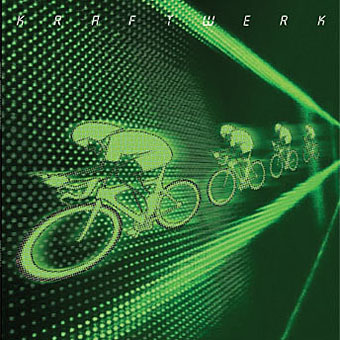
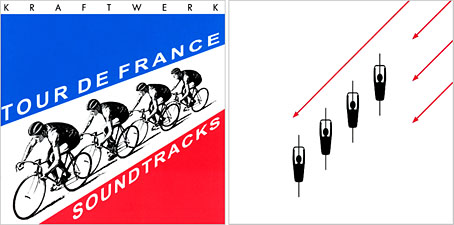
Tour De France Soundtracks (2003); Aerodynamik single (2004).

An additional attraction for this fan is seeing how the design changes from one release to the next. Kraftwerk control their presentation as carefully as their music and this new design combines the original quartet of cyclists (which date back to the first Tour De France single from 1983) with the fluorescent green that became a feature with Expo 2000. The bikes and riders have now been updated so they look suitably aero-dynamic.

Kraftwerk are notoriously tight-lipped about their activities and since the Eighties have developed a Kubrick-like prevarication towards new projects. A multi-disc retrospective, The Catalogue, was supposed to have appeared in 2004 and came close enough to release for promo editions to go out, only to be cancelled at the last minute. (Those promos now sell for hundreds of dollars on eBay.) The new single may be intended to stimulate interest in something more substantial seeing as we’re entering the prime period for pre-Christmas releases. Fingers crossed.

Previously on { feuilleton }
Street Sounds Electro
White Noise: Electric Storms, Radiophonics and the Delian Mode
The genius of Kraftwerk

Street Sounds Electro

electro.jpg

I spent much of the summer of 1983 playing games on a very primitive ZX Spectrum computer while listening to the first couple of Street Sounds Electro compilations. Those mix albums were among the best releases that year and remain highly sought after, seeing as they’ve never been reissued on CD.

face.jpg

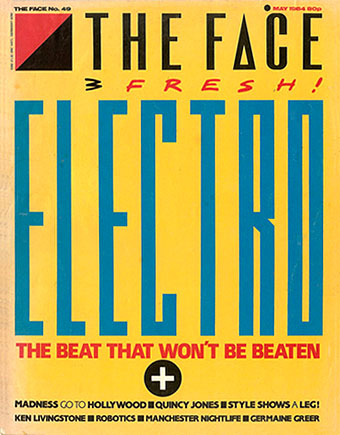
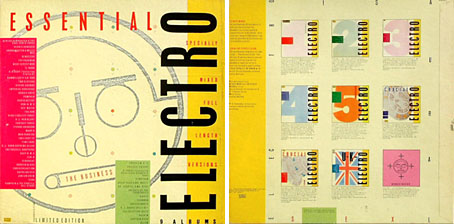
The musical reputation of the compilations has overshadowed the sleeve design which was very distinctive for the time and undoubtedly a factor in their success. The vertical ELECTRO type was inspired by Neville Brody’s design for The Face which had turned the magazine’s title through ninety degrees the year before. Also very Brodyish was the use of photocopier-processed graphics and narrow typography although it should be pointed out that Brody hand-drew nearly all his headlines which left his imitators searching through type catalogues for approximations. The sleeve designs are credited to “Red Ranch for Carver’s” about whom I can find no information whatever. Things came full-circle when The Face ran a feature on the electro scene in 1984 giving Brody the opportunity to do a cover with his own variant on the sleeve layouts.

essential.jpg

Essential Electro 9-album box, HBOX 1 (1984).

One of the big attractions of these albums for me was the new directions they were opening up for electronic music. Outside the mainstream pop world electronica in the early Eighties meant either the polite fare of Tangerine Dream or the dreary sludge of minor industrial acts such as Portion Control. Cabaret Voltaire were still vital in the early 1980s: their thundering Crackdown single (with sleeve design by Neville Brody) was remixed for its 12-inch incarnation by dance producer John Luongo while electro producer John Robie (whose production is featured on Electro 1) remixed their Yashar single for Factory Records. But nothing matched the excitement of a bunch of NYC kids lifting Kraftwerk riffs and playing in a very unselfconscious manner with new and relatively cheap equipment, especially the Roland TR-808 drum machine which provides the backbone for many of these recordings.

Continue reading “Street Sounds Electro”