Passage 12

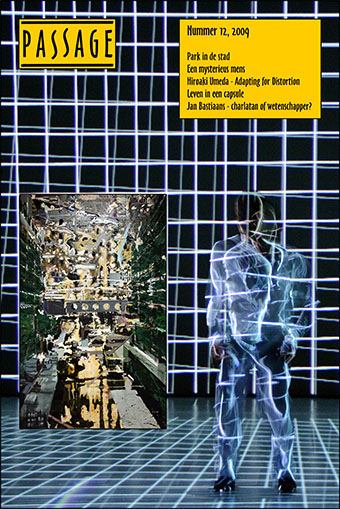
passage12.jpg

Ed Jansen writes again to notify me that the latest number of his web magazine, Passage, is now online, about which he says:

In Passage nr. 12 there are articles about a 17th century garden in The Hague, about the mysterious visit to The Hague by the Comte De Saint Germain. Was he really a enlightened man or a fraud? If you’re an occultist you’ll tend to believe the first, the historian thinks otherwise. Then there are the photos of the dancer and performer Hiroake Umeda. Strange movements underlined by light-effects. Living in a Capsule is a combination of the paintings by the Dutch artist Tjebbe Beekman and the work of J.G. Ballard. Lastly there is an article about Jan Bastiaans, the doctor who experimented with LSD to ‘free’ the victims of the concentration camps of the nightmares and repressed memories.

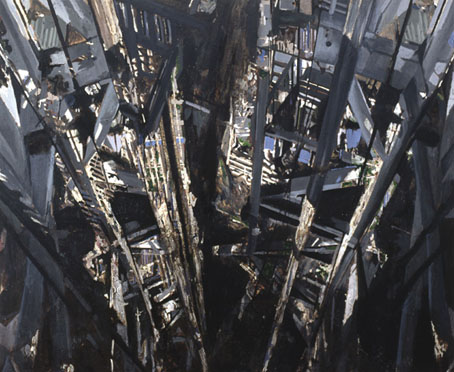
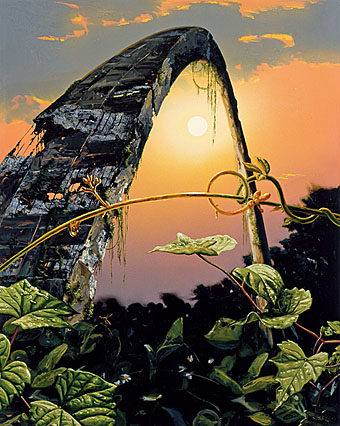
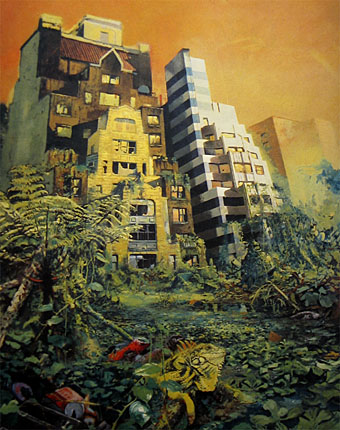
Once again the text content is in Dutch but that doesn’t exclude all visitors here. I hadn’t come across the work of Tjebbe Beekman before. His paintings of urban desolation are indeed a good match for one aspect of Ballard’s work, and they make an interesting contrast with Dick French’s earlier views of the author’s Drowned World.

beekman.jpg

Trust by Tjebbe Beekman (2005).

Previously on { feuilleton }
Drowned Worlds
Passage 11
Passage 10

Roger Dean: artist and designer

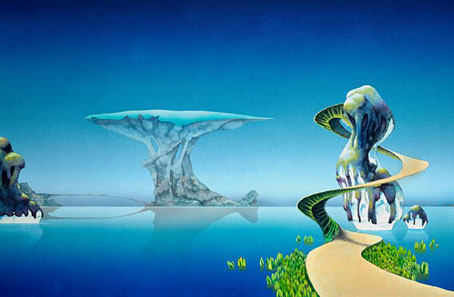
Kieran at Sci-Fi-O-Rama was in touch recently asking me to contribute a paragraph about a favourite Roger Dean picture for this feature about the artist. The following splurge of polemic was the result, something I’d been intending to write for a while. Since so many words would have overwhelmed the other contributions it’s being presented here while Kieran’s post has a variety of shorter appreciations and further examples of Dean’s art and design.
dean1.jpg

Pathways (1973). A slightly reworked version of the original painting.

“Science fiction is unfortunate in having a most unsatisfactory framework of existence—it’s considered literary kitsch. I believe it should be the mainstream of literature because all the books that have become important down the generations of civilisation have been books about ideas. Superficially, science fiction would seem to offer the most scope for idea content, but the promise is unfulfilled. Good ideas and good writing rarely coincide. All too often the medium is used for entertainment alone and its potential beyond this should be obvious to everyone. I don’t just mean in the sense of fantasy technology. The potential for anticipating human evolution is there and perhaps the means to bring it about and definitely the means to bring about a social evolution.”

Roger Dean, interviewed in Visions of the Future (1976).

If popularity is often a curse as well as a blessing, it’s been Roger Dean‘s curse to see his work dismissed along with many other products of a decade—the 1970s—with more than its share of cultural heroes and villains. Music journalists in Britain have for years given the impression that the arrival of the Sex Pistols in 1976 swept away all that preceded them, in particular bands such as Yes whose album covers had helped raise the visibility of Dean’s art to an international level. This is not only a lazy assumption, it’s also wrong. When Yes released Going For the One in 1977 it was their first studio album in three years, yet despite the punk explosion it went to no. 1 in the UK album charts, while a rare single release from the band made the UK top ten. Yes were playing sell-out tours in Europe and the US in 1977 and 78, as were Pink Floyd whose The Wall was massively popular worldwide in 1979. Punk didn’t sweep prog away, what happened with its advent was that progressive rock and everything associated with it—Roger Dean’s art included—became critically disreputable almost overnight, such that no music journalist would dare say anything good about it. That disrepute has persisted for thirty years despite a lasting and indelible influence. This is an old argument but some facts often need restating anew. *
dean6.jpg

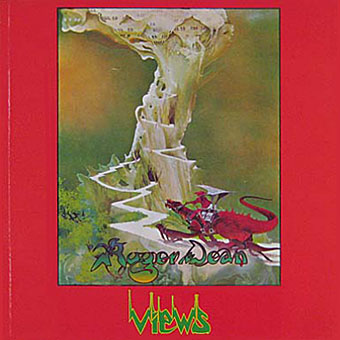
Views (1975).

I was 13 in September 1975 when Roger Dean’s first collection of his illustration and design work, Views, was published. At that time, I hadn’t heard any of the music to which his paintings and drawings were attached, and I didn’t even see a copy of the book until February 1976 when I happened to be in London on a school trip and found a big pile of what I guess was the second edition in Foyle’s book shop. This appeared at exactly the right moment. I wasn’t listening to the music but I was reading a lot of science fiction, and was starting to notice and imitate the work of various paperback artists. I recognised many of the pictures in Views from the covers displayed in the window of our local record shop, Cobweb, whose shopping-bag logo was a cowled magician figure à la Dean or Rodney Matthews. It’s difficult to say what struck me about Dean’s work at the time since you rarely articulate your preferences at that age. I think I liked the consistency of vision and the invention which blended the organic and mechanical, the architecture which looked at once ancient and futuristic, and the flat landscapes which put lone pine trees into rocky terrain familiar from Japanese and Chinese prints. For a teenager his style was also relatively easy to imitate if you forgot about basic things such as imagination and finesse, and I spent a year producing a lot of badly-drawn reptiles posed against lurid watercolour skies.

Continue reading “Roger Dean: artist and designer”

Drowned worlds

rockman1.jpg

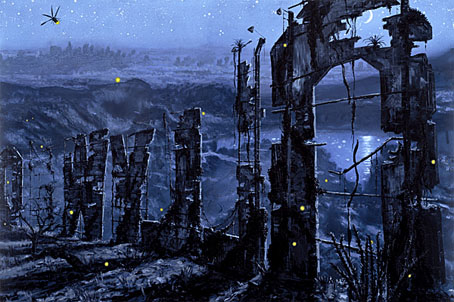
Hollywood at Night (2006).

Alexis Rockman‘s paintings of swamped or ruined American landmarks present views which are a novelty in contemporary art galleries whilst being very familiar to science fiction readers. Many of these could well be illustrations for JG Ballard’s 1981 novel, Hello America, which imagined a depopulated United States reclaimed by flora and fauna. Others would suit The Drowned World, of course, and they bear favourable comparison with Dick French’s illustrated edition (below) which was also published in 1981.

rockman2.jpg

Gateway Arch (2005).

Rockman’s hothouse atmospheres remind me of earlier paintings of Brazilian wildlife by another American artist, Martin Johnson Heade (1819–1904), many of whose tropical landscapes only require a distant ruin or two to match Rockman’s work. (Tip via Design Observer.)

french.jpg

The Drowned World by Dick French (1981).

While we’re on the subject, Ballardian has posted the first of three features about my colleagues at Savoy Books, beginning with a Michael Butterworth interview which discusses some of Ballard’s connections with Savoy. One of the subsequent posts should see yours truly discussing the visual dimension of the Savoy world. More about that later.

Previously on { feuilleton }
The coming of the dust
Ballard and the painters

The coming of the dust

sydney1.jpg

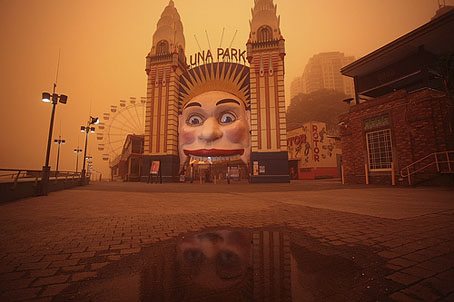
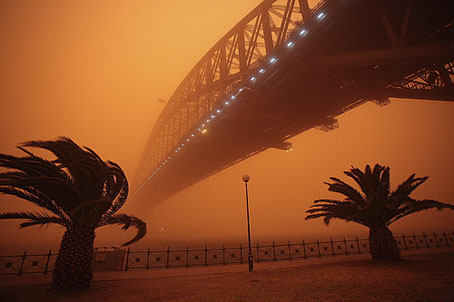
Impossible to avoid thoughts of either JG Ballard or various apocalyptic horror and science fiction scenarios when looking at these photos of Sydney, Australia, taken a few hours ago. A cloud of red dust passed over the city in the early morning and the depopulated views only add to the eerie atmosphere. These are from a Red Dust Flickr gallery. The Other Andrew writes about the inundation on his blog. I’m looking forward now to the reaction of another Sydney Melbourne resident, Simon Sellars, who runs Ballardian.

Update: The Red Sydney Project—Dust Storm Days

sydney2.jpg

Previously on { feuilleton }
Apocalypse now

The art of François Schuiten

schuiten1.jpg

Paris au XXieme Siecle by Jules Verne (1994).

Following a comment I made last week in the post about the Temples of Future Religions by François Garas I’ve decided it’s time to give some proper attention to one of my favourite comic artists, François Schuiten, a Belgian whose obsession with imaginary architecture resembles the earlier endeavours of Garas and others. Schuiten’s parents were both architects which perhaps explains his predilection. In addition to a large body of comics work, he’s produced designs for film—notably Taxandria by Raoul Servais—Belgian stamps, and a steampunk makeover for the Arts et Métiers station of the Paris Métro. In 1994 he created cover designs and a series of illustrations for the publication of Jules Verne’s rediscovered manuscript, Paris au XXieme Siecle.

schuiten2.jpg

Cover for Spirou (2000).

I first encountered Schuiten’s work in a 1980 issue of Heavy Metal magazine which was reprinting translated stories from the French Métal Hurlant along with original work. Schuiten’s story, The Cutter of the Fog, was an erotic and futuristic tale of a small community and the obsession of the local “fog-cutter”. François’s brother Luc wrote the piece and it bears some similarity with JG Ballard’s Vermilion Sands story, The Cloud Sculptors of Coral D. Unusually for Schuiten, the architecture was downplayed in this one although the small homes with their geodesic roofs are like extrapolations of architectural plans from one of the Whole Earth Catalogues.

The next time I saw his work was several years later when artist Bryan Talbot showed me some of the comic albums he’d brought back from a European convention. Among these there were several of the Cités Obscures books that Schuiten had been creating during the Eighties and Nineties with writer Benoît Peeters. These knocked me out with their apparently effortless creation of an imaginary world comprised of several city states, each with their own unique architectural style, and a wealth of retro-future technology, from dirigibles of all shapes and sizes to ornithopters and huge motorised unicycles. One of the many things I liked about European comic artists, and something which made me favour their work over their American counterparts, was the creation of richly detailed imaginary universes with inhabitants one could expect to meet in our world, not facile superheroes or vigilantes. Schuiten went further than his contemporaries by making the architecture meticulously believable and foregrounding its design to an extent that in some of the Cités Obscures stories architecture itself is the subject.

Continue reading “The art of François Schuiten”