Weekend links 279

ray.jpg

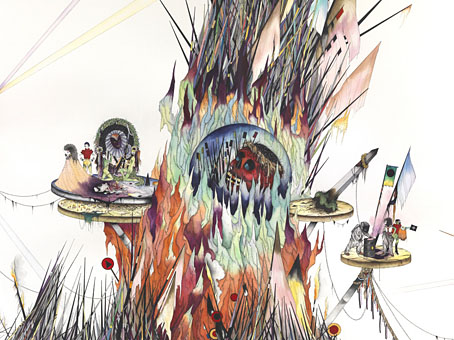
Untitled painting by Jen Ray.

• Lots of architecture links this week so it’s fitting that one of them is director Ben Wheatley talking to David Fear about his forthcoming film of JG Ballard’s High-Rise: “I was just thinking about this the other day, how hard it was to get a hold of stuff before the Internet. You really had to hunt down stuff or have someone who knew what was up to say, ‘You gotta read Naked Lunch, mate. You gotta read Crash.’ […] They were secretive things you had to ferret out, those books. It was the same with music and certain movies. And drugs.” Related: Souvenir d’un Futur, photographs by Laurent Kronental of the high-rise banlieues of Paris.

• “In Ancient Egypt, if a lowly official received the glyph of an owl from the Pharaoh, it was understood that the recipient should take his own life.” Carey McHugh in a brief history of the owl.

• I’d always thought the red buildings seen briefly in Blow-Up (1966) had been painted to Antonioni’s orders. Not so, says Another Nickel In The Machine.

He belongs right up there with Poe and Kafka. The best writer of weird fiction in the past half century. And the reason he belongs there is Ligotti’s both visceral and intellectual, formally experimental and able to tell a traditional horror story with equal ease. He’s also modernized the weird tale, from his early work on. The later workplace stories complete that process. The other thing he brings is a very dark sense of humor and a sense of the absurdity of the world—and a critique of that world that serves as subtext. All of these elements in harmony—symbiosis and contamination—equal genius. I read his work in a continuum that includes Kafka, Poe, Angela Carter, Bruno Schulz, Rikki Ducornet, and the great Caitlin R. Kiernan, but also absurdists and realists and flat-out surrealists. I appreciate that Ligotti stories can be revisited and reveal new dimensions.

Jeff VanderMeer on Thomas Ligotti

David Ferry talks to the people trying to excavate the remains of sets from Cecil B. DeMille’s first film of The Ten Commandments.

• As part of the ongoing vinyl reissue deluge, Crammed Discs are releasing a 10-disc box of albums by the great Tuxedomoon.

• At Strange Flowers: I see for it is night, remembering Marie Cermínová, better known as Surrealist artist Toyen.

Blue Sun Chiming, an animated video by Elisa Ambrogio for the song of that name by Six Organs of Admittance.

• At BLDGBLOG: Occult Infrastructure and the “Funerary Teleportation Grid” of Greater London.

• Enigmatic music makers Watch Repair are now selling their works at Bandcamp.

• Video by Harald Albrigtsen of whales basking under the Northern Lights.

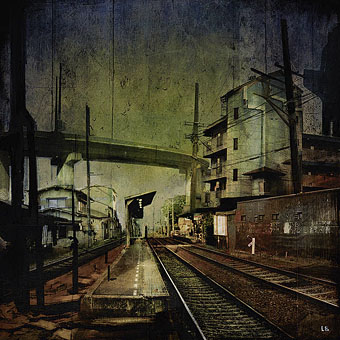
• The urban explorations of Russian photographer Ralph Mirebs.

• Mix of the week: Secret Thirteen Mix 164 by Discipula.

The lost rivers that lie beneath London

Egypt (1985) by Tuxedomoon | Whales Tails (1986) by Cocteau Twins | London’s Lost Rivers (1996) by Coil
Weekend links 278

sanmartin.jpg

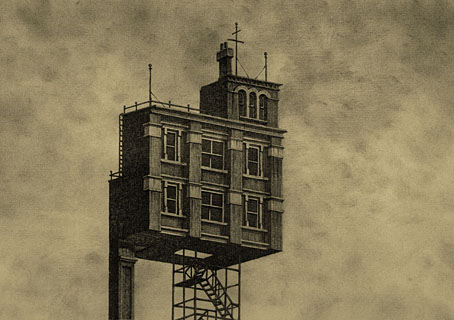
El Hotel Satina (2006) by Oscar Sanmartin.

Andrew Kötting’s By Our Selves is “a melancholy, maverick film” says David Jays. With Toby Jones following in the footsteps of poet John Clare, Iain Sinclair in a goat mask, and Alan Moore warning about the “vision sump” of Northampton.

• “Shunga means ‘spring pictures’. They depict sometimes spectacular sexual contortions and come imbued with the power of taboo. For years they have largely been out of sight—until now.” Related: shunga prints at Ukiyoe Gallery.

• “Who else could link Smokey Robinson and JG Ballard, Iggy Pop and Josephine Baker, James Bond and Stephen Sondheim, Gary Numan and Johnny Cash, Tricky and Tom Moulton…” Grace Jones is the best, says Joe Muggs.

Ballardian space – what he called “inner space” to differentiate it from the science fiction that concerned itself with distant planets and space rockets – is in fact a fusion of inner and outer space. There is no “out there” totally separate from his characters; just as there is no exclusively private, isolated inner life. His most psychologically fulfilled characters look to transcend their physical surroundings, however hostile, by embracing them.

Chris Hall on High-Rise by JG Ballard

• “In March 1984, Jorge Luis Borges began a series of radio ‘dialogues’ with the Argentinian poet and essayist Osvaldo Ferrari, which have now been translated into English for the first time.”

• “I came up with a couple of tunes, literally in my bedroom. People think of bedroom recordings as a modern, laptop invention. It wasn’t.” Daniel Miller on the accidental success of Mute Records.

• “It was in Prague that I first awoke.” Strange Flowers on Gustav Meyrink’s life in Prague.

• At 50 Watts: Stencilled ornament and illustration by William Addison Dwiggins.

• Mix of the week: The Ivy-Strangled Path Vol. X by David Colohan.

Wyrd Daze, Lvl2 Issue 4, is free and brimming with the weird.

Mythology, a new series of drawings by Howard Hardiman.

Spike Jones is the best, says MetaFilter.

Peacocks at National Geographic.

Warm Leatherette (1980) by Grace Jones | Warm Leatherette (1998) by Chicks On Speed | Warm Leatherette (2013) by Foetus

Weekend links 275

wessi.jpg

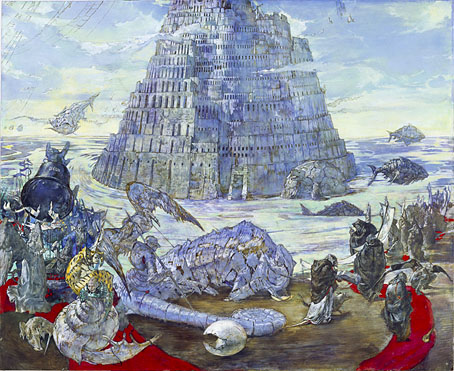
A painting from the Projekt Babelturm series by Wessi.

• “The first thing I would say is that I have no idea what authentic psych music is, and I have no wish to pursue that either. To me the idea of real psych is a paradox. I can’t see how you can have such a thing as real psychedelia when the whole thing is based on a psychedelic drug that gives you hallucinations and illusions and layers and layers of unreality.” Rob Chapman talking to Ben Graham about his new book, Psychedelia And Other Colours.

Elsewhere in a rather psychedelic week: Rob Young reviewed Chapman’s book for the New Statesman; Dangerous Minds posted “Hypnotic video of how a psychedelic masterpiece is made“; and in Germany a homeopathy conference “ended in chaos in Germany after dozens of delegates took a LSD-like drug and started suffering from hallucinations.”

• Coming soon from Dark Entries (so to speak), another collection of Patrick Cowley‘s music for gay porn films.

Jonathan Barnbrook works some quotes from JG Ballard into the British Road Sign Project.

• “Sorcery is more popular than football in Morocco,” says writer and filmmaker Abdellah Taïa.

• “If you’re going to make something, you should try and be wild,” says Mica Levi.

• Coca-Cola Milanese: Patrick Ellis considers the state of the world’s fair in 2015.

• Hear two pieces from Collapse, the forthcoming album by Drew McDowall.

• Mix of the week: Secret Thirteen Mix 162 by Ketev (Yair Elazar Glotman).

Emptyset’s Signal transforms Earth’s ionosphere into sound art.

Paul Laffoley: The Force Structure of the Mystical Experience.

• Fuck off, Star Wars, Ben Wheatley’s High Rise is on its way.

Ideologic Organ

Psychedelic Ride (1967) by The Ides | Psychedelic Warlords (Disappear In Smoke) (1974) by Hawkwind | Psychedelic Sewing Room (1989) by Bongwater

The Gable Window

gable.jpg

The Gable Window (1984) by John Coulthart.

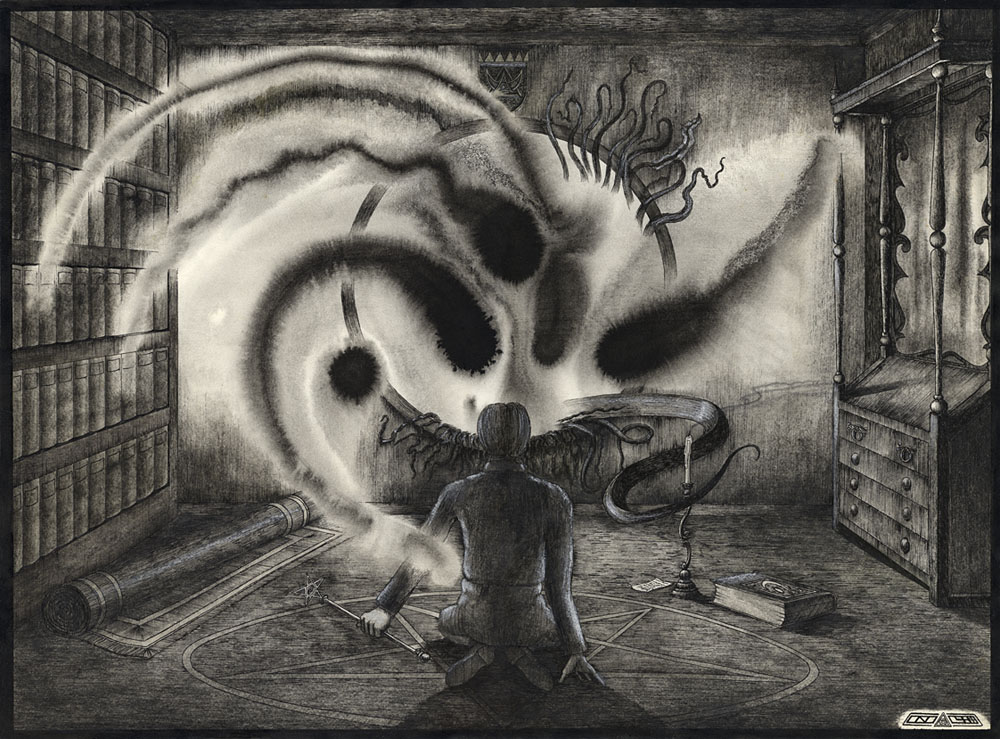
Presenting some of my first Lovecraftian illustrations, neither of which have been made public before. This drawing, and the one below, are as much Derlethian as they are Lovecraftian, depicting scenes from a short story and a short novel written by August Derleth from fragments and notes found in Lovecraft’s papers. The Gable Window was collected in The Survivor and Others (1957) which happens to be the only Lovecraft-related title I own in its original Arkham House printing. Derleth’s posthumous collaborations are often more Derleth than Lovecraft but I liked the central idea of The Gable Window which, like The Music of Erich Zann, concerns a window that also serves as a portal to other dimensions.

lurker.jpg

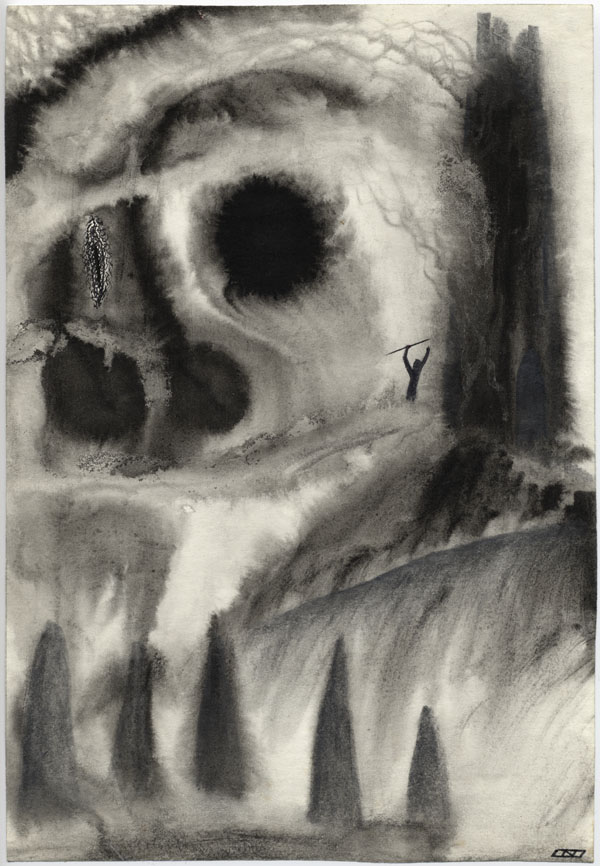
The Lurker at the Threshold (1982) by John Coulthart.

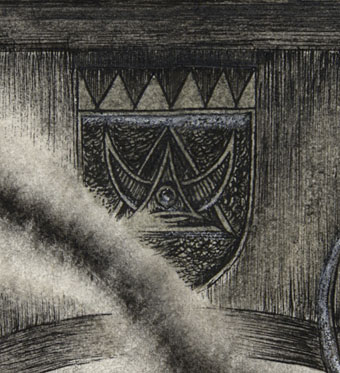
Before I began adapting The Haunter of the Dark in 1986 I hadn’t made much of an attempt to illustrate Lovecraft seriously. These drawings and a handful of other pieces were more like experimental sketches, although The Gable Window is obviously a very polished piece of work. Rather than depict anything overtly monstrous, each piece began as an arrangement of ink splotches and washes applied to cartridge paper soaked with water. The Lurker at the Threshold is one of several small pictures made with this technique in 1982, none of which are very successful. This one doesn’t look too bad but the best one, depicting the climax of The Dunwich Horror, I sent to the late Roger Dobson for possible use in an issue of Aklo, and haven’t seen it since. The Gable Window refined the technique by using fewer splotches and a more detailed drawing applied afterwards. I’ve never been happy with the figure, and the books on the left are lazily done, but it’s one of the better things I was doing in 1984. The biggest surprise looking at the drawing again was noticing the crest over the window which features a triangle/crescent motif that’s very similar to the one I designed a year later for Hawkwind’s Chronicle of the Black Sword album. This wasnt intentional.

gable-detail.jpg

Today The Gable Window seems like an indicator of where my head was at during this time. I was tired of doing Hawkwind-related things, and eager to immerse myself in something different; a series of Ballard illustrations was one potential way forward, Lovecraft was another. A year later I’d made a decision and, as it were, stepped through the window.

Elsewhere on { feuilleton }
The Lovecraft archive

Weekend links 252

brizzi.jpg

Waiting by Liz Brizzi.

• “Music, politics, sex, and art were also widely represented by Evergreen. Gerald Ford famously maligned the magazine on the floor of Congress for printing the likeness of Richard Nixon next to a nude photo.” Jonathon Sturgeon on the return of an avant-garde institution.

• “The hallucinogenic properties of language are widely recognized by all repressive societies…which treat words like other tightly controlled substances.” Askold Melnyczuk reviews Where the Bird Sings Best, a novel by Alejandro Jodorowsky.

• Mixes of the week: A Mix For Thomas Carnacki by Jon Brooks whose Music for Thomas Carnacki has been reissued on vinyl; Solid Steel Radio Show 27/3/2015 by DJ Food.

One of the few vice-friendly cities left in the US, New Orleans remains his spiritual home, or whatever the atheist equivalent is. Waters’ supposed favourite bar in the world is here in the historic French Quarter. The Corner Pocket is a gay dive bar with tattooed strippers—filthy in exactly the way Waters likes.

“Trash and camp just don’t cut it any more,” he told a rapt audience at his interview panel on Friday. “Filth still has a punch to it. The right kind of people understand it and it frightens away the timid.”

John Waters growing older disgracefully

Songs of a Dead Dreamer and Grimscribe by Thomas Ligotti are being republished in a single edition by Penguin. Jeff VanderMeer wrote the foreword.

• “The film is brimming with Bacchanalian revelry, arcane mystery and mortal dread.” Robert Bright on The Saragossa Manuscript by Wojciech Has.

Alistair Livingston has posted page scans from When Darkness Dawns, volume two of his zine from the early 80s, The Encyclopedia of Ecstasy.

• “Without first understanding the flâneur we cannot understand the development of arcades,” says Aaron Coté.

• At A Journey Round My Skull: Jo Daemen cover designs; at 50 Watts: the art of Manuel Bujados.

• Vast spacecraft and megastructures: Jeff Love on the science-fiction art of Chris Foss.

• At Dangerous Minds: RE/Search’s Vale on JG Ballard and William Burroughs.

• RIP John Renbourn

Pentangling (1968) by Pentangle | Lyke-Wake Dirge (1969) by Pentangle | Lord Franklin (1970) by Pentangle