Weekend links 611

ltpf.jpg

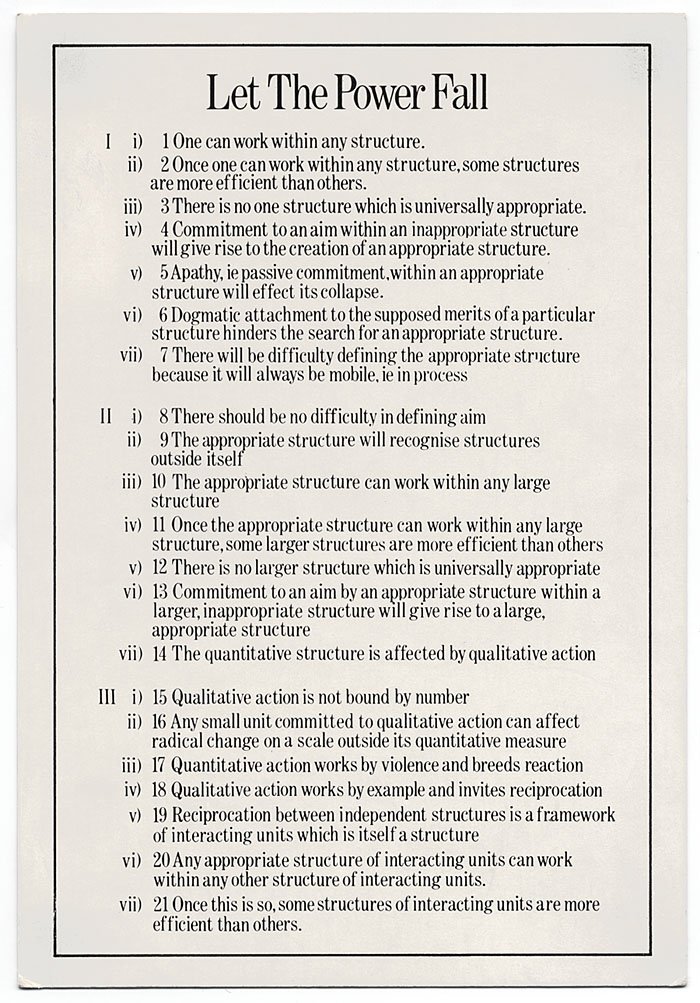
Let The Power Fall (1981) by Robert Fripp. A postcard included with the original vinyl release of the Let The Power Fall album.

Exposures 1977–1983 is the title of another wallet-busting CD/DVD/blu-ray box which will be released by DGM at the end of May. Unlike the previous King Crimson sets this one will be devoted to Robert Fripp’s first run of solo releases, covering the albums that emerged from the artistic campaign he described at the time as “The Drive to 1981”: Exposure (1979), God Save The Queen/Under Heavy Manners (1980), The League Of Gentlemen (1981), and Let The Power Fall (1981). If you’re as interested as I am in this period of Fripp’s career then this is all very exciting. Exposure has been reissued several times over the years, and exists in three different “editions” featuring alternate mixes and song variations, but the other albums have been unavailable in any form for decades, possibly as a result of the turmoil caused by the mismanagement and eventual collapse of the EG label. In addition to the reissues the box will include live recordings, a League Of Gentlemen Peel session plus a substantial quantity of Frippertronics material, including the loops that were recorded for Eno & Byrne’s My Life In The Bush Of Ghosts. Fripp retained a credit for his contribution to Regiment but the results are so far down in the mix that they’re easy to miss. Related: The Drive to 1981: Robert Fripp’s Art-Rock Classic Exposure.

• Galerie Georges-Philippe & Nathalie Valloisin, Paris, is currently creeping out visitors to Strange Aeons—We will meet you there, an exhibition by Peybak (Peyman Barabadi and Babak Alebrahim Dehkordi) that borrows its title from HP Lovecraft and includes a number of creatures, “neither embryos nor chimeras”, which may be found prostrate and breathing on the gallery floor.

• New music: Sub Zero, in which Kevin Richard Martin returns to the subterranean/subaqueous/subarctic zones he charted on his Isolationism and Driftworks compilations in the 1990s; plus The Carrier by Large Plants, an album of “psych rock belters” coming soon on the Ghost Box label.

• Science fiction as revolution: Joe Banks talks to Iain McIntyre, co-editor of Dangerous Visions and New Worlds—Radical Science Fiction, 1950–1985, about the flourishing of the New Wave of SF in the 1960s and 70s.

• “We know from his letters that Joyce sent a Greek flag to Nutting for him to colour-match. So, he was aiming for ‘Greek’ blue.” It’s that book again. Cleo Hanaway-Oakley on Ulysses, blindness and blue.

• Intermittent Eyeball Fodder: More visual delights gathered by S. Elizabeth.

• Steven Heller’s font of the month is Nicholas.

• Galerie Dennis Cooper presents…Liz Larner.

Let The Power Fall (1971) by Max Romeo | Minor Man (1981) by The League Of Gentlemen ft. Danielle Dax | Heptaparapashinokh (1981) by The League Of Gentlemen
Weekend links 603

weird.jpg

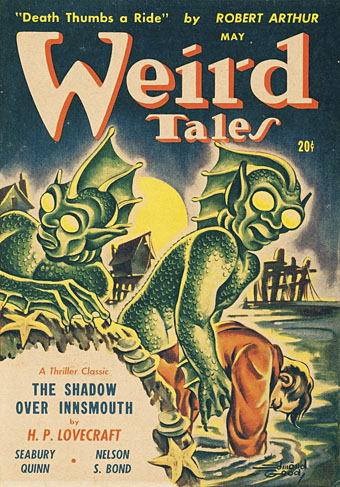
Weird Tales (Canada), May 1942. Cover art by Edmond Good.

• “…in 1968, seven years after the MOMA retrospective, Orson Welles appreciatively got in touch and suggested that Bogdanovich do a book-length set of interviews with him like the one that Bogdanovich had just done with Ford. The resulting book, This Is Orson Welles (which took a winding path to publication, in 1992, seven years after Welles’s death), is a classic of the literature of movies.” Richard Brody on the late Peter Bogdanovich. The book of Welles interviews is one of my favourite film books, as good in its way as Hitchcock/Truffaut, and like Truffaut’s book you wish it was twice as long.

• At Public Domain Review: Paloma Ruiz and Hunter Dukes on Johann Caspar Lavater’s frog-to-human physiognomies. If you reverse the sequence, as I did for one of the illustrations in Lovecraft’s Monsters, you approach The Shadow Over Innsmouth.

• The week in virtual exploration (via MetaFilter): Mini Tokyo 3D and Explore the Soane Museum, London.

• Submissions are open for the 16th issue of Dada journal Maintenant which will have the theme “Nyet Zero”.

• At Spoon & Tamago: Artists and artisans collaborate on exhibition of 144 maekake aprons.

• DJ Food unearths flyers and posters for the Million Volt Light & Sound Rave, 1967.

• Mix of the week: Isolatedmix 116 by Chris SSG.

• At Dennis Cooper’s: Stephen Dwoskin Day.

The Little Blue Frog (1970) by Miles Davis | Jail-House Frog (1972) by Amon Düül II | Tree Frog (1995) by Facil

Ray Harryhausen’s swords and sorceries

golden1.jpg

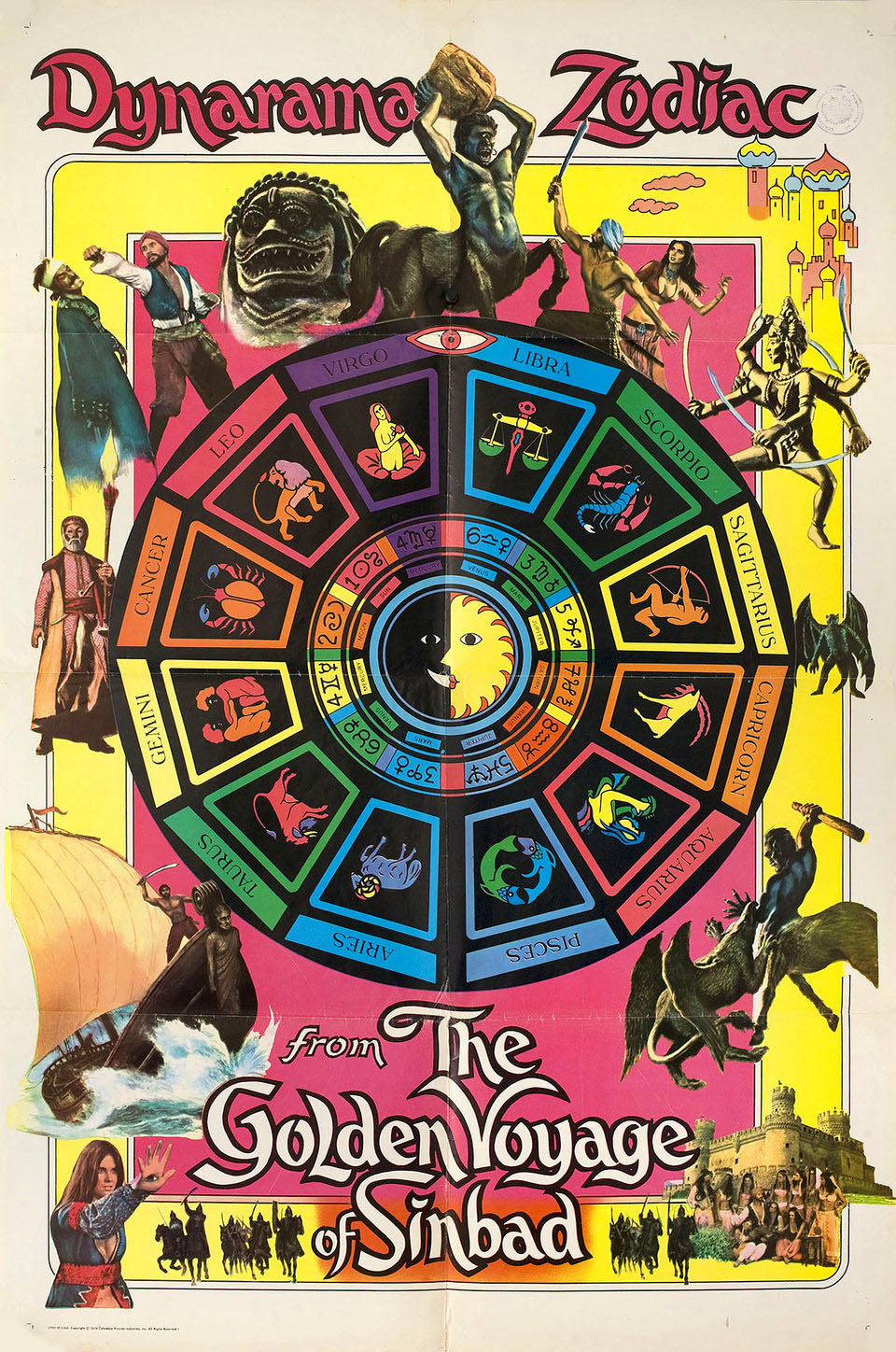
It was the 1970s: promoting Sinbad with a Zodiac poster for the blacklight brigade.

Last month I took advantage of the recent Indicator sale to buy blu-rays of a couple of favourite Ray Harryhausen films, together with Indicator’s reissued box of the three Harryhausen Sinbad features: The 7th Voyage of Sinbad (1958), The Golden Voyage of Sinbad (1973), and Sinbad and the Eye of the Tiger (1977). I’m very familiar with these films but hadn’t seen them for many years. Watching them again made me realise for the first time what perfect examples they are of sword-and-sorcery cinema even though you never see them classed as such. I’ve been reading sword-and-sorcery fiction for almost as long as I’ve been watching Ray Harryhausen films but this rather obvious insight hadn’t occurred to me before, no doubt because I’d always regarded the Sinbad cycle as Arabian Nights fantasies in the manner of The Thief of Bagdad. The 1940 version of the latter happened to be a Harryhausen favourite which prompted his decision to film an Arabian adventure following his monster-on-the-rampage pictures of the 1950s. He subsequently asked The Thief of Bagdad‘s composer, Miklós Rózsa, to score The Golden Voyage when Bernard Herrmann was unable to do so.

seventh.jpg

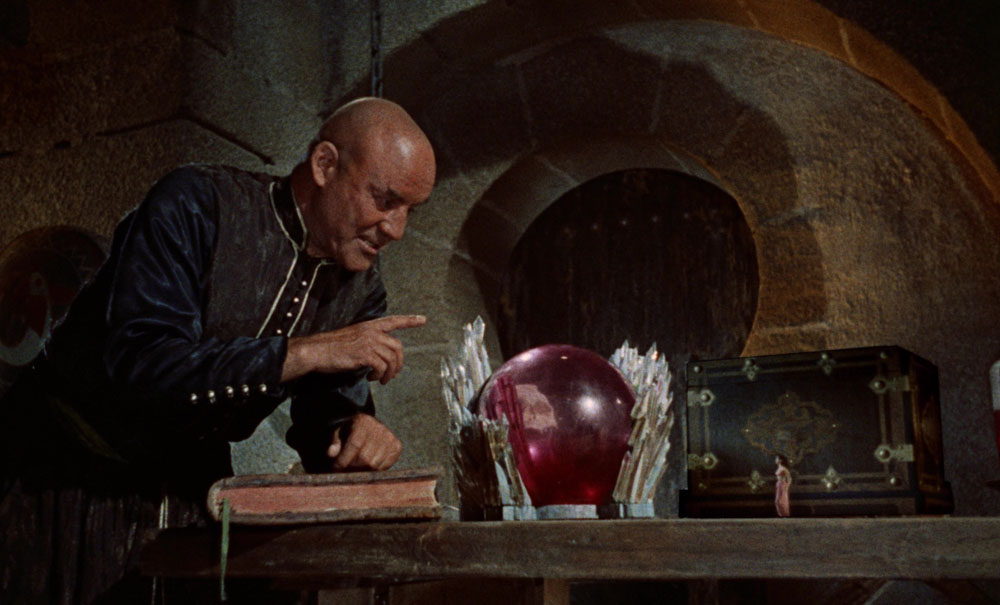
Sokurah (Torin Thatcher) with a shrunken Princess Parisa (Kathryn Grant).

The 7th Voyage is at least based on the original Sinbad tales but the second and third films have little to do with The Arabian Nights beyond Sinbad’s persona and a handful of cultural references. If you swapped the Arabian names for invented ones then you’d be even closer to the stories of Clark Ashton Smith and his colleagues at Weird Tales than the films already are. Smith’s sorcery-infused fiction is the key here even though his stories are light on sword-play. The sight of a shaven-headed Torin Thatcher as Sokurah, the duplicitous magician in The 7th Voyage, was so strongly reminiscent of one of Smith’s many sorcerers—he even looks a little like Virgil Finlay’s depiction of Dwerulas from The Garden of Adompha—that I couldn’t help but watch the films this time as though they were adaptations of Smith’s fantasies. In The 7th Voyage the similarity is most evident in the scene where Sokurah demonstrates his powers to the caliph by temporarily turning a handmaiden into a serpent-woman, and the later scenes in Sokurah’s underground fortress. Smith and his cohorts in the pulp magazines were of course refashioning elements from The Arabian Nights and from other legends so none of this should be surprising. The 7th Voyage may take some of its scenes from The Arabian Nights but the story establishes the template which the sequels follow, with Sinbad pitted against a magic-wielding adversary.

Continue reading “Ray Harryhausen’s swords and sorceries”

Resurrecting R’lyeh

rlyeh-2021.jpg

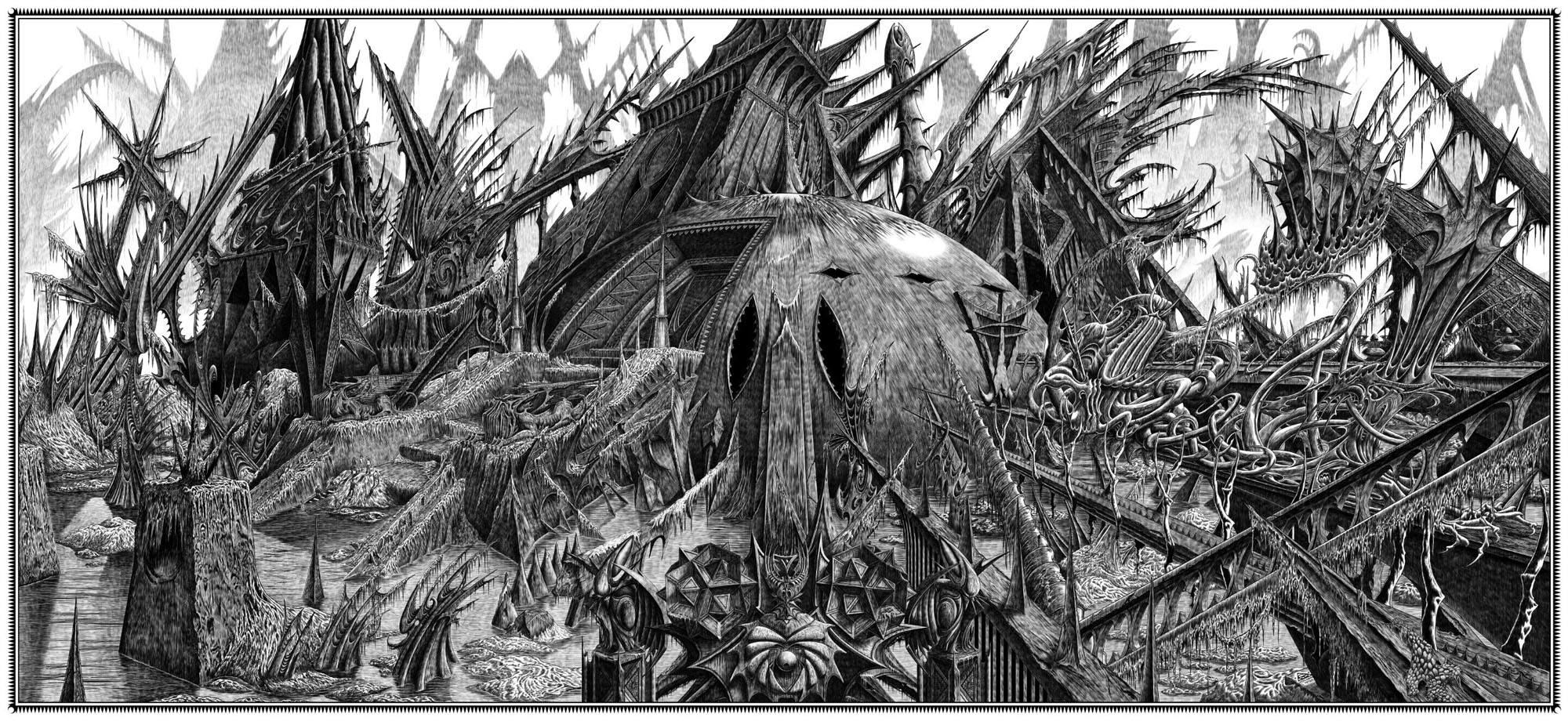
Then, driven ahead by curiosity in their captured yacht under Johansen’s command, the men sight a great stone pillar sticking out of the sea, and in S. Latitude 47°9′, W. Longitude 126°43′, come upon a coastline of mingled mud, ooze, and weedy Cyclopean masonry which can be nothing less than the tangible substance of earth’s supreme terror—the nightmare corpse-city of R’lyeh, that was built in measureless aeons behind history by the vast, loathsome shapes that seeped down from the dark stars. There lay great Cthulhu and his hordes, hidden in green slimy vaults and sending out at last, after cycles incalculable, the thoughts that spread fear to the dreams of the sensitive and called imperiously to the faithful to come on a pilgrimage of liberation and restoration.

HP Lovecraft, The Call of Cthulhu (1928)

Behold the fruits of a more benevolent pilgrimage of liberation and restoration. It was just over a year ago that I decided to draw an exact replica of the R’lyeh triple-spread from my comic-strip adaptation of The Call of Cthulhu, the intention being to make the picture available as a poster-sized print once I had a print-ordering system in place. The picture may now be purchased here as a giclée print on Hahnemüle Pearl art paper. This is a big picture (870.46 x 401.15 mm or 34.27 x 15.793 ins), and unlike my other Etsy prints I’m afraid there won’t be a half-size version which means the price will remain relatively high. I’m also keeping it as a black-and-white piece despite the temptation to create a tinted version.

And so to the obvious question: why did I want to redraw a large and very detailed piece of art in the first place? Pull up a weed-festooned Cyclopean bollard and I’ll explain…

starrywisdom.jpg

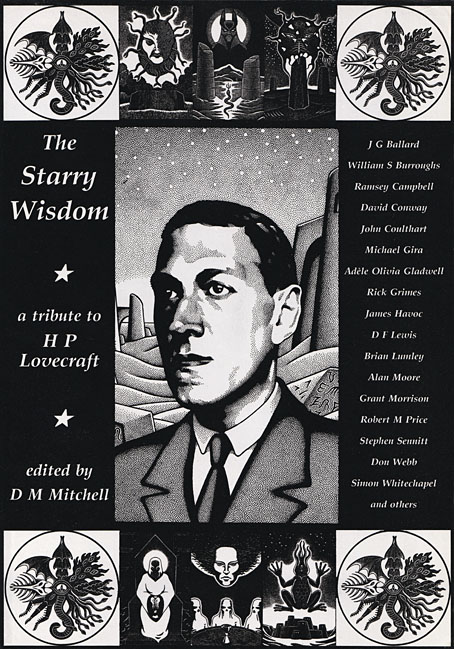
Creation Books, 1994. Cover art by Peter Smith.

I spent 17 months drawing The Call of Cthulhu, from January 1987 to May 1988, using my preferred media of the time, a 0.2 mm Rotring Variant pen on A3 sheets of Daler cartridge paper. The story took its time getting into print but it was eventually published in 1994 by Creation Books as part of The Starry Wisdom, a collection of Lovecraftian fiction edited by DM Mitchell. I was very pleased to be represented in the book but the pleasure turned to dismay when it transpired that all the artwork had vanished after the printing was done. Or almost all the artwork… To this day I don’t know whether the drawings by other artists suffered the same fate, but my Cthulhu pages disappeared along with the anatomical cross-section and the Yuggoth collage that I created specially for the collection. I still don’t know what really happened either, whether the drawings were stolen (possible), thrown away deliberately (unlikely), or thrown away accidentally (also possible). The lack of resolution to the whole business is partly my fault. Losing all that art was a painful thing to consider, and I couldn’t accuse the printer of anything when nobody could say what had happened (I was in the Creation office during one of the phone conversations between publisher and printer). The printer was also located in the middle of a rural county somewhere so journeying there would have been difficult for this non-driver, as well as being pointless if they could only tell me what I knew already. Time passed and I did my best to put the whole episode behind me.

pens.jpg

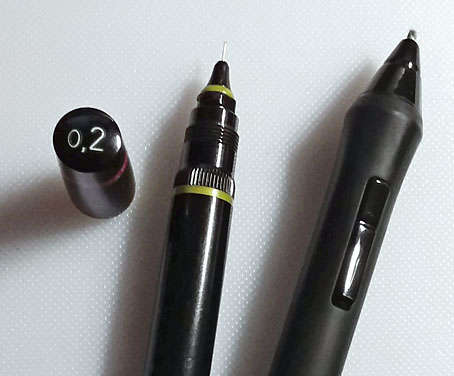
Drawing technology then and now: the Variant pen I used throughout the 1980s and the Wacom stylus I use today. That Variant nib is so fine that I have a faint ink dot tattooed on one of my knuckles from where I accidentally stabbed it into my hand. The Wacom pen looks stubby in comparison but is capable of drawing equally fine lines and much more besides.

On the plus side (there was one), the printer had done a good job of half-toning the artwork, so even though the Starry Wisdom pages are rather small the detail in the drawings is still evident. And I also had a complete set of photocopies of the A3-sized originals. I’d been working for Savoy Books since 1989 during which time making photocopies of new drawings had become second nature. Since 1994 this set of copies has become the original art for the Call of Cthulhu strip, rather like the surviving prints of Murnau’s Nosferatu which are all that anyone can see of his film today. The analogy is an apt one since it also extends to picture quality. Just as silent films always look their best when they’ve been restored from the camera negative, my Rotring drawings really need to be reproduced from the originals. The 0.2 mm pen that I insisted on using throughout the 1980s was too fine for the photocopy machines of the time, especially when my shading was so densely rendered that I might as well have been using a pencil. This isn’t so much of a problem if the pages are being reduced in size but it became one last year when I had the idea of making a print of the R’lyeh panorama that would be the same size as the original drawings. Giclée printing is an ink-jet process that reproduces fine detail with great accuracy, so while I could make full-size prints of the Cthulhu pages they’d never look better than what they were, photocopies that hadn’t fully captured the fine lines of the drawings. This wasn’t the only problem.

Continue reading “Resurrecting R’lyeh”

T-shirts by Skull Print

skullprint-dotu.jpg

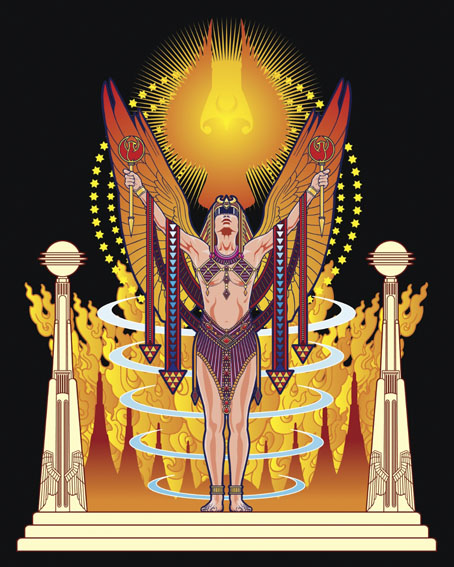
I’m very pleased to announce that I’ve partnered with T-shirt printers Skull Print to make shirts available featuring my artwork. See this standalone page for details. Skull Print are a small business based in the UK who specialise in music-related merchandise. Joe Banks pointed me in their direction when he was wondering if I’d considered doing a shirt design based on the cover of his Hawkwind book, Days of the Underground. To thank Joe for this, the first shirt is an adaptation of his cover design, which is followed by a very old piece of cover art for the Zones album by Hawkwind. Skull Print cater to a substantial Hawkwind fanbase so it makes sense to make this one available. And since we’re now in the horror month, I’ve added a couple of recent Lovecraft-related designs which have been tailored specially for this purpose.

skullprint-monsters.jpg

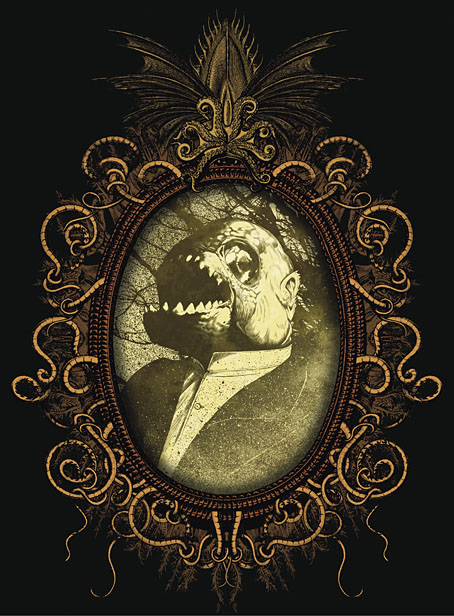
A design based on my cover for Lovecraft’s Monsters, an excellent story collection edited by Ellen Datlow.

I should emphasise that these aren’t the only shirt designs available. Skull Print operate on a print-on-demand basis so in theory any artwork of mine may be printed as a shirt if someone makes a request for one. (With a couple of exceptions; a few designs are subject to copyright restrictions.) The advantage that Skull Print have over other services such as CafePress is that I don’t have to spend time uploading the artwork to a website then creating a special sales page for it. Anyone who wants a shirt can now send me a request for one then I send the artwork to Skull Press and they’ll take care of everything else.

joyce.jpg

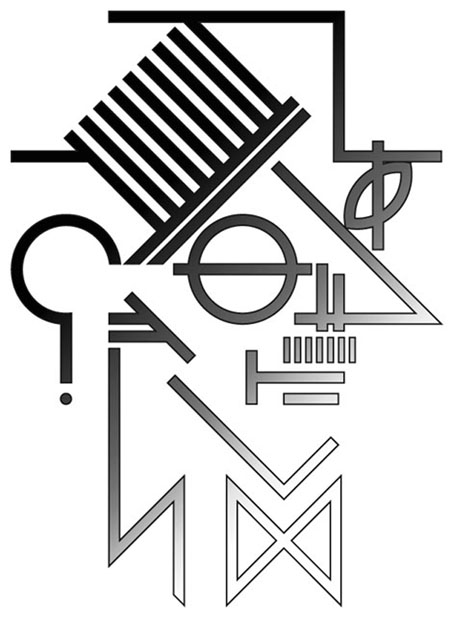
I’ll be setting up a few more designs with PayPal buttons when I have a spare moment. Some designs have been surprisingly persistent sellers at CafePress, such as my ideogrammatic portrait of James Joyce which is often ordered in the run-up to Bloomsday. A few years ago a shirt bearing this design was ordered by one “M. Atwood” of Halifax, Nova Scotia. I’ve been hoping ever since that the M. Atwood who everyone knows as a writer might turn up somewhere dressed in this item. If anyone sees a photo like this then please let me know!

Previously on { feuilleton }
Hawkwind: Days of the Underground
The Chronicle of the Cursed Sleeve
Rock shirts
Void City