Raffles, the gentleman thief

raffles1.jpg

The Raffles that concerns us here is the television incarnation as seen in a series of adventures made by Yorkshire TV in 1977. I recently bought a cheap DVD set of the series, not for reasons of nostalgia (a wretched condition) but out of curiosity and whim. I had a vague recollection of enjoying the few episodes I’d seen, and was hoping for another decent Victorian adventure series along the lines of The Rivals of Sherlock Holmes (1971/1973). Raffles proved to be better than I expected; not quite up to the standards of Granada TV’s peerless adaptations of the Sherlock Holmes stories but thoroughly enjoyable. The production values are better than those in The Rivals of Sherlock Holmes, a well-written series with an impressive cast that was nevertheless compromised by a restricted budget. I’m not really reviewing the Raffles series here, this piece is intended to note a couple of points of interest which, for me, added to its pleasures.

raffles2.jpg

Raffles and Bunny as they were originally. An illustration by FC Yohn from Raffles: Further Adventures of the Amateur Cracksman (1901).

Arthur J. Raffles was invented by EW Hornung, a writer who was, among other things, Arthur Conan Doyle’s brother-in-law. Raffles, like Sherlock Holmes, is a resolute bachelor with a devoted friend and accomplice, but the two men share few other characteristics beyond a talent for outwitting the dogged inhabitants of Scotland Yard. Raffles’ indulgent lifestyle in the bachelor enclave of (the) Albany, Piccadilly, is financed by his burglaries which invariably target aristocrats and the homes of the wealthy. To the general public he’s known as one of the nation’s leading cricket players, a position which gives him access to upper-class social circles from which he would otherwise by excluded. His former school-friend, “Bunny” Manders, is also his partner-in-crime, a position that Bunny is happy to fill after Raffles saves him from bankruptcy and suicide. Conan Doyle disapproved of the immoral nature of the Raffles stories but they were very popular in their day, and they’ve been revived in a number of adaptations for film, TV and radio. George Orwell admired the stories, and writes about them with his usual perceptiveness here, noting the importance of cricket to Raffles’ gentlemanly philosophy of criminal behaviour. I’ve not read any of the stories myself, and I’m not sure that I want now, not when the television adaptations succeed so well on their own terms.

raffles3.jpg

Anthony Valentine and Christopher Strauli.

The TV series was preceded by a pilot episode made in 1975 which saw the first appearances of Anthony Valentine as the dashing Raffles and Christopher Strauli as the fresh-faced Bunny. Valentine and Strauli fit their roles so well it’s difficult to imagine anyone else improving on them, Valentine especially. In the series the pair are supported by many familiar faces from British drama: Graham Crowden, Charles Dance, Brian Glover, Robert Hardy, Alfred Marks, and, in a rare piece of TV acting, Bruce Robinson. Pilot and series were all written by Philip Mackie, and here we have the first noteworthy element since Mackie had earlier adapted six stories for The Rivals of Sherlock Holmes, including the one that features Donald Pleasence as William Hope Hodgson’s occult detective, Thomas Carnacki. Raffles is another rival of Sherlock Holmes, of course, albeit a criminal one, and much more of a mirror image of Holmes than the thoroughly villainous Professor Moriarty. Raffles only breaks the law to improve his bank balance, or as an occasional, daring challenge; he regards theft and evasion from the police as a form of sport, and generally deplores other types of crime. Some of his thefts are intended to punish the victim following an infraction, as with the belligerent South African diamond miner who causes a scene at Raffles’ club, and the Home Secretary who makes a speech in Parliament demanding stiffer penalties for burglary. In one conversation about the morality of their activities Bunny suggests to Raffles that his friend is a kind of Robin Hood figure; Raffles agrees before admitting that he never gives his spoils to the poor.
Continue reading “Raffles, the gentleman thief”

Zen-Gun and The Zen Gun

zen1.jpg

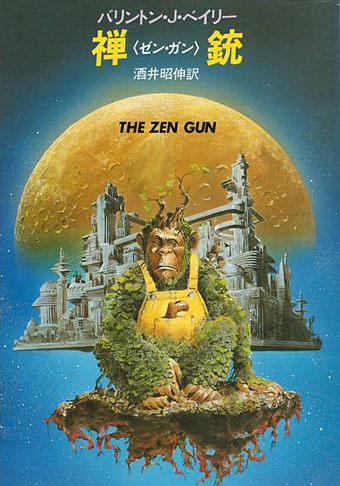
Japanese edition, 1984. Cover artist unknown.

At last, kosho Hako Ikematsu permitted himself to exult, at last he held the zen gun in his hands.

Zen in the art of electronics…

He knew its age: more than three Earth centuries. He knew its provenance: the zen master who made it had been a member of the order from which his own had originally sprung. The external appearance of the gun was a testament to certain cultural concepts: it seemed improvised, unfinished, crude, yet in its lack of polish was a feeling of supreme skill…in the Nipponese language of the time it had wabi, the quality of artless simplicity, the rustic quality of leaves strewn on a path, of a gate mended roughly with a nailed-on piece of wood and yet whose repair was a quiet triumph of adequacy and conscious balance. It had shibusa, the merit of imperfection. Only incompleteness could express the infinite, could convey the essence of reality. Hence, the unvarnished wood bore the marks of the carver’s chisel…

These qualities were themselves but superficial excrescences of the principles on which the gun acted, principles so abstruse in character that one dictum alone succeeded in hinting at them: Nothing moves. Where would it go? Pout the chimera had succeeded in using the gun as an electric beam to hurt or kill, without regard to location. But that was the most trivial of its capabilities. Only a kosho could unlock its real, dreadful purpose…

I read a novel recently that was unapologetic space opera. This isn’t something I do very often. Ryuichi Sakamoto is to blame, strange as this may seem, as a result of my spending a day or two listening to my old Sakamoto CDs. One of these, Illustrated Musical Encyclopedia, contains a short instrumental titled Zen-Gun, a piece which almost shares a title with the space opera in question, The Zen Gun by Barrington J. Bayley. I bought the Sakamoto disc in 1990, and I’ve known about the novel, which was published in 1983, for almost as long as I’ve been listening to the album. Every now and then I’ve wondered whether the two works might be connected, or at least whether Sakamoto borrowed Bayley’s title, but I’d never considered reading the novel until now.

zen2.jpg

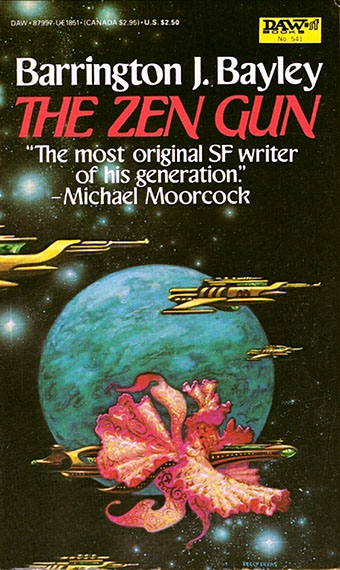
US edition, 1983. Cover art by Kelly Freas.

Barrington Bayley (1937–2008) is a writer whose works I’d mostly avoided while he was alive. This despite the continual praise he received from Michael Moorcock, and the acknowledgement by William Burroughs in Nova Express for an idea borrowed from a Bayley story with a Burroughs-like title, The Star Virus. (Samples of Burroughs’ voice happen to turn up on an album that Ryuichi Sakamoto recorded after Illustrated Musical Encyclopedia, the Bill Laswell-produced Neo Geo. Make of this what you will.) Bayley was the odd man out among the British writers of science fiction’s New Wave for persevering with hard SF, a sub-genre I don’t enjoy reading very much unless it’s by a trustworthy writer. All genres have their share of bad writers but science fiction, especially the variety concerned with space-faring and futuristic technology, has historically been home to more than most. I already knew that Bayley could write a decent story—he appeared regularly in the pages of New Worlds magazine—but I feel I’ve been doing him a disservice by ignoring his novels for so long.

The thing that really pushed me towards The Zen Gun was reading the Wikipedia entry for the novel which includes the following praise from Bruce Sterling:

Yet Bayley’s elemental energy, his mastery of the sense of wonder, cannot be denied. His work is the very antithesis of tired hackdom. To invent an entire self-consistent cosmology and physics for a $2.50 DAW paperback…is one of those noble acts of selfless altruism that keep SF alive.

Then there’s this comment about the mysterious Zen Gun itself, a piece of wood carved into the shape of a pistol which is capable of destroying entire suns: “Powerful as the weapon is, its existence is a paradox, as only those who have attained inner peace can use it.” After reading this I knew I had to read the novel.

Continue reading “Zen-Gun and The Zen Gun”

The Fame and Shame of Salvador Dalí

fasosd1.jpg

…one ought to be able to hold in one’s head simultaneously the two facts that Dalí is a good draughtsman and a disgusting human being.

George Orwell

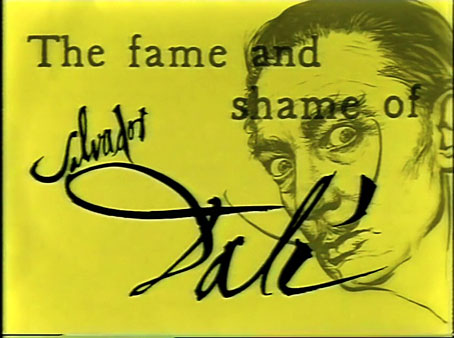
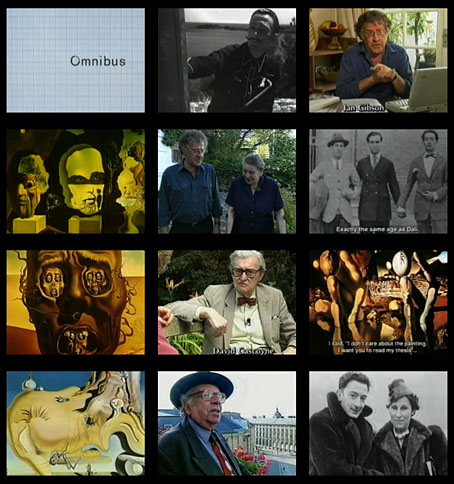
This two-part, two-hour TV documentary from 1997 has a title that makes it sound like more of an exercise in audience pandering than was typical for the BBC’s Omnibus arts strand, fame and shame being qualities that might be considered of greater interest for the general viewer than art history. But Michael Dibb’s film is more insightful than those made 20 years earlier when access to the Dalí circle, and to Dalí himself, required flattery and capitulation to the artist’s whims and attention-grabbing antics. In place of the impersonal approach taken by the BBC’s Arena documentary from 1986 we have writer Ian Gibson serving as a guide to Dalí’s life while conducting research into a major biography, La vida desaforada de Salvador Dalí (The Shameful Life of Salvador Dalí), which was published a year later. “Shame” here refers more to Dalí’s numerous fears and phobias, especially those of the sexual variety, rather than to scandal and public opprobrium, while “Shameful Life” echoes the “Secret Life” title of the artist’s autobiography. Dalí’s sexual neuroses were always to the fore in his art but they remained concealed in his personal life, although the evasions—his frequent declarations of impotence, for example—don’t prevent Gibson from speculating. I saw this documentary when it was first broadcast but had forgotten the discussions of a possible homosexual relationship with Dalí’s adoring friend, Federico García Lorca, as well as the mention of the artist’s voyeurism, all of which was explored in more detail (and with some personal experience) by Brian Sewell a decade later in the TV documentary with the most prurient title of them all, Dirty Dalí: A Private View.

fasosd2.jpg

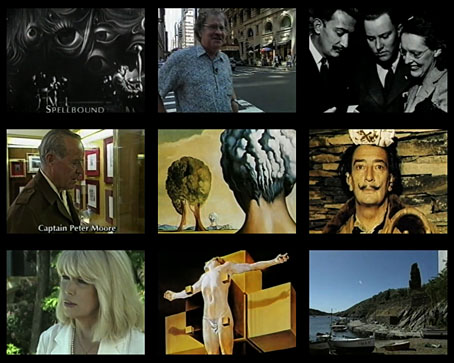
Gibson is a guide with the advantage of being a fluent Spanish speaker able to engage in conversation with those who knew or worked for the artist. Several of the interviewees are familiar faces in Dalí films: Amanda Lear, art collectors Reynolds and Ellen Morse, Dalí’s first secretary and business manager, Captain Peter Moore, and painter Antoni Pitxot. 1997 was about the last time it was possible to make a documentary about Dalí that might feature interviews with people who knew the artist in his younger days, although José “Pépin” Bello, born the same year as Dalí in 1904, lived on until 2008. Bello was the sole surviving member of a Madrid student group in the 1920s whose other members were Dalí, Luis Buñuel and Federico García Lorca. He also turns up in The Life and Times of Don Luis Buñuel (1984), another BBC film which really ought to be on YouTube, where he makes unsubstantiated claims about having contributed ideas to Un Chien Andalou. It’s easy to be sceptical about the assertions of an uncreative man whose youth had been spent in the company of three great talents but according to this obituary both Dalí and Buñuel confirmed the claims. (The image of a rotting donkey, however, had appeared in Dalí’s paintings before the film was made.)

fasosd3.jpg

Among the other people talking to Gibson are Surrealist poet David Gascoyne, and also George Melly, a man who for a long time was a ubiquitous presence whenever Surrealism was being discussed on British TV. The interviews are separated by clips from other films, two of which have featured in earlier posts: Hello Dalí! (which I keep hoping someone will upload to YouTube in better quality), and Jack Bond’s film of Dalí in New York in 1965. I watched both these again last year when I followed my viewing of the Švankmajer oeuvre with a number of Surrealist documentaries. Jack Bond’s film is especially good for its verité qualities, and for Jane Arden’s attempts to persuade Dalí to talk seriously for once about his art.

The Fame and Shame of Salvador Dalí: Part One | Part Two

Previously on { feuilleton }
Figures of Mortality: Lawrence versus Dalí
Être Dieu: Dalí versus Wakhévitch
Chance encounters on the dissecting table
Salvador Dalí’s Maze
Dalí in New York
Dalí’s discography
Soft Self-Portrait of Salvador Dalí
Mongolian impressions
Hello Dalí!
Dirty Dalí
Impressions de la Haute Mongolie revisited

Weekend links 535

beardsley.jpg

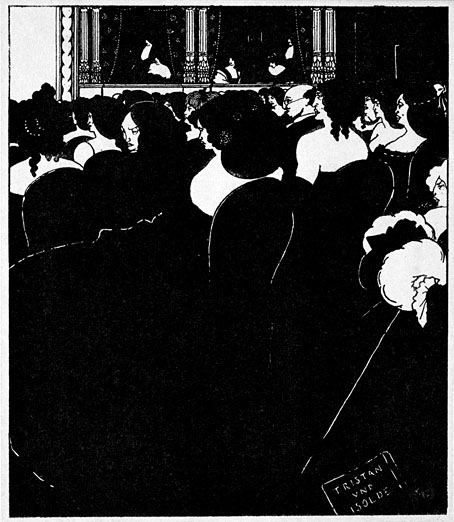
The Wagnerites (1894) by Aubrey Beardsley.

• “Part of my problem with influence is that the concept is too univocal; most of us are impacted by many others during our lifetimes, but often in oblique ways. So many of the most interesting bits of cultural transmission happen nonlinearly, via large groups of people, and in zigzag mutations. Assigning influence can also have the unintentional effect of stripping artists of their own originality and vision.” Geeta Dayal reviewing Wagnerism by Alex Ross.

• “Buñuel stubbornly refused to have any group affiliation whatsoever. Even though critics always tried to categorize him, he never wanted to explain the hidden meanings of any of his films and often denied that there were any.” Matt Hanson on the surreal banality of Luis Buñuel’s The Exterminating Angel.

• Next month Soul Jazz release the fourth multi-disc compilation in their Deutsche Elektronische Musik series devoted to German music from the 1970s and 80s. The third collection was the weakest of the lot so I wasn’t expecting another but this one looks like it may be better.

James Balmont chooses the five best films by Kiyoshi Kurosawa, who he calls “cinema’s master of horror”. I’ve yet to see any of these so I can’t say whether the label is warranted or not.

• At Wormwoodiana: Mark Valentine in a two-part post here and here charts the emergence of an under-examined sub-genre, the metaphysical thriller.

• Power Spots: 13 artists choose favourite pieces of music by Jon Hassell. A surprising amount of interest in his first album, Vernal Equinox.

• At Spine: George Orwell’s Animal Farm receives new cover designs for its 75th anniversary.

• “Pierre Guyotat’s work is more relevant now than ever,” says Donatien Grau.

• Mix of the week: FACT mix 775 by Sarah Davachi.

May 24th by Matthew Cardinal.

• Ry Cooder with Jon Hassell & Jim Keltner: Video Drive-By (1993) | Goose And Lucky (1993) | Totally Boxed In (1993)

Weekend links 469

X.jpg

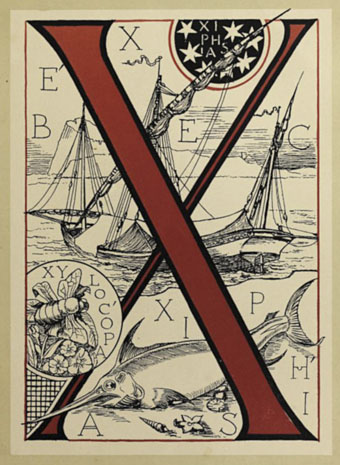
X from Theodore Howard’s ABC (1880) by Theodore Howard.

• “[Parade] has everything: joy and sadness, get-down and wistfulness, mourning and melancholia, group funk and Debussy interludes, echoes of Ellington, Joni, film music, chanson. It’s a perfectly realised whole.” Ian Penman on the enigmas and pleasures of Prince.

• “Mescaline reads like the culmination of a lifetime’s wanderings in the very farthest outposts of scientific and medical history.” Ian Sansom review’s Mike Jay’s history of the psychedelic alkaloid.

• The Day the Music Burned by Jody Rosen: “It was the biggest disaster in the history of the music business—and almost nobody knew. This is the story of the 2008 Universal fire.”

This willing constriction of intellectual freedom will do lasting damage. It corrupts the ability to think clearly, and it undermines both culture and progress. Good art doesn’t come from wokeness, and social problems starved of debate can’t find real solutions. “Nothing is gained by teaching a parrot a new word,” Orwell wrote in 1946. “What is needed is the right to print what one believes to be true, without having to fear bullying or blackmail from any side.” Not much has changed since the 1940s. The will to power still passes through hatred on the right and virtue on the left.

George Packer on what George Orwell’s Nineteen Eighty-Four means today

• Having spent the past week watching Jacques Rivette’s 775-minute Out 1, this interview with Rivette from 1974 was of particular interest.

• At Dangerous Minds: Donald Sutherland as “a sperm-filled waxwork with the eyes of a masturbator” in Fellini’s Casanova.

The Adventures of the Son of Exploding Sausage (1969): the Bonzo Dog Band getting it untogether in the country.

• Dark, velvety dark: Nabokov’s discarded ending to Camera Obscura, introduced by Olga Voronina.

• “Spotify pursues emotional surveillance for global profit”, says Liz Pelly.

• Mix of the week: Then Space Began To Toll by The Ephemeral Man.

• An interview with master of horror manga Junji Ito.

• Announcing the Arthur Machen Essay Prizes.

• RIP film-maker and author Peter Whitehead.

X is for…

X Offender (1976) by Blondie | X-Factor (1981) by Patrick Cowley | X-Flies (1997) by Mouse On Mars