

Weekend links 211

shau.jpg

Secret Bloom (2014) by Natalie Shau.

Bloomsday approachs. “Reading Ulysses changed everything I thought about language, and everything I understood about what a book could do,” says Eimear McBride whose debut novel, A Girl Is a Half-formed Thing, recently won the first Bailey’s women’s prize for fiction. McBride was interviewed by Susanna Rustin last month, shortly before the award was announced, and her novel has now become one of those minor causes célèbres for being rejected so often it was eventually published by a new imprint set up by a bookseller. “If the publishing industry doesn’t take a risk then who will?” asks Henry Layte, the bookseller in question.

Speaking of risk, David Hebblethwaite coincidentally wrote a post earlier this week asking where the formal challenge has gone in science-fiction writing. (He mentions McBride in passing.) Nina Allen followed up with a post of her own. I suspect the books are still being written but they’re no longer being accepted by editors and publishers who want even more adventure stories, “sympathetic” characters, and easy reads. Novels that only aspire to be written equivalents of action films or computer games are doomed to be less exciting than their more kinetic competitors. The struggle between the values of art and the values of entertainment is an old one but it shouldn’t be an either/or proposition. “Difficulty is subjective,” says Eimear McBride, “the demands a writer makes on a reader can be perceived as a compliment.”

Related: the following from Geoffrey Hill on “difficulty”:

We are difficult. Human beings are difficult. We’re difficult to ourselves, we’re difficult to each other. And we are mysteries to ourselves, we are mysteries to each other. One encounters in any ordinary day far more real difficulty than one confronts in the most “intellectual” piece of work.

• The Quietus pulled out all the stops this week, interviewing Annette Peacock, Iain Sinclair (again), Alan Moore (again), and asking Peter Strickland, the director of Berberian Sound Studio, for a list of his favourite albums. Given the above, it’s worth noting that all those people have produced challenging work of their own in different media.

• “The Satyrs Motorcycle Club was founded in 1954 with seven members, but little did anyone know it would become the oldest running LGBT organization (and oldest gay motorcycle club) in the world.”

Trunk TV posted another great selection of television title sequences. The previous selection has been taken down for the usual tiresome copyright reasons so watch this one while you can.

• “Detroit techno and black metal have so much in common,” say Wolves In The Throne Room whose new album, Celestite, is predominantly a product of synthesizer technology.

• “Houghton Library’s copy of Arsène Houssaye’s Des destinées de l’ame (FC8.H8177.879dc) is without a doubt bound in human skin.”

• The secret of Nabokov’s sexual style: David Lodge reviews Nabokov’s Eros and the Poetics of Desire by Maurice Couturier.

• How long can you hold your breath? 2 models, 7 divers in an underwater shipwreck by photographer Von Wong.

• At Dangerous Minds: Paul Gallagher on The fantastic world of Sharmanka Kinetic Theatre.

• Wizards of the Coast: Benjamin Breen on John Dee and the occult in California.

• More photography: Peter Guenzel captures strange lights in forests.

• Mix of the week: Bleep podcast 121 presented by Margot Didsbury.

I’m The One (1972) by Annette Peacock | Eros Arriving (1982) by Bill Nelson | The Dire And Ever Circling Wolves (2005) by Earth

Weekend links 200

fukaya.jpg

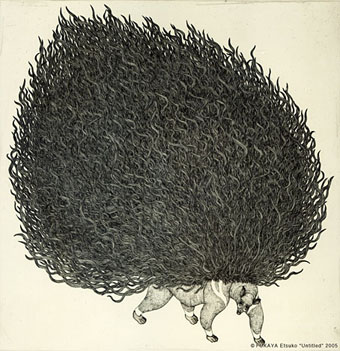
Untitled etching by Etsuko Fukaya, 2005.

• “By the time Scorsese met Powell, in 1975, the British director had fallen on hard times and was largely ignored by the UK film establishment.” A London office used by Michael Powell and Emeric Pressburger is given the Blue Plaque treatment.

• Ambient reminiscences at The Quietus: Wyndham Wallace on the genesis of Free-D (Original Soundtrack) by Ecstasy Of St Theresa, and Ned Raggett on Aphex Twin’s Selected Ambient Works II.

• “Even Queen Victoria was prescribed tincture of cannabis,” writes Richard J. Miller in Drugged: the Science and Culture Behind Psychotropic Drugs. Steven Poole reviewed the book.

I don’t relate to standard psychologizing in novels. I don’t really believe that the backstory is the story you need. And I don’t believe it’s more like life to get it—the buildup of “character” through psychological and family history, the whole idea of “knowing what the character wants.” People in real life so often do not know what they want. People trick themselves, lie to themselves, fool themselves. It’s called survival, and self-mythology.

Rachel Kushner talking to Jonathan Lee

Sound Houses by Walls is a posthumous collaboration based on a collection of “weird sonic doodles” by electronic composer Daphne Oram. FACT has a preview.

The skeletal trees of Borth forest, last alive 4,500 years ago, were uncovered in Cardigan Bay after the recent storms stripped the sand from the beach.

Stephen O’Malley talks to Jamie Ludwig about Terrestrials, the new album by Sunn O))) and Ulver. There’s another interview here.

• At BibliOdyssey: Takushoku Graphic Arts—graphic design posters by contemporary Japanese artists.

• The Unbearable Heaviness of Being: Dave Segal on the rumbling splendour of Earth 2.

So Much Pileup: “Graphic design artifacts and inspiration from the 1960s – 1980s.”

• Lots of illustrations by Virgil Finlay being posted at The Golden Age just now.

• Mix of the week: Episode #114 by Lustmord at Electric Deluxe.

Lucinda Grange’s daredevil photography. There’s more here.

Experimental music on Children’s TV

Kazumasa Nagai at Pinterest.

• Teeth Of Lions Rule The Divine (1993) by Earth | He Who Accepts All That Is Offered (Feel Bad Hit Of The Winter) (2002) by Teeth Of Lions Rule The Divine | Big Church (megszentségteleníthetetlenségeskedéseitekért) (2009) by Sunn O)))

Weekend links 94

walpoth.jpg

Mateo (2011), carved wood sculpture by Bruno Walpoth.

“Dennis Potter’s [The Singing Detective] is 25 years old but still feels avant garde,” says Stephen Armstrong. No fucking kidding, I watched the DVDs again last weekend. Potter’s drama featured non-linear flashbacks, song-and-dance hallucination sequences, an intertextual sub-plot, and a central character who was vitriolic, misanthropic, misogynist and covered from head-to-toe in flaking skin. This wasn’t exiled to an arts channel ghetto but was primetime viewing, Sunday evenings on BBC 1. • Related: “Is Dennis Potter’s singalong noir miniseries the all-time pinnacle of television drama? Graham Fuller thinks it is.”

• American band Earth are using Kickstarter to fund their next project, Wonders from the House of Albion, an LP/CD/DVD/book combining their music with “field recordings from various megalithic and other sites of human/fairy encounters across the UK, also the use of ritual and folkloric magical practices”. Dylan Carlson & Adrienne Davies discuss their work here.

…sort of like Nabokov’s objection to Our Lady of the Flowers, which he saw as a masterpiece but thought, “Why isn’t this book about women?” Nabokov hated homosexuality and was very edgy around it, partly because his own brother was homosexual and his uncle. And he believed that it was hereditary, so he was always nervous about it.

Edmund White chooses five favourite gay novels. Related: a dance adaptation by Earthfall of Jamie O’Neill’s At Swim, Two Boys.

• “The Belbury Tales is the kind of record you feel should have come out on Vertigo around ’73, but never actually did.” Belbury Poly‘s Jim Jupp on ploughman’s lunches, prog rock and avoiding “Clarkson/Wakeman territory”.

Morbid Curiosity: The Richard Harris Collection, an exhibition at the Chicago Cultural Center exploring “the iconography of death across cultures and traditions spanning nearly six thousand years”.

Geoff Dyer’s Zona, an exegesis of Andrei Tarkovsky’s Stalker, is officially out at the end of this month. The book is reviewed here and here.

• “Through a blurry electronic prism“: MetaFilter traces a history of analogue video synthesis.

Dylan Ricci‘s wonderful photography of the male body has moved to a new location.

Infinite Forest by Studio a+i, a design for an AIDS memorial in New York City.

Susan Cain discussing “the power of introverts” at Scientific American.

• Strange Flowers on that icon of Middle Eastern music, Umm Kulthum.

Ewan Morrison on “The self-epublishing bubble”.

Winter Sleep (2007) by Valgeir Sigurdsson feat. Dawn McCarthy | Black (2008) by Ben Frost with Valgeir Sigurdsson, Sam Amidon & Sigrídur Sunna Reynisdóttir | Unbreakable Silence (2011) by Ben Frost & Daníel Bjarnason