The night that panicked America

mercury.jpg

The Mercury Theatre on the air.

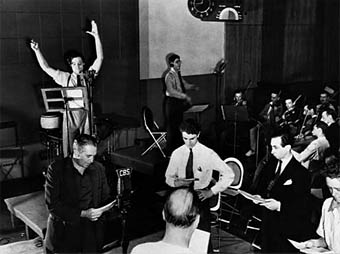
Being a long-time fan of both HG Wells and Orson Welles, the latter’s radio production of War of the Worlds with the Mercury Theatre group has always held a special fascination. This was staged sixty-nine years ago today, October 30th, 1938, and famously caused panic among listeners who missed the opening and believed they were hearing genuine news reports of an alien invasion. I’ve often listened to the rather crude recording of the play around this time of year, having owned that recording on vinyl, cassette tape and CD. These days you don’t have to buy it, you can head over to the Internet Archive or this Mercury Theatre page and grab an mp3 to discover what all the fuss was about. The recording may be crude but the presentation still strikes me as decades ahead of its time, with a very astute sense of how ordinary people behave when faced with the news media. I’ve always loved the attention to detail, such as the moment when the man who’s been interviewed at the crash site wants to carry on talking and the interviewer has to shut him up. That same verisimilitude was carried over to the newsreel footage in Citizen Kane (which was pretty much a Mercury production for cinema) and it was those moments in the radio play which helped encourage people to think that what they were hearing was real, not drama.

Screenwriter Howard Koch, who later polished the rudimentary draft script that became Casablanca, is credited as writer of the play but the adaptation was a group effort according to Koch in his book The Panic Broadcast (1970). The idea of presenting Wells’s story as a series of news bulletins came from Orson Welles and producer John Houseman, with Koch scripting the scenes and dialogue. Most of the other Mercury adaptations took a more traditional approach and if you want some spooky listening for Halloween I’d suggest you try their version of Dracula, also from 1938. The story is severely truncated, of course, but Agnes Moorehead is very impressive as Mina, there’s some remarkable music from Bernard Herrmann and Welles plays both Arthur Seward and the sinister Count.

Previously on { feuilleton }
Alexandre Alexeieff and Claire Parker
The Door in the Wall
Voodoo Macbeth
War of the Worlds book covers

Kafka and Kupka

kafka_kupka.jpg

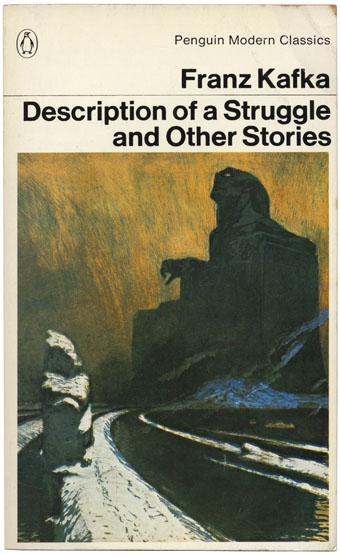
And speaking of Kafka, today’s book purchase was this 1979 story collection. The picture on the cover is a coloured aquatint and my favourite work by Czech artist František Kupka (1871–1957).

kupka2.jpg

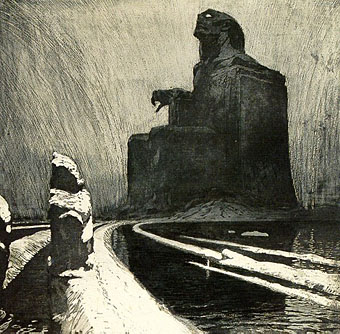
Resistance, or The Black Idol (1903).

Kupka is one of the more unique artists of the period, having begun his career in the Symbolist mode then abruptly changed course, post-Cubism, to become one of the earliest abstract painters. Kandinsky and Mondrian followed a similar evolution but little of their early work is valued, whereas Kupka’s Symbolist pastels and etchings are still regarded as significant. This page has several of his pictures on mystical themes.

As well as being a good match for Kafka, The Black Idol was also the model for the ruined castle in Francis Coppola’s Dracula. There aren’t any decent pictures around, unfortunately, but if you must you can go and squint at the screen grabs here.

Elsewhere on { feuilleton }
The book covers archive

White Noise: Electric Storms, Radiophonics and the Delian Mode

white_noise.jpg

Many sounds have never been heard—by humans: some sound waves you don’t hear—but they reach you. “Storm-stereo” techniques combine singers, instrumentalists and complex electronic sound. The emotional intensity is at a maximum. Sleeve note for An Electric Storm, Island Records, 1969.

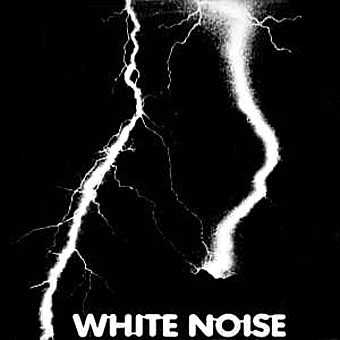
An Electric Storm by White Noise is reissued in a remastered edition this week. It’s a work of musical genius and I’m going to tell you why.

Hanging around with metalheads and bikers in the late Seventies meant mostly sitting in smoke-filled bedrooms listening to music while getting stoned. Among the Zeppelin and Sabbath albums in friends’ vinyl collections you’d often find a small selection of records intended to be played when drug-saturation had reached critical mass. These were usually something by Pink Floyd or Virgin-era Tangerine Dream but there were occasionally diamonds hiding in the rough. I first heard The Faust Tapes under these circumstances, introduced facetiously as “the weirdest record ever made” and still a good contender for that description thirty-four years after it was created. One evening someone put on the White Noise album.

It should be noted that I was no stranger to electronic music at this time, I’d been a Kraftwerk fan since I heard the first strains of Autobahn in 1974 and regarded the work of Wendy Carlos, Tangerine Dream, Brian Eno and Isao Tomita as perfectly natural and encouraging musical developments. But An Electric Storm was altogether different. It was strange, very strange; it was weird and creepy and sexy and funny and utterly frightening; in places it could be many of these things all at once. Electronic music in the Seventies was for the most part made by long-hairs with banks of equipment, photographed on their album sleeves preening among stacks of keyboards, Moog modules and Roland systems. You pretty much knew what they were doing and, if you listened to enough records, you eventually began to spot which instruments they were using. There were no pictures on the White Noise sleeve apart from the aggressive lightning flashes on the front. There was no information about the creators beyond their names and that curious line about “the emotional intensity is at a maximum”. And the sounds these people were making was like nothing on earth.

Continue reading “White Noise: Electric Storms, Radiophonics and the Delian Mode”

Ghost Box

ghost_box.jpg

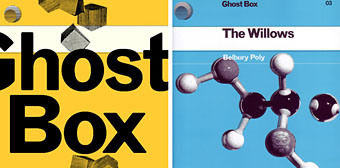
Q: What do you get when you cross analogue synthesizers, samples from obscure public information films, the graphic design of Pelican Books, Arthur Machen, HP Lovecraft, Algernon Blackwood, CS Lewis, Hammer horror, the Wicker Man and the music from Oliver Postgate’s animated films for children?

A: the CD releases by artists on the Ghost Box label. Ghost Box describe themselves as “an independent music label for artists that find inspiration in library music albums, folklore, vintage electronics, and the school music room” which, if you’re familiar with the reference points, is exactly what you get. A rather wonderful blend it is too, some of the tracks on Belbury Poly’s The Willows (named after Algernon Blackwood’s stunning horror tale) are how I expected Stereolab to sound until I heard them and was rather disappointed.

Favourite of the Ghost Box releases I’ve heard to date is (perhaps inevitably) Ourobourindra by Eric Zann (the “artist” here is named after Lovecraft’s haunted musician from The Music of Erich Zann). The website description—”Eric Zann’s radios, oscillators and recordings conjure eldritch, echoing spaces and invoke the voices of the dead that whisper within them”—again is a pretty accurate summation of this atmospheric and sinister audio collage. “Sinister” is a term that can be applied to much of this music and the Ghost Box founders, Julian House and Jim Jupp, declare in a Wire feature this month that matters spectral are of particular concern, hence the label name. Ourobourindra works especially well in this regard, sounding like the product of someone working through a trauma caused by viewing the seance scene from Dracula AD 1972 at too young an age. This is one I’ll be playing on Halloween.

Ghost Box music can be purchased online here.

Elsewhere on { feuilleton }
The album covers archive

Previously on { feuilleton }
Penguin book covers
The music of Igor Wakhévitch
The music of the Wicker Man
The Absolute Elsewhere

Hail, horrors! hail, infernal world!

horror.jpg

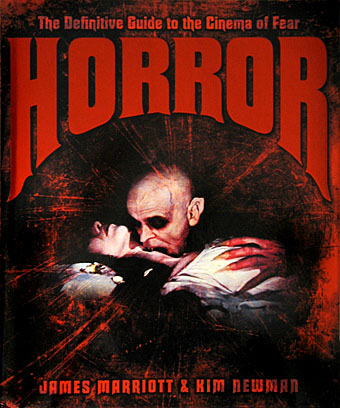
This marvellously lurid 250pp tome turned up in the post today, something I was looking forward to seeing as I wrote 30 of the reviews within, as well as some longer essays on Dracula, Lovecraft and a brief history of occult cinema. Nice layout, lots of colour and some great photos, many of which I haven’t seen elsewhere which isn’t always the case with books like this; I’ll enjoy reading the rest of it. Not sure when it’s due for publication just yet as Andre Deutsch/Carlton Books’ web presence is sketchy to say the least.

Update: The book was published on October 2nd, 2006.

Previously on { feuilleton }
The music of The Wicker Man
Nosferatu
David Rudkin on Carl Dreyer’s Vampyr