The Island of Doctor Moreau

moreau2.jpg

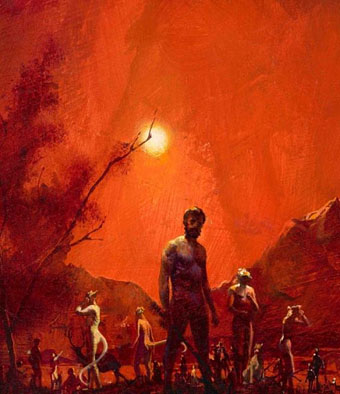
Painting by Paul Lehr for the Berkley Highland paperback (1970).

The Island of Doctor Moreau is one of those Victorian novels everyone thinks they know well enough from various film or television adaptations, even when those adaptations have accreted a layer of misconception around the story. In the case of HG Wells’ novel we have The Island of Lost Souls (1932), which the author loathed for its vulgarisations, and which he helped get banned in Britain for many years; the 1977 film directed by Don Taylor which nobody seems to have a good word for; and Richard Stanley’s 1996 adaptation which might have been worthwhile if he hadn’t been kicked off his own film shortly after shooting began. These films may not distort Wells’ novel as much as the numerous adaptations of Dracula, and Dr Jekyll and Mr Hyde, but they still present a skewed impression of a book which is stranger and more disturbing than any screen version.

Wells’ story purports to be the written account of one Edward Prendick who finds himself on Moreau’s remote island after a shipwreck. The bare bones of the story are familiar: Prendick is rescued by Moreau’s alcoholic assistant, Montgomery, and ends up on the island against the doctor’s wishes. The story deviates from the films very quickly by introducing a setting that’s commonplace in Victorian literature but which Hollywood abhors: the all-male enclave. The Island of Lost Souls put “Edward Parker” on the island with his fiancée but went further (to the outrage of Wells and the British censors) by adding a sexy Panther Woman to the menagerie with whom Moreau encourages Parker to mate. There are women among the “Beast People” in Wells’ novel but we’re assured that they’re as grotesque as their male counterparts.
moreau3.jpg

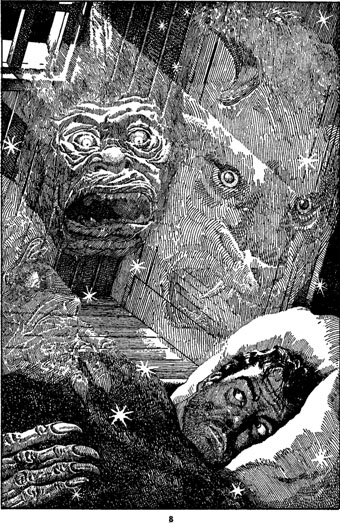
Illustration by Lawrence Sterne Stevens (aka Lawrence) for Famous Fantastic Mysteries, October 1946.

And here we have the second major difference between novel and films: given the limitations of makeup effects—not to say the limitations of the human body—it’s no surprise that the Beast People in the films tend to be like Star Trek aliens, mostly humanoid with a variety of different facial features. Stan Winston’s effects in the 1996 film were the most successful, and were aided considerably by casting a range of actors of different sizes and shapes. All the films tend to present single types, however: wolf-man, cat-woman, bear-man, etc. Wells was writing in 1896 yet his imagination had already brought him this far:

The two most formidable Animal Men were my Leopard-man and a creature made of hyena and swine. Larger than these were the three bull-creatures who pulled in the boat. Then came the silvery-hairy-man, who was also the Sayer of the Law, M’ling, and a satyr-like creature of ape and goat. There were three Swine-men and a Swine-woman, a mare-rhinoceros-creature, and several other females whose sources I did not ascertain. There were several wolf-creatures, a bear-bull, and a Saint-Bernard-man. I have already described the Ape-man, and there was a particularly hateful (and evil-smelling) old woman made of vixen and bear, whom I hated from the beginning. She was said to be a passionate votary of the Law. Smaller creatures were certain dappled youths and my little sloth-creature. But enough of this catalogue.

Later on Moreau has this to say:

“The fact is, after I had made a number of human creatures I made a Thing—” He hesitated.

“Yes?” said I.

“It was killed.”

“I don’t understand,” said I; “do you mean to say—”

“It killed the Kanaka—yes. It killed several other things that it caught. We chased it for a couple of days. It only got loose by accident—I never meant it to get away. It wasn’t finished. It was purely an experiment. It was a limbless thing, with a horrible face, that writhed along the ground in a serpentine fashion. It was immensely strong, and in infuriating pain. It lurked in the woods for some days, until we hunted it; and then it wriggled into the northern part of the island, and we divided the party to close in upon it. Montgomery insisted upon coming with me. The man had a rifle; and when his body was found, one of the barrels was curved into the shape of an S and very nearly bitten through. Montgomery shot the thing. After that I stuck to the ideal of humanity—except for little things.”

Continue reading “The Island of Doctor Moreau”

Weekend links 187

delia.jpg

Delia Derbyshire (2007) by Iker Spozio.

Whatever you think of Doctor Who, Delia Derbyshire’s recording of Ron Grainer’s theme tune is a landmark piece of electronic music. Those glassy electronic tones still sound unique today, not least for their having been created using rudimentary oscillators and much laborious tape editing. In Radiophonic Workshop: the shadowy pioneers of electronic sound, Joe Muggs looks at the history of the BBC’s electronic composers. If you’re a Radiophonic-head then the Alchemists of Sound TV documentary from 2003 is essential viewing.

There’s more (there’s always more): Delia Derbyshire – Sculptress of Sound: part one of a seven-part radio documentary about the great electronic music composer, and Blue Veils and Golden Sands, Martyn Wade’s radio play about Delia. Related: Delia-Derbyshire.org, Delia Derbyshire: An audiological chronology and A History of the Doctor Who theme. And don’t miss: Silence Is Requested In The Ultimate Abyss (1969) by Welfare State and White Noise, an incredible slice of electro-psychedelia from the John Peel Presents Top Gear album.

• “Why don’t books for grown-ups have illustrations any more?” asks Christopher Howse. Some of them do, this past week I’ve been finishing a new series of illustrations for a story anthology.

• From 2006: Ian Penman on cigarettes, espionage, and the masterful (and superior) television adaptation of Tinker, Tailor, Soldier, Spy.

It was Malcolm [McLaren] who suggested that the main characters be a boy who looks like a girl who looks like a boy and vice versa. What was strange was that, actually, in 1985 this was nobody’s vision of the fashion industry. Since then, fashion and fascism have crept closer: you’ve got John Galliano doing his promotional bits for the Third Reich, you’ve got Alexander McQueen killing himself, you’ve got Versace and that horrible, violent stalker coming for him. Since it was written, almost all of it has come true apart from the nuclear winter, but I think we’re working on that. The actual society that the story happens in is much more like the society we have now than culture was in 1985.

Alan Moore on Fashion Beast, Situationism, and why he hates superheroes.

• KW Jeter talks about his latest novel, Fiendish Schemes, and the “cultural juggernaut” that is steampunk.

• Grit and Social Dynamics in Smoke Ghost: Elwin Cotman on the weird fiction of Fritz Leiber.

The Secret Lives of the Vatican’s Gay Cardinals, Monks, and Other Clergy Members.

Don Cherry & Organic Music Theatre, live in the RAI TV studios, 1976.

• Otherworldly Art and Photography: Mlle Ghoul finds the best things.

• From 1998: Rahma Khazam on composer Bernard Parmegiani.

• Mix of the week: Marshland: The Mix by Hackneymarshman.

• “Let’s colonize the clouds of Venus,” says Ian Steadman.

J. Hoberman on David Cronenberg’s Visual Shock.

The Delian Mode (1968) by Delia Derbyshire | Tom Baker (1981) by The Human League | Doctor Who? (1984) by Doctor Pablo & The Dub Syndicate

Weekend links 135

kuhlman.jpg

Two Grove Press covers by Roy Kuhlman. From Arden Kuhlman Riordan’s Pinterest page collecting her father’s cover designs.

• “When people asked me what boylesque was, I’d say I’m doing burlesque and I have a penis,” said Mr. Ferguson.

Sequence5: 42 tracks of new, atmospheric/ambient music. A free download in a variety of formats.

The trailer for Jimmy’s End, the forthcoming film by Alan Moore and Mitch Jenkins.

As a porn performer, I can say from experience and with confidence that I’ve never been objectified by other performers. Nor have I been objectified by viewers. At least not in a way that seemed to confuse them into thinking I was an object. What happens instead is that I shift in and out of object-hood. Athletes do this too—they engage with their bodies for a specific task. At the end of the game or the shoot, the context changes.

Conner Habib on The Virtues of Being an Object

Secret Weapons (1972), David Cronenberg’s lost TV movie resurfaces.

Joseph Burnett reviews Nude, the new album by The Irrepressibles.

Over a third of e-readers are used just once before being set aside.

The guarded, the cautious, the small-scale, the modest, the well-crafted—such books may be rewarded (in our own time, at the national level), but they are rarely preserved. They are not preserved because guardedness, caution, smallness, modesty, and craft can be replaced in any given generation. What is irreplaceable is excess: Of verbal kinesis, religious intensity, intellectual voracity.

Amit Majmudar on Entertainment and Excess: The Great Literary Audiences

Miniature Book Interviews with Louis Wain Bound by Hand.

A Tour Inside Salvador Dalí’s Labyrinthine Spanish Home.

• Horror fiction should be deep, not cheap, says Nina Allan.

• RIP Peter Kuhlmann aka Pete Namlook

More is More by Alex Trochut

The Useless Web

Lost In The Sea (1992) by Sequential (Pete Namlook & DJ Criss) | Angel Tech (1994) by Bill Laswell & Pete Namlook | Yenlik (Part II) (1996) by Burhan Öçal & Pete Namlook

Long Live the New Flesh: The Films of David Cronenberg

cronenberg.jpg

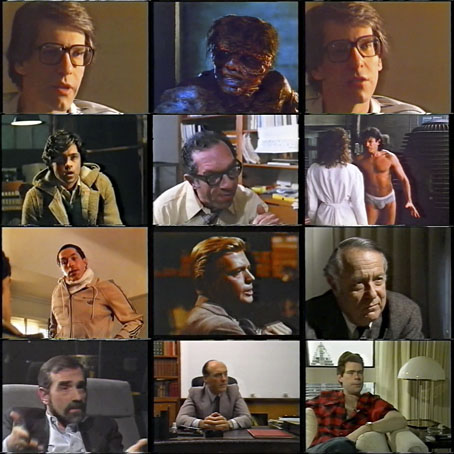
I used to have this documentary on tape but it vanished years ago so it’s good to find it again on YouTube. Long Live the New Flesh: The Films of David Cronenberg was directed by Laurens C. Postma and broadcast on British television in 1987 as a tie-in with the UK release of Cronenberg’s The Fly. The writer was Chris Rodley who subsequently directed some equally good documentaries of his own including the South Bank Show feature about the making of Naked Lunch (now present as an extra on the Naked Lunch DVD), A Very British Psycho about Michael Powell’s Peeping Tom (clips of which can be found in this film), and Donald Cammell: The Ultimate Performance.

Postma’s film captures Cronenberg when he was starting to gain visibility outside the science fiction and horror genres he’d mostly been working in up to this point. Among the interviewees are Martin Scorsese, an early champion, and Stephen King, whose The Dead Zone Cronenberg adapted in 1983. In the critical corner there’s the late film critic Robin Wood who the producers possibly chose on account of his being the voice of dissent in Piers Handling’s 1983 study of Cronenberg’s films The Shape of Rage. Wood isn’t as tiresomely ideological here as he is in Handling’s book (where you can play a drinking game if you count the times he uses the phrase “bourgeois patriarchal capitalism”) but he still seemed to find something reactionary and “unprogressive” (in a political sense) about Cronenberg’s work. Elsewhere there are clips of the films from Shivers on, and I’d forgotten about the comparisons Rodley and Postma make between Cronenberg’s work and Michael Powell’s still astonishing Peeping Tom.

Long Live the New Flesh is 67 minutes long and unfortunately chopped into chunks on the YouTube copy. Watch it here:

Part 1 | part 2 | part 3 | part 4 | part 5 | part 6 | part 7

Mars architectures

davidovici1.jpg

Mars Architectures 3

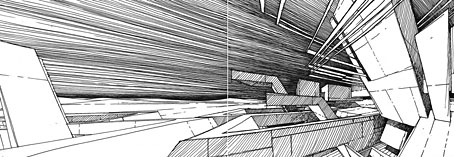
Italian architect Stefan Davidovici was in touch recently asking whether I’d be interested in his speculative views of Mars architectures and an imaginary Jerusalem. I am indeed interested in work such as this, whether the designs resemble Frank Lloyd Wright sketches for David Cronenberg’s unfilmed adaptation of Total Recall or the Piranesian buttresses of the Jerusalem pieces. As to the question of “why Mars?”, Davidovici says this:

Because the functions of any Mars settlement, be it made by near-future humans or by far-future post-humans or by the famous little green local cousins of humans are so, so, so completely obscure to us – answering to an unknown society in an unknown environment – as to become totally, completely, absolutely irrelevant. Therefore we can read the architectural space of such a place as pure art.

A range of his work can be found at his blog, the architecture draftsman.

davidovici2.jpg

Mars Architectures 6

davidovici3.jpg

Mars Architectures 9

davidovici4.jpg

Mars Architectures 10

davidovici5.jpg

Mars Architectures 9

Previously on { feuilleton }
La Tour by Schuiten & Peeters
The art of Pierre Clayette, 1930–2005
The art of Erik Desmazières
The art of Gérard Trignac