Weekend links 286

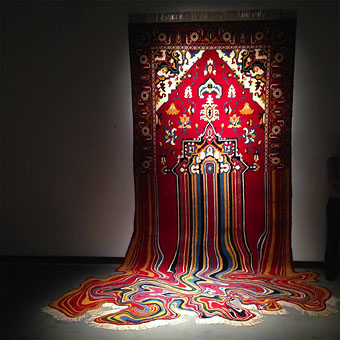
ahmed.jpg

One of Faig Ahmed‘s melted Azerbaijani rugs.

• “I asked [William Burroughs] about the future of typography and he said that letterforms would go back to hieroglyphs, similar to the ancient Egyptians.” Jonathan Barnbrook discussing the thinking behind his design for blackstar, the new David Bowie album.

• “…a thick, yellow fog fills the air, sinks, crawls on the very ground; at 30 paces a house or a steam-ship look like ink-stains on blotting paper.” PD Smith review London Fog, a history of the capital’s lethal pea-soupers by Christine Corton.

• At Rue Morgue: Dejan Ognjanovic asks seven writers and editors why HP Lovecraft is still relevant. Related: big thanks to Paul Gallagher for plugging my Lovecraft calendar at Dangerous Minds.

• Some end-of-year weirdness from Moon Wiring Club: Into The Chattering Ground, a sample of the new releases available at the MWC website.

Elaine Lustig Cohen: accidental graphic designer. Related: book covers and other designs by Elaine Lustig Cohen.

• The tomb that architect John Soane built for his wife inspired the shape of Gilbert Scott’s red telephone box.

• Mix of the week: Stephen O’Malley at the controls of Stuart Maconie’s Freak Zone on BBC Radio 6.

• At Dirge Magazine: S. Elizabeth talks to Alice Rogers about art and occultism.

Simon Callow on taking 25 years to write a three-volume life of Orson Welles.

Todd Haynes on Cate Blanchett, Saul Leiter and Queer Cinema.

Le Freak (1978) by Chic | Freak (2003) by LFO | Jovan Freak (Rune Lindbaek Nomaden Mix) (2012) by Georges Vert

Weekend links 268

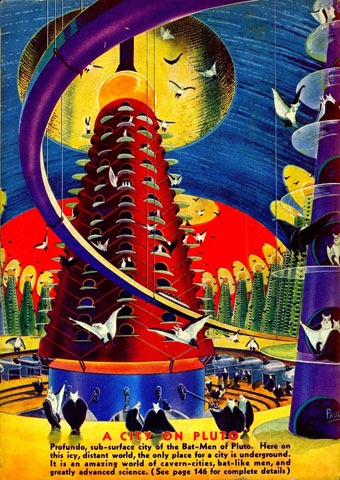
paul.jpg

A City on Pluto (1940) by Frank R. Paul. Related: Paul’s predictions about life on other planets.

23 Skidoo’s Peel Session from September 16th, 1981. Only 18 minutes of music but I’m thrilled for its being unique material that’s never been given an official release. There are many more Peel Sessions at the uploader’s channel, not all of which were reissued on the Strange Fruit label. Download favourites in their as-broadcast form (some with John Peel’s introductions) before they vanish or get blocked like the 1981 Cabaret Voltaire session. Related: Wikipedia’s list of Peel Sessions.

• Mixes of the week comprise two collections by Jon Dale of strange and beguiling Italian music: The Prevarications Of The Sky Against The Earth and La Verifica Incerta; the Summer Window Mix (“telly detritus, new-not-new synth nonsense & off-colour pop oddities”) by Moon Wiring Club; and Secret Thirteen Mix 158 by Haunter Records.

• “Hello, this is David Bowie. It’s a bit grey out today but I’ve got some Perrier water, and I’ve got a bunch of records…” Two hours of the Thin White Duke playing favourite music on BBC Radio One, 20th May, 1979.

Some of Vidal’s guests were writers, not exactly his favorite group. “Writers are the only people who are reviewed by people of their own kind,” Vidal said in an interview. “And their own kind can often be reasonably generous—if you stay in your category. I don’t. I do many different things rather better than most people do one thing. And envy is the central fact of American life.”

Frank Pizzoli reviews Sympathy for the Devil: Four Decades of Friendship with Gore Vidal by Michael Mewshaw

• Yair Elazar Glotman’s new album, Études, conjures “bone-rattling resonance, thick, alien-like atmospheres, and percussive fragments”. Stream it in full here.

• London’s Lost Department Store of the Swinging Sixties: Inge Oosterhoff on the splendours of Biba.

• It’s that Ungeziefer again: Richard T. Kelly on 100 years of The Metamorphosis by Franz Kafka.

• The History of Creepy Dolls: Linda Rodriguez McRobbie explores the uncanny valley.

• At Dangerous Minds: Matt Groening tells the story of The Residents in 1979.

• The NYT collects NASA’s photos from the New Horizons Pluto flyby.

The Museum of Imaginary Musical Instruments

Written on the Body: tattoos in cinema

The Doll’s House (1981) by Landscape | Voodoo Dolly (1981) by Siouxsie and the Banshees | Devils Doll Baby (1986) by Sonny Sharrock

The Cosmic Grill

hotmg1.jpg

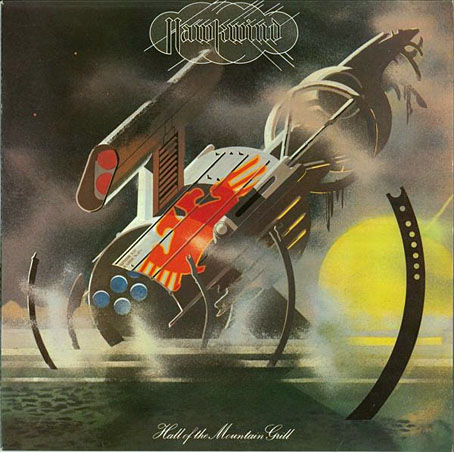
Design and illustration by Barney Bubbles.

The past week’s music listening has alternated between the back catalogue of Seattle band, Earth (who I recommend highly), and the early recordings of my erstwhile employers, Hawkwind. The latter were reissued recently in a 10-CD box, This Is Your Captain Speaking…Your Captain Is Dead (The Albums And Singles 1970–1974) which I also recommend, it’s very good value, and packages the albums in those facsimile card sleeves that now seem de rigueur for album reissues. A swathe of my rare Hawkwind vinyl got sold off circa 1990, and I’ve never replaced any of the albums or singles so this was a good opportunity to catch up. If you like this period of the band there’s the added bonus of the complete Greasy Truckers concert from the Roundhouse in 1972, a ramshackle performance that nonetheless sounds pristine (my Greasy Truckers vinyl—which I do still own—was ruined by a previous owner with a spillage of tea on the Hawkwind side); there’s also the entirety of the 1999 Party concert from Chicago which I’d not heard before.

hotmg2.jpg

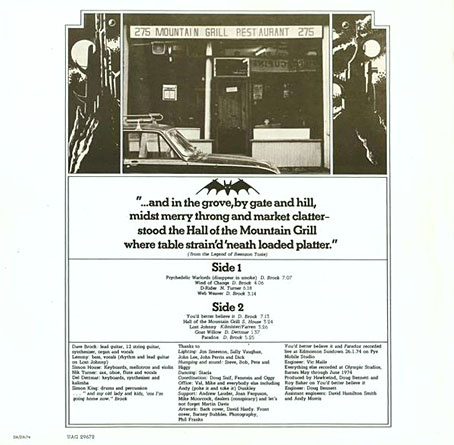
Listening again to Hall Of The Mountain Grill (1974) had me thinking about the origin of the album’s title. Hawkwind never took themselves as seriously as many of their contemporaries, but naming an album of ostensible space rock after a very mundane café in the Portobello Road was one of their more eccentric moments. The humour is compounded by Barney Bubbles’ cover design which for the title uses the kind of typeface (Palace Script) that you see on menus; on the inner sleeve there’s a photo of the fabled restaurant flanked by a pair of Barney’s futuristic towers. The verse beneath the photo (“from the Legend of Beenzon Toste”) refers to nearby Ladbroke Grove, and, of course, to Notting Hill Gate which in 1974 was still a haven for counterculture freaks, the very antithesis of that film. The verse was probably the work of Robert Calvert who explained the attraction of the restaurant in Pete Frame’s Hawkwind family tree:

The Mountain Grill was a working man’s café in Portobello Road—frequented by all the dross and dregs of humanity. Dave Brock always used to go and eat there—which is how I first met him…because I used to eat there too, when I worked on Frendz magazine. It was a kind of Left Bank café/meeting place for Notting Hill longhairs—a true artists’ hangout…but it never became chic, even though Marc Bolan, David Bowie and people like that often went there to eat lunch.

portobello.jpg

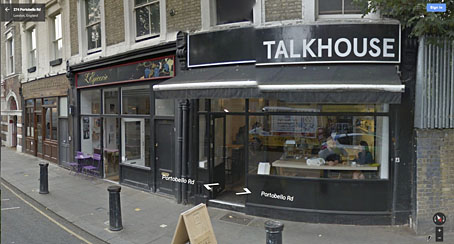
Photos on Flickr show how the place looked in 1977 when the sign from the album sleeve was still intact, and also in 2003 shortly before the restaurant closed down. The premises are a very different kind of eaterie today, remodelled and upmarket as befits a gentrified area.

Previously on { feuilleton }
Void City
Hawk things
The Sonic Assassins
New things for July
Barney Bubbles: artist and designer

Edgar Froese, 1944–2015

froese.jpg

“I was a big fan of Kraftwerk, Cluster and Harmonia, and I thought the first Neu! album, in particular, was just gigantically wonderful,” admits Bowie. “Looking at that against punk, I had absolutely no doubts where the future of music was going, and for me it was coming out of Germany at that time. I also liked some of the later Can things, and there was an album that I loved by Edgar Froese, Epsilon In Malaysian Pale; it’s the most beautiful, enchanting, poignant work, quite lovely. That used to be the background music to my life when I was living in Berlin.”

David Bowie, Mojo magazine, April 1997

Epsilon In Malaysian Pale was Froese’s second solo album released in September 1975. That month David Bowie was in Los Angeles recording his Station To Station album, the opening of which features phased train sounds that are strikingly similar to those that run through the first side of the Froese album. I’ve never seen this similarity mentioned by Bowie scholars but if there was an influence it’s a good example of the degree to which Tangerine Dream infiltrated the wider culture as much as Can and Neu! (Kraftwerk remain in a league of their own.)
zeit.jpg

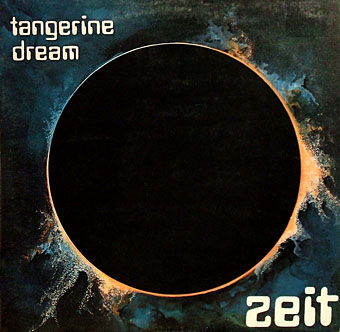
All you need is Zeit. Cover painting by Edgar Froese.

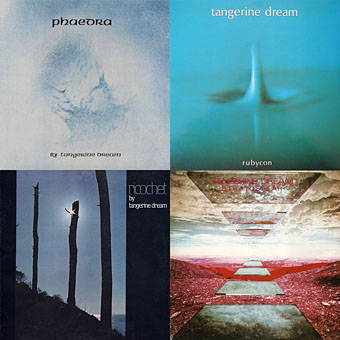
The influence of Tangerine Dream’s albums on the Ohr and Virgin labels is now so widespread that it’s difficult to compile a definitive list of those who’ve either paid homage or copied the group’s trademark style of extended sequencer runs and phased chords. Offhand I could mention the Ricochet-like tracks on Coil’s Musick To Play In The Dark Volumes 1 & 2; the many moments on the early Ghost Box albums, one of which samples from Alpha Centauri; and some of Julian Cope’s more out-there recordings from the late 1990s. There’s also all the releases by a group of loosely affiliated musicians dedicated to maintaining the 70s sound of Mellotrons and bouncing sequencers; many of these I’ve yet to hear but I’ve enjoyed the albums by Node and Redshift.
td.jpg

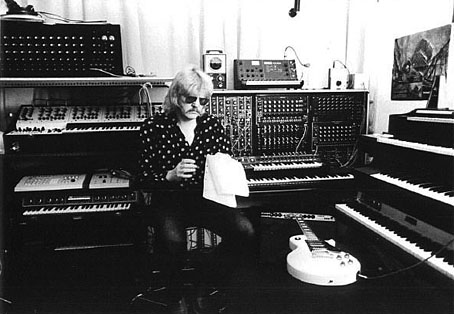
Tangerine Dream have been a continual fixture in my music listening since I was a teenager; I drew most of The Call of Cthulhu to a soundtrack of Rubycon and Jon Hassell’s Aka/Darbari/Java album. I kept up with them after they departed from Virgin then jumped ship in 1986 after Johannes Schmoelling left the group. The albums continued to proliferate in recent years to an extent that even the Freeman brothers only follow the discography (with some exasperation) up to 1990 in their redoubtable Krautrock tome The Crack in the Cosmic Egg. Navigating a late career is a tricky business for a popular musician so you can’t blame Froese for carrying on the project. Those early recordings are the important ones, and he was a crucial component in their creation.

There’s a lot of Froese and TD on YouTube. If you like the early material these are some of the better moments:

Bath Tube Session, 1969: TD in psych-freakout mode. Klaus Schulze on drums, and lots of German heads looking bemused/bored.
Ossiach Lake, 1971: Playing outdoors for the TV cameras.
Paris, 1973: Footage of the group improvising in the manner of the Atem album.
Coventry Cathedral, 1975: Tony Palmer’s film of one of the cathedral concerts which caused them to be banned by the Pope from playing in churches. The original sound on this one is lost so the YT version has edits of the Ricochet album as the soundtrack.
London, 1976: Great film of the Ricochet period. Total synth porn.
Thief, 1981: The opening scene to Michael Mann’s thriller, and one of their best soundtrack moments. In The Wire this month John Carpenter enthuses about the TD score for Sorcerer but I’ve always felt Mann’s crime drama was a better match for their sound.
Warsaw, 1983: A Polish TV recording of the concert documented on the Poland (1984) album.

Previously on { feuilleton }
Synthesizing
Tangerine Dream in Poland

Weekend links 238

hinrichsen.jpg

We Are The Water – Snow Drawings Project, Colorado (2014) by Sonja Hinrichsen with 50 volunteers.

• I don’t do end-of-year lists but Dennis Cooper does. My thanks to Dennis once more for including this blog among his selections. Also there is Jonathan Glazer’s film of Under the Skin, an adaptation of Michel Faber’s novel that impressed me as the most insidiously disturbing thing I’ve seen since Mulholland Drive. The Guardian‘s film critics agreed, making it their film of the year. I’d add to Peter Bradshaw’s appraisal by noting the superb score by Mica Levi, the refusal to spoon-feed the audience with explanations, and a refreshing absence of Hollywood gloss. Glazer’s film, like Kill List before it, shows that mundane British streets and interiors can still be a setting for serious horror.

• Related to the above: “I like Caravan, Coil—it’s very sad that they’re both dead now. In fact, Peter Christopherson, who was leader of Coil, contributed a song to a CD which I made for my wife for what we believed would be her last birthday.” Michel Faber talks to Hope Whitmore about Under the Skin and his new novel, The Book of Strange New Things. M. John Harrison recommends the latter on his own end-of-year list. In January Black Mass Rising will release a recording of The Art of Mirrors, Peter Christopherson’s homage to Derek Jarman from 2004.

David Bowie and band live on Musikladen in 1978: 40 minutes with Adrian Belew on squealing lead guitar, some Kurt Weill and an outstanding performance of “Heroes”.

• “Realism is a literary convention – no more, no less – and is therefore as laden with artifice as any other literary convention.” Tom McCarthy on realism and the real.

• Mixes of the week: The Best of the Best of the Best by TheCuriosityPipe, and Secret Thirteen Mix 138, a medley of post punk from Psyche.

• “We spent two weeks making the penises.” Livin’ Thing: An Oral History of Boogie Nights by Alex French and Howie Kahn.

• At Dangerous Minds: Seeing The Man Who Fell to Earth was one of the greatest experiences of Philip K. Dick’s life.

• Giving Voice to Our Pagan Past and Present: Pam Grossman on Witches, Women and Pop Occulture.

• Neglected last week (and linked everywhere but still a good one): The typography of Alien.

William Mortensen, the photographer who Ansel Adams called the Anti-Christ.

• Hear a track from analogue synthesizer virtuoso Kaitlyn Aurelia Smith.

Rick Poynor on illustrations by Bohumil Stepan for Crazy Fairy Tales.

12 excellent features from directors who never made another feature.

Werner Herzog Inspirationals

The Devil in the Hedgerow

New Warm Skin (1980) by Simple Minds | Rapture Of The Skin (1996) by Paul Schütze | Take Me Into Your Skin (2007) by Trentemøller