Weekend links 810

luminet.jpg

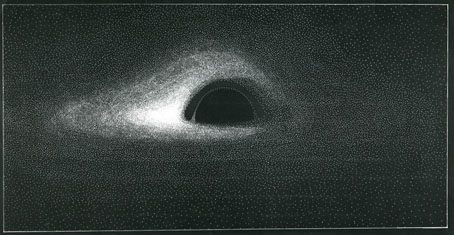
Image of a Spherical Black Hole with Thin Accretion Disk (1979) by Jean-Pierre Luminet. Via.

• “I would be willing to bet that every student of fantastic fiction has at some point in his or her career read a book with the name EF Bleiler printed on its cover.” Brian J. Showers of Swan River Press talked to EF Bleiler in 2005.

• “James Webb Space Telescope confirms 1st ‘runaway’ supermassive black hole rocketing through ‘Cosmic Owl’ galaxies at 2.2 million mph.”

• “You have to be ready to see it”: Abel Ferrara and Catherine Breillat on why Pasolini’s Salò is a gift that keeps giving.

• At Dennis Cooper’s: Kosten Koper presents…Bill Nelson: Acquitted By Mirrors (1982–1987).

• At Skurrilsteer: Ongoing research into the life, work and legacy of Edward James.

• At The Daily Heller: All that jazzy record cover design.

Cygnus X-1 (1977) by Rush | Blackhole Dropout (1979) by Tod Dockstader | The Competition Of Supermassive Black Holes And Galactic Spheroids In The Destruction of Globular Clusters (1999) by Jah Wobble

Weekend links 806

wilson.jpg

Cover art by George Wilson for The Twilight Zone #45, September 1972. Via.

• At Public Domain Review: Thea Applebaum Licht on the history of art within art, or cabinets of curiosity and paintings within paintings.

• The final 2025 catalogue of lots for the After Dark: Gay Art and Culture online auction. Homoerotic art, photos, historic porn. etc.

• At Smithsonian Mag: See the “Mona Lisa of Illuminated Manuscripts,” a 600-Year-Old Bible covered in intricate illustrations.

It’s amazing, the number of people out there who love everything about queer life except for queer sex, who would prefer that sex and sexual orientation live in entirely different zip codes, that they exist as non-overlapping magisteria; it’s so much safer that way. Who wants gay sex polluting their enjoyment of the abstraction that is Being Gay?

That is what gay love is, now, in the collective imagination of American commerce: a set of identity relations projected onto bored and indifferent celebrities who will half-heartedly play along with the idea because doing so moves units and, anyway, what does it cost them? The more that sexual orientation slouches to the point of pure abstraction, the less effort it takes. Anyone and anything can be gay, now, because gay is just a set of pompous liberal cultural signifiers that have no earthly material relation to homosexuals.

“I miss when homoeroticism was erotic,” says Freddie deBoer. I’ve made similar complaints myself over the years. For some genuinely erotic homoeroticism, see the latest auction link above.

• At Ultrawolveunderthefullmoon: Illustrations for Edmund Weiss’s Bilderatlas der Sternenwelt.

• DJ Food’s latest harvestings of psychedelic ephemera may be seen here.

• At Dennis Cooper’s: Bruce Connor’s Day.

• The Strange World of…David Lynch.

• RIP Udo Kier and Tom Stoppard.

Atlanta Surrealist Group

Menergy (1981) by Patrick Cowley | Eros Arriving (1982) by Bill Nelson | Erotic City (“Make Love Not War Erotic City Come Alive”) (1984) by Prince & The Revolution

Weekend links 794

views.jpg

Green Castle (1975) by Roger Dean.

• Roger Dean’s first book, Views, was published 50 years ago this month. The book sold 60,000 copies in its initial run, and was reprinted twice the following year. This extraordinary success gave Dean and his associates at the newly-formed Dragon’s Dream the resources to publish a line of art books by other imaginative artists such as Chris Foss, Ian Miller and Syd Mead. Without Views there wouldn’t have been a Dragon’s Dream, and without Dragon’s Dream there wouldn’t have been Paper Tiger, a publishing house launched by Roger Dean, Martyn Dean and Hubert Schaafsma in 1976. All this activity made a huge impression on me at the time, with books that provided a showcase for artists whose work would otherwise only be seen on the covers of paperbacks or vinyl records.

• At Alan Moore World: 3 novels and The Great When, an extract from a new video interview in which Alan talks about three of the books that have influenced his novels.

• At the BFI: “Dead of Night: 80 years on, Ealing’s anthology horror is still a waking nightmare,” says Edward Parnell.

…Drexler’s vision of nanotechnology was a chimera. It was like the philosophers’ stone of the alchemists: magic dressed in the science of its time, by means of which almost anything becomes possible. I call these oneiric technologies: they do not and quite probably cannot exist, but they fulfil a deep-rooted dream, or a nightmare, or both.

These are not simply technologies of the future that we don’t yet have the means to realise, like the super-advanced technologies that Arthur C Clarke said we would be unable to distinguish from magic. Rather, oneiric technology takes a wish (or a terror) and clothes it in what looks like scientific raiment so that the uninitiated onlooker, and perhaps the dreamer, can no longer tell it apart from what is genuinely on the verge of the possible. Perpetual motion is one of the oldest oneiric technologies, although only since the 19th century have we known why it won’t work (this knowledge doesn’t discourage modern attempts, for example by allegedly exploiting the ‘quantum vacuum’); anti-gravity shielding is probably another.

Philip Ball on unrealistic prognostications in science, from nanotechnology to artificial intelligence

• New music: Rún by Rún; Other Sides Of Nowhere by Underwater Sleep Orchestra; I Believe In You by Ladytron.

• At Dennis Cooper’s it’s Curtis Harrington‘s Day.

• Steven Heller’s font of the month is Ritualist.

A View From Her Room (1982) by Weekend | A Private View (1982) by Bill Nelson | Aerial View (2014) by Jon Hassell

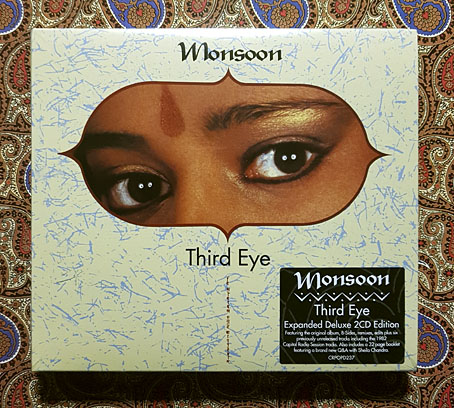
Third Eye by Monsoon

monsoon1.jpg

You know an album is a cult item when you find yourself buying it for the fourth time. I’ve owned Third Eye in most of its previous incarnations—original vinyl, UK CD, US CD with bonus tracks—but this latest reissue from Cherry Red is the first to summarise the career of the group that recorded it. Monsoon were an Anglo-Indian pop ensemble who released just one album and a handful of singles in the early 1980s before disbanding:

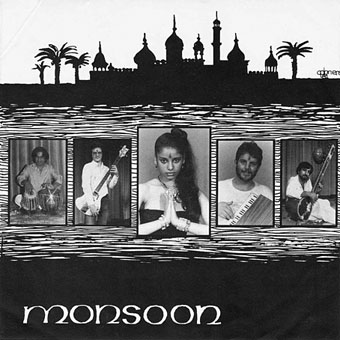
Monsoon led by singer Sheila Chandra (best known for her role in the BBC’S Grange Hill) along with record producer Steve Coe and bass guitarist Martin Smith was a brave and pioneering pop trio that blended traditional music from the Indian sub-continent with 80s British pop. Additionally, they drew on the best musicians they could find from both East and West.

The band originated in 1980 when keyboard player and producer Steve Coe developed an interest in Indian music. Hoping to form a band to pursue this direction, he discovered Sheila via some demo tapes which she had recorded for Hansa Records when she was 14. Sheila joined Monsoon in March 1981, three months before she left school. Monsoon’s first EP Ever So Lonely/Sunset Over The Ganges/Mirror Of Your Mind/Shout Till You’re Heard had been distributed by Rough Trade. Their fresh Asian Fusion sound attracted the attention of label owner David Claridge, and Phonogram A&R man Dave Bates who signed the outfit to the Mobile Suit Corporation (Phonogram).
monsoon2.jpg

In December 1981, the band re-arranged and re-recorded Ever So Lonely at Rockfield Studios with co-producer Hugh Jones, released by Mobile Suit Corporation (Phonogram) in 1982 and, though surrounded by synth-pop singles, and predating the term “World Music” by a full five years, was a smash hit around the world, reaching No.12 in the UK singles chart.

Two further singles followed; Shakti (The Meaning Of Within) and a cover of The Beatles’ Tomorrow Never Knows along with the debut album Third Eye but due to differences with their label, Phonogram, Monsoon dissolved later in 1982.

John Peel apparently played Ever So Lonely on his late-night radio show but I missed it there, hearing it for the first time on the Radio 1 chart countdown one Sunday afternoon. Surrounded by synth-pop hits, the song was strikingly exceptional, while the album that followed still sounds out of time, an infectious blend of sitar, tabla, pop hooks, the occasional drum machine and Bill Nelson’s E-bow guitar. The group’s cover of Tomorrow Never Knows gestures towards the sitar’s entanglement with the psychedelic 60s although you can’t read too much into this when it was Phonogram executives who insisted on a Beatles song. If you’ve never heard this version you may suspect Monsoon of creating a novelty confection like those that fill Sitar Beat (1967), Big Jim Sullivan’s collection of Indian-flavoured psychedelic pop. Monsoon’s cover is much better than Sullivan’s instrumentals, an arrangement that sits so easily among the rest of the songs on Third Eye that it sounds like something they might have written themselves.

indipop.jpg

One of several Indipop compilations.

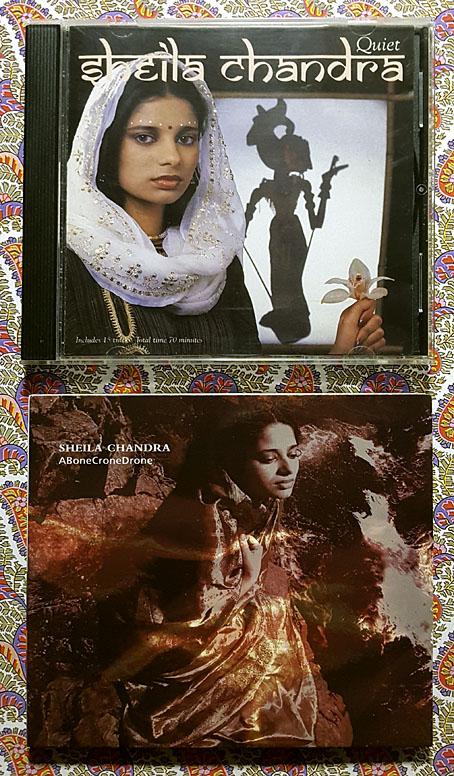
Monsoon didn’t last long but this was only the beginning for Sheila Chandra and Steve Coe who combined forces by getting married and following new musical directions with Coe’s Indipop record label. Indipop developed Monsoon’s fusion sound in a variety of guises centred around Sheila Chandra’s solo releases and The Ganges Orchestra, a Steve Coe studio creation. The label also established links with artists pursuing similar ends, groups like Manchester’s Suns of Arqa, and West India Company, a Blancmange spin-off who brought Asha Bhosle’s voice to European dancefloors. Some of Sheila Chandra’s early albums are a little uneven compared to Third Eye but the best of them, especially Quiet! (1984) and Nada Brahma (1985) are highly recommended. The expanded CD release of Quiet! is another cult disc of mine, a near-beatless suite of raga-like vocalisations. Quiet! foreshadows the paring back of instrumentation that took place on Chandra’s subsequent albums for the Real World label, one of which, Weaving My Ancestors’ Voices (1992) featured an a cappella reprise of Ever So Lonely a decade after the song had reached the Top Twenty. Four years after this, the writers at The Wire magazine voted her third Real World release, ABoneCroneDrone, one of their albums of the year. An interview in the same magazine showed how far Sheila Chandra had travelled in her evolution as a singer and musical artist, from the Top of the Pops studio to this:

The initial recordings for ABoneCroneDrone were made in a deconsecrated church in Bristol: tamburas, harmoniums and vocal tracks were laquered on top of one another, and her voice was also played into the body of a piano via a speaker underneath, to get the strings resonating. Further devices were added to bring character to different tracks, such as didgeridoos, bagpipes, ocean swells and birdsong.

“There was a very fine line to draw between how loud the vocals should be, so that people who weren’t tuned into harmonics could actually hear the subtle things going on, and how far we were drowning out natural harmonics that occurred. And the other kind of balance to be reached was that when I hear a drone as it’s played, unmagnified, untreated, and I hear all these harmonic dances in it and then play it five minutes later, I’ll hear a different dance. I’ll hear South Indian carnatic violins, I’ll even hear rhythm. This performance is going on, and I’ll hear it clear as a bell, very quietly, and it’s in this drone. So, to freeze what I was hearing magnified was also a dilemma, because I didn’t want to make it a static, dead experience. So what we’ve done is layer so many things that you’ll only hear some on different systems and some at different volumes or in different acoustic spaces. There are some things you’ll only hear on the twelfth listen. And it’s like a living experience then.”
chandra.jpg

Essential listening.

The only drones on Third Eye are the resonating strings of the Indian instruments, but this is a pop album, after all, not an avant-garde composition. The new reissue is a 34-track double-disc set that contains enough versions of Ever So Lonely to satisfy the most ardent fan, including the Hindi version and a dub mix. In addition to the original album you get all the other singles with their B-sides, a handful of later remixes and six previously unreleased songs, four of which are sessions recorded for Capital Radio in March 1982.

This would be pretty much definitive if it wasn’t for one of those inexplicable alterations that often bedevil reissues. The final track on the album, Watchers Of The Night, is missing ten seconds or so of the drum-machine intro that you hear on the earlier CD releases. I no longer have my vinyl copy but I’m fairly sure this was the same; Discogs gives the original vinyl duration as 3:47, whereas the new reissue runs for 3:38. Anomalies aside, the mastering is much better than before, something that really benefits the bass and the percussive details. The album has been unavailable in any form since 1995 so this attention is long overdue. Now that Cherry Red have found their way to Indipop’s neglected archives I’m hoping further reissues may follow.

Previously on { feuilleton }
Ravi Shankar’s metempsychosis
Tomorrow Never Knows

Weekend links 506

caligari.jpg

• The late David Roback was a musician who would have been called “enigmatic” for his refusal of the interview treadmill, preferring instead to let his music speak for itself. I wouldn’t label myself a “fan” (a word I dislike at the best of times) but over the years I’ve collected just about everything that Roback was involved in, from the early Rain Parade albums (he co-wrote my favourite song of theirs, No Easy Way Down), to Opal (his collaboration with Kendra Smith and others), and Mazzy Star (with Hope Sandoval), the group whose songs perfected the somnolent blend of blues, country and rock that Roback had been aiming at all along. Some concerts:

Mazzy Star, The Black Sessions, Maison De La Radio, Paris, October 25, 1993
Mazzy Star at the The Metro, Chicago, November 12, 1994
Mazzy Star, KROQ Radio, Los Angeles, December 10, 1994

• “Like other early-modern architects, Lequeu’s drawings explore analogies between bodies and buildings and the erotic, multisensory dimensions of architectural design. In his annotations, he often describes in compulsive detail not only how buildings look but also how they feel, smell, and even taste.” Meredith Martin on the architecture of Jean-Jacques Lequeu.

• “She talks avidly about using pigs’ heads, plastic doll parts, fake blood, and real blood, recollecting with relish a performance where she transformed into a Statue of Liberty that projectile-vomited gore onto the audience…” Geeta Dayal on the performance art of Johanna Went.

Schütte teases out the many ambiguities in these concepts: trains, autobahns, radioactivity, men-machines. All have distinct negative connotations within Germany in particular. Yet Kraftwerk proposed a positive view. Their rigorous determination to deny autobiography forced listeners to focus on the ideas and the music, where apparent contradictions—local/global,  human/machine, past/future—were resolved in a sparkling, crystal-clear sound-world. This was not submission but interaction: as they said, “we are playing the machines, the machines play us”.

Jon Savage reviews Kraftwerk by Uwe Schütte

• “…it was clear that Miles wasn’t sure what he wanted…but he knew what he didn’t want. He didn’t want anything like what he had done before.” John McLaughlin on the recording of Bitches Brew by Miles Davis.

• “His panels are littered with figures standing on the edge of crowds, watching.” Toby Ferris on the paintings of Pieter Bruegel.

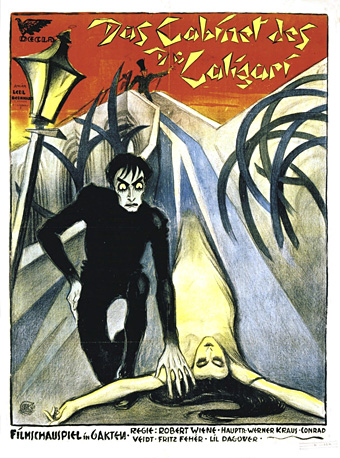
Alex Barrett on 100 years of The Cabinet of Dr. Caligari.

A Boy Called Conjuror by Teleplasmiste.

• At Dennis Cooper’s: Fires.

Smithsonian Open Access

• Picture P. Brueghel “Winter” / Solaris (1972) by Edward Artemyev | The Dream Dance Of Jane And The Somnambulist (1981) by Bill Nelson | St. Elmo’s Fire (1998) by Uilab