The art of Aloys Zötl, 1803–1887

zotl.jpg

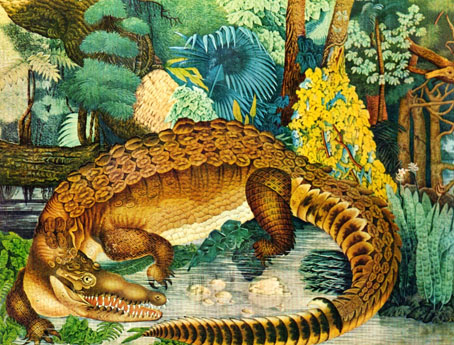
Le caïman (1849).

Two things that everyone seems able to tell you about Austrian artist Aloys Zötl is that his idiosyncratic bestiary was hailed by André Breton as a Surrealist precursor, and that Zötl’s paintings were published in a lavish edition by Ricci in 1977 with accompanying text by Julio Cortázar. Typically for a Ricci book, those editions now sell for excessive sums so we’re left to scour the web for his pictures. Considering their age and Surrealist connections its surprising that there isn’t a decent online collection anywhere. A number of prints can be found on those auction sites which blight the pictures they don’t own with watermarks. Better to look at the examples on this blog or this page at the André Breton site where the copies are small but include quotes from the Ricci volume.

Elsewhere on { feuilleton }
The fantastic art archive

Previously on { feuilleton }
Fantastic art from Pan Books

Dalí in Wonderland

dali1.jpg

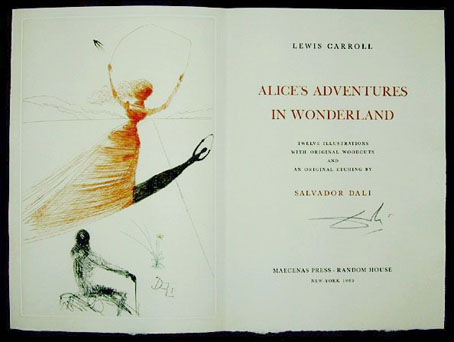
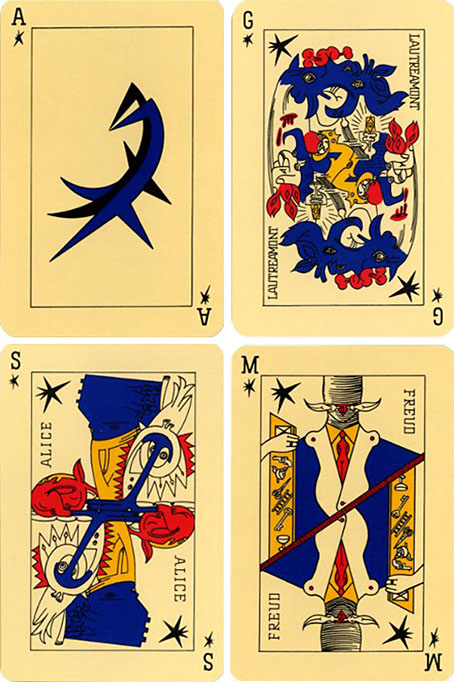
I’d only seen one or two of Salvador Dalí’s illustrations for Alice’s Adventures in Wonderland before but you can see the complete (?) set here. These date from 1969 when Dalí was well past his prime as an artist but they’re still worth a look to see how he tackled each chapter, using the skipping girl motif from earlier paintings as his Alice figure. The attraction of the Alice books for the Surrealists is no surprise; Max Ernst produced a rather enigmatic series of Alice-themed lithographs while André Breton had earlier made Alice the “Siren of Stars” in the set of Surrealist playing cards he designed in the 1940 (below). I’d imagine there are other connections I’ve missed; leave a comment if you know of any. (Thanks to Charity for the tip!)

For more Dalí, here’s something I neglected to link to a while ago, the legendary Dalí meets Disney short, Destino.

stars.jpg

Elsewhere on { feuilleton }
The illustrators archive

Previously on { feuilleton }
Virtual Alice
Psychedelic Wonderland: the 2010 calendar
Charles Robinson’s Alice’s Adventures in Wonderland
Humpty Dumpty variations
Alice in Wonderland by Jonathan Miller
Dalí and Film
The Illustrators of Alice
Surrealist cartomancy

Ballard and the painters

tanguy.jpg

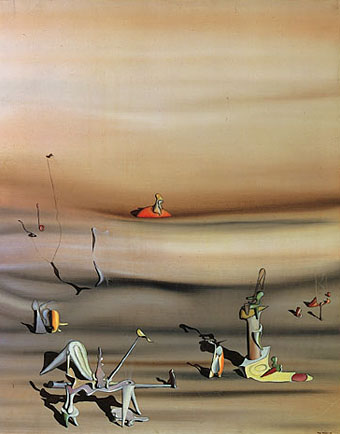
Jours de Lenteur (1937) by Yves Tanguy.

Behind it, the ark of his covenant, stood two photographs in a hinged blackwood frame. On the left was a snapshot of himself at the age of four, sitting on a lawn between his parents before their divorce. On the right, exorcizing this memory, was a faded reproduction of a small painting he had clipped from a magazine, ‘Jours de Lenteur’ by Yves Tanguy. With its smooth, pebble-like objects, drained of all associations, suspended on a washed tidal floor, this painting had helped to free him from the tiresome repetitions of everyday life. The rounded milky forms were isolated on their ocean bed like the houseboat on the exposed bank of the river.

The Drought (1965).

Following my observations yesterday about Ballard’s Surrealist influences, this post seems inevitable. By no means a comprehensive listing, these are merely some of Ballard’s many art references retrieved after a quick browse through the bookshelves earlier. I’d forgotten about the Böcklin reference in The Crystal World. The Surrealist influence in Ballard’s fiction is obvious to even a casual reader, less obvious is the subtle influence of the Surrealist’s precursors, the Symbolists. André Breton frequently enthused over Gustave Moreau‘s airless impasto visions and many of Ballard’s remote femmes fatales owe as much to Moreau’s paintings as they do to Paul Delvaux. The Symbolist connection was finally confirmed for me when RE/Search published their landmark JG Ballard in 1984; there among the list of books on his library shelves was that cult volume of mine, Dreamers of Decadence by Philippe Jullian.

Continue reading “Ballard and the painters”

L’Amour Fou: Surrealism and Design

manray2.jpg

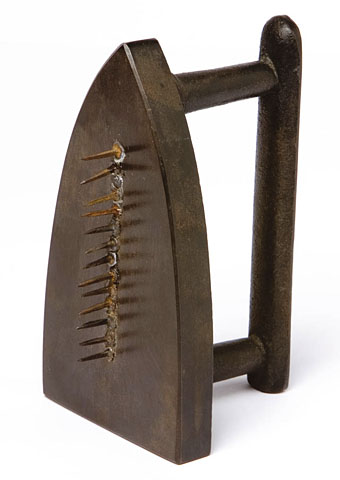
Cadeau Audace by Man Ray (1921).

L’amour fou by Robert Hughes
Fur teacups, wheelbarrow chairs, lip-shaped sofas … the fashion, furniture and jewellery created by the Surrealists were useless, unique, decadent and, above all, very sexy.

The Guardian, Saturday March 24th, 2007

THE VICTORIA AND Albert’s big show for this year, Surreal Things: Surrealism and Design, is—well, maybe we don’t much like the word “definitive”. But it’s certainly the first of its kind.

Everyone knows something about surrealism, the most popular art movement of the 20th century. The word has spread so far that people now say “surreal” when all they mean is “odd”, “totally weird” or “unexpected”. No doubt this would give heartburn to André Breton, the pope of the movement nearly a century ago, who took the title from his friend, the poet Guillaume Apollinaire, who had called his play The Breasts of Tiresias, “a surrealist drama”. But too late now. The term is many years out of its box and, through imprecision, has achieved something akin to eternal life. Surrealist painting and film, that is. In fact, some surrealist images have imprinted themselves so deeply and brightly on our ideas of visual imagery that we can’t imagine modern art (or, in fact, the idea of modernity itself) without them.

Think Salvador Dalí and his soft watches in The Persistence of Memory. Think Dalí again, in cahoots with Luis Buñuel, and the cut-throat razor slicing through the girl’s eye, as a sliver of cloud crosses the moon (actually, the eye belongs to a dead cow, but you never think this when you see their now venerable but forever fresh movie An Andalusian Dog, 1929). Think of photographer Man Ray’s fabulous Cadeau Audace (‘Risky Present’, 1921), the flatiron to whose sole a row of tacks was soldered, guaranteeing the destruction of any dress it would be used on. Think of Rene Magritte’s The Rape, that hauntingly concise pubic face, with nipples for eyes and the hairy triangle where the mouth should be. Think of the shock, the horniness, the rebellion, the unwavering focus on creative freedom, the obsessive efforts to discover the new in the old by disclosure of the hidden…

Continues here

Previously on { feuilleton }
The Surrealist Revolution
Surrealist Women
Las Pozas and Edward James
Surrealist cartomancy

The Surrealist Revolution

bunuel.jpg

The riddle of the rocks by Jonathan Jones
It was the art movement that shocked the world. It was sexy, weird and dangerous—and it’s still hugely influential today. Jonathan Jones travels to the coast of Spain to explore the landscape that inspired Salvador Dalí, the greatest surrealist of them all.

The Guardian, Monday March 5, 2007

I AM SCRAMBLING over the rocks that dominate the coastline of Cadaqués in north-east Spain. They look like crumbling chunks of bread floating on a soup of seawater. Surreal is a word we throw about easily today, almost a century after it was coined by the poet Guillaume Apollinaire. Yet if there is anywhere on earth you can still hope to put a precise and historical meaning on the “surreal” and “surrealism”, it is among these rocks. To scramble over them is to enter a world of distorted scale inhabited by tiny monsters. Armoured invertebrates crawl about on barely submerged formations. I reach into the water for a shell and the orange pincers of a hermit crab flick my fingers away.

The entire history of surrealism—from the collages of Max Ernst to Salvador Dalí’s Lobster Telephone—can be read in these igneous formations, just as surely as they unfold the geological history of Catalonia.

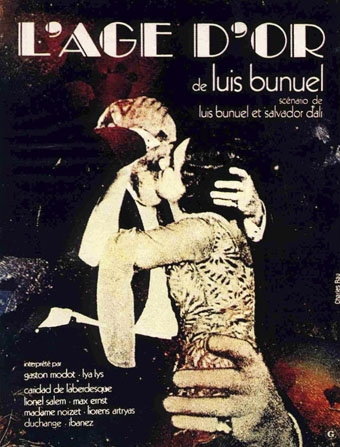
I sit down on a jagged ridge. What if I fell? Would they find a skeleton looking just like the bones of the four dead bishops in L’Age d’Or, the surrealist film Luis Buñuel shot here in 1930?

Buñuel had been shown these rocks by his college friend Dalí years earlier. It was here they had scripted their infamous film Un Chien Andalou. Dalí came from Figueras, on the Ampurdán plain beyond the mountains that enclose Cadaqués, and spent his childhood summers here, exploring the rock pools and being cruel to the sea creatures. In most people’s eyes, this is a beautiful Mediterranean setting. It certainly looked lovely to Dalí’s close friend, the poet Federico García Lorca, when Dalí brought him here in the 1920s: in his Ode to Salvador Dalí, Lorca lyrically praises the moon reflected in the calm, wide bay…

Continues here.

Previously on { feuilleton }
The persistence of DNA
Salvador Dalí’s apocalyptic happening
The music of Igor Wakhévitch
Dalí Atomicus
Las Pozas and Edward James
Impressions de la Haute Mongolie