The art of Jean-Michel Nicollet

nicollet12.jpg

French artist Jean-Michel Nicollet isn’t really known as a comic artist but one of his strips appeared in the Métal Hurlant Lovecraft special in September, 1978, and was reprinted in the Heavy Metal Lovecraft special a year later. Nicollet’s three-page story, H.P.L., is a slight thing which you can read below but his paintings present more of the atmosphere of Lovecraft’s fictional worlds than many of the other strips in those issues, including the equally slight contribution from Moebius. Prior to this, Métal Hurlant had been using some of Nicollet’s paintings for cover art, as a result of which one of the same illustrations appeared on the cover of the very first issue of Heavy Metal magazine in 1977. The winged Lovecraft from his comic strip turned up again on the cover of a Robert Bloch story collection for French publisher Nouvelles Éditions Oswald (NéO) in 1980.

nicollet09.jpg

Nicollet seems to have retired now from cover work but during the 1970s and 80s he was a very prolific illustrator, especially for NéO. NooSFere has a gallery of his covers which are mostly for reprints of early 20th-century horror, fantasy and adventure tales, also a few detective stories. He seems to have enjoyed illustrating classic detective fiction (photos show him posing with a large Holmesian pipe) so there may well be more covers which aren’t included in the NooSFere list.

nicollet11.jpg

The selections I’ve chosen here match my own preferences for cosmic horror and weird fiction, and represent another attempt to look further afield for this type of illustration. French cover design can be unsympathetic to cover illustration, crowding the paintings with poor type choices and purposeless graphics. The uniform layouts of NéO treat the artwork with more respect.

nicollet13.jpg

nicollet14.jpg

Continue reading “The art of Jean-Michel Nicollet”

Another visit to The Other Side

kubin01.jpg

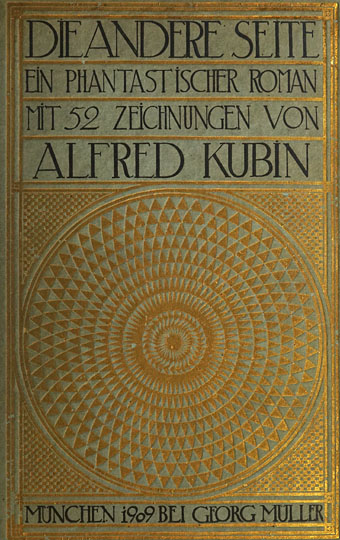
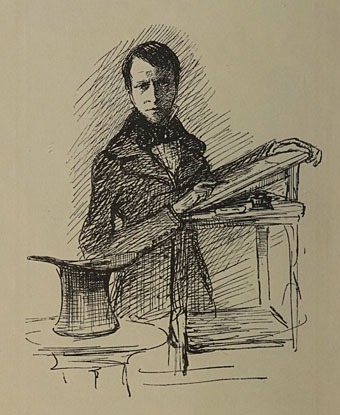
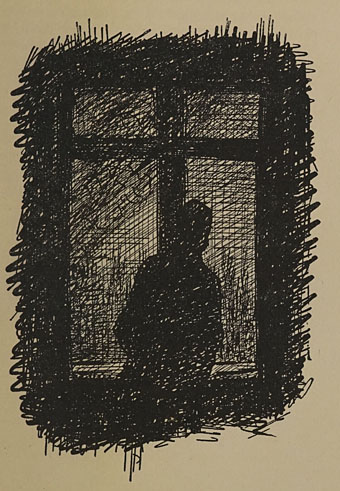
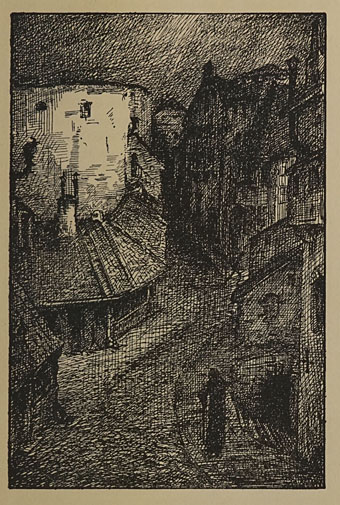
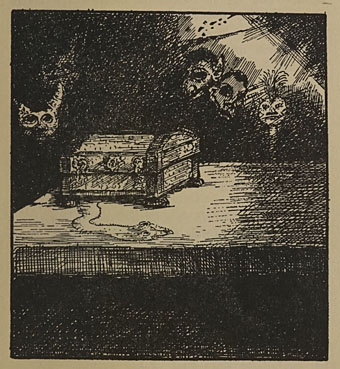
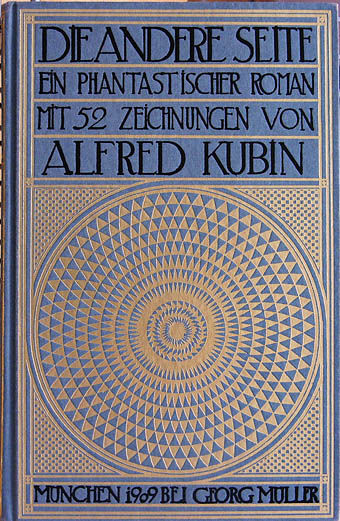
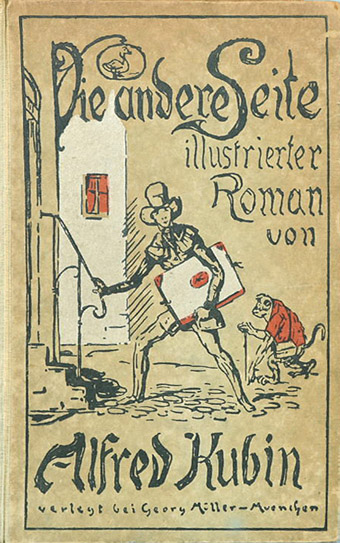
Readers of Alfred Kubin’s nightmarish fantasy novel, The Other Side, may like to know that a first edition was among the new uploads at the Internet Archive in December. The original printing is of note for the fine quality of its illustrations which—unlike subsequent editions—would have been taken from Kubin’s original drawings. Many of these are little more than vignettes but the book contains a number of full-page pieces that are densely cross-hatched, a technique that degrades the more the picture is copied, and which suffers even more if the picture is reduced in size, as these drawings have been in many paperback printings. I complained in an earlier post about the poor quality of the reproductions in my Dedalus reprint, and linked to a Flickr collection of scans from another first edition, but that set didn’t contain all 52 drawings. The pages of this new copy are rather discoloured but the sombre shade suits the increasingly dark tone of Kubin’s story. I imagine the author might approve.

kubin02.jpg

kubin03.jpg

kubin04.jpg

kubin05.jpg

Continue reading “Another visit to The Other Side”

Other Sides

kubin01.jpg

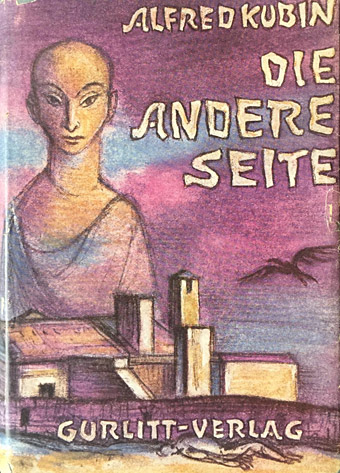
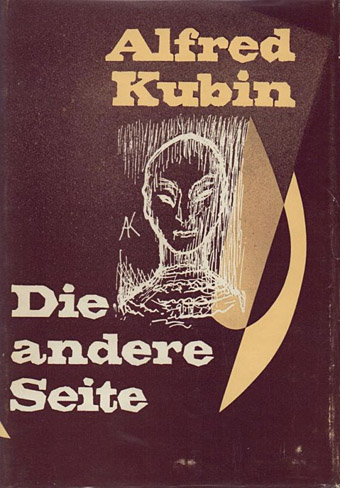
Cover designer unknown.

What becomes clear in the course of Kubin’s long career is how literary a temperament he was, not only because of implicit narratives in much of his work, illustrative and otherwise. Some of his most arresting images in pen and ink seem to arise from some middle ground between writing and drawing, not calligraphy, exactly, but rather as though typeface had sprouted roots and tendrils and spread like invasive groundcover over the whole expanse.

Christopher Benfey, The Shadow World of Alfred Kubin

kubin02.jpg

All art by Alfred Kubin unless otherwise noted.

All the illustrations from the first edition.

kubin03.jpg

kubin04.jpg

kubin05.jpg

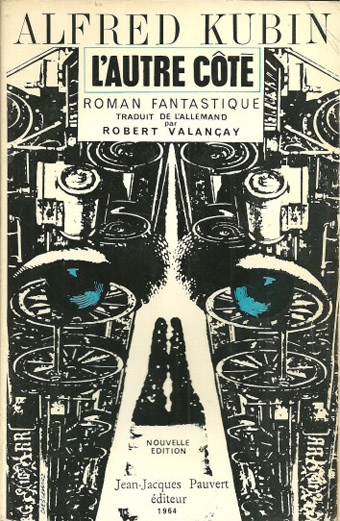
Cover art by Roman Cieślewicz.

Continue reading “Other Sides”

Weekend links 479

hinge.jpg

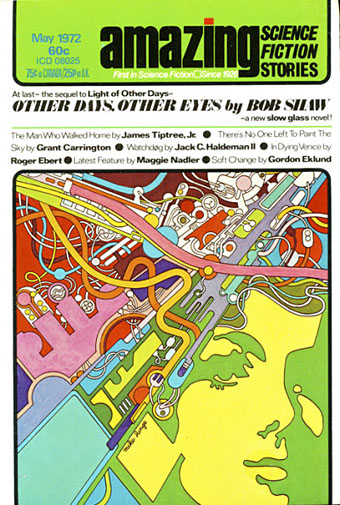
Cover art by Mike Hinge.

• “[The Family] is an unforgettable fusion of journalism and poetic prose that still holds up precisely because it has no use for category, for genre, or for being anything other than its own unique, obsessive self.” Sarah Weinman on how Ed Sanders wrote the definitive account of the Manson murders.

• “The best-known detail of Sartre’s bad trip is Simone de Beauvoir’s anecdote of him being haunted for weeks after by lobster-like creatures scuttling just beyond his field of vision.” Mike Jay on Jean-Paul Sartre (and Walter Benjamin) under the influence of mescaline.

• The MGM film of The Wizard of Oz had its US premiere 80 years ago today. Of Oz the Wizard is a cut-up of the entire film by Matt Busy which rearranges every piece of dialogue (and all the credits) alphabetically.

• “The screenwriter Nagisa Oshima complained that Mishima’s suicide ‘failed to satisfy our Japanese aesthetic’ because it was ‘too elaborate.'” Anna Sherman on Yukio Mishima in Ichigaya.

• “Anarchists don’t like restrictive labels, including the word ‘anarchism’.” Terry Eagleton reviewing The Government of No One by Ruth Kinna.

• At Strange Flowers: Schloss Zwickledt, home of artist and author Alfred Kubin.

• More French music: Zeuhl collection, a list of recommended listening.

• Caro C on Janet Beat, a pioneer of British electronic music.

John Boardley on pomp, type and circumstance.

10 Goth cheeses and what to pair with them.

• At Dennis Cooper’s: Peter Sellers Day.

Longing, Love, Loss by Majeure.

The Lobster (1968) by Fairport Convention | Death Valley 69 (1985) by Sonic Youth | Return To Oz (2004) by Scissor Sisters

Weekend links 359

azuma.jpg

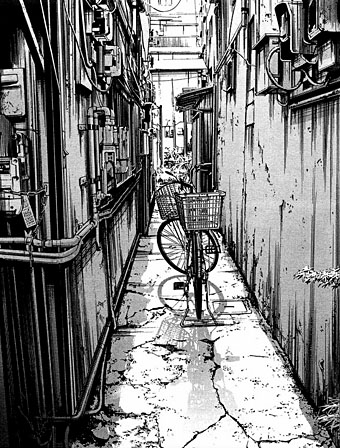
An urban scene from Yotsuba&! by manga artist Kiyohiko Azuma.

• The resurgence of interest in Alice Coltrane’s music is very welcome even if she joins for the moment the list of those artists (usually women: see Leonora Carrington) tagged by editors as “lost”, “forgotten”, “unrecognised”, etc. Alice Coltrane was only ever lost if you weren’t paying attention, and was notable enough fifteen years ago to be given the cover of The Wire magazine. Articles appearing this week have been prompted by a compilation of the devotional music that Coltrane recorded for a series of self-released cassettes in the 1980s. Geeta Dayal writes about the creation of the ashram recordings, while Stewart Smith suggests starting points for new listeners.

• Mentioned here before, but there’s now a page for the book: a new edition of Hashish (1902) by Oscar Schmitz will be published by Wakefield Press in November. “A collection of decadent, interweaving tales of Satanism, eroticism, sadism, cannibalism, necrophilia, and death”, illustrated by Alfred Kubin.

• Mixes of the week: A Dark Entries mix for the 400th issue of The Wire, Procedure, LA, April 25, 2017 by Pinkcourtesyphone, and Secret Thirteen Mix 220, a 4-hour epic by Ricardo Gomez Y De Buck.

• More off-the-beaten-path film lists: Sarah Lyons for Dirge Magazine on three occult documentaries, and Terry Ratchett for Dennis Cooper on 18 needlessly obscured avant-garde films.

• An Island of Peace: James Conway on Amanda DeMarco’s new translation of Walking in Berlin: A Flâneur in the Capital by Franz Hessel.

Ryuichi Sakamoto talks to Aaron Coultate about overcoming cancer, The Revenant and his new album, async.

Ingrid D. Rowland on Caravaggio: The Virtuoso of Compassion.

• “I think I am weirdly politically correct,” says John Waters.

Mnemonic Generator

• Berliner Nächte Part 1 (1990) by Seigen Ono | Berlinerstrasse (1995) by Coco, Steel & Lovebomb | Berlin (1998) by Pole