Clearlight: Symphonies

clearlight1.jpg

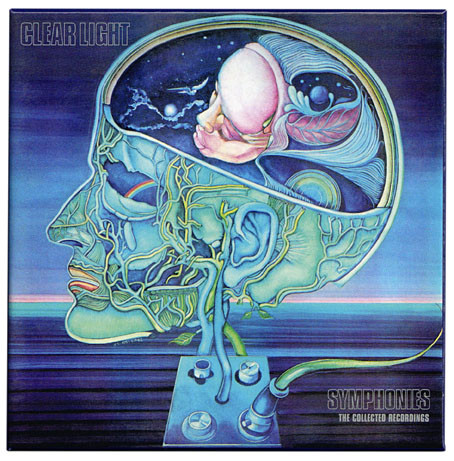
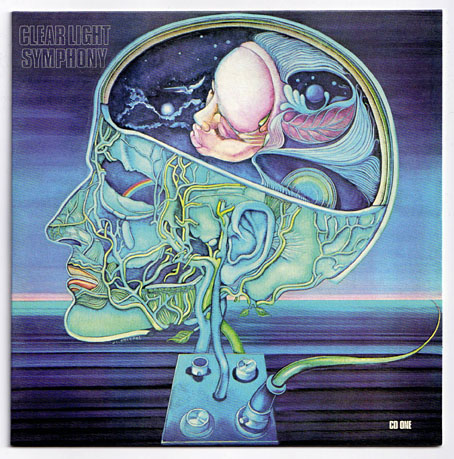
The Clearlight that concerns us here is a French musical ensemble with a shifting line-up, formed by and oriented around the activities of its keyboard-playing composer Cyrille Verdeaux. Clearlight, in other words, shouldn’t be confused with the short-lived American psychedelic band known as Clear Light. Cherry Red have just released five Clearlight albums in one of their well-produced CD boxes: Clear Light Symphony (1975), Forever Blowing Bubbles (1975), Les Contes Du Singe Fou (1977), Visions (1978), and Impressionist Symphony (2014). The box bears the subtitle “The Collected Recordings” but these albums comprise only one half of the Clearlight discography. I doubt there’s much demand for anything more substantial than this, at least in Britain where the group have been chiefly known for their first album, Clear Light Symphony. Cyrille Verdeaux’s booklet notes describe how he secured a deal with Virgin Records thanks to the success of Mike Oldfield’s early albums. Verdeaux’s demo tape was aiming for a similar blend of rock music with classical structures, with one long “symphony” divided into two parts. When the album was being recorded Virgin persuaded him to flesh out his composition with three musicians who were signed to the label via Gong—Steve Hillage, Tim Blake and Didier Malherbe—all of whom play on the second part. Or what should have been the second part… Virgin switched the two playing sides of the recording around in order to give the Gong artists greater prominence. The switch has been reversed for this latest release.
clearlight2.jpg

Cover art by Jean-Claude Michel.

I’ve not heard everything in Cyrille Verdeaux’s discography but the Clearlight albums that follow the debut are further excursions into quasi-classical prog-rock composition. There was a lot of this around in the 1970s, especially from keyboard players like Rick Wakeman, Vangelis, Bo Hansson and others. Verdeaux isn’t as much of a Liberace show-off as Wakeman, and he’s not as original as Vangelis, but in Clearlight his piano and keyboard flourishes benefit from the other musicians assembled on each release. Tim Blake had settled in France in the late 1970s, and turns up on several of the albums that follow Clear Light Symphony. The presence of Blake’s burbling synthesizers and Christian Boulé’s Hillage-like guitar lead the music out of the concert hall and into the cosmos. I have to admit to being pleasantly surprised by this collection of albums. I bought the set mainly to restore Clear Light Symphony to my record collection, an album I used to own on vinyl then sold following a shelf purge in the early 2000s. (One thing you’ll never get on a CD reissue is the locked groove that ends side two of the vinyl release.) My worries about the other albums being severely unpalatable haven’t been realised.
clearlight3.jpg

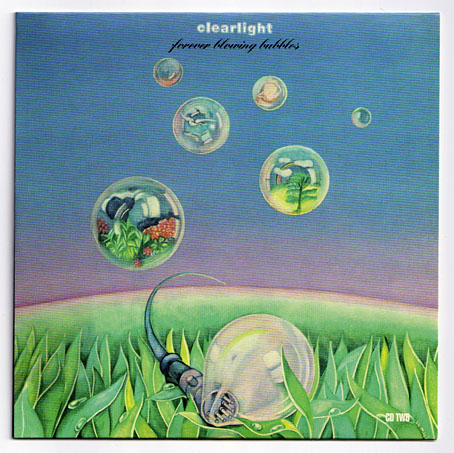
Cover art by Jean-Claude Michel.

Forever Blowing Bubbles was another Virgin release, this time with shorter pieces separated by electronic bubbling noises that posit each composition as one of a number of musical “bubbles” that we’re visiting in turn. A couple of these are songs which I was less keen on but the music is just as good as on the debut album. This is also the first album in the box featuring bonus tracks, a common feature of album reissues which often prove to be superfluous. Not so here, where the additions sound like a continuation of the album as a whole. King Crimson enthusiasts may like to know that David Cross plays violin on this album.
clearlight4.jpg

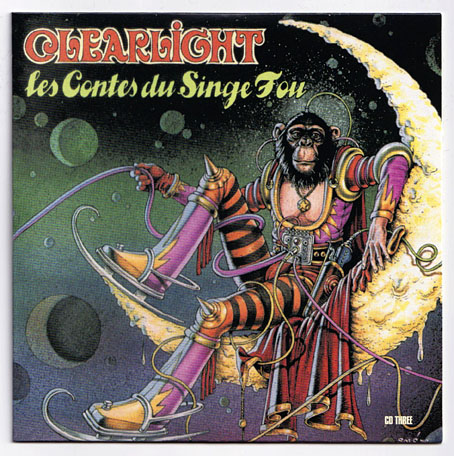
Cover art by Jean Solé.

Les Contes Du Singe Fou continues the formula, with more short compositions and a couple more songs, one of which is so close to the beginning of Supper’s Ready by Genesis as to be almost plagiaristic. In place of David Cross on violin there’s a recent exile from Magma, Didier Lockwood, whose fiery contributions are especially welcome. I didn’t expect there to be a tangible link with the Zeuhl artists when Verdeaux’s compositions are generally more palatable than Magma and co. Christian Boulé was touring in Steve Hillage’s band in 1977 so Yves Chouard takes over on the guitar. I ought to note that this album and the one that follow have been mastered from vinyl sources.
Continue reading “Clearlight: Symphonies”

Zeuhl Ẁortz!

magma-single.jpg

Kobaïa / Müh (1970), a single by Magma.

1: Zeuhl definitions

Zeuhl is an adjective in Kobaïan, the language written by Christian Vander, drummer and founder of the French band Magma.

Pronunciation: zEU(h)l, while the EU are like a French E with a slight U, and the (h) is a semi-silent letter which is an integrated part of the EU, totalling in a “syllable and a half”. (Prog Archives)

Zeuhl (pronounced [zœl]; lit. ’celestial’) is a music genre that is a hybrid of jazz fusion, symphonic rock and neoclassical music, established in 1969 by the French band Magma. The term comes from Kobaïan, the fictional language created by Magma’s Christian Vander and Klaus Blasquiz for Magma, in which Zeuhl Ẁortz means approximately ‘celestial force’.
[…]
Zeuhl is determined by several characteristic elements. Especially important are dominant rhythm fractions, usually in the form of a pumping bass guitar and sometimes sluggish or flexibly playing drum kits. Slow repetitive structures that serve to build a hypnotic atmosphere are just as prominent as solo passages of high technical finesse. Vocals are often widely present and can consist of polyphonic choral movements, such as Carl Orff’s Carmina Burana, or soloistically performed passages with shrill intonation. Zeuhl bands also often have solo guitarists or pianists that usually have a more than accompanying function, especially to emphasize the repetitive patterns. (Wikipedia)


2: The Birth of the Zeuhl

“1967,” he says. “The year John Coltrane died. It seemed to me that afterwards, it was as though music had to try to start all over again. Someone had to pick up the pieces, go on searching in the way that he had. Nobody could match him, but people could pick up the flame. It was almost impossible for anyone to do anything new after Coltrane, but you had to try, try to find other new directions. So that’s what I tried to do with Magma. I was a bit young at the time, but…”

Christian Vander describing the birth of Magma to Paul Stump, The Wire, July 1995


3: Zeuhl lists

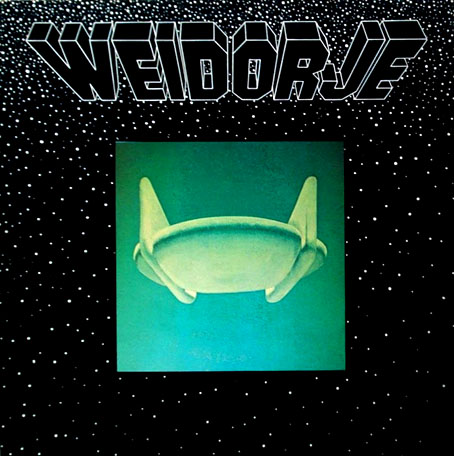
weidorje.jpg

Weidorje (1978) by Weidorje. Cover art by Klaus Blasquiz.

Shindig! Magazine: Magma in seven records, and Deeper Underground: the best albums by the Magma family by Warren Hatter.

• Prog Is Alive and Well in the 21st Century: My Favourite Zeuhl Albums of All-Time by Drew Fisher.

• Bandcamp: There is No Prog, Only Zeuhl: A Guide to One of Rock’s Most Imaginative Subgenres by Jim Allen.

• Discogs: Zeuhl lists by Neit and ultimathulerecords.

• Prog Archives: Top 100 Zeuhl.


4: Live Zeuhl

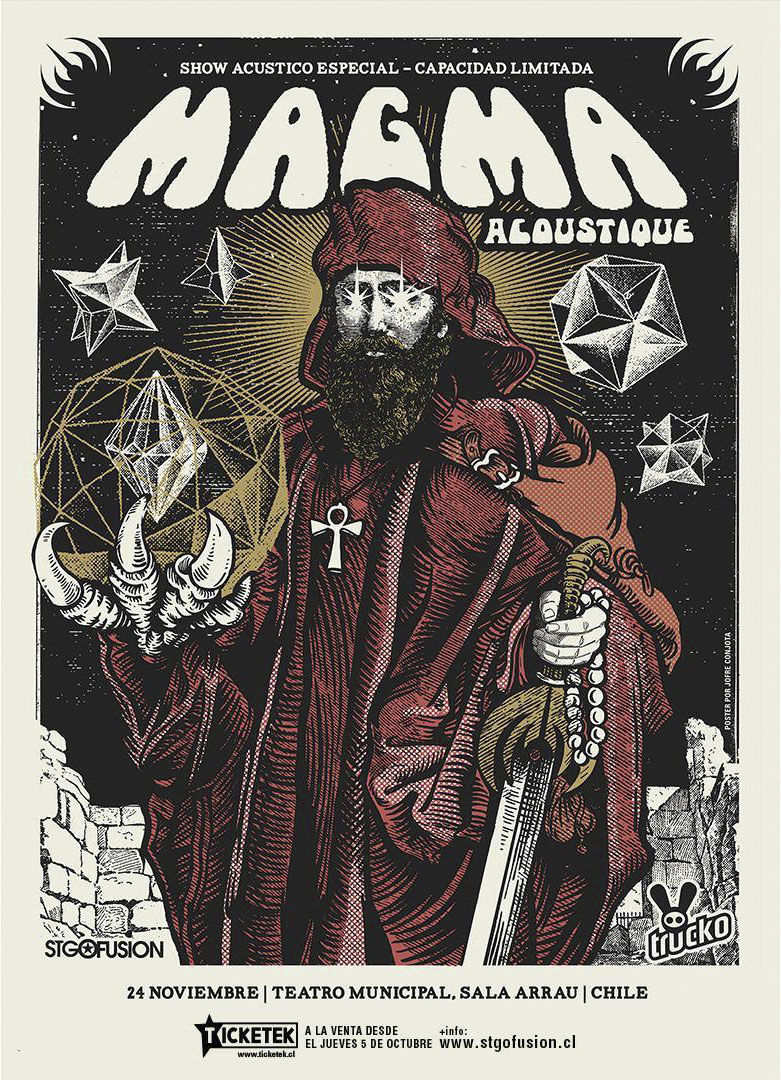
magma-poster.jpg

A poster by Jofre Conjota for a concert in Chile demonstrating that Zeuhl can exist without electricity.

Magma, Hippodrome du Pantin, Paris, 1977 (46 mins; a French TV film that captures one of the 70s lineups in peak form. Includes an almost complete performance of Mekanïk Destruktïẁ Kommandöh.)

Weidorje, French TV, 1979 (11 mins; Magma offshoot Weidorje were only active for a couple of years, this may be their only TV appearance.)

Magma, Théâtre Bobino, Paris, 1981 (A complete concert—1 hr 53 mins—from the group’s weird-funk period: Christian Vander leaves his drumkit to sing and rant at the audience, everyone is dressed in spacey glitter outfits, and some of the songs from the Merci album can’t be classed as Zeuhl at all. The musicians are all first rate, however.)

Magma play Köhntarkösz, 2005 (A fantastic 32-minute performance in a very cramped venue.)

Collectif PTÄH interprète Magma (12 mins; a Magma covers band playing in a village square.)


5: Cinematic Zeuhl

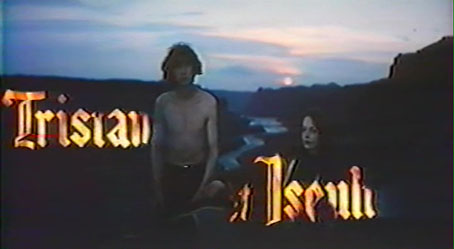
tristan.jpg

Tristan et Iseult (1972): a French feature film with a score by Christian Vander and three members of Magma. The soundtrack album was later incorporated into the Magma official discography as Ẁurdah Ïtah.

Moi y’en a vouloir des sous (1973): a French satire in which Magma make a brief appearance as a way-out rock group.


6: Lovecraftian Zeuhl

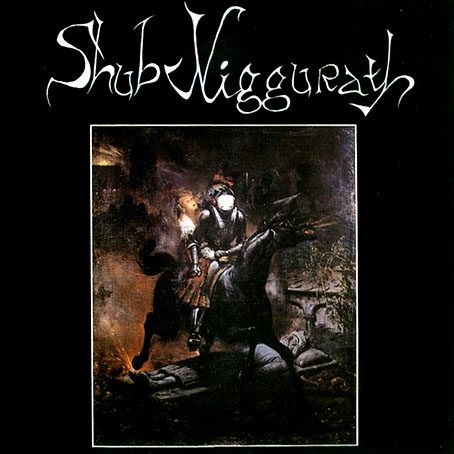
shub-niggurath.jpg

Les Morts Vont Vite (1986) by Shub Niggurath. Cover art: La Ballade de Lénore (1839) by Horace Vernet.

Liriïk Necronomicus Kanht (1978) by Magma.

Dagon (1980) by Eskaton.

La musique d’Erich Zann (1981) by Univers Zero (a Belgian group, originally named Necronomicon, which included former members of an earlier group named Arkham).

Yog-Sothoth (1986) by Shub Niggurath.


7: Comic Zeuhl

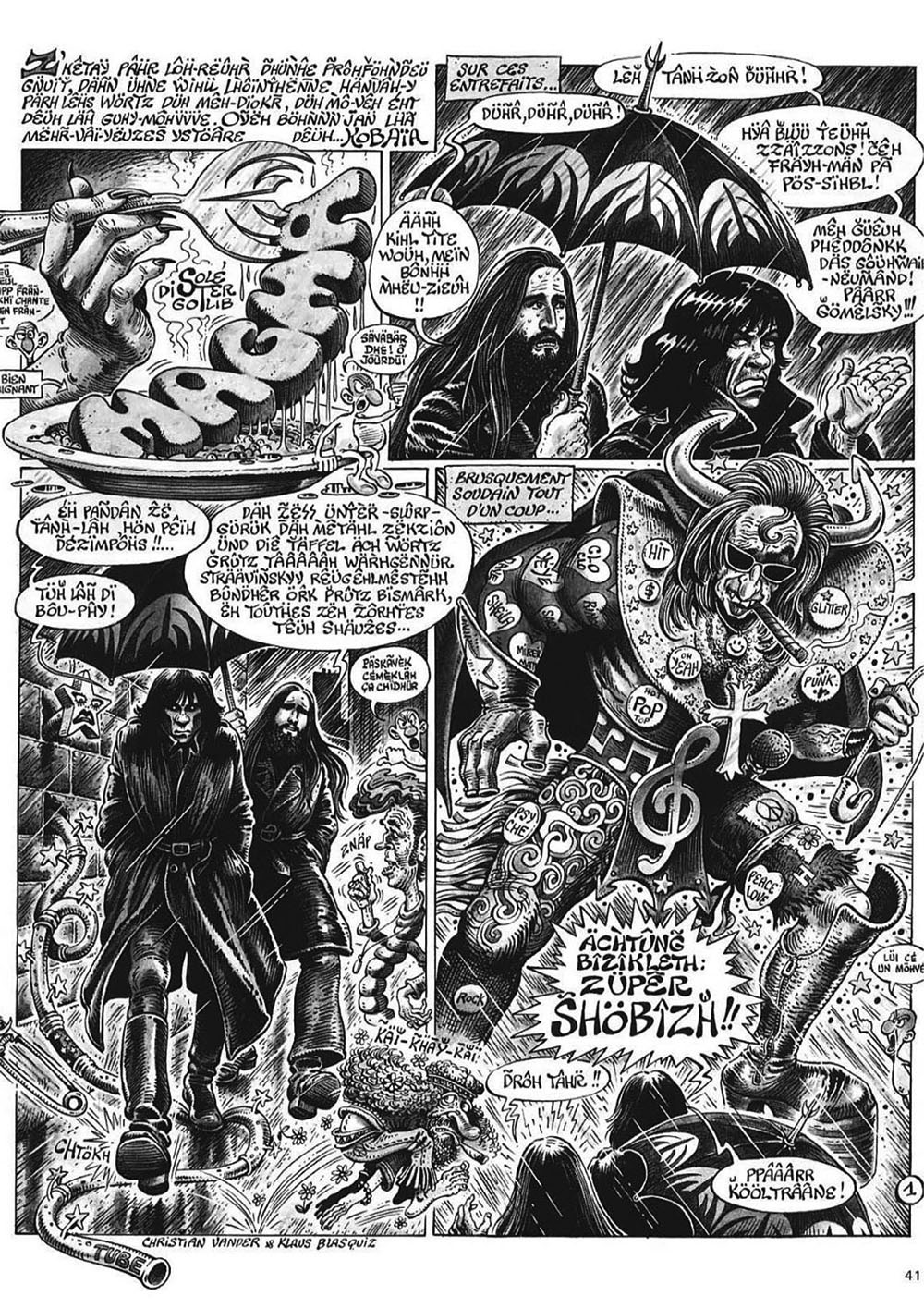
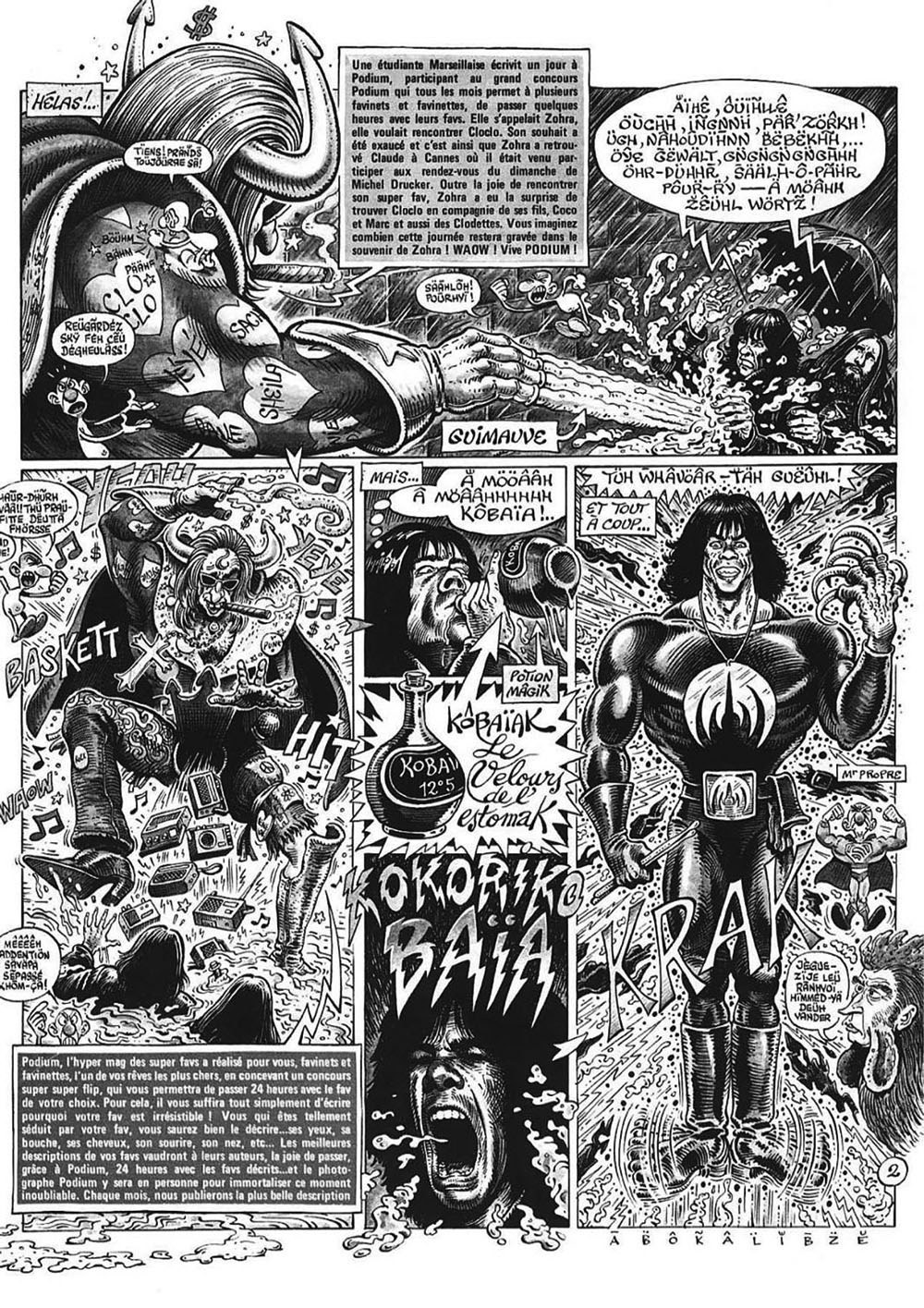
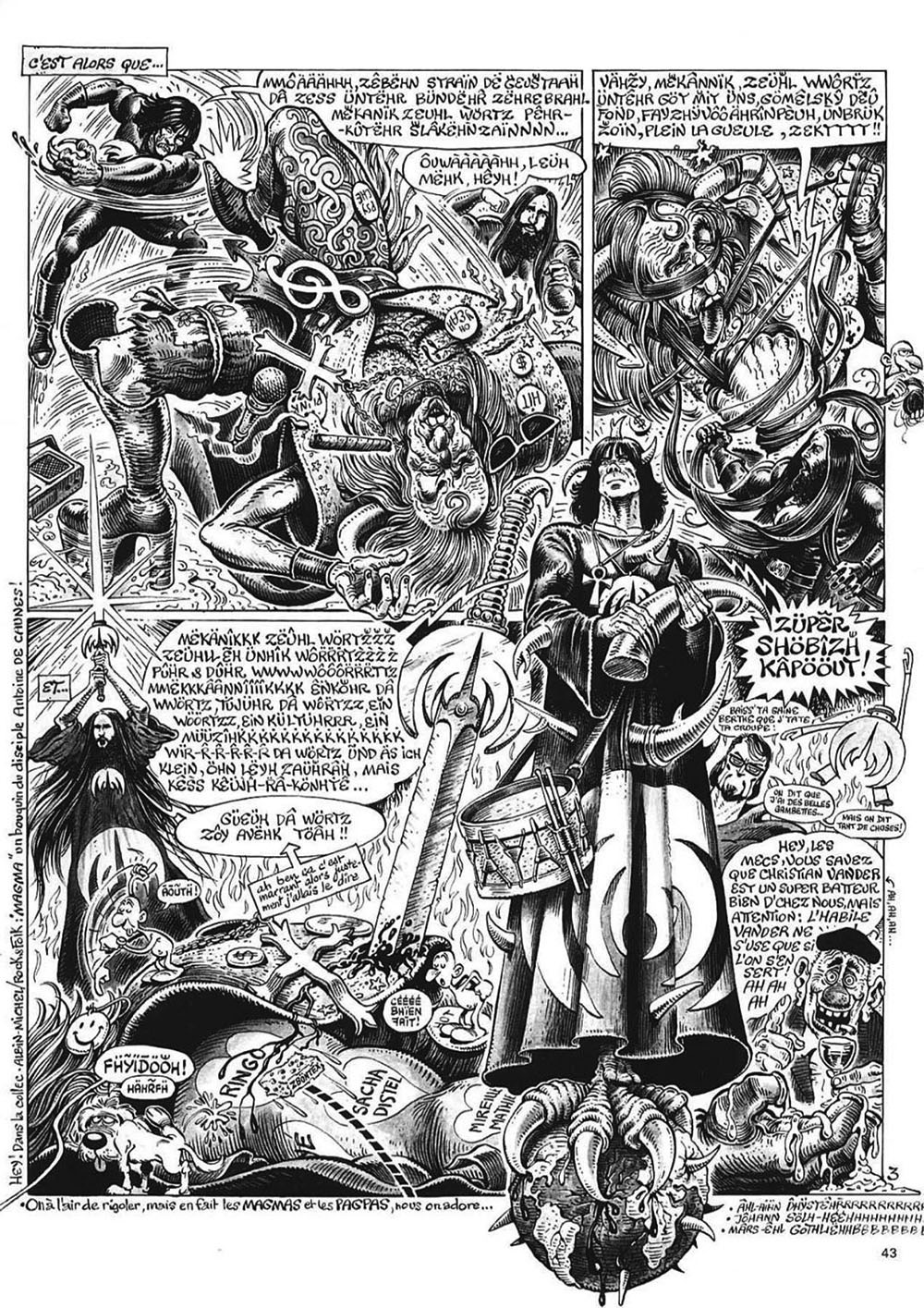
Magma’s Christian Vander and Klaus Blasquiz in a three-page comic strip from Pop & Rock & Colégram (1978), a collection of satirical music-themed pieces by Jean Solé, Alain Dister & Marcel Gotlib.

magma-comic1.jpg

magma-comic2.jpg

magma-comic3.jpg

Previously on { feuilleton }
Dune: some French connections
HR Giger album covers

Weekend links 538

greenaway.jpg

The Elf Ring by Kate Greenaway.

• “Is it possible that the Victorian fairy tradition, beneath its innocent exterior, operated as a conduit for a hidden tradition of psychedelic knowledge?” Just in time for the British mushroom season, Mike Jay explores the connections between psychedelic mushrooms, folklore and fairy tales.

• “This second coming of Prince’s greatest album is the immaculate execution of a flawed conception: the belief that you can never have too much of a good thing.” Simon Reynolds on Prince and the expanded, multi-disc reissue of Sign O’ The Times.

• “An extraordinary stash of more than 400 erotic drawings by Duncan Grant that was long thought to have been destroyed has come to light, secretly passed down over decades from friend to friend and lover to lover.” Mark Brown on a trove of gay erotica.

• New art exhibitions: Wessel + O’Connor celebrates 35 years of homoerotic exhibitionism with 35 works by different artists; “masks a must”. And New Framing at Museum More includes a great painting by Jan Ouwersloot of trams manoeuvring at night.

• There is no Prog, only Zeuhl: A guide to one of rock’s most imaginative subgenres by Jim Allen. I recommend the Weidorje album.

The Power (Of Their Knowledge), another preview of the forthcoming album by Cabaret Voltaire (or Richard Kirk solo).

• RIP Eddie Van Halen. Annie Zaleski selects 10 of his best songs (really 9 plus an instrumental…).

• At Dennis Cooper’s: Spotlight on…Leonora Carrington The Hearing Trumpet (1976).

• Mix of the week: Autumn and Wise (The Fall) by The Ephemeral Man.

Abandoned Isle of Wight

Dark Side Of The Mushroom (1967) by Chocolate Watch Band | Mushroom (1971) by Can | Growing Mushrooms Of Potency (2011) by Expo ’70

Weekend links 479

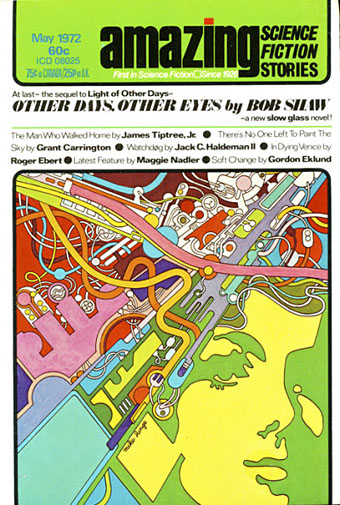
hinge.jpg

Cover art by Mike Hinge.

• “[The Family] is an unforgettable fusion of journalism and poetic prose that still holds up precisely because it has no use for category, for genre, or for being anything other than its own unique, obsessive self.” Sarah Weinman on how Ed Sanders wrote the definitive account of the Manson murders.

• “The best-known detail of Sartre’s bad trip is Simone de Beauvoir’s anecdote of him being haunted for weeks after by lobster-like creatures scuttling just beyond his field of vision.” Mike Jay on Jean-Paul Sartre (and Walter Benjamin) under the influence of mescaline.

• The MGM film of The Wizard of Oz had its US premiere 80 years ago today. Of Oz the Wizard is a cut-up of the entire film by Matt Busy which rearranges every piece of dialogue (and all the credits) alphabetically.

• “The screenwriter Nagisa Oshima complained that Mishima’s suicide ‘failed to satisfy our Japanese aesthetic’ because it was ‘too elaborate.'” Anna Sherman on Yukio Mishima in Ichigaya.

• “Anarchists don’t like restrictive labels, including the word ‘anarchism’.” Terry Eagleton reviewing The Government of No One by Ruth Kinna.

• At Strange Flowers: Schloss Zwickledt, home of artist and author Alfred Kubin.

• More French music: Zeuhl collection, a list of recommended listening.

• Caro C on Janet Beat, a pioneer of British electronic music.

John Boardley on pomp, type and circumstance.

10 Goth cheeses and what to pair with them.

• At Dennis Cooper’s: Peter Sellers Day.

Longing, Love, Loss by Majeure.

The Lobster (1968) by Fairport Convention | Death Valley 69 (1985) by Sonic Youth | Return To Oz (2004) by Scissor Sisters