Kenneth Anger: Film als magisches Ritual

anger1.jpg

Writing about Steven Arnold last week I was wondering whether Arnold and Kenneth Anger had ever crossed paths. Anger moved to San Francisco in 1966 in order to channel the counter-cultural ferment into the film that would eventually become Lucifer Rising. I’m sure he must have been aware of Arnold’s midnight movie shows but if so there’s no mention of Arnold in the Bill Landis Anger biography.

anger2.jpg

When Anger died two years ago I posted links to some of the better online material related to the film-maker and his works. One of these was a German TV profile, Kenneth Anger–Magier des Untergrundfilms, a 53-minute documentary made in 1970 by Reinold E. Thiel for German TV channel WDR. The post included my complaint about the only copy of the film being blighted by an obtrusive graphic fixed to the footage by the person who uploaded it to YouTube a decade ago. The copy was further spoiled by burned-in subtitles but I felt sure that a better version would turn up eventually, and here we are with Kenneth Anger: Film als magisches Ritual, the same film under a different title, and free of obtrusive graphics. (There’s still that “WDR” in the corner but they paid for the damned thing so their proprietorial logo is at least justified.)

anger3.jpg

As a guide to Anger’s cinema, Thiel’s film only skates over the surface, with Anger being interviewed in piecemeal fashion, and explaining his work and magical philosophy to the camera. He doesn’t seem very happy in any of these sequences but WDR had paid to help with his own film so he was obliged to co-operate. We’re fortunate that they did. Thiel’s film is most valuable for having been made when Anger was shooting new scenes for Lucifer Rising in London. As far as I’m aware, this is the only documentary that shows Anger at work on any of the Magick Lantern films. The discussion of his career includes a mention of Rabbit’s Moon, the lost footage of which had been discovered in Paris but not yet pieced together into its finished form. The shots we see here are more rarities, being raw footage, untinted and unedited. The same goes for some of the shots from Lucifer Rising which include brief moments that didn’t make it to the final cut.

anger4.jpg

Anger had moved to London following his aborted attempts to make Lucifer Rising in San Francisco, a period which saw his first choice for the role of Lucifer remove himself from the production by means of suicide. His second choice, Bobby Beausoleil, fell out with Anger and stole most of the existing footage before being imprisoned for life as a result of his involvement with the Manson murders. The London phase of the film’s production was much more fruitful. In addition to the WDR funds and assistance from the Rolling Stones’ photographer, Michael Cooper, Anger was given a small grant by the BFI which helped pay for the sequences filmed in Germany and Egypt. Thiel’s footage shows Anger and assistants filming shots of the basement ritual with Aleister Crowley’s magic circle painted on the floor. Anger’s third Lucifer, Leslie Huggins, left the film before it was finished but we get to see him in several sequences, including shots of him wearing his “Lucifer” jacket. Thiel inadvertently clears up one minor mystery by revealing that the white-haired, ermine-robed Francis Cyril Rose is saying “Haven’t I seen you somewhere before?” to Huggins’ Lucifer during the ritual. In the finished Lucifer Rising we see Rose’s lips moving but the only words you ever hear in Anger’s films are the lyrics in the songs he uses.

anger5.jpg

Leslie Huggins doesn’t say a word either, even when Anger is directing his actions during the later sequences shot among the standing stones of Avebury, the same stones that would summon Derek Jarman to their circle a year later. Avebury’s megaliths have cultivated a great deal of mystery and legend but their aura is dispersed a little when you can hear an endless procession of motor traffic going by in the background. Anger shoots the stones from a low angle to make them seem more impressive, and also keep a flock of curious sheep out of the frame. Another minor mystery in Lucifer Rising was the shot of Huggins standing by the stones while making conjuring gestures towards a very stormy sky. Was the dark sky a special effect like some of the other shots in the film? Thiel reveals it to be a genuine Wiltshire thunderstorm which Anger hurries to photograph. The inhabitants of Avebury village were no doubt used to the sight of film crews gathered around the stones—a few years later the village became the location for an entire TV series—but even they must have been surprised by the sight of two film crews arriving simultaneously, with one of them filming the other. Thiel ends on a self-reflexive note, with a shot from Anger’s camera showing the camera filming him.

Previously on { feuilleton }
Kenneth Anger, 1927–2023
Anger Magick Lantern Cycle, 1966
Don’t Smoke That Cigarette by Kenneth Anger
Kenneth Anger’s Maldoror
Donald Cammell and Kenneth Anger, 1972
My Surfing Lucifer by Kenneth Anger
Inauguration of the Pleasure Dome: The Eldorado Edition
Brush of Baphomet by Kenneth Anger
Anger Sees Red
Kenneth Anger’s Hollywood Babylon</a
Lucifer Rising posters
Missoni by Kenneth Anger
Anger in London
Arabesque for Kenneth Anger by Marie Menken
Edmund Teske
Kenneth Anger on DVD again
Mouse Heaven by Kenneth Anger
The Man We Want to Hang by Kenneth Anger
Relighting the Magick Lantern
Kenneth Anger on DVD…finally
Harry Clarke’s illustrated Swinburne

clarke30.jpg

Aholibah (1928).

You won’t find Harry Clarke’s illustration for Swinburne’s Aholibah in Selected Poems of Algernon Charles Swinburne even though it was intended for the book, and was the illustration that Clarke deemed his favourite of the series. The erotic nature of the drawing was too much for the publisher so Clarke had to content himself by pasting a reproduction in his own copy. The copy above has been scanned from Nicola Gordon Bowe’s Harry Clarke: His Graphic Art; everything below is from the published Swinburne collection which turned up recently at the Internet Archive.

clarke01.jpg

Selected Poems of Algernon Charles Swinburne was Clarke’s last illustrated book, published in 1928, three years before his untimely death. Of all the major Clarke books that appeared during the artist’s lifetime it’s always been the most difficult to find. Some of the drawings have been reprinted in recent collections but never the book itself. As with Clarke’s Faust, the erotic and morbid qualities of the illustrations generated disquiet outside the publisher’s office, with Humbert Wolfe in the book’s introduction stating that Clarke’s interpretations were completely opposed to his own. Given the erotic and morbid preoccupations of the poet and his work this surprises me; Swinburne’s poetry was admired by Aleister Crowley and HP Lovecraft, among others. They weren’t reading him because he was writing paeans to daffodills.

clarke02.jpg

My earlier mention of this volume included a link to a defunct blog with a collection of the illustrations separated from the text. This was unavoidable at the time, there wasn’t anywhere else that you could see all of them in one place. But seeing the illustrations with the poems benefits the drawings as well as the verse, especially when the poems themselves aren’t so familiar. For my part it’s also good to see all of the illustrations, being the owner of a first edition which I bought many years ago only to discover that a couple of the best pictures had been carefully removed with a razor. This is a common problem with old illustrated books. Caveat emptor as always.

clarke29.jpg

Clarke didn’t do many double-page illustrations. This is one of his best.

clarke05.jpg

Continue reading “Harry Clarke’s illustrated Swinburne”

Robert Anning Bell’s Poems by Percy Bysshe Shelley

bell01.jpg

This poetry collection was drawn to my attention a couple of weeks ago when Mr TjZ sent an email containing photos of a copy he’d recently discovered. Poems by Percy Bysshe Shelley was published by George Bell and Sons in 1902. The samples shown here are from a 1907 reprint, a “cheaper reissue” according to the print details which may explain why there’s so much print-through on the obverse side of the illustrated pages. I like Shelley’s poetry, and I like Robert Anning Bell’s illustrations; the pair work well together in this volume which looking back I see posted a link to years ago when writing about Bell’s illustrated edition of The Tempest.

bell02.jpg

The Shelley book may be a cheap reissue but several of the major poems still use red ink to highlight titles or illustrative details. The collection contains a number of Shelley’s longer works, opening with Alastor, or the Spirit of Solitude, a poem that always makes me think of Aleister Crowley. John Symonds in The Great Beast relates that Shelley was one of Crowley’s favourite poets, and that Crowley often identified himself in a pompously romantic fashion with Alastor, even though for most of his life the Beast was seldom without an attendant “Scarlet Woman” or a company of acolytes. Symonds nevertheless refers to Crowley as “Alastor” throughout his biography.

bell03.jpg

bell04.jpg

bell05.jpg

Continue reading “Robert Anning Bell’s Poems by Percy Bysshe Shelley”

Occult rock: The Devil Rides In

devil.jpg

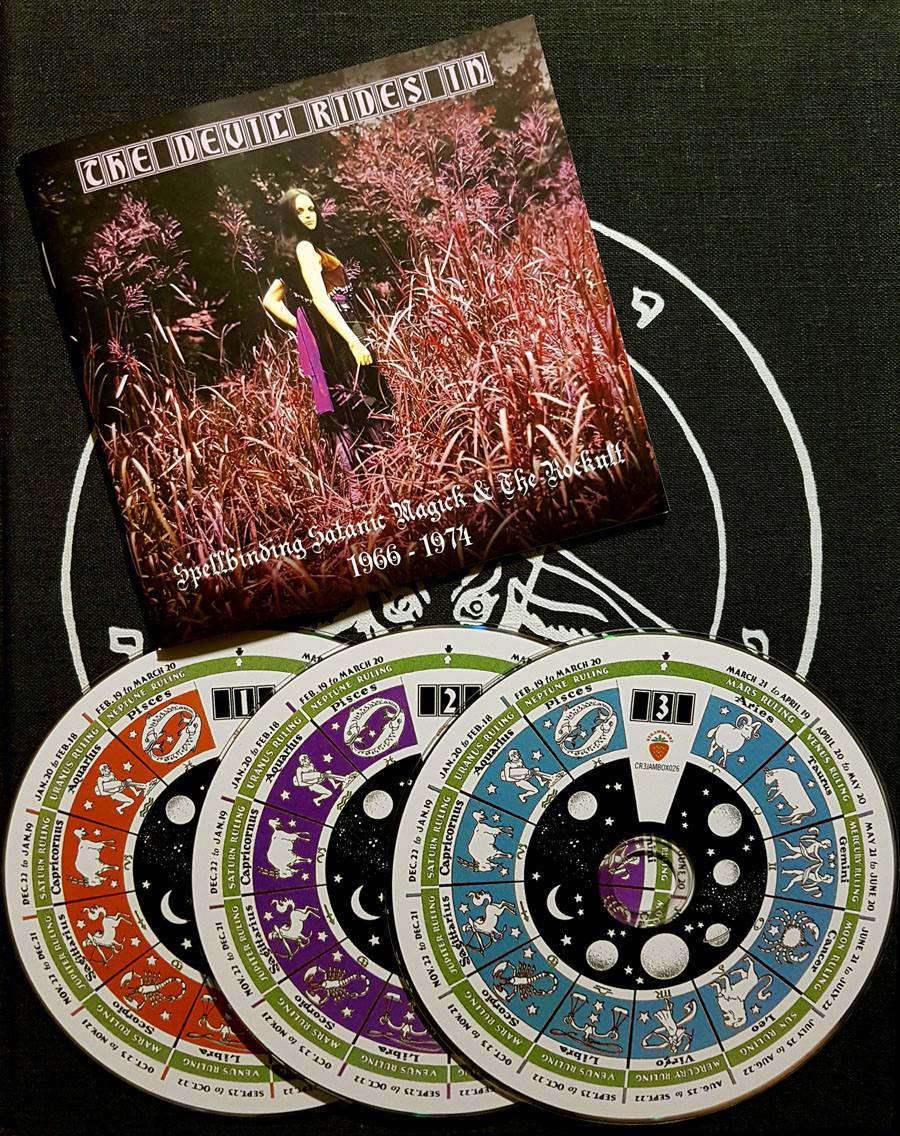
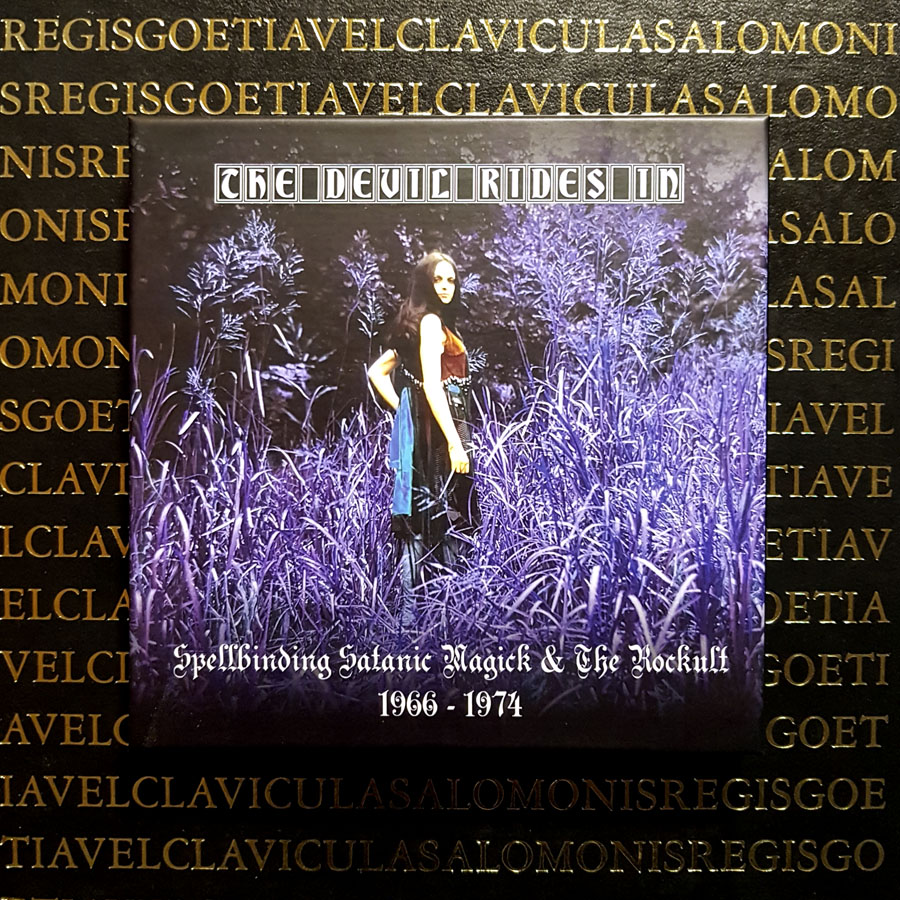
The Devil rode in at the weekend on three shiny compact discs crammed with Satanic psychedelia and the pentagram-branded rock music of the early 1970s: 55 tracks in all. I’d been hoping for some time that an enterprising anthologist might put together an officially-sanctioned collection like the series of mixes compiled by The Ghost of the Weed Garden. Cherry Red Records are ideal candidates for the task, having distinguished themselves in recent years with a series of multi-disc compilations that mine specific periods of British music: psychedelia, heavy rock, folk, punk, reggae, post-punk, experimental electronics, electro-pop, and so on. The Devil Rides In bears a subtitle that ties the collection to the prime years of the Occult Revival, “Spellbinding Satanic Magick & The Rockult 1966–1974”, a period when the Aquarian transcendence of the hippy world was jostling with darker trends in the media landscape. 1967 was the year the Beatles put Aleister Crowley on the cover of the Sgt Pepper album; it was also the year that Hammer were filming their first Dennis Wheatley adaptation, The Devil Rides Out. The song of the same name by Icarus appears on the second disc of this compilation, a single intended to capitalise on the publicity generated by the film. For all the serious occult interest that flourished during by this period many of the cultural associations were frivolous or superficial ones, either cash-ins like the Icarus single or exploitations by those who followed in Dennis Wheatley’s wake. Serious occultists no doubt abhorred the exploitation but it helped create a market for Man, Myth and Magic magazine, and for all the reprints of grimoires and other magical texts that were appearing in paperback for the first time. I’ve always enjoyed the frivolous side of the Occult Revival, probably because I grew up surrounded by it. Without Ace of Wands and Catweazle on the TV I might not have been so interested in my mother’s small collection of occult paperbacks, or gravitated eventually to the Religion and Spirituality shelves of the local library.

devil2.jpg

The Devil Rides In was conceived, designed and annotated by Martin Callomon, working here under the “Cally” pseudonym he uses for many of his activities. The accompanying booklet is evidence of a labour of love, the detailed notes being illustrated throughout with Occult Revival ephemera: film posters and magazines (the inevitable Man, Myth & Magic), also plenty of paperback covers which tend towards the lurid and exploitational end of the magical spectrum (the inevitable Dennis Wheatley). Cherry Red always take care with their sleeve notes but Cally’s booklet design has gone to considerable lengths to track down many obscure book covers, some of which I’d not seen before. The same diligence applies to the music, with the proviso that compilations are often restrained by the hazards of licensing law. There’s a track list on the Cherry Red page but this doesn’t tell you that the collection is divided into eight themed sections:

1) Buried Underground
2) Phantom Sabbaths
3) Popular Satanism
4) She Devils
5) Folk Devils
6) Evil Jazz
7) Beelzefunk
8) Let’s All Chant

Many of the selections on the first disc are the kinds of songs I’d usually avoid outside this collection, the lumbering heavy rock that filled the Vertigo catalogue for the first half of the 1970s. But groups that you wouldn’t want to hear at album length become palatable when placed in a context such as this.

blackwidow.jpg

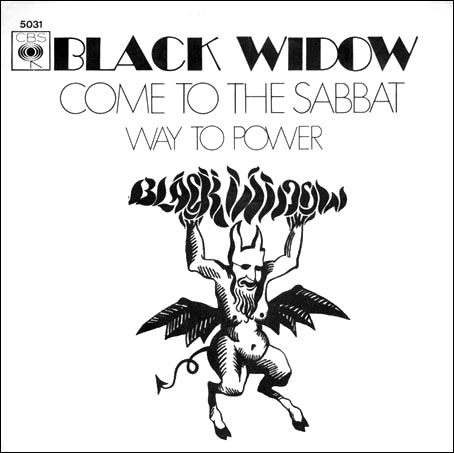
Among the immediate highlights I’d pick Race With The Devil by The Gun, already a favourite of mine by the group that launched Roger Dean’s career as a cover artist; Black Mass by Jason Crest, a psychedelic B-side whose subject matter and high-pitched wailing is a precursor of the heavy-metal future; and the perennially popular Come To The Sabbat by Black Widow. A few of the selections have been chosen more for their name than anything else, something I’m okay with so long as the choices are good ones. Cozy Powell’s Dance With The Devil, for example, is a drum-led instrumental with a musical theme swiped from Jimi Hendrix; it has nothing at all to do with the Devil but it’s still a great piece of music which was also a surprise UK chart hit in 1973. More of a reach is Magic Potion by The Open Mind, a song about psychedelic drugs not witches’ brews. I included this one on one of my psychedelic mixes so I can tolerate its presence here. Less tolerable is Long Black Magic Night by Jacula, an Italian prog band whose contribution features Vittoria Lo Turco as “Fiamma Dallo Spirito” stuck in one channel of the stereo mix where she intones monotonously in very poor English; the cumulative effect is diabolical in the wrong way. And I would have prefered Julie Driscoll’s long, slow version of Season Of The Witch instead of Sandie Shaw squeaking her way through Sympathy For The Devil. But you can’t always get what you want, as Mick Jagger reminds us elsewhere, something which is especially true of compilation albums.

Continue reading “Occult rock: The Devil Rides In”

Weekend links 697

munnings.jpg

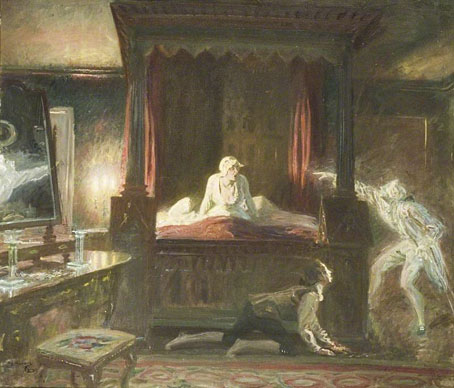
The Haunted Room, Painted at a Farmhouse on Exmoor (1952) by Alfred James Munnings.

• “In Scotland, children made terrifying jack-o’-lantern turnips and piled cabbage stalks around doors and windows, baiting fairies to bring them new siblings.” It’s that time of year again. Public Domain Review looks at The Book of Hallowe’en (1919) by Ruth Edna Kelley.

• At Wormwoodiana: Mark Valentine on the centenary of Visible and Invisible, EF Benson’s collection of horror stories.

• At Dennis Cooper’s: DC’s ostensibly favourite haunted attractions of Halloween season 2023 (international edition).

Mostly it was down to the environments of their sound. The aerial acrobatics of Fraser’s voice. The architecture of sound that came from Guthrie’s effects-treated guitars; not just the often-cited often-derided ‘cathedrals of sound’ but all manner of sunken ballrooms, tunnels, factories, attics, foundries, observatories, caverns. If any category was required, Cocteau Twins could have been placed within Symbolism, a hallucinatory death-rattle of romanticism in the industrial age, when all that had been discarded returned in dreams and decadence, orgiastic excess, disembodied spectral heads and ornate altars, lonely demons and alluring succubi, jewels and masks and apparitions, all the minutiae of things that the steam engine and the printing press had yet to fully exorcise.

Darran Anderson on the Cocteau Twins’ Head Over Heels at 40. His digs at the music press are a welcome riposte to the nostalgia that often attends discussion of the weekly snark-machine that was the NME, Sounds et al in the 1980s

• Follow the footsteps of the Beast in a guide to Aleister Crowley’s British haunts, with text by Gary Lachman and design by Michelle Merlin. Also at Herb Lester: Occult Paris: City of Night.

• At Print Magazine: Charlotte Beach talks to illustrator and author Edward Carey about his spooky drawings.

• “Silent movies are full of friendly ghosts.” Kathleen Rooney on Caspar, Colleen [Moore] and the Beyond.

• New music: Mizuniwa by Yui Onodera.

Spooksville (1963) by The Nu-Trends | Spooks (1981) by Tom-Tom Club | Spooky Rhodes (1997) by Laika