Weekend links 81

wittkamp.jpg

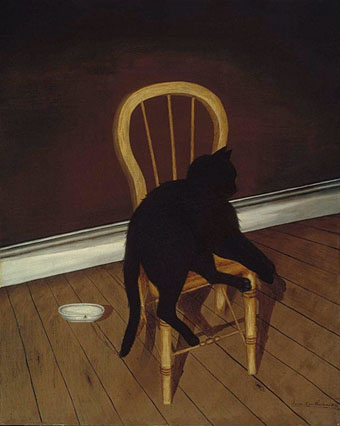
Black Cat on a Chair (1850–1860) by Andrew L Von Wittkamp.

• “A little bit of acid, lots of weed, and too much Castaneda and I was ready to move from the magical realm of Middle Earth into a world that was much stranger than any involving hairy dwarves and white wizards…” Too Much to Dream by Peter Bebergal, “a psychedelic American boyhood”.

This year’s Booker prize isn’t about the power of the new – there’s no experiment with form or strangeness of imagination. The winner may get on the bedside tables of middle England, but that’s not as important as changing the way that even one person dreams.

Jeanette Winterson throws the cat among the pigeons.

• 50 Watts continues to show us things you’d be hard-pressed to find elsewhere: illustrations by TagliaMani from a new edition of Les Chants de Maldoror, and War Is a Verb, collages by Allan Kausch.

• Don’t go in the swimming pool! Coilhouse directs us to Fantasy: music by French outfit DyE with a weird and nasty animation by Jérémie Périn.

• Ace album cover designer and photographic Surrealist Storm Thorgerson is having another exhibition at IG Gallery, London.

The Art of Leo and Diane Dillon, an art and illustration archive.

John Turturro reads a short story by Italo Calvino.

Spaceport America by Foster + Partners.

Your Body of Work by Olafur Eliasson.

Wonder-Cat cures all ailments.

Blogging Moby-Dick.

Krazy Kat (1927) by Frankie Trumbauer & His Orchestra with Bix and Lang | Pussy Cat Dues (1959) by Charles Mingus | Katzenmusik 5 (1979) by Michael Rother | Big Electric Cat (1982) by Adrian Belew | Purrfect (1996) by Funki Porcini.
Weekend links 80

holberg.jpg

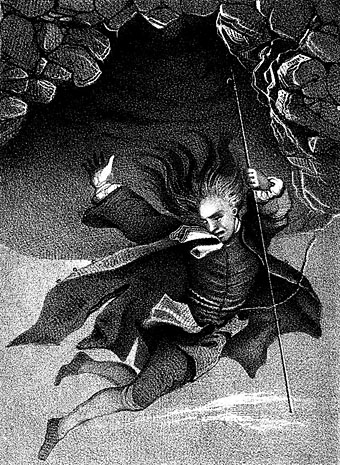
Niels Klim’s descent to the planet Nazar from the 1845 edition of Nicolai Klimii Iter Subterraneum (Niels Klim’s Underground Travels) (1741) by Ludvig Holberg.

BibliOdyssey posts illustrations from different editions of Ludvig Holberg’s satirical fantasy, appends the usual informative links and draws our attention Stories of a Hollow Earth at The Public Domain Review. I’d not come across the latter site before but it’s now bookmarked.

• While the economy of Europe continues to circle the toilet bowl it’s good to know that our Prime Minister is focusing on the important issues such as…limiting access to internet pornography. “Look at the implementation, and no matter where you stand on porn, I think you’ll see this plan is going to cause a lot of problems on its way to the eventual fail bin,” says Violet Blue. I was wondering how the four targeted ISPs would feel about a filtering plan that would drive many new customers elsewhere. The Register reports their response which comes down to offering guidelines rather than attempting the difficult and contentious task of filtering millions of websites.

• Related: Won’t you fuck off, Reg Bailey, in which the report by the small Christian pressure group that started all the fuss is eviscerated. | Elsewhere: Porn is good for society says Anna Arrowsmith, while Tristan Taormino asserts that “writing and publishing erotica, especially for minorities, is a political act.” Then there’s Pornsaints, “an artistic approach to porn, a pornographic approach to art, a pornartistic approach to religion.”

• In the music world: Richard H Kirk and Peter Care discuss Cabaret Voltaire and Johnny YesNo, Roy Harper talks to Alexis Petridis, and soundtrack composer Cliff Martinez is interviewed (and pictured playing a Cristal).

Witch’s Cradle at Strange Flowers (Maya Deren, Marcel Duchamp and Peggy Guggenheim), The Ghosts of Senate House, London, and Aleister Crowley’s Abbey of Thelema as it is today.

• RIP Frank Kameny, co-founder of the Mattachine Society, and a tireless gay rights advocate from the early 1960s on.

Bruce Weber photographs some of the dancers from Matthew Bourne’s Dance Company.

Terry Gilliam says “I used to think I could will things into existence. Not any more.”

• Charts at Business Insider: What the Wall Street protesters are so angry about.

Five From…: assorted wit and wisdom in the Tumblr labyrinth.

• Glass art by Jasmine Targett.

Ballard Geocoded.

Porno Base (1982) by 23 Skidoo | Kylie Minogue (2003) by Satanicpornocultshop | Tantric Porno (live) (2009) by Bardo Pond.

Brion Gysin’s walk, 1966

gysin.jpg

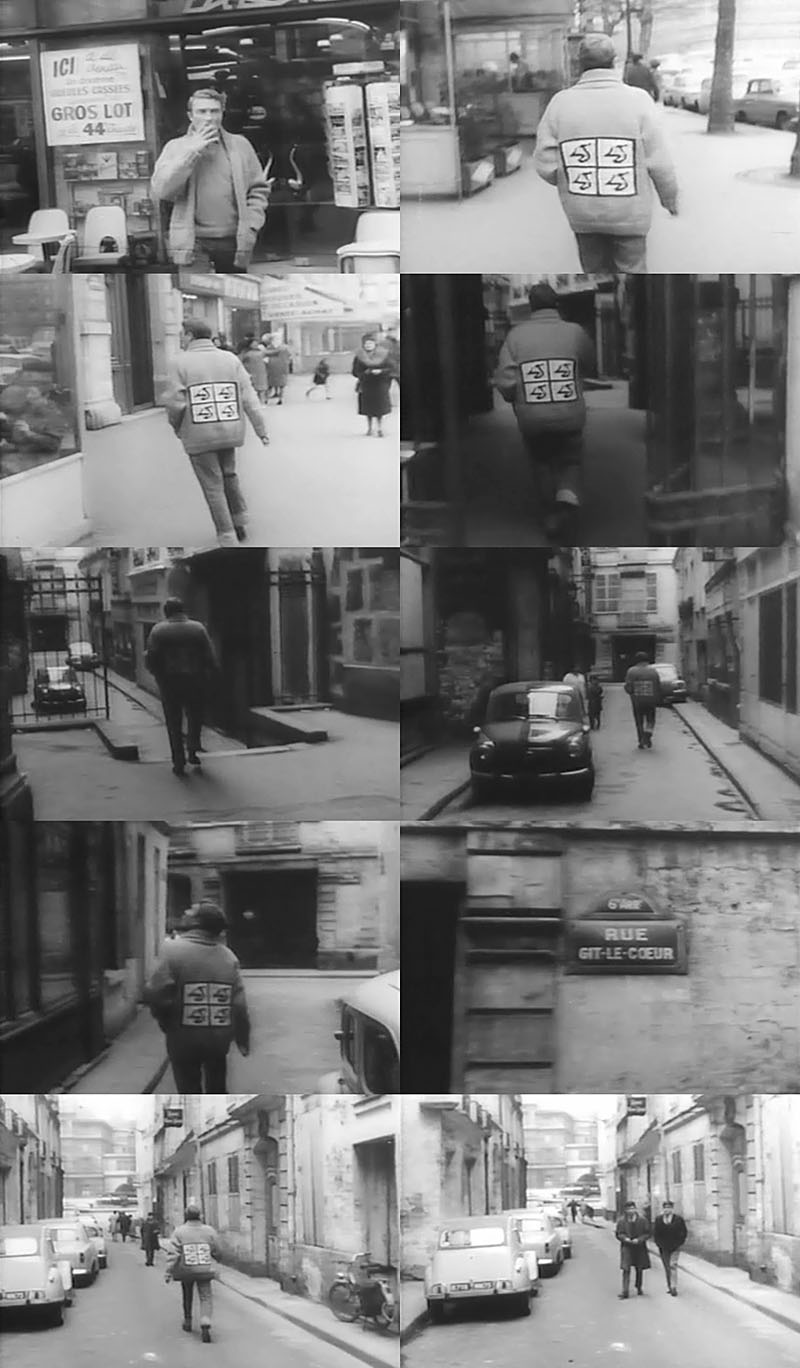
The Cut-Ups (1966).

More of the present preoccupation. Choosing Brion Gysin as a subject seems like a detour but the shots above are from Antony Balch’s 1966 film The Cut-Ups which also features William Burroughs, Ian Sommerville and someone-or-other’s cute boyfriend of the time who’s only ever credited as “Baby Zen”, a person about whom I know nothing at all.

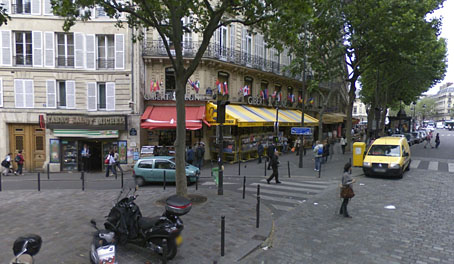
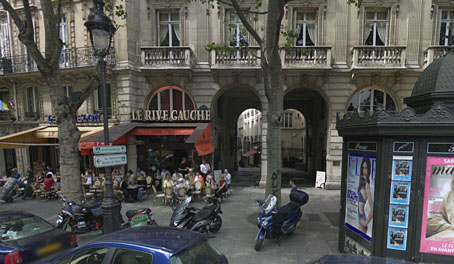
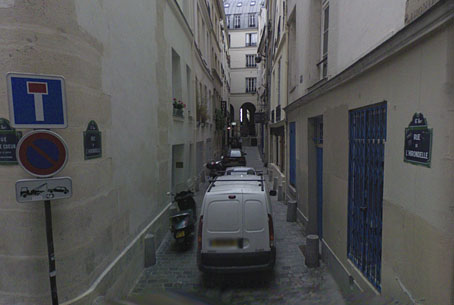
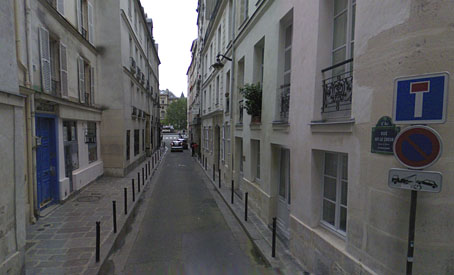
I first saw The Cut-Ups in video form projected on the screens of the Haçienda nightclub in Manchester during their Final Academy evening in 1982, an event at which Burroughs and John Giorno both gave readings. The film on that occasion was mixed with some of the other Antony Balch shorts including Towers Open Fire, and together they made a strong (and bewildering) impression. The Cut-Ups, as noted a few days ago, may have inspired some of the flash edits in Performance, although Nicolas Roeg had been cinematographer on Petulia for Richard Lester the year before, a film which uses similar Resnais-like flashbacks and flash-forwards. In Balch’s film several sequences each a foot in length are cut together at random, a process which was a lot more radical in 1966 than it looks today. The opening sequence shows Brion Gysin walking out of a shop, along a street, down an alley and into the Rue Git le Coeur where the Beat Hotel was located at no. 9, and into whose door he disappears. I visited the street the last time I was in Paris, and took a few snaps whilst there, but it wasn’t until I rewatched The Cut-Ups a couple of years later that I realised I’d made the same walk as Gysin, having inadvertently discovered the narrow passage (the Rue de L’Hirondelle) which connects Git le Coeur with the Boulevard Saint-Michel.

saintmichel1.jpg

The corner of the Boulevard Saint-Michel where Gysin’s walk begins.

The route can be traced (after a fashion) using Google’s Street View where the photos have the usual drawbacks of being positioned high in the air and with a field-of-view which makes narrow spaces look a lot more cramped than they seem when you’re there. For those who can’t visit Paris, however, you at least get a sense of the Latin Quarter, even though the area is a lot more gentrified today than it was in 1966. The Beat Hotel, as I’ve noted before, is now the expensive Hotel du Vieux Paris whose website makes no mention of their establishment having once been cheap lodgings for depraved writers, artists and junkies. As for the Gysin film, I still wonder where he began his walk: was it at the Tabac Saint-Michel or elsewhere? You can judge for yourself at Ubuweb which has a copy of The Cut-Ups in its Burroughs film collection.

saintmichel2.jpg

Rue de L’Hirondelle from the Boulevard Saint-Michel.

saintmichel3.jpg

Rue de L’Hirondelle from Rue Git le Coeur.

saintmichel4.jpg

Rue Git le Coeur looking towards the Seine. The former Beat Hotel is down the street on the right.

Elsewhere on { feuilleton }
The William Burroughs archive

Burroughs in Paris

wsb-paris1.jpg

William Burroughs and Maurice Gerodias.

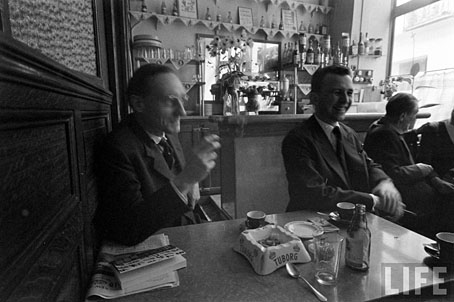
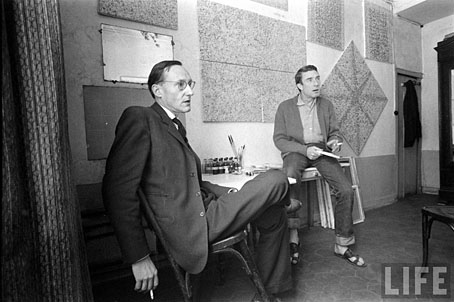
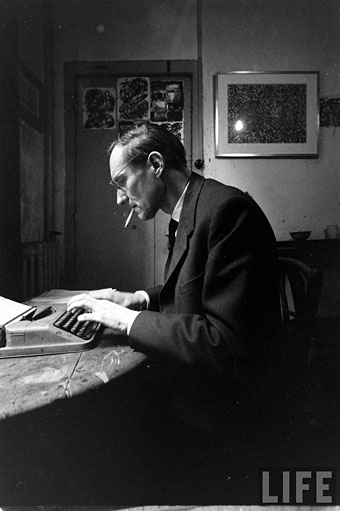
More specifically, William Burroughs photographed in 1959 for Life magazine by Loomis Dean. This was no doubt a story based around the publication of The Naked Lunch by Olympia Press: in the full set there’s shots of Burroughs with Olympia boss Maurice Gerodias, some pictures of the author signing copies of his novel (which can also be seen resting on the newspaper above), and many shots of the shabby interior of the Beat Hotel where the walls of Burroughs’ and Brion Gysin’s rooms are decorated with Gysin’s calligraphic paintings.

wsb-paris2.jpg

Burroughs and Gysin.

Over at the Time archives there’s an amusingly snotty review from 1962 of the first US publication of The Naked Lunch. The reviewer isn’t credited but they trot out details of Burroughs’ history with the implication that nasty people can’t possibly be good or worthwhile writers. In 1962 the Pulitzer Prize for Fiction was won by something called The Edge of Sadness by Edwin O’Connor. What? Who? Exactly.

wsb-paris3.jpg

Elsewhere on { feuilleton }
The William Burroughs archive

The recurrent pose 44

flandrin.jpg

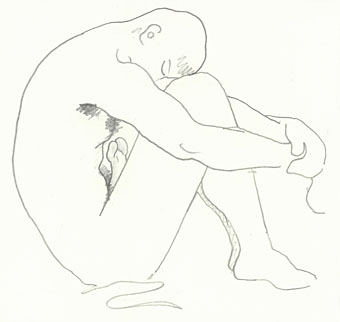
An item found in a collection of erotic drawings of dubious provenance, this piece is credited to Jean Cocteau. While I can’t be 100% certain it is Cocteau’s work it does closely resemble his other erotic drawings, and the rendering of the ear and hands is typical. Cocteau (or whoever) here does the obvious jokey thing with the Flandrin pose, something I’m surprised I haven’t seen already.

Elsewhere, Nathalie spotted a feature about the photography of Yannis Bournias which features another close variation as well as being gorgeous pictures in their own right.

Elsewhere on { feuilleton }
The recurrent pose archive

Previously on { feuilleton }
The writhing on the wall
Le livre blanc by Jean Cocteau
Cocteau’s sword
Cristalophonics: searching for the Cocteau sound
Cocteau at the Louvre des Antiquaires
La Villa Santo Sospir by Jean Cocteau