Friends and Spectres

spectres1.jpg

Presenting my latest cover illustration for Swan River Press, and another story collection edited by Robert Lloyd Parry:

Friends and Spectres is a companion volume to Ghosts of the Chit-Chat (2020), an anthology of ghost stories by authors who had been members of the Cambridge University Chit-Chat Club along with M. R. James. Here the associations with MRJ are less formal, but stronger and more enduring: for it is the bond of genuine friendship that ties these writers to him.

The majority of pieces here were originally published under pseudonyms, and over half appeared first in amateur magazines or local newspapers. All deal with the supernatural, and several of the stories are themselves spectres—or more properly “revenants”, only now re-emerging into the light after decades of oblivion. There are rediscoveries here of “lost” tales by Arthur Reed Ropes, E. G. Swain, and the enigmatic “B.”

My cover for the earlier volume showed an imaginary interior for one of the meetings of the Chit-Chat Club where James first read his own ghost stories. The new cover shows a more accurate exterior view of the grounds outside the King’s College Chapel. Given the quantity of pictorial reference I thought this might be relatively easy to do but I had a problem finding a view that matched the one I had in mind, a twilight view of the west end of the chapel seen front-on rather than at a sharp angle. Views of the chapel from the banks of the river have been standing as an emblem of the university itself for a very long time but the majority of these are angled views. My solution was to work from a collage of three different reference photos in order to have enough drawing to fill out the spread of the jacket.

spectres2.jpg

Friends and Spectres is another of Swan River’s small hardbacks which in this case is limited to 500 copies. Given the following that Mr Parry has accumulated via his readings of James’ stories I imagine this one will go quickly, so anyone interested is advised to pre-order now.

Previously on { feuilleton }
Ghosts of the Chit-Chat

Weekend links 729

demorgan.jpg

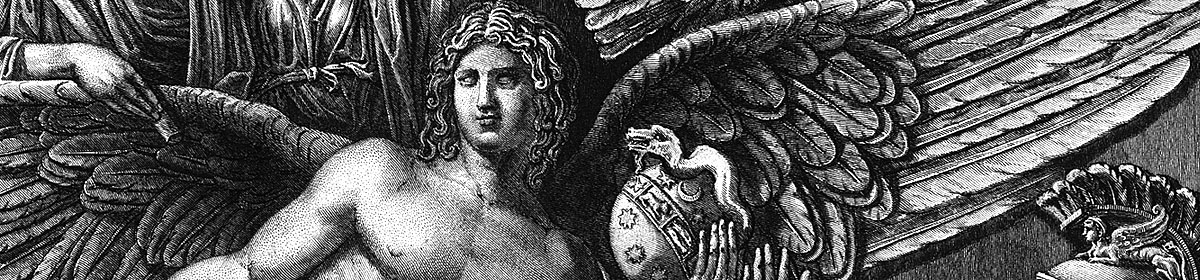
Phosphorus and Hesperus (1881) by Evelyn De Morgan.

• Mix of the week, or possibly the entire year: The Deep Ark, 167 tracks (over 8 hours of music), most of which are from the electronic deluge of the early 1990s. The download link may not work for all browsers—it didn’t for one of mine—but it is active. Via Simon Reynolds who has more about the Deep Ark project.

• At Nautilus: Betsy Mason on the use of stage magic to investigate animal behaviour. “By performing tricks for birds, monkeys, and other creatures, researchers hope to learn how they perceive and think about their world.”

• At The Daily Heller: Mad and the Usual Gang of Idiots. Meanwhile, Mr Heller’s font of the month may prove useful for this election season, a Jonathan Barnbrook design named Moron.

Looking back, you can see a pattern in those eras in which interest in telepathy boomed. Coined by Myers and his fellow psychical researchers in the 1880s, telepathy gained traction because it was formulated inside a moment of scientific and technological revolution, where uncanny transmissions proliferated across the visible and invisible spectrum, seeming to collapse the natural and the supernatural together. In the 1970s, telepathy returned, if under different names, as part of another moment of crisis. The Cold War arms race was an essential part of this, feeding a strange supplemental world of fantasy technologies, from mind control to brainwashing, and playing on an all-too-widespread psychological paranoia around being seen, infiltrated and manipulated by invisible agents.

Roger Luckhurst looks back at a century of psychic research

• New music: Portable Reality Generator by Field Lines Cartographer, and Sublime Eternal Love by Chrystabell and David Lynch.

• Coffee and Chocolates for Two Guitars: Robert Fripp interviewing John McLaughlin in July, 1982.

• Paintings by Ithell Colquhoun currently showing at the Ben Hunter gallery, London.

• At Public Domain Review: Eye Miniatures (ca. 1790–1810).

ESP (1965) by Miles Davis | ESP (1990) by Deee-lite | ESP (2002) by Comets On Fire

Phaeton: The Son of the Sun

phaeton1.jpg

The animation collection at the Internet Archive has been improving of late, with a wider variety of uploads being added to the already copious quantities of American cartoons and Japanese anime. Last week I drew attention to Jan Lenica’s Adam 2. This week it’s the turn of Phaeton: The Son of the Sun (1972), a short Russian film written and directed by Vasiliy Livanov which is a curious combination of ancient myth and science fiction. Phaeton in Greek mythology was the son of Helios the sun god, a minor deity whose demise is related in the first part of Livanov’s film. The son takes his father’s fiery chariot for a ride across the sky after being warned about the damage the chariot’s flames may cause if it strays to close to the world below or too far from it. Phaeton’s poor horsemanship provokes a spate of natural disasters until Zeus ends the ride with a fatal thunderbolt.

phaeton2.jpg

This tale of cosmological destruction informs the “Phaeton hypothesis”, a 17th-century theory which sought to explain the existence of the Solar System’s asteroid belt as the remains of a destroyed planet, a body which a German linguist, Johann Gottlieb Radlof, named after the doomed god. The second part of Livanov’s film concerns a group of cosmonauts being launched into the asteroids in order to investigate the theory. The film is too short to properly explore the subject but the discussion detours briefly into ancient astronaut territory; Livanov had evidently been reading one or more of Erich von Däniken’s specious books which were topping the bestseller lists in 1972. One of the “astronaut” figures seen during the explication is the same Japanese figurine that von Däniken reproduces in Chariots of the Gods?, a book whose title echoes the theme of Livanov’s film. Short as it is, Phaeton: The Son of the Sun is nicely styled, and features the voice of Nikolay Burlyaev, an actor familiar to Tarkovsky aficionados as the boy in Ivan’s Childhood.

(Note: The Internet Archive has English subtitles for this one as a separate text file. You can get these to work by saving them in a folder along with the film file then changing the subtitle extension from txt to srt. Video applications such as VLC autoload subtitles if they’re stored in the film folder with the correct extension and a name that matches that of the film file.)

Previously on { feuilleton }
Crank book covers
The Heat of a Thousand Suns by Pierre Kast

The art of Vojtech Preissig, 1873–1944

preissig19.jpg

Self-portrait.

There are times when one of my searches for work by an unfamiliar artist turns up results that are much more varied than I anticipated. Vojtech Preissig is one such artist, a Czech graphic designer, printmaker and typographer whose name I’d only registered in the past via digital revivals of his type designs. Preissig’s career follows a similar trajectory to that of his contemporary František Kupka: both artists started out working their own variations on fin-de-siècle art—Symbolism in Kupka’s case, Art Nouveau design in Preissig’s—before finding their way to abstraction in the 1930s. Both artists also worked for a time with Alphonse Mucha in Paris, until Preissig moved to the USA where he spent a number of years teaching.

preissig03.jpg

When reading about European artists of this generation there’s always the question of how they fared during the Second World War. Preissig was among the less fortunate. After his return to Prague he spent his last few years putting his print skills to the service of the Czech Resistance. He ended his days in the concentration camp at Dachau.

A monograph, Vojtech Preissig by Lucie Vlckova, was published in 2012.

preissig05.jpg

Day (1899).

preissig04.jpg

Night (1899).

preissig01.jpg

Dreaming (1899).

Continue reading “The art of Vojtech Preissig, 1873–1944”

Weekend links 728

wadsworth.jpg

Composition: Cones and Spirals (1929) by Edward Alexander Wadsworth.

• “Repeating items over and over, called maintenance rehearsal, is not the most effective strategy for remembering. Instead, actors engage in elaborative rehearsal, focusing their attention on the meaning of the material and associating it with information they already know.” John Seamon on the vicissitudes of memory, and how actors remember their lines.

• “Mary McCarthy described it as ‘Fabergé gem, a clockwork toy, a chess problem, an infernal machine, a trap to catch reviewers, a cat-and-mouse game, and do-it-yourself novel’, among other things.” Mary Gaitskill on the pleasures and difficulties of Nabokov’s greatest novel, Pale Fire. Also a reminder that I ought to read it again.

• New music: Movement, Before All Flowers by Max Richter; A Thread, Silvered And Trembling by Drew McDowall; Unspeakable Visions by Michel Banabila.

• Among the new titles at Standard Ebooks, the home of free, high-quality, public-domain texts: Ulysses by James Joyce.

• The latest cartographical design from Herb Lester Associates is Facts Concerning HP Lovecraft and His Environs.

• At the Daily Heller: A look back at the craze for poster stamps.

• Mix of the week: A tuning mix for The Wire by Tashi Wada.

• At Dennis Cooper’s: Michael Lonsdale Day.

Annie Hogan’s favourite music.

Clockworks (1975) by Laurie Spiegel | Tin Toy Clockwork Train (1985) by The Dukes Of Stratosphear | Clockwork Horoscope (2008) by Belbury Poly