Borges and the cats

borges1.jpg

To a cat

Mirrors are not more wrapt in silences
nor the arriving dawn more secretive;
you, in the moonlight, are that panther figure
which we can only spy at from a distance.
By the mysterious functioning of some
divine decree, we seek you out in vain;
remoter than the Ganges or the sunset,
yours is the solitude, yours is the secret.
Your back allows the tentative caress
my hand extends. And you have condescended
since that forever, now oblivion,
to take love from a flattering human hand.
You live in other time, lord of your realm —
a world as closed and separate as dream.

Jorge Luis Borges (translated by Alastair Reid, 1977)

There are many tigers in the writings of Borges—the poem above is from a collection entitled The Gold of the Tigers—so it’s no surprise that the author would pay his respects to their domestic relatives. Regarding translations (and this is something I’ve noted before), those by Anthony Kerrigan, Alastair Reid, Norman Thomas di Giovanni and others were made with the author’s approval, and sometimes with his collaboration. The more recent translations by the Borges estate are poor in comparison.

Many more photos of cats with their writers may be seen here.

borges4.jpg

Grove Press, 1994.

borges2.jpg

borges5.jpg

Debolsillo, 2011.

borges6.jpg

Previously on { feuilleton }
Invasion, a film by Hugo Santiago
Spiderweb, a film by Paul Miller
The Library of Babel by Érik Desmazières
Books Borges never wrote
Borges and I
Borges documentary
Borges in Performance

Weekend links 211

shau.jpg

Secret Bloom (2014) by Natalie Shau.

Bloomsday approachs. “Reading Ulysses changed everything I thought about language, and everything I understood about what a book could do,” says Eimear McBride whose debut novel, A Girl Is a Half-formed Thing, recently won the first Bailey’s women’s prize for fiction. McBride was interviewed by Susanna Rustin last month, shortly before the award was announced, and her novel has now become one of those minor causes célèbres for being rejected so often it was eventually published by a new imprint set up by a bookseller. “If the publishing industry doesn’t take a risk then who will?” asks Henry Layte, the bookseller in question.

Speaking of risk, David Hebblethwaite coincidentally wrote a post earlier this week asking where the formal challenge has gone in science-fiction writing. (He mentions McBride in passing.) Nina Allen followed up with a post of her own. I suspect the books are still being written but they’re no longer being accepted by editors and publishers who want even more adventure stories, “sympathetic” characters, and easy reads. Novels that only aspire to be written equivalents of action films or computer games are doomed to be less exciting than their more kinetic competitors. The struggle between the values of art and the values of entertainment is an old one but it shouldn’t be an either/or proposition. “Difficulty is subjective,” says Eimear McBride, “the demands a writer makes on a reader can be perceived as a compliment.”

Related: the following from Geoffrey Hill on “difficulty”:

We are difficult. Human beings are difficult. We’re difficult to ourselves, we’re difficult to each other. And we are mysteries to ourselves, we are mysteries to each other. One encounters in any ordinary day far more real difficulty than one confronts in the most “intellectual” piece of work.

• The Quietus pulled out all the stops this week, interviewing Annette Peacock, Iain Sinclair (again), Alan Moore (again), and asking Peter Strickland, the director of Berberian Sound Studio, for a list of his favourite albums. Given the above, it’s worth noting that all those people have produced challenging work of their own in different media.

• “The Satyrs Motorcycle Club was founded in 1954 with seven members, but little did anyone know it would become the oldest running LGBT organization (and oldest gay motorcycle club) in the world.”

Trunk TV posted another great selection of television title sequences. The previous selection has been taken down for the usual tiresome copyright reasons so watch this one while you can.

• “Detroit techno and black metal have so much in common,” say Wolves In The Throne Room whose new album, Celestite, is predominantly a product of synthesizer technology.

• “Houghton Library’s copy of Arsène Houssaye’s Des destinées de l’ame (FC8.H8177.879dc) is without a doubt bound in human skin.”

• The secret of Nabokov’s sexual style: David Lodge reviews Nabokov’s Eros and the Poetics of Desire by Maurice Couturier.

• How long can you hold your breath? 2 models, 7 divers in an underwater shipwreck by photographer Von Wong.

• At Dangerous Minds: Paul Gallagher on The fantastic world of Sharmanka Kinetic Theatre.

• Wizards of the Coast: Benjamin Breen on John Dee and the occult in California.

• More photography: Peter Guenzel captures strange lights in forests.

• Mix of the week: Bleep podcast 121 presented by Margot Didsbury.

I’m The One (1972) by Annette Peacock | Eros Arriving (1982) by Bill Nelson | The Dire And Ever Circling Wolves (2005) by Earth


Weekend links 210

usaoov.jpg

Crashing Diseases And Incurable Airplanes (2014) by USA Out Of Vietnam. Artwork by Amy Torok.

Amy Torok’s cover art for the debut album by Canadian band USA Out Of Vietnam is pleasingly reminiscent of the surreal and psychedelic collages of Wilfried Sätty. The music within has been described as “a cross between ELO and Sunn O)))” which it is up to a point, although to these ears the group are more in the Sunn O))) camp than the post-Beatles pop of Jeff Lynne and co. The sound is big whatever label you apply, and promises much for the future.

Mysterious creatures of Monterey Bay Aquarium’s ‘Tentacles’. The Aquarium bought one of my drawings last year for this exhibition which juxtaposes tentacular artwork with live creatures. The show runs until 2016.

• Jon Hassell’s 1990 album, City: Works Of Fiction, has been reissued in an expanded edition including a live concert collaboration with Brian Eno, and a collection of remixes/alternate takes.

• Photographer Jonathan Keys uses antique camera equipment to give his views of contemporary Britain a patina of the past.

Roman Polanski and the man who invented masochism. Nicholas Blincoe on Leopold von Sacher-Masoch and Venus in Fur (sic).

• Mixes of the week are by James Pianta, E.M.M.A. (whose Blue Gardens album I helped design), and Balduin.

• Sweet Jane unearths another great article about psychedelic London: The Fool and Apple Boutique, 1968.

• “Did Chris Marker think history to be not only an infinite book but a sacred one?” asks Barry Schwabsky.

• Front Free Endpaper on the story behind the cover photo of A Boy’s Own Story by Edmund White.

Mapping the Viennese Alien Event Site. Christina Scholz explores another Zone.

Moondog: The Viking of 6th Avenue. The first and only movie about Moondog.

Rick Poynor on rediscovering the lost art of the typewriter.

• At BLDGBLOG: 100 Views of a Drowning World.

Miguel Chevalier’s magic carpets

Venus In Furs (1967) by The Velvet Underground | Sex Voodoo Venus (1985) by Helios Creed | Venus As A Boy (1993) by Björk

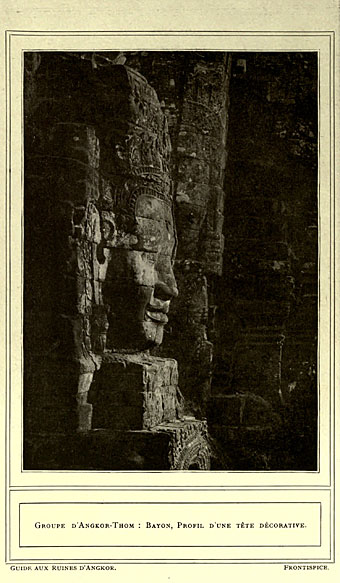
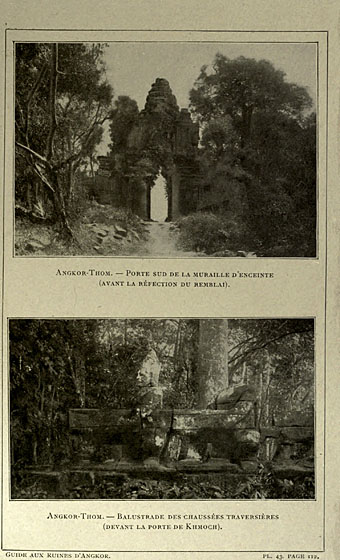
Guide aux Ruines d’Angkor

angkor22.jpg

These photographs of Angkor Vat (sic), Angkor Thom, and some of the smaller Cambodian temples show the difference between the overgrown ruins of 1912 and today’s domesticated tourist attraction. Guide aux Ruines d’Angkor by Jean Commaille contains many more photos plus maps of the grounds and plans of the temple construction. The depredations of the jungle would eventually have destroyed everything but I still prefer to see the walls and statues festooned with foliage.

angkor09.jpg

angkor10.jpg

angkor11.jpg

Continue reading “Guide aux Ruines d’Angkor”

Angkor Wat street view

angkor1.jpg

The ruined temple complex of Angkor Wat is another of those places for which I maintain a cult fascination despite never having been there. I’ve posted links to panoramas of Angkor Wat in the past but Google recently added the complex to their Street View catalogue, so you now have the opportunity to see the fabled Nagas in their natural habitat: surrounded by garishly-clad tourists.

A large part of the attraction of places such as this involves the promise of deterioration and isolation, two qualities kept remote by the site’s World Heritage status. I imagine a visit to Angkor would be like the visit I paid to the ruins of Hadrian’s villa outside Rome, the well-tended bones of a formerly splendid construction. Hadrian’s villa is still worth a visit even if you won’t ever see it overgrown by foliage the way it was in Piranesi’s day.

angkor2.jpg

angkor3.jpg

angkor4.jpg

Continue reading “Angkor Wat street view”