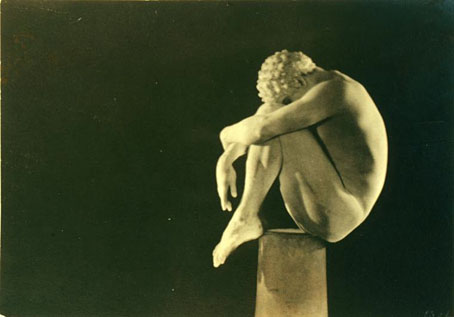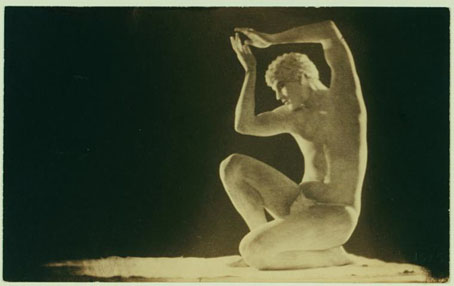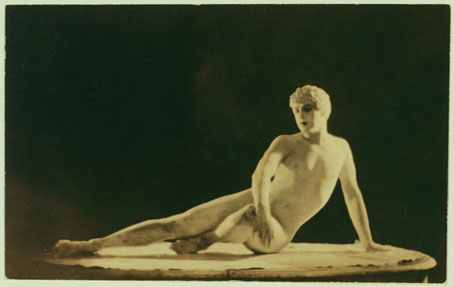
Following some leads about American dancer Ted Shawn (1891–1972) turned up this series of photos from 1923 in which he adopts the Flandrin pose whilst enacting “The Death of Adonis”. The series is from a large collection of Shawn photos at the NYPL Digital Gallery. The dancer had dark hair which has here been covered by a light wig in order to convey a statue-like appearance. Poses plastiques, as they were known, were a common Victorian form of titillation which enabled variety audiences to admire near-naked women and men masquerading as living statuary or as figures from mythology and famous paintings. As with many Victorian fashions, they persisted into the early 20th century. Ted Shawn at this time was still married to dancer Ruth St Denis, and the pair had no qualms about displaying their bodies tastefully for the camera. Shawn is a fascinating figure so there’ll be a little more about him tomorrow.
Chute Libre science fiction

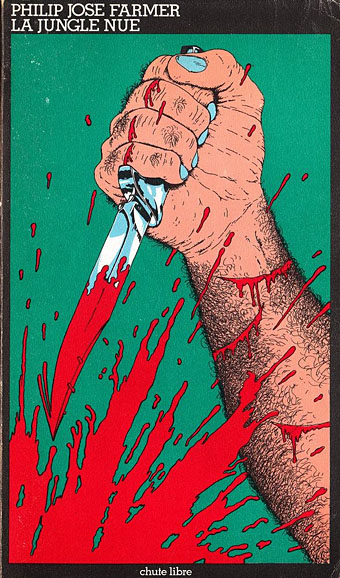
La Jungle Nue (A Feast Unknown, 1974). Illustration de Alain Le Saux.
Chute libre means “free fall” in French, and here refers to an imprint of French publisher Champ Libre that from 1974 to 1978 reprinted a series of science fiction titles under that name. The imprint is notable for a number of reasons, not least the striking covers which impress with their uniform design and bold imagery. The combination of black cover with vivid artwork is very similar to the covers Penguin were producing for their SF titles a few years earlier but since there’s little written anywhere about the French books I can’t say whether this was an influence or merely coincidence. I’ve not been able to find a complete list of all the illustrators either. At least two of the covers are the work of Moebius, rare examples of him being commissioned outside the comics medium.
The other notable aspect of the imprint is the books themselves which are an odd mix of the outrageous and sexually provocative end of SF spectrum, together with more usual fare. Some of the covers play to the provocation more than is necessary: Michael Moorcock has always been pleased by the attention his work receives in France but I’ll bet he hates that cover. Several of these titles appeared as SF in the 1970s because of other work by their authors despite there being nothing overtly science fictional about The Atrocity Exhibition or Breakfast in the Ruins. Farmer’s A Feast Unknown and The Image of the Beast/Blown are violent and sexually excessive, and feature little genre material, but managed to slide onto the SF shelves for the same reason. Every so often I wonder whether any of these books (or books like them) would be offered to, or accepted by, genre publishers today.
As usual, if anyone can supply information about the missing illustrators then please leave a comment.
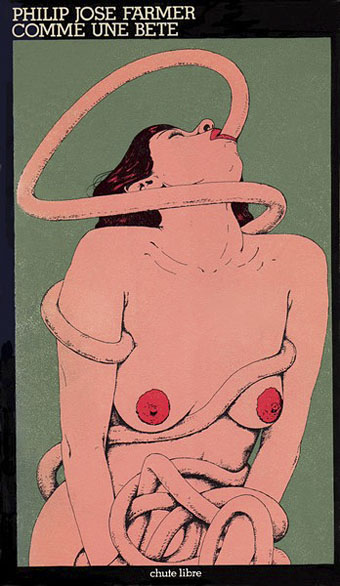
Comme une Bête (Image of the Beast, 1974). Illustration by Moebius.
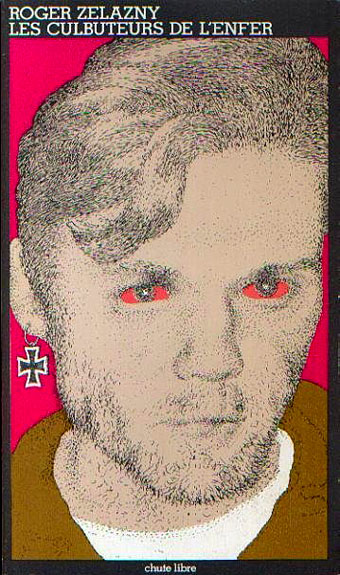
Les Culbuteurs de l’Enfer (Damnation Alley, 1974). Illustration by Jean-Claude Castelli.
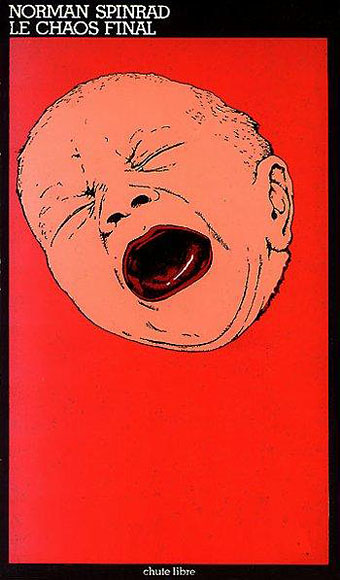
Le Chaos Final (The Men in the Jungle, 1974).
More from the Decadent Dutch
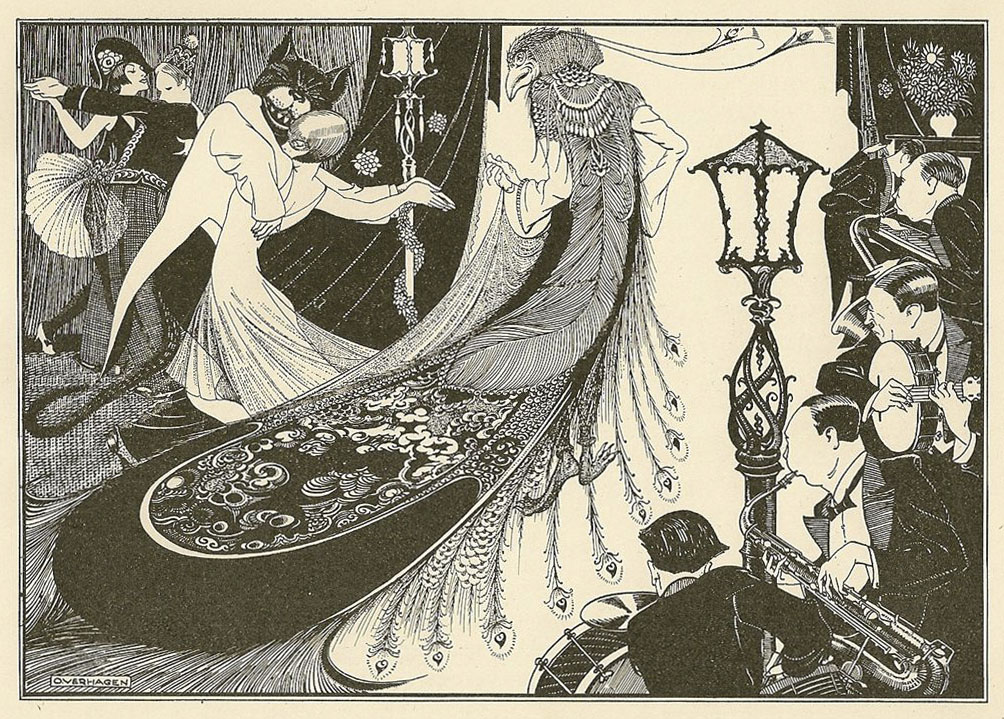
Illustration by Otto Verhagen from Yolanda – Het Boek van Bloei (1931) by Nan Copijn.
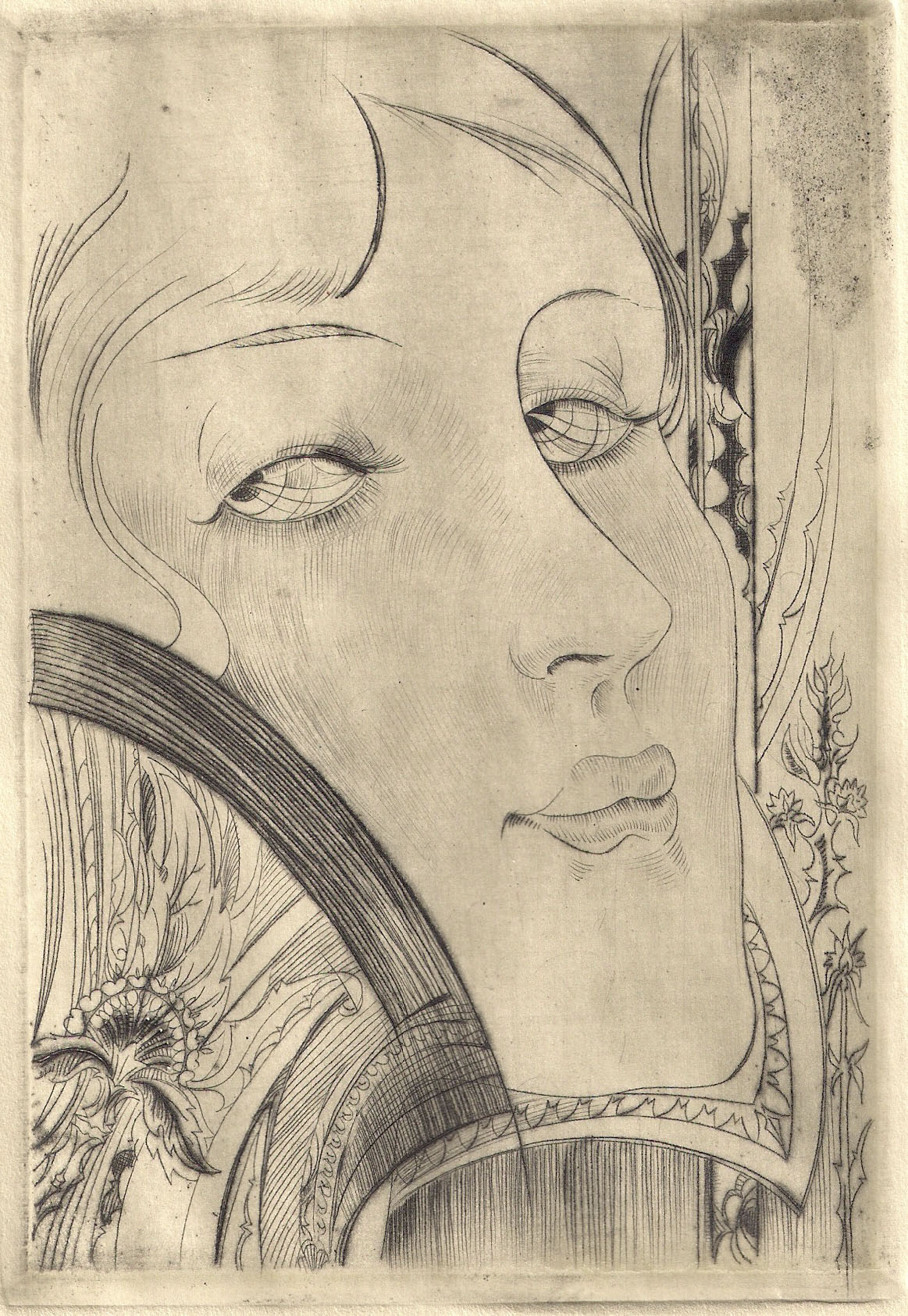
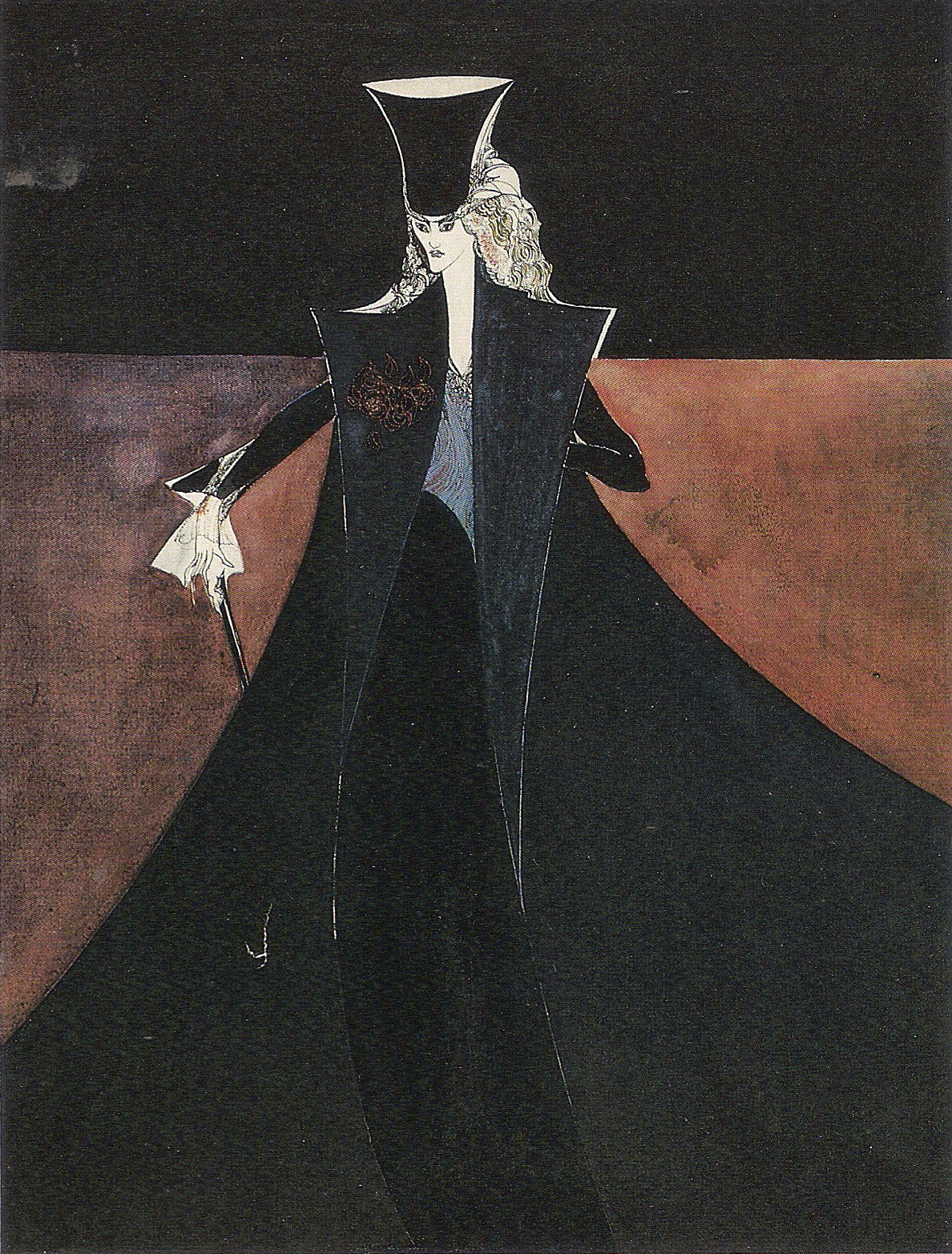
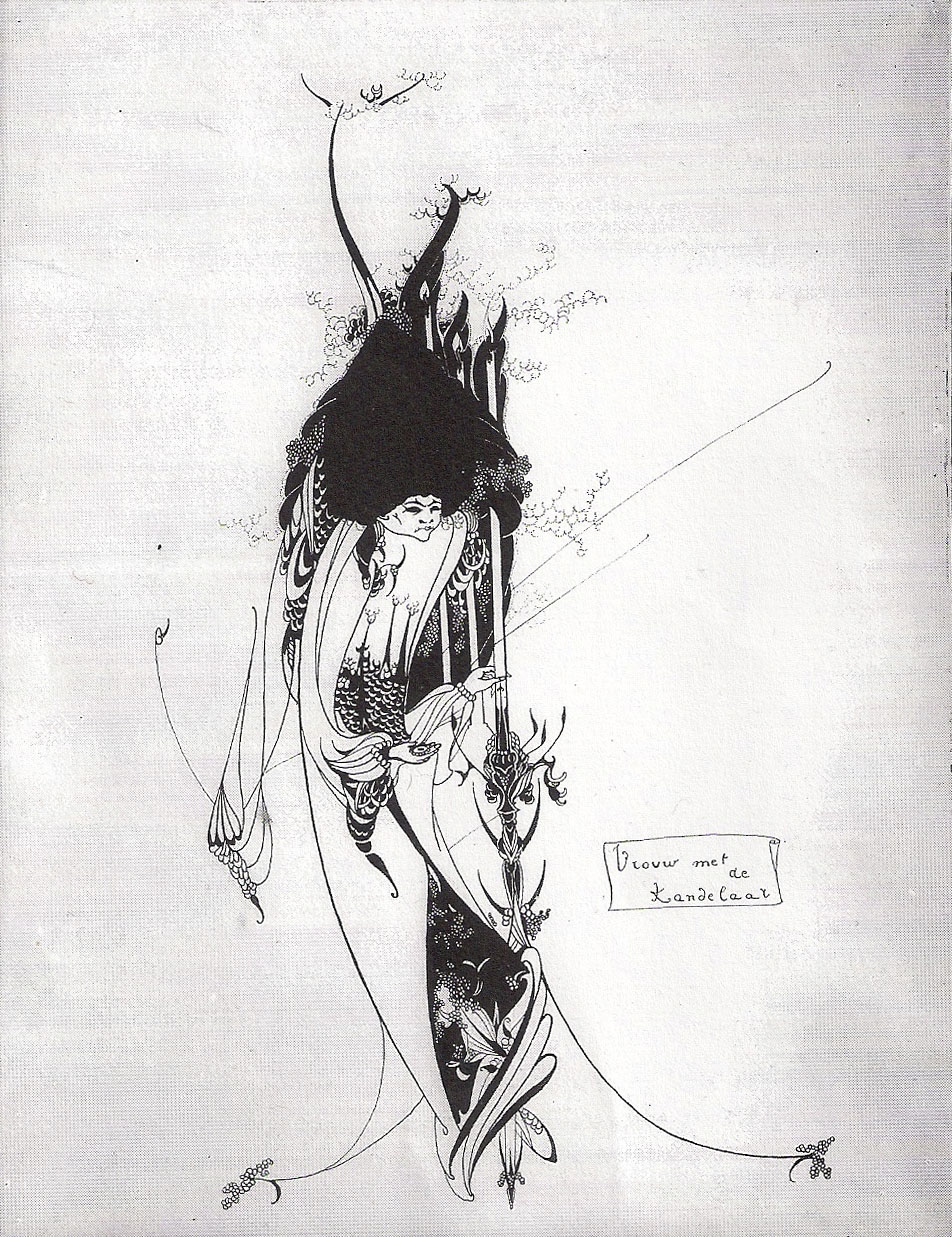
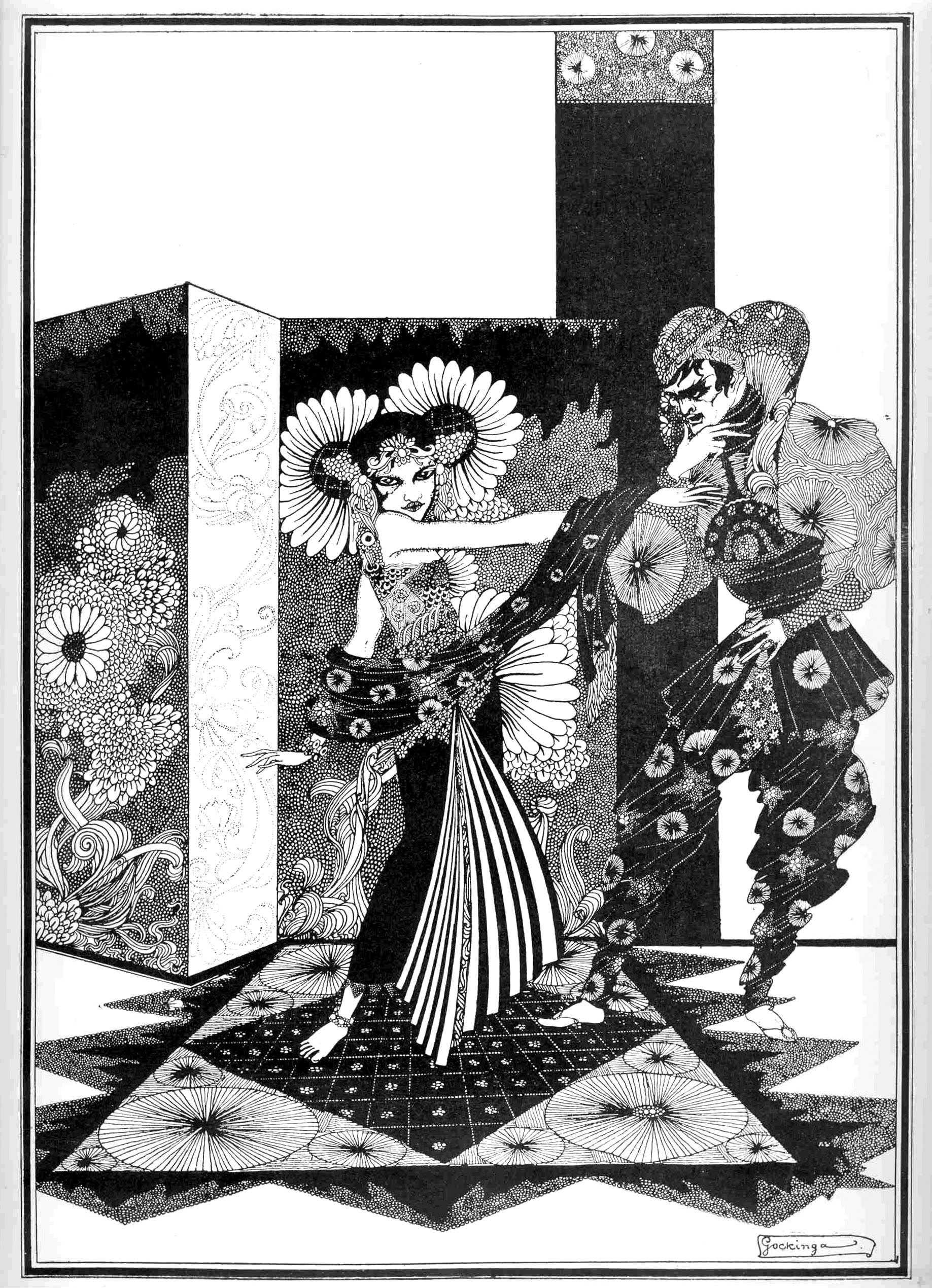
Would-be Decadents is perhaps a better label, the Decadent ship having set sail across an absinthe-tinted sea by the time these artists were putting pen to paper. Their drawings are another set of scarce images forwarded by Sander Bink who maintains the Rond1900 site. (See this earlier post for further examples.) Sandor also sent artwork details which I’ve quoted below. In addition to yet more overt Beardsley influence (the Verhagen above and René Gockinga’s woman with a candle) there’s also a striking Harry Clarke influence in the second Gockinga drawing which is closer to Clarke’s idiosyncratic style than (for example) these later drawings by Cardwell Higgins. Seeing one artist borrow the mannerisms of another is a common thing; far less common is finding an artist who adopts different styles the way Gockinga does. Incidentally, the Couperin novel mentioned below was published with a typically elegant cover design by Symbolist artist Jan Toorop.
(Thanks again Sander!)
Otto Verhagen. Illustration (not used as such) for Couperus’ Psyche (1898). Engraving, ca 1913. Collection Sander Bink. This is a personage from the story but to me it looks somewhat like an Oscar Wilde portrait!
Illustration for the very popular fairy tale for adults Psyche by Louis Couperus (1863–1923). You might have heard of Couperus: Oscar Wilde appreciated his decadent, somewhat homosexual, novel Noodlot (1890), translated as Footsteps of fate. Some letters were exchanged. Couperus’ wife Elisabeth translated Dorian Gray in 1893. (First Dutch translation.)
Sortie (1904) by Carel de Nerée tot Babberich. Museum of Modern Art, Arnhem (from De Neree catalogue, 1986). Verhagen’s Dorian Gray seems to be influenced by this.
Woman with candle by René Gockinga, ca 1916. Current location unknown.
Indonesian lady dancing [as I call it—SB] by René Gockinga. From the Indonesian satirical-political periodical De Zweep [The Whip] 1922.
Previously on { feuilleton }
• Further echoes of Aubrey
• A Wilde Night
• Echoes of Aubrey
• After Beardsley by Chris James
• Illustrating Poe #1: Aubrey Beardsley
• The art of Karel de Nerée tot Babberich, 1880–1909
• Beardsley’s Rape of the Lock
• The Savoy magazine
• Beardsley at the V&A
• Merely fanciful or grotesque
• Aubrey Beardsley’s musical afterlife
• Aubrey by John Selwyn Gilbert
• “Weirdsley Daubery”: Beardsley and Punch
• Alla Nazimova’s Salomé
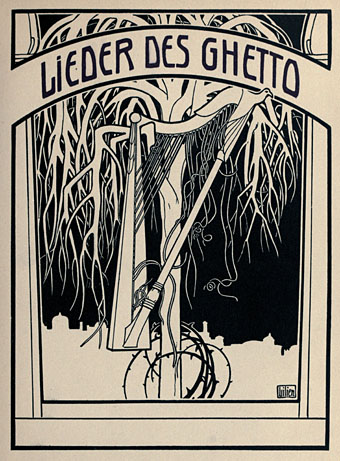
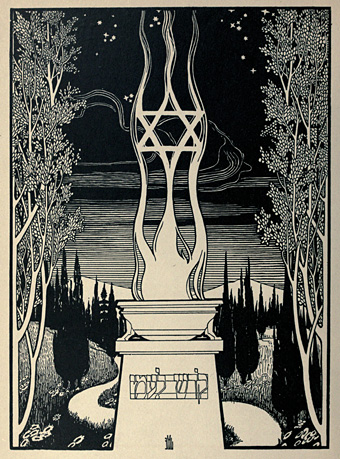
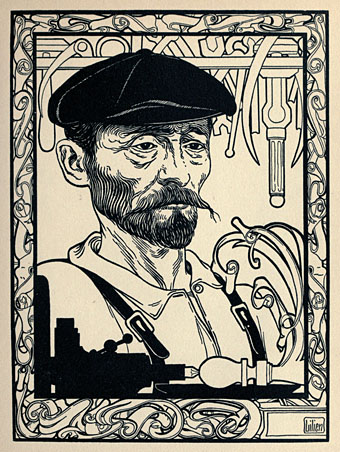
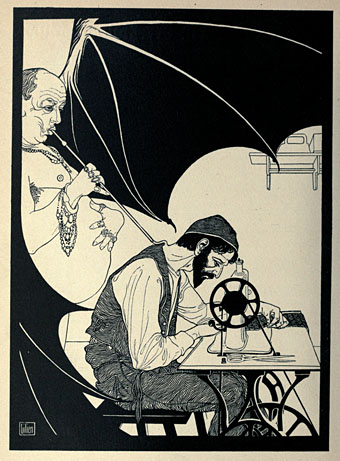
Ephraim Moses Lilien’s Lieder des Ghetto

There are no golems in Morris Rosenfeld’s Songs of the Ghetto (1899), translated here by Berthold Feiwel for a German readership as Lieder des Ghetto (1902). But the Berlin edition does contain many superb full-page illustrations and embellishments by Ephraim Moses Lilien (1874–1925), a German artist whose work has featured here on a number of occasions. I’d seen a couple of these drawings before but hadn’t quite registered the pronounced Beardsley influence until now. Aubrey had only died four years before this book was published, and while Lilien’s style is strong enough to establish its own identity you can find a Beardsley-like quality not only in the heavy blacks and areas of white, but also in the border designs, the treatment of landscape and foliage, and even the jewellery on the demon figure below, details which resemble the similar jewellery on Beardsley’s title page for the story of Ali Baba. There’s more of Lilien’s work at this Flickr set while the rest of the book may be browsed or downloaded at the Internet Archive.


More Golems
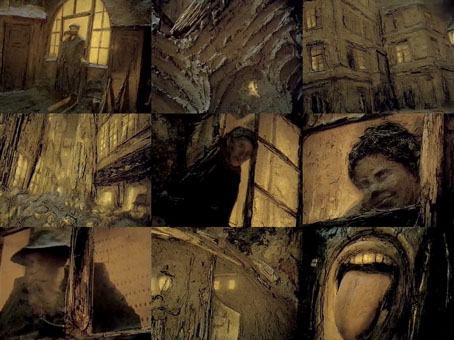
Golem by Jiri Barta.
There are always more golems. Among recent reading I’ve been catching up with the works of Michael Chabon, and have just finished The Amazing Adventures of Kavalier & Clay (2000), a novel concerned with several things that obsessed me when I was 13, namely Harry Houdini, conjuring tricks and the Empire State Building. Chabon even acknowledges JC Cannell’s The Secrets of Houdini, a book I re-read many times trying in vain to learn some of Houdini’s card tricks. What didn’t obsess me at that age happens to be the main subject of the novel: superhero comics. Chabon does a good job of communicating the enthusiasm that powered the early days of the American comics industry, however, and I can appreciate the enthusiasm that history generates for him even if I don’t quite share it. Lurking at the back of his story is the mute and symbolic figure of Rabbi Loew’s Golem of Prague, mention of which prompted me to see whether Czech animator Jiří Barta had managed to complete his film of the Golem story, a project which has been stalled since the 1990s. He hasn’t, unfortunately, but there is a trailer which I hadn’t seen before, a sight that makes the prospect even more tantalising. Someone give this man some money to finish his film.
Emet (2009).
Elsewhere, there’s Emet by Bonsaininja Studio, Milan, a short steampunk take on the Golem creation story. Great use of CGI and digital animation but I’d still prefer to see Barta’s version. Meanwhile, the whole of Paul Wegener’s The Golem: How He Came into the World (1920) is now on YouTube. If you’ve never seen Wegener stomping around medieval Prague with his shopping basket then here’s your chance.
See also:
• Golem: The Recipe For Life by Michael Chabon
Previously on { feuilleton }
• Hodgson versus Houdini
• Das Haus zur letzten Latern
• Hugo Steiner-Prag’s Golem
• Barta’s Golem