Charles Ricketts’ Salomé

ricketts1.jpg

Here is my scheme. I proposed a black floor – upon which Salomé’s white feet would show; this statement was meant to capture Wilde. The sky was to be a rich turquoise blue, and across by the perpendicular fall of strips of gilt matting, which should not touch the ground, and so form a sort of aerial tent above the terrace. Did Wilde actually suggest the division of the actors into separate masses of colour, today the idea seems mine! His was the scheme, however, that the Jews should be in yellow, the Romans were to be in purple, the soldiers in bronze green, and John in white. Over the dresses of Salomé, the discussions were endless: should she be black “like the night”? Silver, “like the moon”? Or – here the suggestion is Wilde’s – “green like a curious poisonous lizard”? I desired that the moonlight should fall upon the ground, the source not being seen; Wilde himself hugged the idea of some “strange dim pattern in the sky”.

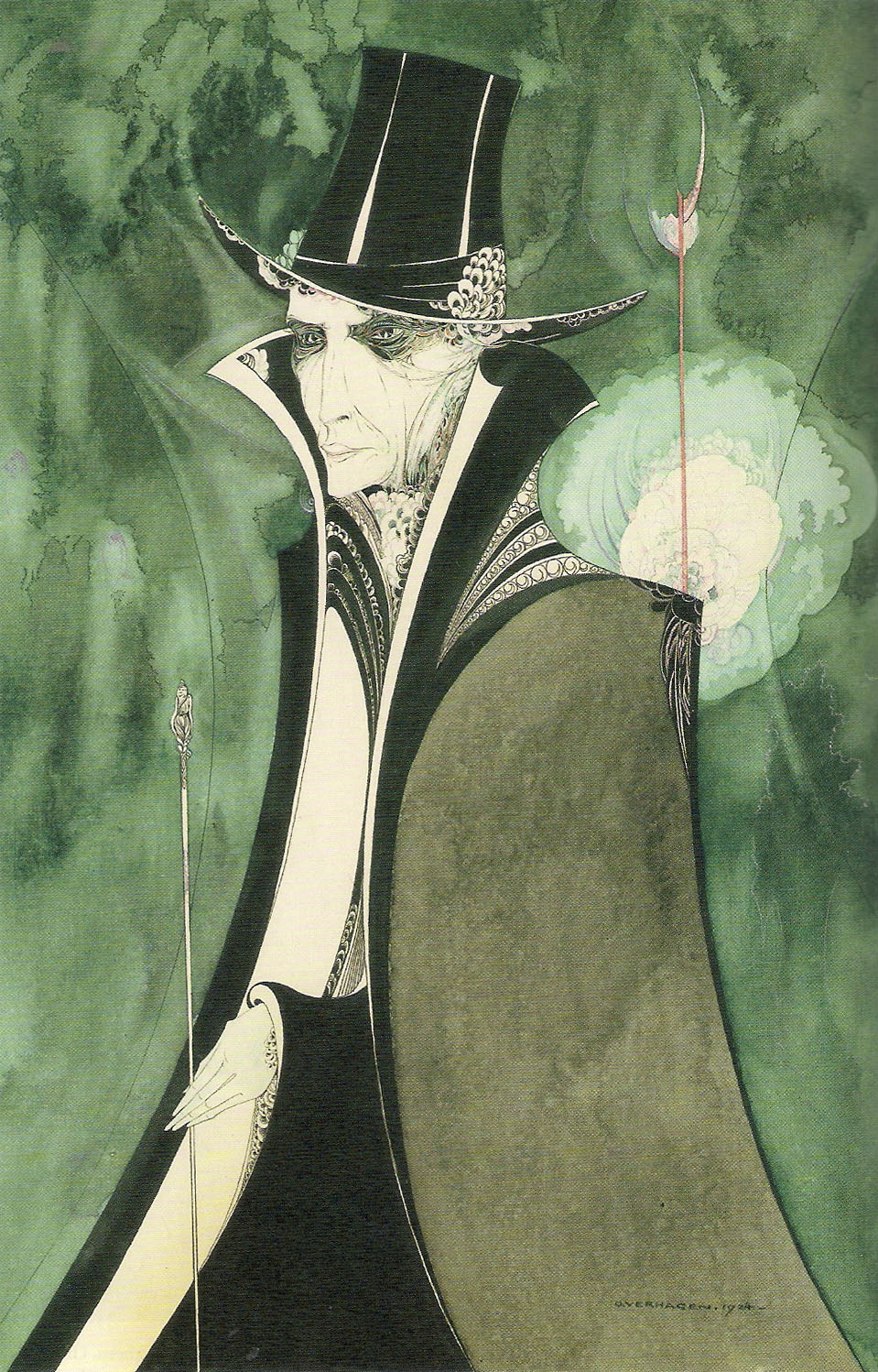
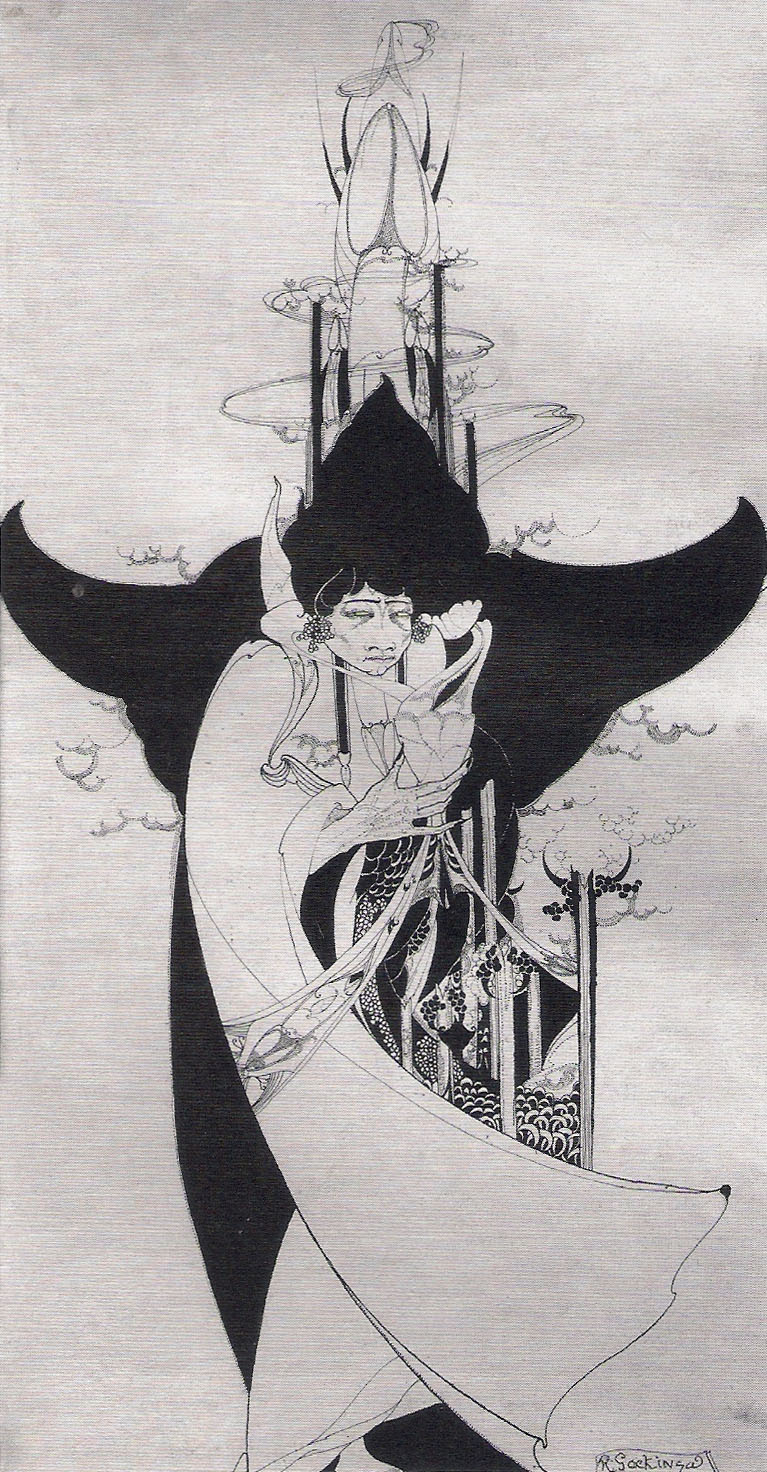
Thus artist, designer, publisher and writer Charles Ricketts (1866–1931), describing in later years his proposal for what would have been the first staging of Oscar Wilde’s Salomé in London. The scheme never materialised since the play was banned but Ricketts did create costume and stage designs for subsequent productions elsewhere, including performances in Japan in 1920. The V&A has Ricketts’ sketch of the stage for a private production in 1906 by the Literary Theatre Society, London. (The ban on Biblical themes in theatre kept the play from public performance in London until 1931.) In the Tate archives there’s what may be one of Ricketts’ costume designs from the Japanese production. Ricketts’ painting of Salomé dates from 1925, and for such a lurid and passionate subject seems rather passionless and inert. This isn’t so surprising, he was always a better designer and graphic artist than a painter; his lifelong partner, Charles Shannon, was the one who excelled with oils.

And speaking of Ricketts and Shannon, searching around turned up this recent blog devoted to the pair which contains much detail about their celebrated book designs.

ricketts2.jpg

Elsewhere on { feuilleton }
The Salomé archive

Previously on { feuilleton }
Charles Ricketts’ Hero and Leander

Albert Robida’s Vieux Paris

vieux1.jpg

After several posts about Albert Robida it seems more-or-less mandatory to write something about his spectacular creation for the Paris Exposition Universelle of 1900. “Vieux Paris” was an elaborate theme park-style attraction that sought to recreate some of the lost buildings of medieval Paris on the right bank of the Seine, a short distance from the Trocadero. (The international pavilions were situated on the opposite bank.) Robida is remembered today for his science fiction but he was given this job as a result of books such as Paris de siècle en siècle; le coeur de Paris, splendeurs et souvenirs (1896) which explored life in the historic city. Vieux Paris was planned by the artist, with the buildings being created by a team of architects under the direction of Léon Benouville. As with modern theme parks, teams of actors and other staff were costumed in order to convey the requisite period flavour. The birds-eye drawing is the best view I’ve seen of the construction, the pages being from Albert Quantin’s L’Exposition du siècle.

vieux2.jpg

From the Brooklyn Museum’s Flickr set.

vieux3.jpg

Photo by Michel Berthaud at Luna Commons.

Previously on { feuilleton }
The End of Books, 1894
Le Vingtième Siècle by Albert Robida
La Vie Électrique by Albert Robida
The Lumière Brothers at the Exposition Universelle
Le Grand Globe Céleste, 1900
Tony Grubhofer’s Exposition Universelle sketches
The Cambodian Pavilion, Paris, 1900
Le Manoir a l’Envers
Suchard at the Exposition Universelle
Esquisses Décoratives by René Binet
Le Palais de l’Optique, 1900
Exposition Universelle films
Exposition jewellery
Exposition Universelle catalogue
Exposition Universelle publications
Exposition cornucopia
Return to the Exposition Universelle
The Palais Lumineux
Louis Bonnier’s exposition dreams
Exposition Universelle, 1900

The End of Books, 1894

robidabooks01.jpg

More illustrations from Albert Robida, and a riposte to anyone thinking that the idea of the end of books is a recent thing. This article by bibliophile Octave Uzanne appeared in Volume 16 of Scribner’s Magazine (July–December 1894). The piece opens with a description of various scientists and artists at a Royal Society evening making predictions about life in the future. Among other proposals there’s that old saw of science fiction, the meal of condensed nutrients which would supposedly put an end to world hunger. Uzanne’s account of the future of the book involves authors speaking their works into recording devices. Despite Robida’s somewhat comic extrapolations Uzanne seemed to have been semi-serious; even if he wasn’t he made a good job of predicting audio books, and (after a fashion) television: those wanting illustrations would have images projected by one of Edison’s Kinetoscopes.

There will be registering cylinders as light as celluloid penholders, capable of containing five or six hundred words and working up on very tenuous axles, and occupying not more than five square inches; all the vibrations of the voice will be reproduced in them; we shall attain to perfection in this apparatus as surely as we have obtained precision in the smallest and most ornamental watches.

As to the electricity, that will often be found in the individual himself. Each will work his pocket apparatus by a fluent current ingeniously set in action; the whole system may be kept in a simple opera-glass case, and suspended by a strap from the shoulder.

As for the book, or let us rather say, for by that time books “will have lived,” as for the novel, or the storyograph, the author will become his own publisher. To avoid imitations and counterfeits he will be obliged, first of all, to go to the Patent-Office, there to deposit his voice, and register its lowest and highest notes, giving all the counter-hearings necessary for the recognition of any imitation of his deposit. The Government will realize great profits by these patents.

The full article may be read here.

robidabooks02.jpg

robidabooks03.jpg

Continue reading “The End of Books, 1894”

Le Vingtième Siècle by Albert Robida

robidasiecle01.jpg

More 19th-century futurism from French illustrator and author Albert Robida. Le Vingtième Siècle was published in 1883, and is a far more comical look at life in the 20th century than La Vie Électrique, showing a future where most of the airships are shaped like enormous fish. This is a copiously illustrated volume of over 500 pages so the selection is again limited. These examples are taken from a copy at Gallica but some of the larger drawings can be seen in higher quality at this Flickr set.

robidasiecle02.jpg

robidasiecle03.jpg

Continue reading “Le Vingtième Siècle by Albert Robida”

La Vie Électrique by Albert Robida

robidavie01.jpg

Albert Robida (1848–1926), a French illustrator and writer, might be less well-known today had he not authored several books which attempt to predict what life might be like in the 20th century. He was sufficiently well-regarded in his lifetime to be given the task of imagining “Old Paris” for one of the attractions at that cult event of mine, the Exposition Universelle of 1900. These days his work mostly appears in histories of science fiction as a result of books such as Le Vingtième Siècle: La Vie Électrique, a comic novel published in 1890 that looks at French life in the distant year of 1955. The attitude may be humorous, with a drawing style that resembles the contraptions of William Heath Robinson rendered by Gustave Doré, but some of Robida’s predictions are as prescient as those of HG Wells. The inhabitants of France in the 1950s may still dress like those in the 1890s but they communicate via “Téléphonoscope” while the military wage biological and chemical warfare. The usual fleets of fanciful airships fill the skies; the idea that everyone in the future would be the owner of a flying-machine goes back a long way. Robida also shows submarines, transit tubes connecting cities, and pollution caused by the new technologies.

La Vie Électrique is copiously illustrated so the selection here is a necessarily small sample. Anyone wishing to see the whole book can browse it or download it at the Internet Archive.

robidavie02.jpg

robidavie03.jpg

robidavie04.jpg

Continue reading “La Vie Électrique by Albert Robida”