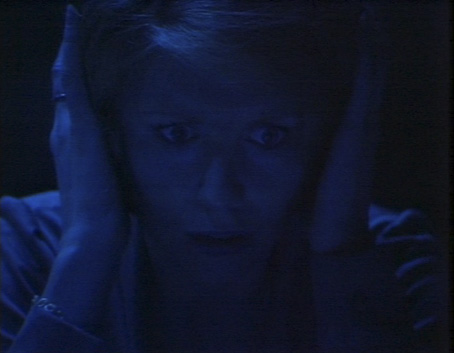
Salomé by Upside Down House

salome1985.jpg

Big thanks to Mr. Kenneth at Radio Shirley for drawing my attention to this 1985 music video by Australian group Upside Down House. From their brief listing at Discogs the group don’t seem to have lasted long or released a great deal, Salomé being their second and final single. Given the quality of the music that’s not too surprising, you need someone like Jarboe to do justice to this theme. But the video is remarkably good for a low-budget imitation of silent cinema. The verisimilitude is no doubt a result of director Bob Eagle having used a hand-cranked camera which gives that distinctive flickering effect, a common feature of silent films which sound cameras and digital filters seldom replicate with any accuracy. The wildly emoting femme fatale is Kathleen Stewart, now better known as a novelist.

Elsewhere on { feuilleton }
The Salomé archive

Vampyroteuthis Infernalis by Vilém Flusser

vampyroteuthis.jpg

Cover design by Michel Vrana.

This, then, is the book that arrived a fortnight ago when I just happened to be in the midst of a week of tentacle posts. Vampyroteuthis Infernalis: A Treatise, with a Report by the Institut Scientifique de Recherche Paranaturaliste was originally published in Germany in 1987. This new edition is the first translation into English (by Valentine A. Pakis) published by the University of Minnesota Press in their Posthumanities series. It’s 100 pages long with a supplement of squid illustrations by Louis Bec. It is, to say the least, an odd book:

Part scientific treatise, part spoof, part philosophical discourse, part fable, Vampyroteuthis Infernalis gives its author ample room to ruminate on human—and nonhuman—life. Considering the human condition along with the vampire squid/octopus condition seems appropriate because “we are both products of an absurd coincidence…we are poorly programmed beings full of defects,” Flusser writes. Among other things, “we are both banished from much of life’s domain: it into the abyss, we onto the surfaces of the continents. We have both lost our original home, the beach, and we both live in constrained conditions.”

I’m not familiar with Flusser’s other work since I read few academic texts but it seems safe to assume that Vampyroteuthis Infernalis is an exception among the author’s volumes of media and communication theory. The tone is light but not overly comic unless you regard as inherently amusing Flusser’s analysis of an obscure cephalopod—the Vampyroteuthis Infernalis (the name translates as “vampire squid from hell”)—as a useful tool for studying the human condition. The study so far as it goes is along the lines of some of the essays by Jorge Luis Borges rather than any lengthy disquisition, looking at the squid’s existence from a number of angles in order to draw comparisons with human life. You wouldn’t think it easy to talk about “squid culture” or “squid politics” but Flusser manages:

…we are able to imagine cultural structures (“Utopias”) in which even our biological constraints are done away with. The vampyroteuthis cannot fathom Utopias, for the structure of its society is not a cultural product (it is not a “factum”) but rather a biological given (a “datum”). When it engages in politics, it does so against its own “nature”—it commits a violent act against itself. In the end, however, is not all human political activity contra nature?

And so on. In Borges terms (for me he’s the obvious touchstone) the book is reminiscent of the Chronicles of Bustos Domecq (1967), a series of deadpan essays about absurd cultural developments credited to one “H. Bustos Domecq” but written by Borges and Adolfo Bioy Casares. Flusser lived in Brazil for a number of years so Borges may have been an inspiration. Like Borges, Flusser is learned enough to write convincingly about his subject before he starts evading the reader’s grasp. The opening of Vampyroteuthis Infernalis is a creditable and informative run through the Octopoda taxonomy; later we have references and terminology from Heidegger, and Wilhelm Reich makes a surprising appearance. Many of the parallels are ingenious, such as when Flusser compares our electronic media—the glowing screens of televisions and computer monitors—to the glowing chromatophors on the skin of the squid which the animal uses to communicate in the lightless depths of the sea. Flusser ends on another Borgesian note, describing his “fable” as offering “an image of the self reflected between two facing mirrors”. Perhaps that’s the best way to regard this book: a continual play of reflections all of which would vanish if one of the mirrors were removed.

Those who wish to lose themselves in the reflections can order the book in hardback or paperback direct from the University of Minnesota Press. Elsewhere there’s a fair amount of Vampyroteuthis Infernalis footage on YouTube which reveals the animal in question to be as wonderfully strange as its name would imply.

Previously on { feuilleton }
Le Poulpe Colossal
Fascinating tentacula

Design as virus 15: David Pelham’s Clockwork Orange

clockworkbook.jpg

Design by David Pelham (1972).

Continuing an occasional series. Pity the poor designer who has to create a new cover for Anthony Burgess’s novel when David Pelham’s Penguin cover—created in haste forty years ago—is more visible than ever. Pelham’s design is a familiar sight on these pages but it’s also an increasingly familiar sight elsewhere, having become the primary visual signifier not only of the novel itself but also the novel’s entanglement with Stanley Kubrick’s film. Burgess came to resent the cult power of the film and the way it inflated the status of one of his early novels whilst overshadowing the rest of his work. The book still overshadows his other novels but what’s interesting now, fifty years after it was published, and forty years on from Pelham’s cover design, is seeing the novel clawing back some of the territory ceded to the film, in part because of that memorable cog-eyed face. What follows is a look at some of the subsequent reworkings of Pelham’s design.

clockworkposter1.jpg

Artwork by Philip Castle, design by Bill Gold (1971).

It’s necessary to mention the original poster art first since the fat title typography gets reused more than any other part of the film’s publicity. The poster was also indirectly responsible for Pelham’s cover design when Kubrick denied Penguin any use of his promotional material:

Barry Trengove had designed a delightful cover for the Penguin edition of A Clockwork Orange and then the movie came along. While the Penguin marketing department was desperate to tie in with the film graphics, the director of the movie Stanley Kubrick wasn’t at all interested in tying in with the book. Consequently I was given the task of commissioning an illustration that gave the impression of being a movie poster. Sadly I was subsequently let down very badly by an accomplished airbrush artist and designer (whose name I will keep to myself), who kept calling for yet more time and who eventually turned in a very poor job very late. I had to reject it which was a hateful thing to have to do because we were now right out of time.

[…]

Well there I am, late in the day and having to create a cover for A Clockwork Orange under pressure. Already seriously out of time I worked up an idea on tracing paper overnight, ordering front cover repro from the typesetter around 4.00 am. I remember that my type mark-up was collected by a motorcycle messenger around about 5.00 am. Later that morning, in the office, I drew the black line work you see here on a matt plastic acetate sheet, specifying colours to the separator on an overlay while the back cover repro was being pasted up by my loyal assistants who had the scalpel skills of brain surgeons. I had wonderful assistants, absolutely wonderful.

Then more motorcycle messengers roaring around London in large crash helmets; and some days later I would see a proof. In those days, that was quick! Since those times I have often been amused to notice that my hurried nocturnal effort of so long ago appears to have achieved something of iconic status, for I’ve seen this cog-eyed image on fly-posters in Colombia, on t-shirts in Turkey, and put to a variety of uses in Canada, Los Angeles and New York. Because I did it, I spot it. Its like walking into a room where a party’s going on and, although the room is buzzing with conversation, if somebody simply mentions your name in conversation you immediately pick it up because it’s so familiar.

Penguin by Designers: David Pelham

clockworkposter2.jpg

A scarce item, allegedly from 1972 (although it may be from a year later), which surprisingly uses the book design with the film poster titles. According to a film memorabilia site “This rare alternate style R-Rated poster was designed for wild posting exclusively in New York and Los Angeles”. In the US the film was given an X rating on its first release meaning that many theatres wouldn’t have shown it. Following a few edits it was reissued with an R rating. On the back of the 1972 Penguin paperback there’s notice of a copyright restriction against selling that edition in the US so Pelham’s design wouldn’t have been familiar there until much later.

Continue reading “Design as virus 15: David Pelham’s Clockwork Orange”

Weekend links 129

proffer.jpg

Daughters of Maternal Impression by Arabella Proffer.

A genre’s landscape should be littered with used tropes half-visible through their own smoke & surrounded by salvage artists with welding sets, otherwise it isn’t a genre at all.

M. John Harrison, incisive as ever, on what he memorably labels “Pink Slime Fiction”. Elsewhere (and at much greater length) Cowardice, Laziness and Irony: How Science Fiction Lost the Future by Jonathan McCalmont, and a two-part Paul Kincaid interview here and here.

• “Once upon a time, in almost every city, many rivers flowed. Why did they disappear? How? And could we see them again? This documentary tries to find answers by meeting visionary urban thinkers, activists and artists from around the world.” A trailer for Lost Rivers, written and directed by Caroline Bâcle. Related (and mentioned here before), London’s Lost Rivers: A Walker’s Guide by Tom Bolton.

Ghosts in the Machine: “Curated by Massimiliano Gioni and Gary Carrion-Murayari, a recent exhibition was imagined as a Wunderkammer simultaneously tracing and questioning the relationship between people and technology.” And in Istanbul a Wunderkammer of a different kind: Rick Poynor looks at Orhan Pamuk’s Museum of Innocence.

• “There’s a vast territory still to be explored…” Bristol duo Emptyset (James Ginzburg & Paul Purgas), many of whose releases I’ve designed, talk about their music. Tracks from their new EP on the Raster-Noton label can be heard here. You’re going to need bigger speakers.

• “I liked doing it one time but I don’t want to become the gay porn soundtrack guy.” Ben Chasny of Six Organs of Admittance talking to Sir Richard Bishop about one of his more unusual commissions.

durham.jpg

Double Vision (2009) by Bonnie Durham.

FACT mix 349: Silent Servant puts together a great selection of music old and new with the emphasis on the grit of the early Industrial era.

• Read Joyce’s Ulysses line by line, for the next 22 years, with Frank Delaney’s podcast.

Borges and the Plain Sense of Things, an article from 2006 by Gabriel Josipovici.

Clive Hicks-Jenkins on Equus and seeing your inspirations come full circle.

• At Pinterest: A few nice paintings of men

Spunk [arts] magazine

Derelict London

• Ritualistic Bug Use (2009) by Pink Skull | Demiurge Variations (2012) by Emptyset | Utopian Disaster (End) (2012) by Silent Servant.

Posters: A Critical Study, 1913

posters01

An appraisal of the state of poster design from almost a century ago by Charles Matlack Price. Lots of the names you’d expect from Europe and the United States—Steinlen, Mucha, Beardsley, Will Bradley, Maxfield Parrish, etc—plus a number of examples I hadn’t seen before. Also a surprising scarcity of Italians and Germans. Scroll down for a remarkably advanced dancer with a guitar by Will Bradley from 1895, a design that anticipates the flourishing of Cubism and abstracted graphics a few years later. Price’s book may be browsed here or downloaded here.

posters02

posters03

posters04

Continue reading “Posters: A Critical Study, 1913”