The Marat/Sade

maratsade1.jpg

The Marat/Sade (1967).

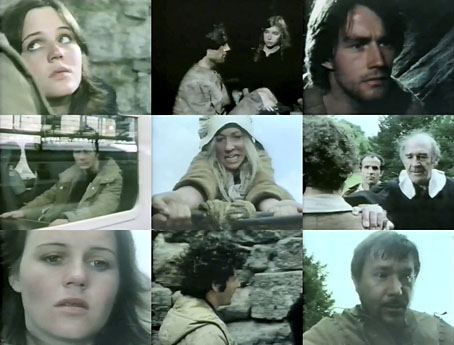
Good to find this Peter Brook film on YouTube (for the time being…) as I’d been watching Ian Richardson in a couple of things recently and wanted to remind myself of how he fares here. He’s excellent, of course, as the serious foil to Patrick Magee’s equally serious Marquis de Sade. Brook’s film is a recording of his stage presentation of Peter Weiss’s play, in which the two actors embody the poles of a dialogue about the perennially knotty problems of revolution, freedom, and the interests of the individual in the face of political abstractions. What fascinates most about this is the Brechtian nature of the drama: structured as a play-within-a-play (we’re watching the inmates of an asylum performing a fictional Sade drama), and with a proxy audience regarding the performance through iron bars, the staging is as far away from dry theorising as you can get. Brief moments of debate between Sade and the asylum inmate portraying Marat act as punctuations between scurrilous chorus songs and frequent scenes of outright chaos which erupt when the demands of performance become too much for the inmates. It’s loud, sardonic, cynical, and often riveting. One of the more miserable features of drama from the 1960s and 70s is the recurrence of ham-fisted political didacticism which, however well-intentioned, makes for a dismal viewing experience. Weiss’s play shows how well you can deliver political rhetoric when the staging doesn’t ignore the presence of a possibly sceptical audience who might also like to be entertained.

maratsade2.jpg

Peter Brook has had a peculiar career as a film director, most of his films being screen adaptations of his stage productions, or odd one-offs such as his documentary-like (and somewhat superfluous) film of Lord of the Flies, and the bizarre Meetings with Remarkable Men. (More about that later.) Brook’s Royal Shakespeare Company staging of the Weiss play was performed to great acclaim in 1965 so we’re fortunate that it’s captured so well here. The cast includes many first-rate actors, not only Richardson and Magee but Glenda Jackson as the inmate given the task of portraying Charlotte Corday, Michael Williams as the Herald, and (easy to miss among the clown-faced chorus) Freddie Jones. A low-grade YouTube copy does little for David Watkin’s superb photography which gives the film a very different look to other films of the 1960s. Studios films of the era tended to be horribly over-lit so it’s refreshing to find a film such as this using only the available light to illuminate the action. Searching around for DVDs reveals a single Spanish edition which I’m tempted to buy if I could be sure it was widescreen and with the English soundtrack intact. As for the play itself, the concerns may be typical of the period but many of the sentiments have lost none of their relevance. Highly recommended.

maratsade3.jpg

Weekend links 162

penrose.jpg

Untitled drawing by Sophie Penrose.

• “…many arts producers – much more so than the artists themselves – were over-fearful of the prospect of prosecution, when in nearly all incidents there were no reasonable grounds for bringing charges.” Julia Farrington of Index on Censorship on self-censorship by artists and art institutions in the UK.

• “Tons of tones – some dissolved in beats, some beatless treatments – in a continuous mix of current ambient and electronic goodies, pouring more than a score of ambi-valent shapes and etheric waves into an occluded reverb-trail echo-veil mood-stream.” Ambivalentine, a mix by Albient.

• “I was followed by a bee, a golden bee. For three years, every day, the golden bee followed us.” Forty years ago Penthouse magazine talked to Alejandro Jodorowsky. This month Dazed magazine asked the polymath twenty questions.

• “…investigators were stupefied to find the spymaster’s quarters full of pink leather whips, cosmetics, and pornographic photographs, framed in snakeskin.” Erik Sass on Colonel Redl and a gay spy scandal in the Vienna of 1913.

• “With no one to sponsor him, Marino Auriti’s dream museum became the stuff of legends.” Stefany Anne Golberg on Marino Auriti’s Enciclopedico Palazzo del Mondo.

• The Crime Epics of Louis Feuillade: YouTube links and more. Related: YouTube’s Vault of Horrors.

Werner Herzog: 50 years of potent, inspiring, disturbing films.

• The doors of perception: John Gray on Arthur Machen.

• Some Sort of Alchemy: Albert Mobilio on Sun Ra.

• British Pathé’s film of ghost hunters in 1953.

• “Escape your search engine Filter Bubble

• RIP Jack Vance

Bumble Bee Bolero (1957) by Harry Breuer | The L S Bumble Bee (1967) by Peter Cook & Dudley Moore | Ant Man Bee (1969) by Captain Beefheart and His Magic Band | Be A Bee (2009) by Air

Palladini’s Aquarian Tarot

palladini01.jpg

For the past two months I’ve been busy drawing a new set of Tarot designs. More about these later, but sporadic research has naturally led to me to look at a few earlier sets, although my Trumps have mostly been following Pamela Colman Smith’s illustrations for the Waite deck. Tarot designs have really proliferated in the past few years (Is there a Lego Tarot? Yes, of course there is), so much so that many previous designs which would once have been notable are now swamped by mediocre decks.

David Palladini’s Aquarian Tarot first appeared in 1970 when the occult revival was getting into its stride. Palladini had contributed to the Linweave Tarot in 1967 along with three other artists, something you can read more about at the excellent Sweet Jane’s Pop Boutique. I’m sure I must have seen the Aquarian Tarot in the past but probably dismissed it for being too modish and not occult enough; for a long time Aleister Crowley’s Thoth deck was the only one I’d look at. Palladini’s art is a lot more familiar now that his fabulous poster for Nosferatu the Vampyre looks down on me every day, and I’ve grown to enjoy his combination of Art Nouveau and Deco motifs so much that I wouldn’t mind a pack of these cards. The Aeclectic site reviews the deck, and has a few more examples of the designs. They also review the New Palladini Tarot which the artist produced in 1996. Given the choice I’d still go for the earlier set.

palladini02.jpg

Continue reading “Palladini’s Aquarian Tarot”

George Barbier’s Nijinsky

barbier05.jpg

An inevitable one this, given the amount of times that George Barbier’s work has been featured here. Designs on the Dances of Vaslav Nijinsky was a series of prints published in 1913 when the dancer was at the height of his celebrity. All of Nijinsky’s major roles are represented although this isn’t quite the complete set. There did used to be a Japanese site with several galleries of Barbier’s early prints but this has now disappeared.

barbier04.jpg

Schéhérazade.

barbier02.jpg

Prélude à l’après-midi d’un faune.

barbier01.jpg

Schéhérazade.

barbier10.jpg

L’oiseau de feu.

Continue reading “George Barbier’s Nijinsky”

The Rite of Spring and The Red Shoes

redshoes1.jpg

The Red Shoes: Moira Shearer and Léonide Massine.

Emeric is often too easily accused of basing the principal male character of The Red Shoes on Serge Diaghilev, to which he replies: “There is something of Diaghilev, something of Alex Korda, something of Michael, and quite a little bit of me.”

Michael Powell, A Life in Movies (1986)

Despite Emeric Pressburger’s qualificatory comments, there’s a lot more of the Ballets Russes in Powell and Pressburger’s film of The Red Shoes (1948) than first meets the eye. Or so I discovered, since I’d known about the film via my ballet-obsessed mother for years before I’d even heard of Diaghilev or Stravinsky. The most obvious connection is the presence of Léonide Massine who took the leading male roles in Diaghilev’s company following the departure of Nijinsky. He also choreographed Parade, the ballet which featured an Erik Satie score and designs by Picasso. The fraught relationship between Diaghilev and Nijinsky forms the heart of The Red Shoes: Anton Walbrook’s impresario, Boris Lermontov, is the Diaghilev figure while the brilliant dancer who obsesses him, and for whom he creates the ballet of The Red Shoes, is Moira Shearer as Victoria Page. That the dancer happens to be a woman is a detail which makes the film “secretly gay”, as Tony Rayns once put it. Diaghilev and Nijinsky were lovers, and fell out when Nijinsky married; in The Red Shoes Lermontov demands that Vicky choose between a life of art or a life of marriage to composer Julian Craster (Marius Goring). She chooses love but ends up drawn back to art, with tragic consequences that mirror the Hans Christian Andersen story. That story, of course, ends with a young woman dancing herself to death after donning the fatal shoes, a dénouement that’s unavoidably reminiscent of The Rite of Spring.

redshoes2.jpg

Anton Walbrook as Lermontov.

Lermontov: Why do you want to dance?

Vicky: Why do you want to live?

Other parallels may be found if you look for them, notably the figure of Julian Craster who comes to Lermontov as a young and unknown composer just as Stravinsky did with Diaghilev. Craster’s music isn’t as radical as Stravinsky but The Red Shoes was already giving the audience of 1948 enough unapologetic Art with a capital “A” without dosing them with twelve-tone serialism. The film aims for the same combination of the arts as that achieved by Diaghilev, especially in the long and increasingly fantastic ballet sequence. This was another of Powell’s shots at what he called “a composed film” in which dramaturgy and music work to create something unique. The Red Shoes is a film that’s deadly serious about the importance of art, a rare thing in a medium which is so often at the mercy of Philistines. In the past I’ve tended to favour other Powell and Pressburger films, probably because I’ve taken The Red Shoes for granted for so long. But the more I watch The Red Shoes the more it seems their greatest film, even without this wonderful train of associations. The recent restoration is out now on Blu-ray, and it looks astonishing for a film that’s over sixty years old.

Seeing as this week has been all about The Rite of Spring, here’s a few more centenary links:

Stravinsky’s The Rite of Spring, Visualized in a Computer Animation for its 100th Anniversary
• George Benjamin on How Stravinsky’s Rite of Spring has shaped 100 years of music
Strange Flowers visits the Théâtre des Champs-Elysées

Previously on { feuilleton }
The Rite of Spring, 2001
The Rite of Spring, 1970
The Rite of Spring reconstructed