The original Cabaret Voltaire

cv1.jpg

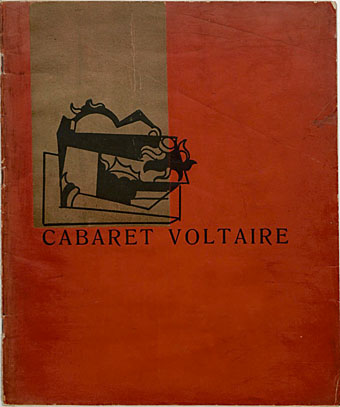
Cabaret Voltaire #1 (1916). Cover by Hans Arp.

Richard H. Kirk’s announcement that he’ll be performing at the Berlin Atonal festival as Cabaret Voltaire caused some raising of eyebrows recently, although if Stephen Mallinder isn’t involved I won’t be getting too excited myself. The last few releases under the Cabaret Voltaire name were credited to Kirk/Mallinder but from Plasticity (1992) on they don’t sound very different to Kirk’s solo releases from the same period. That’s not to say the music suffers but you have to wonder why the group name is being perpetuated if there’s nothing unique attached to it.
cv2.jpg

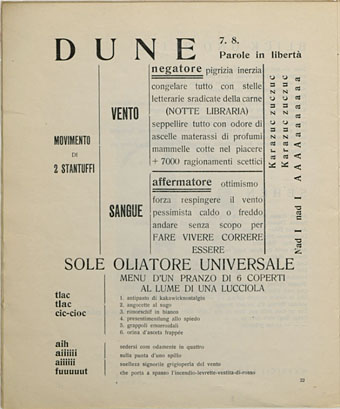
Dune, parole in libertà by Filippo Marinetti.

The group, old or new, will be the first thing that comes to mind for most people when they hear the name Cabaret Voltaire, something that might have surprised Hugo Ball who founded the original Cabaret Voltaire in Zurich almost a century ago. Cabaret Voltaire (the group) named themselves after Ball’s project, their intentions in the mid-1970s being similarly Dadaist. Early Cabs performances were more audience provocations than anything to do with entertainment; the music came later, and only after several years of very uncommercial tape experimentation, some of which can be heard on Methodology ’74–’78: Attic Tapes (2003). Thanks to Switzerland staying out of the war the original Cabaret didn’t get wrecked by bombs or destroyed by the Nazis, and is still active today. Ball also published a Cabaret Voltaire journal, two pages of which can be seen here. If this doesn’t look very dramatic to our eyes it needs to be remembered that everyone who first saw it would have been born in the 19th century so the contents would have seemed a lot more radical. A slim publication but with a formidable list of contributors: Guillaume Apollinaire, Hans Arp, Blaise Cendrars, Wassily Kandinsky, Filippo Marinetti, Amedeo Modigliani, Pablo Picasso, Tristan Tzara and others.

Also at Ubuweb (where else?) there are several recordings of Hugo Ball’s Dada poetry including a recital of Karawane by (of all people) Marie Osmond. Who knew there was a connection between the Osmonds and Cabaret Voltaire?

Previously on { feuilleton }
Cabaret Voltaire on La Edad de Oro, 1983
Doublevision Presents Cabaret Voltaire
Just the ticket: Cabaret Voltaire
TV Wipeout
The Crackdown by Cabaret Voltaire
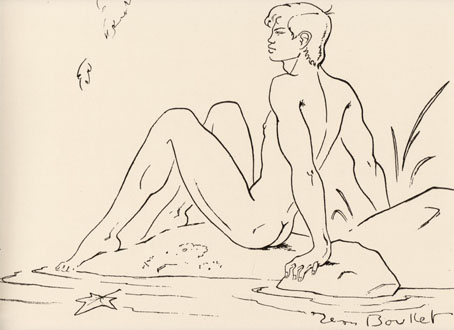
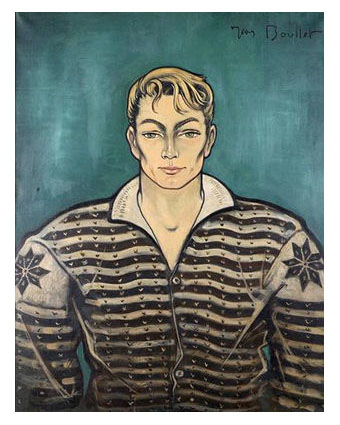
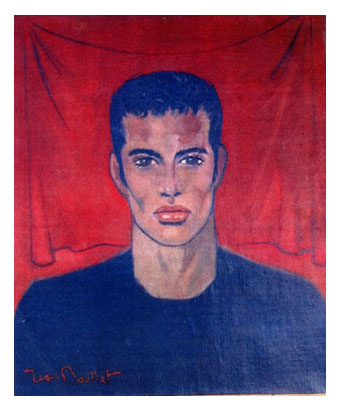
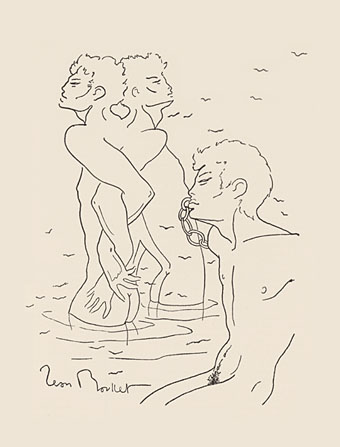
The art of Jean Boullet, 1921–1970

boullet3.jpg

From Antinous (1954).

A few drawings and paintings by Jean Boullet, a prolific French illustrator who was also a writer—passionate about “sexology, conjuring, magic, demonology, and mythology”, says Wikipédia—and a film critic. His illustrations range from books by Raymond Radiguet, Boris Vian and Edgar Allan Poe to unabashed homoerotic collections of his own, one of which, Tapis volant (1945), has an introduction by Jean Cocteau. Boullet’s figures are very Cocteau-like, especially those depicting the sailors which Cocteau also liked to draw and fantasise about. The Au Bonheur du Jour gallery has many pages of Boullet’s drawings and publications, while Bibliothèque Gay has several posts showing complete sets of drawings from some of his books. Many of the artist’s drawings circulating without credit on the web seem to originate there. Don’t miss Metamorphoses (1950).

• See also: The Male Universe of Subversive Genius Jean Boullet by Julien Beyle.

boullet1.jpg

Portrait of Jean Marais.

boullet2.jpg

Portrait of Kenneth Anger.

boullet4.jpg

Continue reading “The art of Jean Boullet, 1921–1970”

The Nest, a film by David Cronenberg

cronenberg.jpg

This isn’t exactly news when it’s been posted on numerous sites over the past few days, but for the benefit of those who haven’t yet seen it, The Nest is a short film by David Cronenberg made for the exhibition of the director’s work that’s currently running at the EYE Film Institute in Amsterdam. Nine minutes, a single shot and no overt horror but it’s still an insidious piece. It’s only on YouTube for as long as the exhibition is in progress so watch it while you can.

Previously on { feuilleton }
Long Live the New Flesh: The Films of David Cronenberg

Weekend links 215

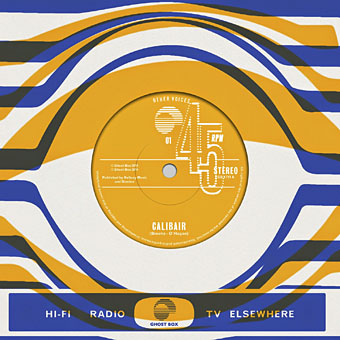
calibair.jpg

Julian House artwork for Other Voices, a new singles series on the Ghost Box label. Other Voices 01 is a collaboration between Sean O’Hagan of the High Llamas and Jon Brooks of The Advisory Circle.

Last week I linked to a copy Zadie Smith’s new introduction for Crash by JG Ballard. That piece could only be read in full by NYRB subscribers but this week the Guardian has the full text:

I was in college when the Daily Mail went to war with [David Cronenberg’s] movie, and found myself unpleasantly aligned with the censors, my own faux-feminism existing in a Venn diagram with their righteous indignation. We were both wrong: Crash is not about humiliating the disabled or debasing women, and in fact the Mail‘s campaign is a chilling lesson in how a superficial manipulation of liberal identity politics can be used to silence a genuinely protesting voice, one that is trying to speak for us all.

Related: Thomas Jones in 2008 reviewing Miracles of Life:

Despite all the bodily fluids spurted and smeared onto wrecked dashboards, the problem isn’t that it’s too pornographic but that it isn’t pornographic enough: the novel is too conscious of the deeper meaning of the sex and violence for the sex and violence to work as elements in themselves.

The fetishisation of Ballard’s novel (and Ballard’s fetishes) show no signs of abating: B-Movie (Ballardian Video Neuronica), is a short film by John Foxx, Karborn and Jonathan Barnbrook.

• Last Thursday I was watching a live performance by Pye Corner Audio and Not Waving, so it’s good to find this mix by the pair surfacing in the same week. Kudos to the latter for choosing something by Chrome. More mixes: FACT mix 468 by Throwing Snow, and Secret Thirteen mix 120 by Drøp.

• Ellen Datlow’s horror anthology, Lovecraft’s Monsters, continues to gather plaudits. Among recent reviews there’s Matt Barone at Complex who included the book in his Year’s Best Genre Fiction Books (So Far) list, and also praised my illustrations.

In recent years, many of the people on book covers have been women without faces. So prevalent is this visual cliché that the publishing industry has cycled through at least two well-documented iterations. The first, the Headless Woman, features some poor thing cut off above the neck, like the swimsuit-clad beachgoer on Alice Munro’s story collection “The View from Castle Rock.” The website Goodreads’s Headless Women page has 416 entries. Last year, the Headless Woman was supplanted by the Sexy Back, in which a woman is shown from behind, often gazing out over a vista.

Eugenia Williamson on the packaging of books for a female readership.

• The latest Taschen volume from Dian Hanson, editor of (among other titles) The Big Penis Book, is My Buddy. World War II Laid Bare, featuring photos from the archives of Michael Stokes. World of Wonder has pages from the interior.

I Have Walked This Body by Jenny Hval and Susanna is a track from a forthcoming album inspired by Maya Deren and Alexander Hammid’s Meshes of the Afternoon. It sounds fantastic so I’m looking forward to hearing more.

• If you have a spare half-million dollars, and don’t mind the possibility of possession by murderous supernatural entities, the Palmer house from Twin Peaks is for sale.

• Read an extract from Season of the Witch: How the Occult Saved Rock and Roll by Peter Bebergal.

The Stars and Their Courses: over six hours of the Nevada night sky in 4k definition.

Lee Siegel on the fraught friendship of TS Eliot and Groucho Marx.

Harmony Korine talked to Kenneth Anger for Interview Magazine.

New Scientist: How magic mushrooms induce a dream-like state.

• 3D-print your own Marcel Duchamp chess set.

Scott O)))

Crash (1980) by Tuxedomoon | Burning Car (1980) by John Foxx | A Crash At Every Speed (1994) by Disco Inferno | Burning Car (Dubterror Remix, 2008) by John Foxx

The Hell Courtesan

yoshitoshi.jpg

The Enlightenment of Jigoku-dayu (1890) from the series New Forms of Thirty-six Ghosts by Tsukioka Yoshitoshi.

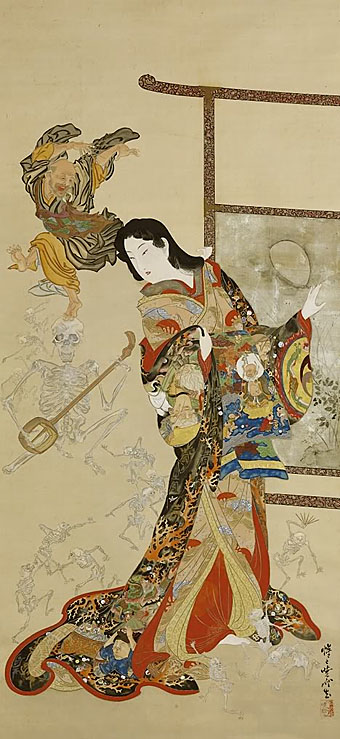
Jigoku-dayu of Takasu was a courtesan adopted by the Zen Priest Ikkyu (1394–1481), who converted her to a religious life and gave her a literary education. She is seated in meditation with a ghostly vision of a procession of the skeletons of a courtesan and her entourage, thus showing her the impermanence of life.

Jigoku-dayu is portrayed here as a high-ranking courtesan. Her white robe is embossed with fine key patterns and her outer robe is decorated with the Goddess of Mercy on the front and at the back with scenes of hell. Her name consists of Jigoku (hell), a term for the lowest form of unlicensed prostitute and dayu (respect) for a courtesan of the highest rank. (via)

See also Junko Mizuno‘s contemporary drawings of Jigoku-dayu.

kyosai1.jpg

Jigoku-dayu (date?) by Kawanabe Kyosai.

kyosai4.jpg

Jigoku-dayu (another version) by Kawanabe Kyosai.

Continue reading “The Hell Courtesan”