Maska: Stanisław Lem and the Brothers Quay

maska1.jpg

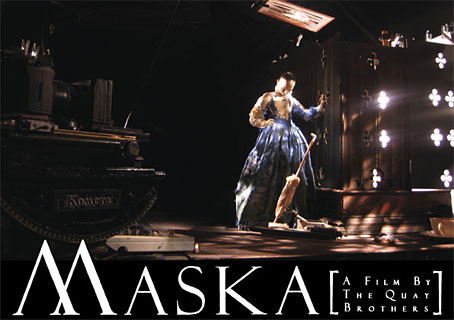
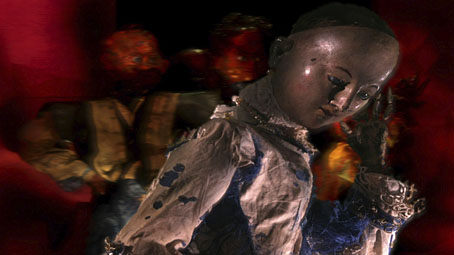
Did I mention the Brothers Quay? This is a mesmerising piece, and another short film to add to the growing number of Quay works yet to be collected on DVD. Maska (2010) is a 23-minute digital animation based on Stanisław Lem’s short story, The Mask (1976), which the producers have recently made available on YouTube. It was perhaps inevitable that if the Quays were going to venture into science fiction they’d use an Eastern European source. Lem’s story concerns a sophisticated technological society which is nonetheless still a monarchy. The narrator is an artificial woman who the aristocracy have created for a special mission; her human exterior conceals a robot interior, but this is no Maria from Metropolis. Midway through the story the robot breaks free of its human shell and is revealed to be a mantis-like creature.

maska2.jpg

The Quays’ corpus has tended to avoid genres of any kind so it’s fascinating seeing how they wrangle both sf and horror into a mise-en-scène which is remote from their decaying European scenarios but which, in its details, is completely familiar: puppet characters, flickering light, shifting focus, everything immersed in shadow. Maska also departs from form by having a spoken narration which offers some rudiments of explanation. The habitual atmosphere of unease is still present, however, and pushed to outright horror in places, assisted by extracts from Penderecki’s nerve-jangling De Natura Sonoris No. 1.

maska3.jpg

As with Piotr Kamler’s Chronopolis, this is a good reminder of how science fiction can be presented in a less obvious manner by animation, offering a view into a world that doesn’t have to be explained down to the last detail. Some of the best written SF, and some comic-strip SF (usually the Continental titles), delivers a strangeness that’s completely absent from most filmed science fiction. Vast budgets demand simple-minded narratives with mass appeal so it’s left to animation and low-budget films to venture into areas that would be off-limits elsewhere. Maska is an impressive film, one of the best Quay shorts I’ve seen for some time. Watch it here.

Elsewhere on { feuilleton }
The Quay Brothers archive

The art of Léon Spilliaert, 1881–1946

spilliaert08.jpg

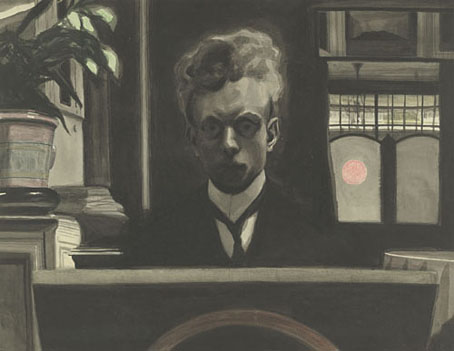
Self-portrait (1907).

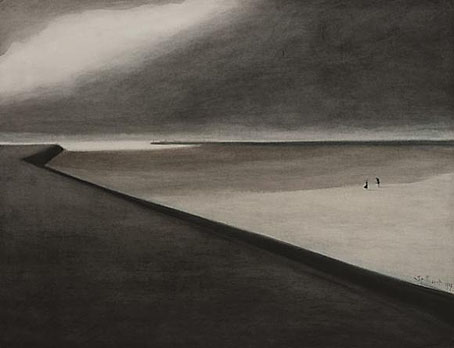
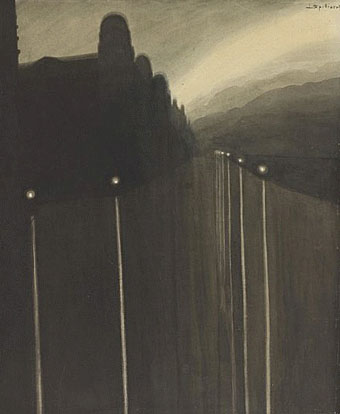
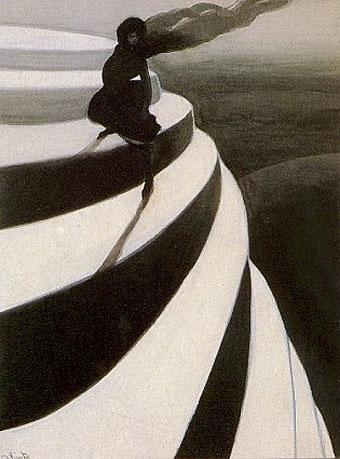
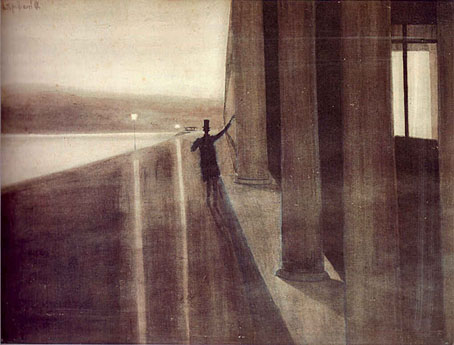
Yesterday’s post gives me an excuse to draw further attention to Belgian Symbolist Léon Spilliaert, an artist whose gloomy and mysterious early style is easy to recognise once you’ve seen a couple of his pictures. Spilliaert grew up in Ostend so the Belgian coast dominates his pastels which renounce sunlit beach scenes in favour of windswept vistas. The Impressionists flocked to the coast to paint fluffy clouds and waves and parasols; Spilliaert gives us monochrome shades and oppressively empty views.

One of my books says Spilliaert suffered from insomnia which may explain his fondness for nocturnal scenes. But when you see the self-portraits where he looks less like a human being and more like a refugee from a film by the Brothers Quay you can assume a predilection for the dark. Later Spilliaert pictures are brighter and more representative of the seaside actuality but it’s the gloomy and mysterious fare for which he’s remembered today.

spilliaert04.jpg

Dyke and Beach (1907).

spilliaert02.jpg

Dyke at Night (1908).

spilliaert03.jpg

Vertigo (1908).

spilliaert05.jpg

The Night (1908).

Continue reading “The art of Léon Spilliaert, 1881–1946”

Dunes

dunes4.jpg

Sand Dunes near Boulogne-sur-Mer, France (c. 1870) by Joséphine Bowes.

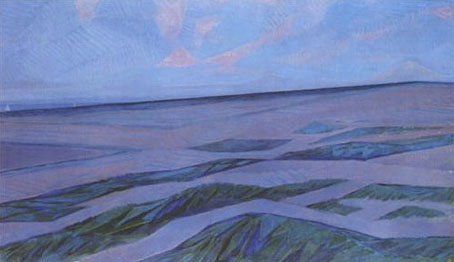
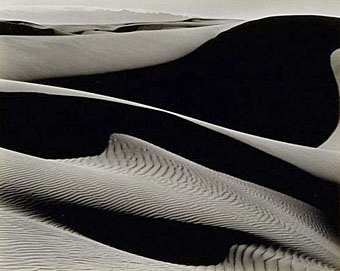
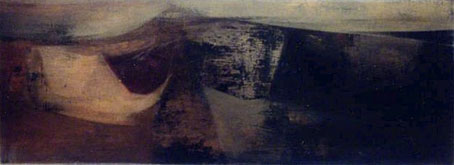
Dunes. Having visited the sand dunes that run along the French and Belgian coast it’s notable how much dune art has taken them as a subject. Belgian Symbolist Léon Spilliaert returned to them frequently, and managed to invest the littoral with a greater sense of mystery than many of his contemporaries.

dunes1.jpg

Dune Landscape (1911) by Piet Mondrian.

dunes6.jpg

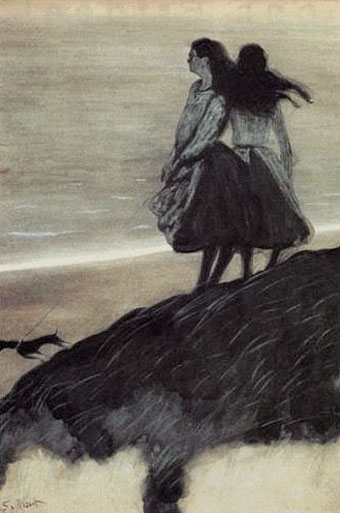
Girls on a Dune (1913) by Léon Spilliaert.

dunes2.jpg

Dunes, Oceano (1936) by Edward Weston.

dunes5.jpg

Dune (1961) by Alexander MacKenzie.

dunes3.jpg

Pale Dunes (1970) by Ronnie Landfield.

Dune: some French connections

landi.jpg

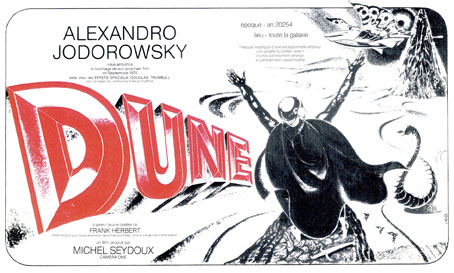
French poster by Michel Landi for the ill-fated Jodorowsky film.

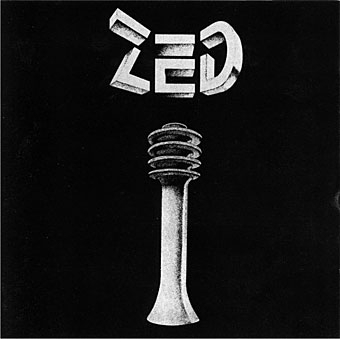
There’s more to French music than Air and Daft Punk, and there’s more to cosmic French music than Magma, although you wouldn’t always know it to read Anglophone music journalists. I’ve been championing the electronica recorded by Bernard Szajner for a long time, and even tried without success to get one of his albums reissued a few years ago. (Which reminds me: Gav, you’ve still got my Szajner albums!) That album (credited to “Zed”), Visions Of Dune (1979), has been out-of-print since 1999 so it’s good to know it’s being reissued on vinyl and CD next month by Finders Keepers’ Andy Votel. FACT has a mix of extracts to give the curious some idea of its buzzing analogue soundscapes.
szajner.jpg

Visions Of Dune (1979) by Zed (Bernard Szajner). Artwork by Klaus Blasquiz.

Visions Of Dune attempts to illustrate Frank Herbert’s novel in musical form; you wouldn’t really know this without the track titles but that’s the way it often is with instrumental music. The album has gained a surprising cult reputation in recent years although it’s difficult to tell whether this is merely a consequence of its rarity or whether it’s because people like Carl Craig have taken to listing it as a favourite electronic record. It’s a decent enough album but I’ve always preferred Szjaner’s follow-up, Some Deaths Take Forever (1980), a conceptual polemic against the death penalty which is ferocious enough in places to be classed among the post-punk electronica being produced in the same year by Throbbing Gristle and Cabaret Voltaire. Szajner later recorded an album with Howard Devoto, Brute Reason (1983), which puts him even more firmly in the post-punk camp. I suspect Some Deaths… offends the hardcore synth-heads with its squalls of electric guitar and other traces of the rock milieu. More amenable is another Szajner album, Superficial Music (1981), which remixes the Visions Of Dune tracks into seven chunks of doom-laden ambience. I’ve never thought of the resulting sound as very superficial, “unsettling” is closer to the mark which is why I included an extract in my Halloween mix last year.
pinhas.jpg

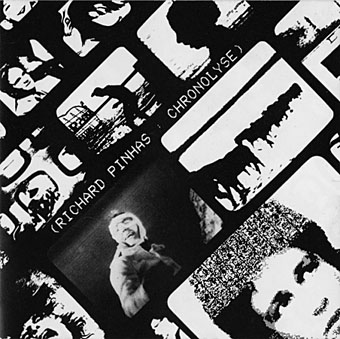
Chronolyse (1978) by Richard Pinhas. Artwork by Patrick Jelin.

Visions Of Dune isn’t the only Dune-related synth album from France. Chronolyse (1978) is the second solo album by Richard Pinhas, another musician you won’t find many Brit writers discussing even though he’s been recording since 1974. Pinhas’s inspirations are an unusual amalgam of science fiction and contemporary French philosophy, a subject he studied at the Sorbonne; prior to going solo he was performing with Heldon, a French prog band whose name is taken from Norman Spinrad’s The Iron Dream. Heldon may be classed as a prog group but their first album, Electronique Guerilla (1974), has one side dedicated to William Burroughs, features a track with “lyrics by Nietzsche”, and also contains an appearance by Gilles Deleuze. Deleuze and Norman Spinrad appeared on later Pinhas solo albums although neither of them are on Chronolyse which, like Visions of Dune, is a wordless (and often tuneless) meander through synthesised soundscapes named after Dune characters. The music on the first side is much more sparse than Szajner’s, and less satisfying as a result; the second side improves with the 29-minute Paul Atreïdes, a typical Pinhas guitar-and-synth jam with extended Fripp-like soloing. As with Szajner, all the Heldon/Pinhas output tends towards the abrasive, and looking at the recent Pinhas discography the man is showing no sign of growing soft, having played shows recently with notorious noise merchants Merzbow and Wolf Eyes.
dune.jpg

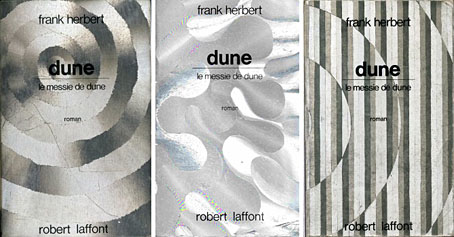
Dune paperbacks from Robert Laffont (1975–1983). Designer unknown.

Has there been any other Dune-related music from France? Given the French enthusiasm for science fiction I wouldn’t be surprised. A search for French covers of Frank Herbert’s novels turned up these strikingly abstract examples from Robert Laffont which I’d not seen before. That combination of foil backing and lower-case Helvetica is clearly derived from the celebrated Prospective 21e Siècle series of new music albums released by Philips in the late 1960s. Many of those albums featured exclusive recordings of musique concrète or electro-acoustic compositions (and many of them featured French composers) so there’s another electronica connection. Incidentally, if you ever find one of those Philips albums going cheap in a shop, buy it! The series is very collectible and some of them command high prices. Even if you don’t like the music, they’re worth having for the shiny sleeves.

Update: Further investigation reveals another French album with Dune connections, Eros (1981) by Dün, a Magma-like band whose name is taken from Herbert’s novel. So too are some of the track titles on their sole release: L’Epice and Arrakis.

Previously on { feuilleton }
Alejandro Jodorowsky’s Dune
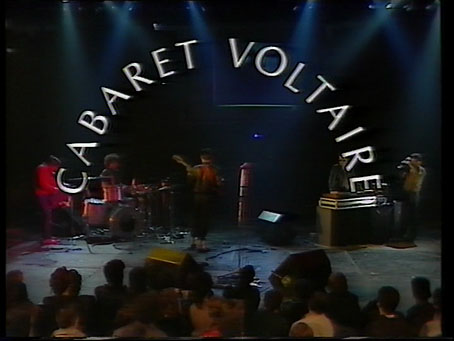
Cabaret Voltaire on La Edad de Oro, 1983

cabs1.jpg

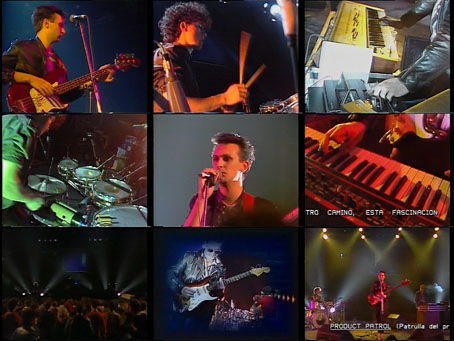
Cabaret Voltaire appeared on Spain’s La Edad de Oro music show a few months after Tuxedomoon in November 1983. This was three months after I saw the Cabs at the Haçienda in Manchester, a concert you can see yourself in terrible sound and picture quality on a Cherry Red DVD. (Granted, the Haçienda video recordings were never intended for public sale but that taping looks particularly poor.) So it’s good to find this Spanish broadcast capturing the band performing songs from their recently released The Crackdown album. As with many of the other British groups given a slot on La Edad de Oro, this was a much more generous showcasing than was allowed by the UK’s music shows of the period, most of which tended to favour safe pop or rock acts. One reason Cabaret Voltaire formed their own video label, Doublevision, was to provide an outlet for visual works by groups that the major TV channels were ignoring. The tenth release on the Doublevision video label happened to be Tuxedomoon’s Ghost Sonata film.

cabs2.jpg

The drummer for the Spanish broadcast, as on the Cabs’ albums, was Alan Fish, and the performance is mixed with shots of the band’s vaguely ominous film and video material. Both this show and the Tuxedomoon performance have translated lyrics running over the screen, a strange thing to see with Cabaret Voltaire who never printed their lyrics.

By coincidence a new Cabaret Voltaire compilation album has just been released, #7885 (Electropunk To Technopop 1978 – 1985), which Eugene Brennan reviews here. I’ve already got everything on it but it’s a good overview of the group’s evolution from post-punk weirdos to a formidable electronic-dance outfit. (Although the full-length 12″ tracks are the essential versions.)

Previously on { feuilleton }
Tuxedomoon on La Edad de Oro, 1983
Doublevision Presents Cabaret Voltaire
Just the ticket: Cabaret Voltaire
European Rendezvous by CTI
TV Wipeout
Seven Songs by 23 Skidoo
Elemental 7 by CTI
The Crackdown by Cabaret Voltaire
Network 21 TV