Two albums

mu1.jpg

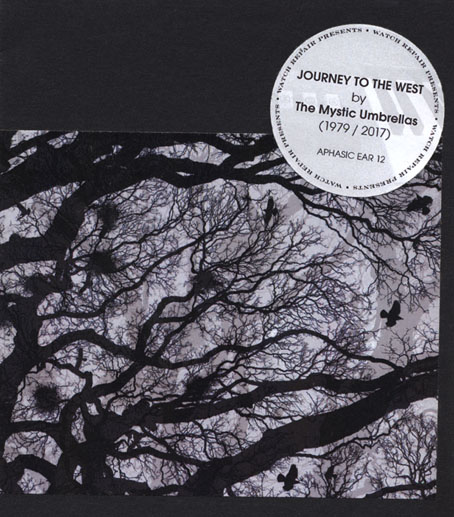
A pair of albums by friends of mine are released this month: the first, Journey to the West (1979–2017) by Watch Repair presents The Mystic Umbrellas, has been gestating for several years; the second, Dreaming Dangerous Rainbows by Albatross Project, came together very quickly earlier this year after song sketches led to an album that none of the participants had originally planned. I designed both releases so I have more than a passing interest.
mu3.jpg

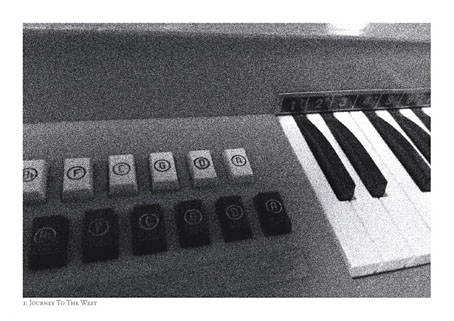
The Mystic Umbrellas project will probably be of most interest to regular readers since it evolved from a couple of very minimal organ recordings made in 1979 by Mark Valentine. Mark is well-known today as a writer of weird fiction, and also an editor and publisher of the same, but in the early 1980s he was involved briefly with the British wing of the independent cassette scene, a micro-budget offshoot of the post-punk DIY ethos which spurred many amateur (or non-) musicians to create and release their own musical works on limited-edition cassettes. The UK manifestation of this scene tended either to imitate higher profile post-punk artists (some of the better examples may be heard on the recent Cherry Red compilation, Close To The Noise Floor) or indulge in a very British form of what might be called Low Surrealism, although “absurdity” is probably a more accurate definition. (A UK label of the time was even named Absurd Records.)
mu4.jpg

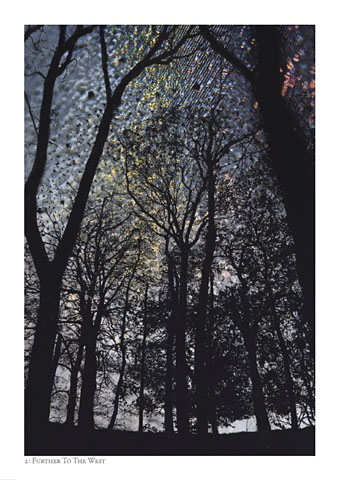
Photocard by Deborah Judd.

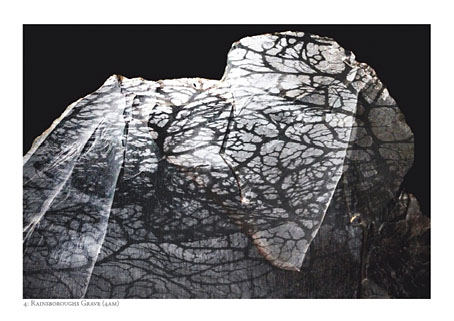
Mark’s Mystic Umbrellas pieces—Journey To The West, Radio Dromedary (a short-wave radio capture) and Rainsborough’s Grave 1 & 2—were released on separate cassette compilations, Deleted Funtime (1980) and National Grid (1981). My friend in Watch Repair (who is happy to remain otherwise anonymous) bought both cassettes, and marked out the Mystic Umbrellas pieces as favourites for their qualities of melancholy and restraint; the organ recordings were very different from the post-punk fumblings or the absurdity in evidence elsewhere. The cassettes sat in a box for years until the same friend decided to try using them as source material for some of his sound processing experiments; these experiments eventually yielded a suite of marvellously atmospheric extensions/transmutations which mutate the recordings beyond recognition but which remain faithful to the haunting qualities of the originals. The precedence for this kind of repurposing would include Jon Hassell’s Magic Realism (1983) and some of the recent works of Thomas Köner, but Mystic Umbrellas and Watch Repair are in a territory of their own.
mu5.jpg

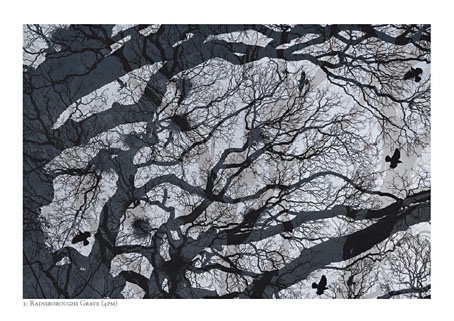
Photocard by Deborah Judd.

While working on the design for this release I kept ruminating on the curious net of connection and coincidence around these recordings. After buying the Deleted Funtime cassette my Watch Repair friend contacted one of the other artists, “Stabmental”, to ask about similar recordings. Stabmental was a name used by Geoff Rushton for his post-Throbbing Gristle musical experiments and an Industrial music fanzine; a couple of years later he joined Psychic TV and changed his name to John Balance. Geoff/John was later in Coil, of course, and a decade after this was in correspondence with me having been greatly impressed with my Lovecraft art in The Starry Wisdom anthology. My earlier Lovecraft story, The Haunter of the Dark, had been published in a large-format edition in 1988 by Caermaen Books, an imprint run by a pair of Arthur Machen enthusiasts, Roger Dobson and Mark Valentine. It was shortly after my first meeting with Mark and Roger that my Watch Repair friend realised that Mark must be the Mystic Umbrellas person so the Lovecraft artwork helped remind us of the Deleted Funtime cassette. The same cassette surfaced again a few years ago when it was sold to an obsessive Coil collector who wanted it for the Stabmental piece. That sale led to the cassette being digitised before it was let go, and the digitisation process led to these recordings.
mu6.jpg

Photocard by Deborah Judd.

Things got even more tangled earlier this year when I was working on the final layout while also reading the expanded edition of England’s Hidden Reverse, David Keenan’s fascinating history of Coil, Current 93 and Nurse With Wound. Keenan discusses the independent cassette scene (and mentions Stabmental) so all the above was circling in my head once more; but I really wasn’t expecting the instance when Keenan goes into David Tibet’s enthusiasm for Arthur Machen by including a page of explanation from a Machen expert…Mark Valentine. In Mark’s notes for the Watch Repair release he describes the origin of the Mystic Umbrellas name which came about during a rainy day-trip to Glastonbury. Somerset’s most mystical town includes Chalice Well among its complement of New Age tourist traps; shortly after finishing England’s Hidden Reverse I was re-reading a typically wild interview with Alejandro Jodorowsky in which he proposes that the humble umbrella is in fact a black chalice, and that the knights of the Round Table are searching for a Holy Grail that’s actually an umbrella. A mystic umbrella, in other words. Elsewhere in the same interview he expounds on the symbolism of the Black Sun, a favourite symbol of Coil’s. (And Coil for a short while had a Chalice record label…) By this point I’d ceased to be surprised, the endless chain of connections seemed inevitable.

albatross1.jpg

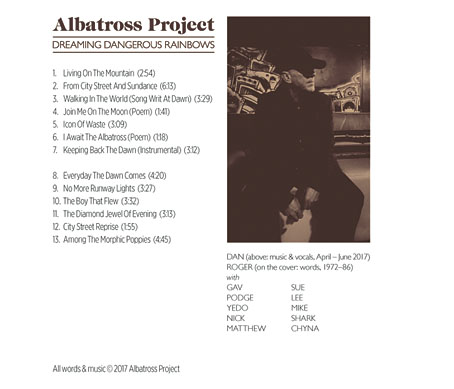
After all the above the album by Albatross Project risks seeming a little mundane, although grounded (one meaning of “mundane”) would be better. The origin this time was a series of poems written by Roger (that’s him on the cover) from 1972 to 1986. These were set to music by Dan of Warper’s Moss and Watch Repair. (Nobody in this group is offering their surnames so you’ll have to accept the circumspection.) Everyone involved was surprised by the quality of the resulting songs, not least Roger who wrote the words sporadically while travelling the world in his youth. Dan and friends have been writing songs and playing in bands since the 1980s which is why they were able to produce such an accomplished album in a matter of months. Musically, this is quite straightforward: well-crafted songs in a rock idiom which had me thinking at times of Pink Floyd circa 1972 (fitting since several of the musicians are from the Floyd-worshipping environs of Merseyside). But it also owes something to the Elektra years of the early 70s (as does my design), and the period flavour harks back to the time and experiences that Roger was writing about.
albatross2.jpg

Both albums are available via Bandcamp. The hard format of Dreaming Dangerous Rainbows is a CD-R in a jewel case while the Mystic Umbrellas hard format is a lavish hand-crafted package that includes copious notes and four art cards, three of which feature Deborah Judd’s evocative photo montages. The latter package will be strictly limited. Original copies of the Deleted Funtime cassette command high prices among Coil collectors but the curious (or foolhardy) may download a copy at Die or DIY?

Previously on { feuilleton }
The Polarities by Watch Repair
Seven Harps by Warper’s Moss
The Tidal Path by Watch Repair
Watch Repair

Weekend links 372

mognetti.jpg

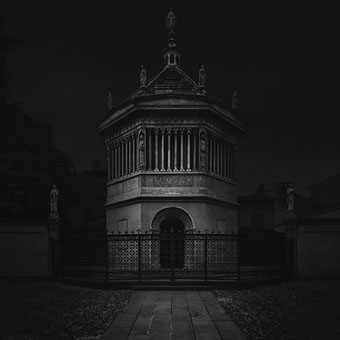
Battistero della Basilica di Santa Maria Maggiore, Bergamo (2017) by Mattia Mognetti.

• “Mumbo Jumbo: a dazzling classic finally gets the recognition it deserves.” Jonathan McAloon on Ishmael Reed’s unique novel being reissued as a Penguin Modern Classic.

• Amanda Gefter talks to Donald D. Hoffman, professor of cognitive science at the University of California, about “the evolutionary argument against reality”.

• Geeta Dayal on composer Raymond Scott. A new compilation, Three Willow Park, collects more of Scott’s electronic music from the 1960s.

Nagle critiques the follies of campus identity politics and social media liberalism not from the right, but as a left-leaning feminist. As she elucidates point after reasonable point, it feels as if a grown-up has finally entered the room. Like Mark Fisher, the Marxist critic who was savaged by his putative comrades for decrying “the stench of bad conscience and witch-hunting moralism” of the online left, Nagle has no sympathy for Twitter/Tumblr liberalism’s “cult of fragility and victimhood mixed with a vicious culture of group attacks, group shaming, and attempts to destroy the reputations and lives of others”. It is reassuring to find a self-described feminist disdaining the “hysterical” liberal call-out culture, and acknowledging that it has produced “a breeding ground for an online backlash of irreverent mockery and anti-PC”. Without joining the forces of reaction or losing sight of the vileness of the alt-right, she writes of “the deep intellectual rot of contemporary political progressivism”; “the moral self-flattery of … a tired liberal intellectual conformity”; and “the hysteria and faux-politics of liberal Internet culture”.

Rob Doyle reviewing Kill All Normies by Angela Nagle

• Mixes of the week: XLR8R Podcast 501 by Ryan Elliott, and ReMelodiya vol. 1 by Laurent Fairon.

Sumit Paul-Choudhury on the slime mould instruments that make sweet music.

The Wire Salon: an audience with photographer and writer Val Wilmer.

Simon McCallum‘s list of 10 great lesser-known British LGB films.

Zaria Gorvett on the ghostly radio station that no one claims to run.

S. Elizabeth reposted her Coilhouse interview with me from 2010.

• “Boys are selling sex in Japan. Who is buying?” Boys For Sale

• At Spoon & Tamago: Ando Tadao’s Hill of Buddha.

• At Dennis Cooper’s: Gisèle Vienne Day.

Sun Ra is now on Bandcamp.

Shaolin Buddha Finger (1994) by Depth Charge | Atomic Buddha (1998) by Techno Animal | Psycho Buddha (2001) by Acid Mothers Temple & The Melting Paraiso U.F.O.

Weekend links 371

behold.jpg

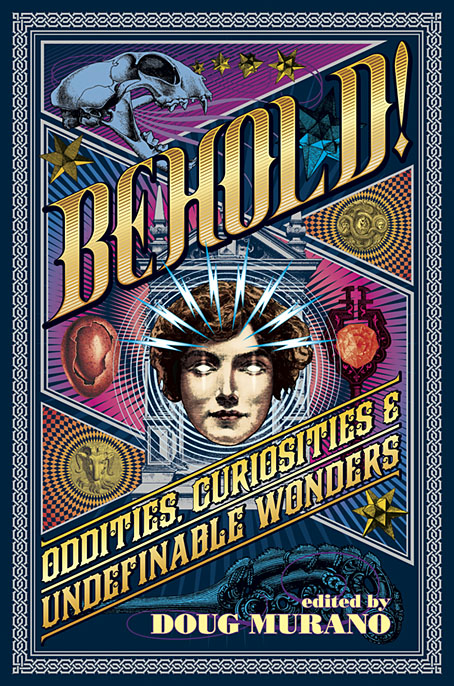
• My cover design for the Doug Murano-edited story collection, BEHOLD! Oddities, Curiosities and Undefinable Wonders, appeared here last December but a repost is in order since the book has been published this week by Crystal Lake. Back in December I didn’t have a list of the featured authors but I do now: Clive Barker, Neil Gaiman, Ramsey Campbell, Lisa Morton, Brian Kirk, Hal Bodner, Stephanie M. Wytovich, John Langan, Erinn L. Kemper, John FD Taff, Patrick Freivald, Lucy A. Snyder, Brian Hodge, Kristi DeMeester, Christopher Coake, Sarah Read and Richard Thomas. The foreword is by Josh Malerman, and the interior illustrations are by Luke Spooner.

• “How do you memorialize an artist who refused to remain identical to himself? How do you remember one of the great philosopher-artists of memory?” Ben Lerner on the elusive Chris Marker.

Diabolical Fantasia: The Art of Der Orchideengarten, 1919. A welcome reprinting of art from the German magazine of weird fiction compiled by Thomas Negovan. (Previously)

• Coming in September: Conny Plank: The Potential of Noise, a documentary by Reto Caduff and Stephan Plank about the great record producer.

The Roman Roads of Britain mapped by Sasha Trubetskoy in the style of Harry Beck’s London Tube Map.

• At Dennis Cooper’s: Spotlight on…Julia Kristeva Powers of Horror: An Essay on Abjection (1980).

Ian Shank on the trove of erotic Roman art that scandalized Europe’s royals.

• At Haute Macabre: Biblio-alchemy: The Liquid Library of Annalù Boeretto.

• What makes a French film noir? Andrew Male has some suggestions.

David Shariatmadari on how 1967 changed gay life in Britain.

• Mix of the week: Gated Canal Community Radio.

• A Gallery of Moods by Mlle Ghoul.

Loe And Behold (1970) by Sir Lord Baltimore | Behold The Drover Summons (1983) by Popol Vuh | Beholding The Throne Of Might (2014) by The Soft Pink Truth

Weekend links 367

sarto.jpg

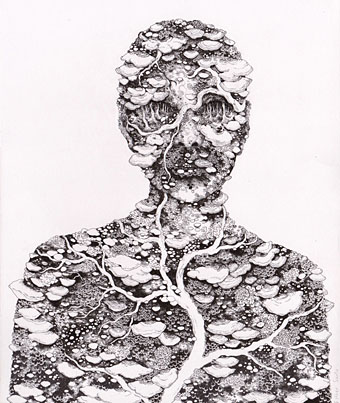
Human Nature by Esther Sarto.

I Feel Love: “Donna Summer and Giorgio Moroder created the template for dance music as we know it”. Bill Brewster on the creation of one of the greatest songs ever recorded.

The Tearoom by Robert Yang “is a (free) historical public bathroom simulator about anxiety, police surveillance, and sucking off another dude’s gun”.

Tim Walker’s Leonora Carrington-themed fashion shoot with Tilda Swinton reaches i-D‘s website at last. More pictures and in better quality.

Joe Dante on the legacy of Nigel Kneale. Related: We Are The Martians: The Legacy of Nigel Kneale, edited by Neil Snowdon.

Beth Comery‘s report on the progress of Gage Prentiss’s planned statue of HP Lovecraft for Providence, RI.

• The Plagiarist in the Kitchen: Jonathan Meades talks food and cooking with John Mitchinson.

• At Dangerous Minds: “Forget Louis Wain’s psychedelic cats, here are his crazy Cubist ceramics”.

• “Court orders Salvador Dalí‘s body be exhumed for paternity test.”

Flash the flesh: Manchester’s gay club heroes – in pictures.

Rick Poynor on the joy and sadness of dust.

MostlyCatsMostly

From The Tea-Rooms Of Mars…To The Hell-Holes Of Uranus: “Beguine”, “Mambo”, “Tango” (1981) by Landscape | I Feel Love (Patrick Cowley Mega Mix) (1982) by Donna Summer | Martian Sperm And Bagpipes (1991) by Helios Creed

Weekend links 365

brunovsky.jpg

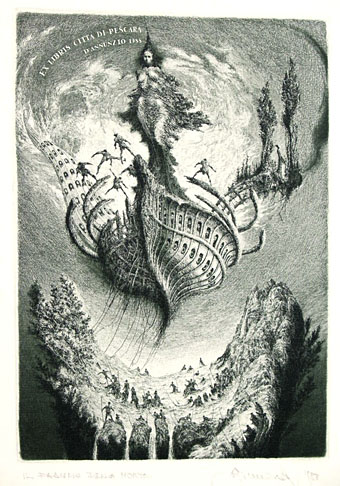
Il Fascino Della Morte (1988) by Albin Brunovsky.

• One of the forthcoming books featuring my cover art is Behold! Oddities, Curiosities, & Undefinable Wonders, a story collection due to be published next month by Crystal Lake Publishing. Bleeding Cool talked to editor Doug Murano about the collection and its contributors.

Six episodes of Tom Keating on Painters, a TV series from 1983 presented by Britain’s most well-known art forger. In six further episodes Keating examines the work of the Impressionists and Post-Impressionists.

• Opening at the Guggenheim, NYC, at the end of this month: Mystical Symbolism: The Salon de la Rose+Croix in Paris, 1892–1897.

The most potent form of gatekeeping is religion. When certain beliefs are deemed sacred, they are put beyond questioning. To challenge such beliefs is to commit blasphemy. The accusation of cultural appropriation is a secular version of the charge of blasphemy. It’s the insistence that certain beliefs and images are so important to particular cultures that they may not appropriated by others.

In Defence of Cultural Appropriation by Kenan Malik

• Mixes of the week: FACT Mix 605 by Anthony Parasole, and Secret Thirteen Mix 224 by Fanny Kaplan.

• Artist Tom Phillips at 80: “I’m still reading books. Nothing changes and everything changes.”

Negative Chambers is a new album by Yair Elazar Glotman and Mats Erlandsson.

• “Pornhub is the Kinsey Report of our time,” says Maureen O’Connor.

• “Postmodernism is dead. What comes next?” asks Alison Gibbons.

Cat Street View

Mystic Eyes (1965) by Them | Mystical Dream (1965) by The Roland Kirk Quartet | Mystic Green (1985) by Rain Parade