The Fantastic World of MC Escher

escher1.jpg

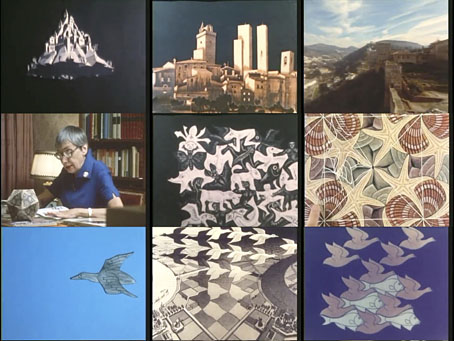
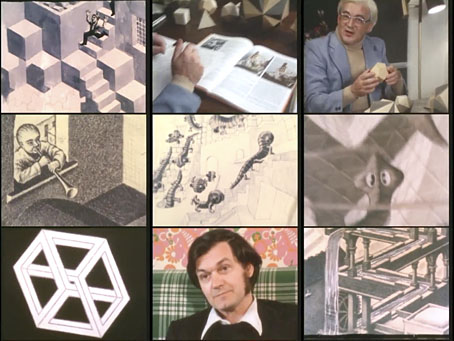
An Italian documentary about the Dutch artist made in 1980 and directed by Michele Emmer. I don’t recall ever seeing a British TV documentary about Escher (although I’d be surprised if there were none) but this resembles the type of thing the BBC used to do so well. Shots of the Italian towns where Escher lived for many years show the influence of the vernacular architecture on Escher’s prints. Elsewhere, animated sequences bring to life his tessellations, while various mathematicians examine some of the structural principles at work in these very familiar images. Of greatest interest for me is mathematician and physicist Roger Penrose discussing his first encounter with Escher’s work, and the development with his father of the Penrose Triangle, an impossible object similar to those that appear in some of Escher’s prints. (I used a Penrose Triangle in my cover art for Zones by Hawkwind.) The Fantastic World of MC Escher runs for 50 minutes, and may be watched here.
escher2.jpg

Previously on { feuilleton }
MC Escher album covers
Escher and Schrofer

Weekend links 246

ngai.jpg

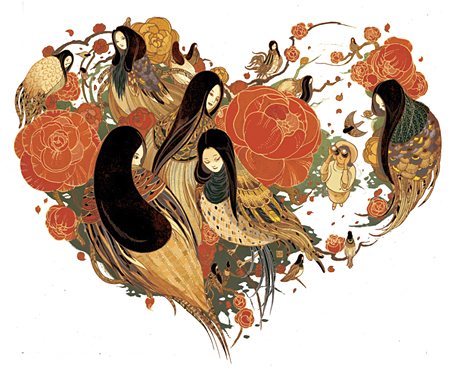
Love Hunter by Victo Ngai.

• “The strangeness of the lyric style, the misuse of words and awkward phraseology that have been criticized even by Poe’s fervent admirers, are here taken as virtues, heightening as they do, a given poem’s conscious and calculated formalism.” Marjorie Perloff reviews The Poet Edgar Allan Poe: Alien Angel by Jerome McGann.

• Mix of the week: Secret Thirteen Mix by Jeremy Kolosine. Starting with Michael Rother is apt when I’ve spent the past week in a Cluster/Harmonia/Kraftwerk/La Düsseldorf/Neu!/Rother loop.

• Court records “suggest that the supposedly prudish Victorians had a far more relaxed attitude to sex between men than their 1960s counterparts”. Historian Jeff Evans has the data.

• “Part of HP Lovecraft’s acknowledged debt to Machen also lies in hearing without seeing.” London Sound Survey on Arthur Machen’s “sounds from beyond the veil”.

• “…pity the designer who has to enact the stage direction that instructs rats to carry away a character’s feet.” Andrew Dickson on the extreme theatre of Sarah Kane.

• Psychedelic collage artist Wilfried Sätty receives a mention in Carey Dunne‘s piece about how LSD helped shape California’s ecstatic design legacy.

• More psychedelia: The Psychedelic Sex Book by Eric Gotland & Paul Krassner, edited by Dian Hanson.

• At Dangerous Minds: Robert Fripp demonstrates Frippertronics on The Midnight Special, 1979.

• Dreams from a Glass House: artist Josiah McElheny on the glass architecture of Paul Scheerbart.

• Director Peter Strickland on six films that fed into The Duke of Burgundy.

Vintage trade card designs

The Zero Of The Signified (1980) by Robert Fripp | Heptaparaparshinokh (1981) by Robert Fripp & The League of Gentlemen | 1984 (1981) by Robert Fripp

Have a heart

belisle.jpg

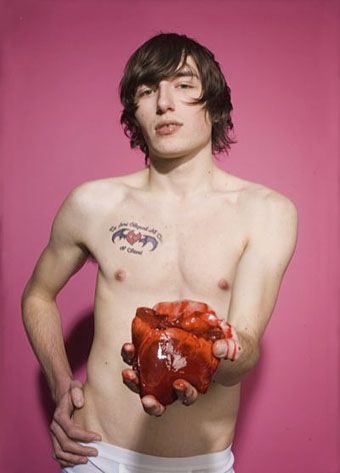
Kristopher photographed by David Belisle.

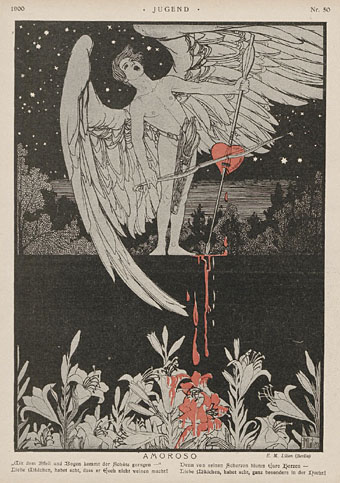
A little something for the 14th; I can always be relied on to post some gore for Valentine’s Day. I was tempted to post this still from Bride of Re-Animator but it’s a bit excessive for something so frivolous. Ephraim Lilien’s drawing shows that the bleeding love heart isn’t such a recent idea.

jugend-1900-11.jpg

Illustration by EM Lilien for Jugend, 1900.

Nine

nine.jpg

Celebrating nine years of interests, obsessions and passing enthusiasms. As before, a look at the annual delivery of stats from WordPress is instructive.

The Louvre Museum has 8.5 million visitors per year. This blog was viewed about 970,000 times in 2014. If it were an exhibit at the Louvre Museum, it would take about 42 days for that many people to see it.

The busiest day of the year was August 30th with 4,215 views. The most popular post that day was Index, fist or manicule?

Most posts here hit between 2,500 to 3,000 visits a day although the annual total is down on last year. I have Google stats indexing this site but I can never be bothered logging in to see how they compare. WordPress has the advantage of delivering stats to your blogging dashboard.

These are the posts that got the most views in 2014.
1 The art of NoBeast June 2007
2 The art of Thomas Eakins, 1844–1916 March 2006
3 The art of Takato Yamamoto June 2007
4 Gekko Hayashi revisited December 2012
5 The art of Oliver Frey July 2009

The gay art posts always beat everything else, and NoBeast is the most popular post for another year. Russia’s current crop of authoritarian goons may regard gay sex as horribly un-Russian but NoBeast gets consistently heavy traffic from VK, the Russian social network.

The top referring sites in 2014 were:
1. twitter.com
2. facebook.com
3. ficbook.net
4. pinterest.com
5. mentalfloss.com

Twitter and Facebook referrals are all very well but the way they hide what people are looking at means they’re no help to people running websites. Anyway, thanks as always for reading, referring and commenting! Here’s a few musical nines:

If 6 Was 9 (1967) by The Jimi Hendrix Experience
Nine Feet Underground (1971) by Caravan
Nine Moons In Alaska (1971) by Beaver & Krause
Party 9 (1973) by Faust
Katzenmusik 9 (1979) by Michael Rother

Leitkegel

autobahn12.jpg

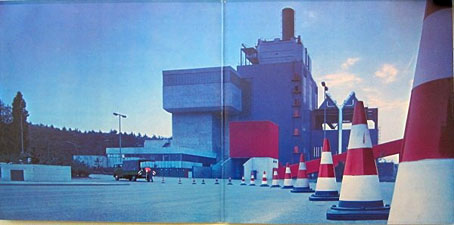
Gatefold interior for Doppelalbum (1974), a double-disc compilation album by Kraftwerk.

More Kraftwerkiana. “Leitkegel” is the German name for traffic cones, and it’s immediately obvious to anyone browsing Kraftwerk’s pre-Autobahn recordings that Ralf and Florian had a fixation with these objects. The closest thing I’ve found for a rationale is in Tim Barr’s history of the group, Kraftwerk: From Dusseldorf to the Future (1998), which features some musings about the influence of Joseph Beuys and the Düsseldorf arts scene of the late 60s. Prior to Kraftwerk, Florian Schneider was a member of a short-lived art collective/music outfit with the very un-Kraftwerkian name of Pissoff. Recordings exist of the group performing with Beuys. A more straightforward explanation might be to look towards Pop Art (something that Barr also suggests), with the traffic cone serving as a symbolic objet trouvé that’s also the first inkling of the future Kraftwerk obsessions with roads, trains and cycling. Whatever the impulse behind its adoption, between 1969 and 1973 the traffic cone was turning up everywhere that Ralf and Florian went.

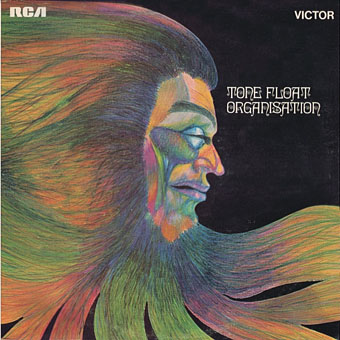
tonefloat1.jpg

Cover design by “Comus” (Roger Wooton).

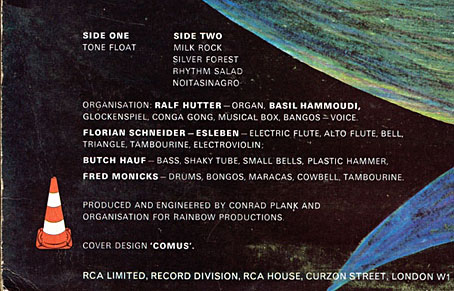
tonefloat2.jpg

The first instance is on Tone Float (1970), the pre-Kraftwerk album by Organisation, a collection of freeform improvisations that’s very much of its time. The album wasn’t very successful, and matters weren’t helped by the poor cover artwork. That multicoloured head and Ringlet typeface are also very much of their time but if you look on the back of the sleeve you find a traffic cone beside the album credits.

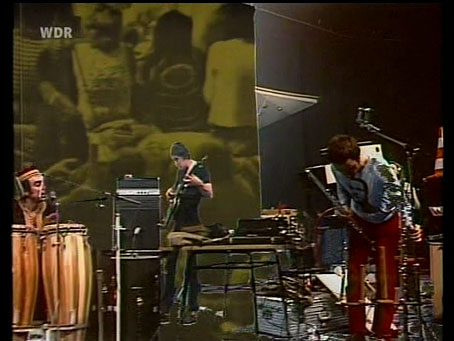
organisation.jpg

Organisation live (1970).

Before the group split they were recorded by German TV, a performance that gives a good idea of the Organisation sound and of how odd they all look together. Ralf Hütter isn’t visible but you do glimpse a traffic cone for a moment when Florian is moving his microphone stand. I suspect the proliferation of cones around Florian (see below) is an indicator that their adoption was his doing.

Continue reading “Leitkegel”