
The eyes of Odilon Redon

redon1.jpg

L’Oeil, comme un ballon bizarre se dirige vers l’infini from A Edgar Poe (1882).

Another decently thorough Symbolist website covers the life and work of Odilon Redon (1840–1916), an artist whose pastels and prints were strange even by the standards of his contemporaries. His giant eyeballs and other floating figures are always startling and point the way inevitably to Surrealism, especially in dream lithographs like the one below.

redon2.jpg

Vision from Dans le Rêve (1879).

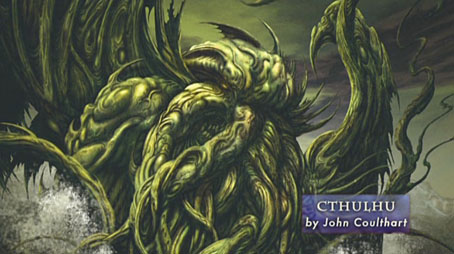
I compounded that Symbolist/Surrealist association when I was drawing The Call of Cthulhu in 1987 by showing Ardois-Boonot’s Dream Landscape (which Lovecraft doesn’t describe beyond the word “blasphemous”) as being a Max Ernst-style frottage canvas with a Redon eye rising from the murk. Cthulhu’s presence reduced to a single ocular motif like the eye of Sauron.

call.jpg

The Call of Cthulhu (1988).

And while we’re on the subject there’s Guy Maddin’s typically phantasmic short, Odilon Redon or The Eye Like a Strange Balloon Mounts Toward Infinity made for the BBC in 1995. Ostensibly based on the balloon picture above, this manages to reference a host of other Redon lithographs and charcoal drawings in the space of four-and-a-half minutes. Sublimely weird and weirdly sublime.

Elsewhere on { feuilleton }
The fantastic art archive

Previously on { feuilleton }
Arthur Zaidenberg’s À Rebours
The Heart of the World

Plates: Volume 2

plates.jpg

My third CD design for the Tectonic label is another piece of relative minimalism which once again features photos by Liz Eve. All the backgrounds on this occasion are microscope close-ups of vinyl records, very fitting for a double-CD collection of recent 12″ releases.

The Tectonic logo (which predates my involvement with the label) is based on the Technics logo and for this release I tidied the label logo slightly, a process which led to the discovery that the Technics design used a variant of the Clarendon typeface for its letter shapes (it’s not an exact match). This in turn led me to use Clarendon in various weights across the packaging, something which made a change from the usual sans serif or monospace font. The great Saul Bass frequently used Clarendon for his title sequences; if it’s good enough for Saul, it’s certainly good enough for me.

Tectonic main man Rob Ellis talked to Fact magazine about the new release earlier this week.

Previously on { feuilleton }
Aerial by 2562
New things for November

The Great God Pan

pan_daphnis.jpg

Pan teaching Daphnis to play the panpipes; Roman copy of a Greek original from the 3rd-2nd centuries BCE by Heliodoros.

“The worship of Pan never has died out,” said Mortimer. “Other newer gods have drawn aside his votaries from time to time, but he is the Nature-God to whom all must come back at last. He has been called the Father of all the Gods, but most of his children have been stillborn.”

So says a character in The Music on the Hill, one of the slightly more serious stories from Saki’s The Chronicles of Clovis (1911). Saki’s Pan is a youthful spirit closer to a faun than the goatish creature of legend. But being a gay writer whose tales regularly feature naked young men (surprisingly so, given the time they were written) I’m sure Saki would have appreciated the Roman statue above. There’s nothing chaste about this Pan with his “token erect of thorny thigh” as Aleister Crowley put it in his lascivious 1929 Hymn to Pan, a poem which caused a scandal when read aloud at his funeral some years later. The Roman statue was for a long while an exhibit in the restricted collection of the Naples National Archaeological Museum where all the more scurrilous and priapic artefacts unearthed at Pompeii were kept safely away from women, children and the great unwashed. These are now on public display and include the notorious statue of a goat being penetrated by a satyr.

Continue reading “The Great God Pan”

L’Ange by Patrick Bokanowski

lange.jpg

The good people at Ubuweb have excelled themselves by turning up this 70-minute avant garde work by a director who’d managed to stay resolutely off my radar despite years spent delving for cinematic weirdness. L’Ange (1982) is a film which stands comparison with the more abstracted moments of David Lynch and the Brothers Quay. In fact some scenes (and the music) are so reminiscent of parts of the Quay canon I’d suspect an influence if I didn’t consider that an unfair diminishing of the Brothers’ own considerable talents. So what is L’Ange? Trying to describe this film isn’t exactly easy so it’s simpler to hijack Ubuweb’s own précis:

During the seventy minutes of The Angel, viewers see a series of distinct sequences arranged upward along a staircase that seems more mythic than literal. Each of the sequences has its own mood and type of action. Early in the film, a fencer thrusts, over and over, at a doll hanging from the ceiling of a bare room. At first, he is seen in the room at the end of a narrow hallway off the staircase, and later from within the room. He fences, sits in a chair, fences – his movements filmed with a technique that lies somewhere between live action and still photographs. At times, Bokanowski’s imagery is reminiscent of Etienne-Jules Marey’s chronophotographs. Further up the stairs, we find ourselves in a room where a maid brings a jug of milk to a man without hands, over and over. Still later, we are in a room where there seems to be a movie projector pointing at us. Then, in a sequence reminiscent of Méliès and early Chaplin, a man frolics in a bathtub, and in a subsequent sequence gets up, dresses in reverse motion, and leaves for work. The film’s most elaborate sequence takes place in a library in which nine identical librarians work busily in choreographed, slightly fast motion. When the librarians leave work, they are seen in extreme long shot, running in what appears to be a two-dimensional space, ultimately toward a naked woman trapped in a box, which they enter with a battering ram. Then, back in the room with the projector, we are presented with an artist and model in a composition that, at first, declares itself two-dimensional until the artist and model move, revealing that this “obviously” flat space is fact three-dimensional. Finally, a visually stunning passage of projected light reflecting off a series of mirrors introduces The Angel‘s final sequence, of beings on a huge staircase filmed from below; the beings seem to be ascending toward some higher realm. Bokanowski’s consistently distinctive visuals are accompanied by a soundtrack composed by Michèle Bokanowski, Patrick Bokanowski’s wife and collaborator. Like Robert Wiene’s The Cabinet of Dr. Caligari (1919), Bokanowski’s The Angel creates a world that is visually quite distinct from what we consider “reality,” while providing a wide range of implicit references to it and to the history of representing those levels of reality that lie beneath and beyond the conventional surfaces of things.

lange2.jpg

Asking what it all means is pointless, we’re in the world of dreams here and once again we see how film is able to capture the ambience of dream states in a way no other artform can manage. For an obviously low-budget production there’s real craft and control at work throughout L’Ange, not least in the excellent score—a blend of strings and electronics—which could easily stand alone. Many experimental films of this type quickly outstay their welcome via prolonged repetition or a failure to exploit the imaginative potential of their techniques. Like Lynch and the Quays, Bokanowski successfully balances on the dividing line between narrative and abstraction, finding images unlike any we’ve seen elsewhere. Yes, I enjoyed this a lot, and now I want to watch it again on DVD (if such a thing exists). Anyone who enjoys The Grandmother or Rehearsals for Extinct Anatomies is advised to set aside seventy minutes of their time.

Previously on { feuilleton }
The Hourglass Sanatorium by Wojciech Has
Babobilicons by Daina Krumins
Impressions de la Haute Mongolie revisited
Short films by Walerian Borowczyk
The Brothers Quay on DVD