Wildeana 10

wilde.jpg

Illustration from The House of Pomegranates (1914) by Jessie M. King.

Continuing an occasional series. Recent Wildean links.

• It’s a measure of a writer’s success if the characters or stories they create resonate sufficiently with future generations to be subject to new interpretations. Among Oscar Wilde’s contemporaries this has happened to Arthur Conan Doyle and Bram Stoker, both of whom Wilde knew. Increasingly it’s been happening to Wilde’s own fiction, especially in the case of Dorian Gray whose tragedy assumes the status of a modern myth. At Cannes this year, Clio Barnard premiered a contemporary retelling of Wilde’s The Selfish Giant. Bleeding Cool has some clips. The social realism is a long way from Wilde’s tale but that shows how flexible these fables can be.

• Jessie M. King’s illustrations for Wilde’s The House of Pomegranates have appeared here before but the copies posted at The Golden Age are the usual quality scans.

Rick Gekoski: “Visiting the US, I am reminded of Oscar Wilde’s tour there in 1881, which allowed him to become an orator and a celebrity.”

Paper Dolls by David Claudon based on the characters from The Importance of Being Earnest. (Thanks to Gabe for the tip.)

Elsewhere on { feuilleton }
The Oscar Wilde archive

Skivvies

underwear1.jpg

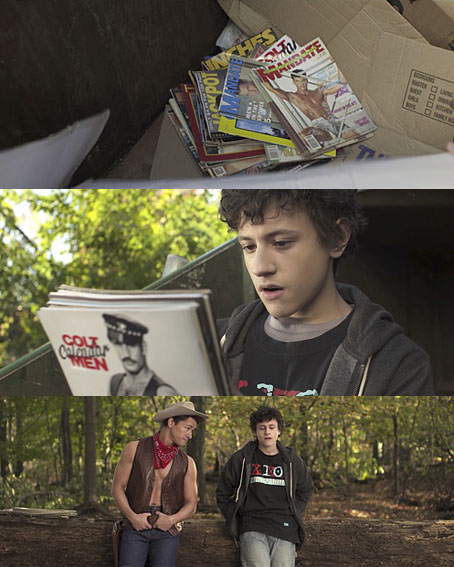
Not had anything for a while deserving of the eye candy tag so here’s some gratuitous shots from a short promo video for some underwear company or other (he said disingenuously). The ad is directed by Steven Klein, and the piece as a whole doesn’t appear to have had a straight viewer in mind given the amount of shots that look like AMG beefcake or extra auditions for Fassbinder’s Querelle. And speaking of Rainer’s matelots, they’ve been in mind recently following news that the director’s Genet fantasia will be making a welcome appearance on Blu-ray later this month. The DVD format didn’t do much for those saturated colours so this is good to hear. (Underwear tip via Homotography.)

Previously on { feuilleton }
Hello, sailor
Querelle again
Sailors
Mikel Marton
Exterface

Weekend links 175

maeda.jpg

Heartbeat of the Death – Queen Elizabeth the First (2013) by Haruko Maeda.

• “The casual mixing of people from across the world at The Garden broke down many barriers. Its rich, beautiful, smart, and successful people were confident enough to exercise the kind of sexual freedom that would land you in jail elsewhere in the country.” Kate Webb on Alla Nazimova’s Hollywood estate, The Garden of Alla.

• “…from 1956 to 1970 Borges taught English literature at the University of Buenos Aires, and now, over half a century later, one of his courses is finally available in English in a slim, delightful volume.” Will Glovinsky on Professor Borges. Related: Jacob Mikanowski says “To Tlön: Let’s Invade Reality”.

• Mixes of the week: Secret Thirteen Mix 084 by Koen Holtkamp—Alice Coltrane, Alan Watts, John Cage, Popol Vuh, Faust and others—and Sequenze E Frequenze, “the rarefied outer limits of ‘stare at the sun, outsider peaked’ Italian music”.

Consider the fate of the concept of ‘futuristic’ music. The ‘futuristic’ in music has long since ceased to refer to any future that we expect to be different; it has become an established style, much like a particular typographical font. Invited to think of the futuristic, we will still come up with something like the music of Kraftwerk, even though this is now as antique as Glenn Miller’s big band jazz was when the German group began experimenting with synthesizers in the early 1970s.

Where is the 21st-century equivalent of Kraftwerk? If Kraftwerk’s music came out of a casual intolerance of the already-established, then the present moment is marked by its extraordinary accommodation towards the past. More than that, the very distinction between past and present is breaking down. In 1981, the 1960s seemed much further away than they do today. Since then, cultural time has folded back on itself, and the impression of linear development has given way to a strange simultaneity.

Mark Fisher on the present cultural moment, and the weirdness of Sapphire and Steel.

• At Front Free Endpaper: A Gay Library Thing and French Line Gay Pulp Cover Designs. Callum is also giving away books by Frederick Rolfe/Baron Corvo to anyone who asks. The proviso is you write a short review for his blog.

• Film director Ben Wheatley on Don’t Look Now: “I felt a great panic come over me”. Elsewhere it was announced this week that Wheatley is planning a film of JG Ballard’s High Rise.

• Brits may remember the wonderful Laurie Pike from the Manhattan Cable TV show in the early 1990s. These days she’s writing an online guide to the city of Paris.

Ben Frost has made three previously unreleased recordings available at Bandcamp.

The Media History Digital Library: 800,000 pages of film and radio periodicals.

• The results of three derives in London by Christina Scholz here, here and here.

• The late Seamus Heaney reads his own translation of Beowulf here and here.

High Rise (1979) by Hawkwind | Pop Sicle (1994) by High Rise | High Rise (2005) by Ladytron

Sirene by Raoul Servais

sirene.jpg

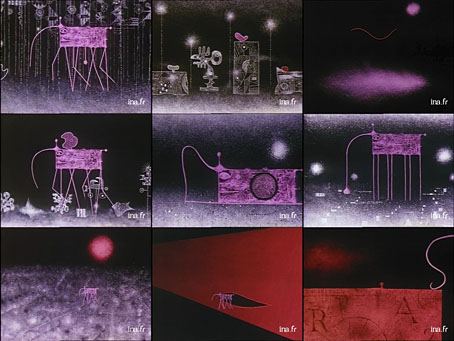
Sirene (1968), a short animation by Belgian filmmaker Raoul Servais, isn’t as sinister as his nightmarish Harpya (1979), despite the similar titles. But Sirene does have a collection of anthropomorphic harbour cranes, and a flock of inexplicable pterodactyls like something out of a Gerald Scarfe cartoon. Watch it here.

Previously on { feuilleton }
Harpya by Raoul Servais
Taxandria, or Raoul Servais meets Paul Delvaux

Dr Mabuse posters

mabuse00.jpg

This picture of a séance in the 1920s circulates endlessly in the Tumblr labyrinth, usually without attribution so that many of the people seeing it won’t be aware that it’s a still (or a set photo) from Fritz Lang’s Dr. Mabuse, The Gambler (1922). Mabuse himself originates in a novel of the same name by Norbert Jacques published in 1921, the tale of a Moriarty-like super-criminal at large in Weimar-era Berlin. Lang made three films about the character, the first two of which, Dr. Mabuse, The Gambler, and The Testament of Dr. Mabuse (1933) feature Rudolf Klein-Rogge as the sinister Doctor, an actor better known today for his role as the mad scientist, Rotwang, in Lang’s Metropolis (1927). Testament was banned by Goebbels for being subversive. The third film, The Thousand Eyes of Dr. Mabuse (1960), was also one of the director’s last but it managed to revive interest in the character at a time when super-criminals were coming back into vogue. Wolfgang Preiss played Mabuse in this film, and in several sequels by other directors.

mabuse01.jpg

I’ve known about the Mabuse films for years, thanks in part to Lotte Eisner’s superb history of German silent cinema, The Haunted Screen (1952), yet despite this I’ve still not seen any of the films. That should change soon with the news that Eureka Video are releasing a new print of Dr. Mabuse, The Gambler on Blu-ray at the end of October, a restored version that will run for 280 minutes. The running time sounds excessive but Eisner points out that the film was originally screened in two parts: The Great Gambler: An Image of the Age, and Inferno: A Game for the People of our Age. In addition to Rudolf Klein-Rogge fixing everyone with his hawk-like glare there’s also Alfred Abel playing a weaker character than his master of the city in Metropolis. Moviemail describes Mabuse as “a criminal mastermind whose nefarious machinations are based around hypnotism, charlatanism, hallucinations, Chinese incantations, cold-blooded murder, opiate narcosis and cocaine anxiety”; how can one resist?

The posters gathered here are from a web trawl so lack the usual credits. The second film evidently had a wider distribution hence the greater quantity of posters from other countries.

mabuse02.jpg

mabuse03.jpg

Continue reading “Dr Mabuse posters”