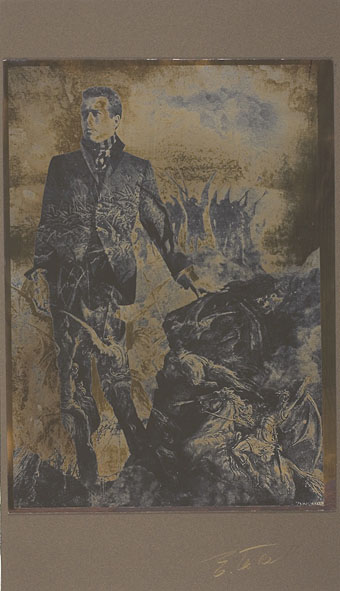
Kenneth Anger, Topanga Canyon, Composite with Gustave Doré Engraving (1954) by Edmund Teske.
Les Chants de Maldoror, 1951–1952.
16mm; black and white; filmed in Paris and Deauville.
With a hand-held 16mm camera I shot my first series of short haiku. This was my apprenticeship in the marvels that surround us, waiting to be discovered, awake to knowledge and life and whose magical essence is revealed by selection. At 17, I composed my first long poem, a 15 minute suite of images, my black tanka: Fireworks.
I had seen this drama entirely on the screen of my dreams. This vision was uniquely amenable to the instrument that awaited it. With three lights, a black cloth as décor, the greatest economy of means and enormous inner concentration, Fireworks was made in three days.
An example of the direct transfer of a spontaneous inspiration, this film reveals the possibilities of automatic writing on the screen, of a new language that reveals thought; it allows the triumph of the dream.
The wholly intellectual belief of the “icy masters” of cinema in the supremacy of technique recalls, on the literary level, the analytical essays of a Poe or the methods of a Valéry, who said: “I only write to order. Poetry is an assignment.”
At the opposite pole to these creative systems there is the divine inspiration of a Rimbaud or a Lautréamont, prophets of thought. The cinema has explored the northern regions of impersonal stylization; it should now discover the southern regions of personal lyricism; it should have its prophets.
These prophets will restore faith in a “pure cinema” of sensual revelation. They will re-establish the primacy of the image. They will teach us the principles of their faith: that we participate before evaluating. We will give back to the dream its first state of veneration. We will recall primitive mysteries. The future of film is in the hands of the poet and his camera. Hidden away are the followers of a faith in “pure cinema.” even in this unlikely age. They make their modest “fireworks” in secret, showing them from time to time, they pass unnoticed in the glare of the “silver rain” of the commercial cinema. Maybe one of these sparks will liberate the cinema….
Angels exist. Nature provides “the inexhaustible flow of visions of beauty.” It is for the poet, with his personal vision, to “capture” them.
Kenneth Anger—Modesty and the Art of Film, Cahiers du Cinéma no. 5, September 1951
* * *
Little is known about Anger’s activities during the mid-1950s. By 1958 he still had not been able to complete any films in Paris. He held on to his hope of completing Maldoror. His stack of preproduction notes and sketches had grown larger and he had plans to photograph nudes in a graveyard. Several Parisian Surrealists threatened to hand Anger’s head to him if he shot Maldoror. The book’s fluid, dreamlike imagery had been one of the trailblazers of Surrealism, and his detractors felt that a gauche American with a reputation for pop iconography and bold homosexual statement would debase a sacred text.
Bill Landis—Anger: The Unauthorized Biography of Kenneth Anger, 1995
* * *
I discovered the book when I was quite young. I loved it, put a lot of passion into it. I found people to play the parts. I found settings, gaslit corners, places still had the romantic look of a Second Empire. It was a terrific ambition to make this epic film-poem. I found ways to translate the text’s extraordinary images. I planned to film a mid-nineteenth century story taking place in twentieth century Paris. I filmed “the hymn to the ocean” on the beach at Deauville, with Hightower and members of the Marquis de Cuevas Ballet. They danced in the sea; tables were placed beneath the water line so the dancers could stand on their points. It looked as though they were standing on waves. The people who called themselves “Surrealists” were furious—this group of punks threatened me—they didn’t want a Yank messing round with their sacred text. I just told them to go to hell! I also managed to film the war of the flies and pins. I put bags of pins and dozens of flies into a glass container; revolved the container and filmed in close-up. As the pins dropped the flies zigzagged to escape. In slow motion an impressive image.
Kenneth Anger—Into the Pleasure Dome: The Films of Kenneth Anger, edited by Jayne Pilling & Michael O’Pray, 1989
* * *
The sections of the film that were completed [are] stored in the Cinémathèque Française, but [their] exact whereabouts in the archive is unknown, with no images from the film being currently available for reproduction.
Alice L. Hutchinson—Kenneth Anger, 2004
Previously on { feuilleton }
• Donald Cammell and Kenneth Anger, 1972
• My Surfing Lucifer by Kenneth Anger
• Inauguration of the Pleasure Dome: The Eldorado Edition
• Brush of Baphomet by Kenneth Anger
• Anger Sees Red
• Kenneth Anger’s Hollywood Babylon
• Lucifer Rising posters
• Missoni by Kenneth Anger
• Anger in London
• Arabesque for Kenneth Anger by Marie Menken
• Edmund Teske
• Kenneth Anger on DVD again
• Mouse Heaven by Kenneth Anger
• The Man We Want to Hang by Kenneth Anger
• Relighting the Magick Lantern
• Kenneth Anger on DVD…finally