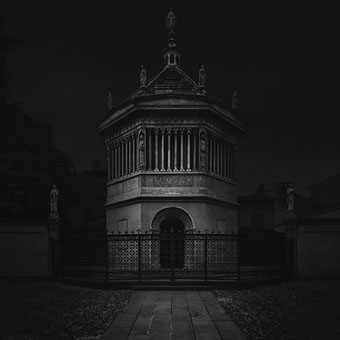
A mix for Halloween: Analogue Spectres

Presenting the eleventh Halloween playlist, and another mix of my own. Previous mixes have been wide-ranging and not a little nerve-jangling so this year the focus has been narrowed to a synth-only mix. The theme is the analogue synthesizer music of the 1970s, particularly the style popularised by Tangerine Dream on Phaedra, Rubycon, Ricochet and Stratosfear.

The “fear” element of the latter title is significant in this context. Tangerine Dream from their earliest days produced timbres and atmospheres that tended towards the sinister and the doom-laden. This quality continued when they moved to Virgin Records in 1974, using new synthesizers and sequencers to develop their sound. In part the doomy atmosphere was a result of limitations, a combination of organ-led chord sequences and the difficulties of using primitive electronics for anything other than unnatural atmospheres. The earliest albums by Klaus Schulze are equally sombre but Schulze lost this tendency as his playing improved. Tangerine Dream, meanwhile, seemed to enter a Gothic phase with the move to Virgin: their track titles became darker—Mysterious Semblance At The Strand Of Nightmares, The Big Sleep In Search Of Hades, Stratosfear—and they swapped concert halls for the cavernous spaces of European cathedrals. William Friedkin in his sleeve note for the Sorcerer soundtrack album expressed disappointment that he hadn’t heard the group soon enough for them to provide music for The Exorcist.

Tangerine Dream are only represented here with two tracks—one of them from the Sorcerer soundtrack—but their influential Virgin years provide the template for several other pieces. Two of the groups, Redshift and Node, are British ensembles who take Tangerine Dream’s albums of the 1970s as their sole template. In the case of Redshift this has yielded a number of albums that are flawless in their imitation (and extension) of the Rubycon/Ricochet template, and the group are highly recommended to anyone who enjoys those albums. Redshift have also continued with the doom-laden atmospheres which is why this mix contains so many of their pieces.

The other axis here is the early scores by John Carpenter which have often seemed as influential as his films: imitated, sampled, and inspiring the sinister, throbbing electronica of Pye Corner Audio and others. Carpenter has frequently mentioned Tangerine Dream in lists of favourite electronic musicians; no surprise there but it feels satisfying to have things join up.

As before, Mixcloud no longer allows the posting of a tracklist so this is the running order:

Tangerine DreamSorcerer (Main Title) (1977)
Pye Corner AudioProwler (2015)
RedshiftLeave The Light On (2004)
John CarpenterThe Fog Enters The Town (1980)
Ian BoddyThere’s Something In Your Attic (1999)
NodeDark Beneath The Earth (2014)
Tangerine DreamDesert Dream (1977)
RedshiftWraith (2002)
RedshiftNightshift (2007)
RedshiftDown Time (2001)
Pye Corner AudioStars Shine Like Eyes (2015)

Previously on { feuilleton }
A mix for Halloween: Teatro Grottesco
A mix for Halloween: Unheimlich Manoeuvres
A mix for Halloween: Ectoplasm Forming
A playlist for Halloween: Hauntology
A playlist for Halloween: Orchestral and electro-acoustic
A playlist for Halloween: Drones and atmospheres
A playlist for Halloween: Voodoo!
Dead on the Dancefloor
Another playlist for Halloween
A playlist for Halloween

Weekend links 332

seamans.jpg

Suspiria (2012) by Jessica Seamans.

Matthew Sperling on Tom Phillips’ “treated Victorian novel” A Humument, which he calls “a multimedia masterpiece”. Phillips’ sixth and final edition of the book is published by Thames & Hudson next month.

Strange Flowers on Monsieur de Bougrelon (1897), a short novel by Jean Lorrain which will be published next month by Spurl Editions. The book is currently on my to-be-read-next pile.

Theodore Carter finds images of skulls by artists through the ages. I’d have included Giacometti’s almost abstract Head-Skull (1934) or his sketch of 1923.

• The horror stories of EF Benson contain “enough nastiness to give you just the right kind of frisson for the time of year,” says Nicholas Lezard.

• Covers for One, an American magazine of the 50s and 60s dedicated to “the homosexual viewpoint”.

Kelly Sullivan takes a close look at the illustrations and stained-glass work of the great Harry Clarke.

• Lost Moomins cartoon strips will be shown in the first UK Tove Jansson exhibition.

• The extravagant homes of Ludwig II of Bavaria are in urgent need of restoration.

• Mix of the week: The Nine Ten Never Sleep Again Mix by The Curiosity Pipe.

Ténéré Tàqqàl (what has become of the Ténéré), a new song by Tinariwen.

• The King of Weird: Joyce Carol Oates on HP Lovecraft.

• Charting the legacy of cult 1970s band, Big Star.

Falling (1992) by Miranda Sex Garden | Inferno (Version II) (1993) by Miranda Sex Garden | Peep Show (1994) by Miranda Sex Garden

More Quays: Slow Time—Tempus Fugit

slow1.jpg

This short video—officially released to YouTube by the makers of Leffe, a Belgian beer—is two films in one: Slow Time is a brief portrait of the Brothers Quay by Gary Tarn, more fleeting even than Christopher Nolan’s film; Tempus Fugit is an ad by the Quays for Leffe beer that’s more typical than many of their earlier commissions from the commercial world. The portrait is one of six promotional pieces that Leffe have made about artists. Belgian beer seems a fitting product for the Quays when you know that the production company they formed with Keith Griffiths in 1979, Koninck, took its name from a Belgian beer mat.

slow2.jpg

slow3.jpg

Tempus Fugit.

Elsewhere on { feuilleton }
The Quay Brothers archive

Inner Sanctums—Quay Brothers: The Collected Animated Films 1979–2013

quays.jpg

In previous posts about the Quay Brothers’ films I’ve expressed a hope that we might see a new collection from the BFI that gathers together more of their recent works. That’s what we have now in a 2-disc Blu-ray set that will be released in the UK on 10th October.

quay.jpg

Quay (2015) directed by Christopher Nolan.

The new collection repeats the contents of the earlier BFI DVD set, The Short Films 1979–2003, while adding some of their recent commissions including Maska (2010), Through the Weeping Glass (2011), and Unmistaken Hands: Ex Voto F.H. (2013). Among the extras there’s a short portrait of the brothers, Quay (2015), directed by Christopher Nolan. This shows the Quays at work in their Southwark studio where they discuss the technical details of animation and puppet-making a little more than I’ve seen in other interviews. Nolan’s film is both beguiling and frustrating, the latter for being so inexplicably short. When I first saw Quay announced I thought it might be a feature-length documentary rather than a fleeting glimpse; the Quays have been interviewed regularly over the past few years so they’re not exactly unforthcoming. I’m hoping now that Nolan’s public enthusiasm for the brothers might at least help them to make another feature, a decade having elapsed since The Piano Tuner of Earthquakes (2005).

street1.jpg

Street of Crocodiles (1986).

As to the films, seeing them in high-definition is certainly a plus although the earliest ones were all made in 16mm so they don’t gain a great deal. Street of Crocodiles, however, looks superb, and I found myself noticing details that I’d earlier missed despite numerous viewings. I’m disappointed that two early shorts, Igor: The Paris Years (1982) and Leoš Janáček: Intimate Excursions (1983), remain unreleased due to apparent problems with music copyrights. (See this post for YouTube links.) Also uncollected are their other music videos apart from the two produced for His Name Is Alive, together with a handful of other short pieces. (See this post for further links.)

street2.jpg

Street of Crocodiles (1986).

Of the longer films on the second disc, Maska has become a favourite, with its combination of a baroque science-fiction scenario (from Stanisław Lem) and a score by Penderecki. Through the Weeping Glass, a 30-minute documentary about the medical oddities housed in the Mütter Museum in the Quays’ home city of Philadelphia, is a kind of companion piece to The Phantom Museum (2003), a similar study of the Wellcome Collection in London. This is the first film the Europhile Quays have made in the US, and comes with a short documentary showing them at work on the film, and an interview about the production. I’m still getting used to their shift to digital video—I miss the grain and texture of their films—but since I’ve been working digitally myself for many years now I can’t complain if others choose to do the same.

maska1.jpg

The preview discs of the new collection came without the booklet which will be present in the package. This will include an updated Quays Dictionary by Michael Brooke (as featured in the previous BFI collection), and the 2012 “interview” by the deceased calligrapher Heinrich Holzmüller, On Deciphering the Pharmacist’s Prescription for Lip-Reading Puppets. The latter appeared in the catalogue for the Quays’ MoMA exhibition where it was printed at an eye-straining point size. I’m hoping the BFI version will be an improvement.

The Films
Nocturna Artificialia (1979)
The Cabinet of Jan Švankmajer (1984)
This Unnameable Little Broom (1985)
Street of Crocodiles (1986)
Rehearsals for Extinct Anatomies (1988)
Stille Nacht I: Dramolet (1988)
Ex-Voto (1989)
The Comb (1990)
Anamorphosis (1991)
The Calligrapher (Parts I, II, III) (1991)
Stille Nacht II: Are We Still Married? (1992)
Stille Nacht III: Tales from Vienna Woods (1993)
Stille Nacht IV: Can’t Go Wrong Without You (1994)
In Absentia (2000)
The Phantom Museum (2003)
Songs for Dead Children (2003)
Eurydice, She So Beloved (2007)
Alice in Not so Wonderland (2007)
Kinoteka Ident (2008)
Inventorium of Traces (2009)
Wonderwood for Comme des Garçons (2010)
Maska (2010)
Through the Weeping Glass (2011)
Unmistaken Hands: Ex Voto F.H. (2013)

Special features
Introduction by the Quay Brothers (2006, 20 mins)
Quay (2015, 8 mins): a film by Christopher Nolan
Quay Brothers audio commentaries for This Unnameable Little Broom, Street of Crocodiles, Stille Nacht I-III and In Absentia
The Falls [excerpt] (1980, 5 mins)
BFI Distribution ident (1991, 30 secs)
The Summit (1995, 12 mins)
No Bones About It: Quay Brothers (2010, 12 mins)
Behind the Scenes with the Quay Brothers (2013, 31 mins)
Unmistaken Hands: Ex Voto F.H. trailer (2 mins)

Elsewhere on { feuilleton }
The Quay Brothers archive

Weekend links 329

vyletal.jpg

Josef Vyletal borrows figures from Aubrey Beardsley’s Salomé for a Czech poster promoting The Immortal Story (1969) by Orson Welles. Vyletal’s own paintings were often strange and surreal.

Pale Fire is Nabokov’s “great gay comic novel,” says Edmund White. A surprising but not inappropriate reappraisal. White has noted in the past that Nabokov “hated homosexuality” despite having a gay brother and uncle. The portrayal of Charles Kinbote in Pale Fire isn’t unsympathetic if you overlook his being delusional, and possibly insane…

• At Folk Horror Revival: details of the charity donations raised by sales of the Folk Horror Revival books, the first of which featured my David Rudkin essay. A one-day Folk Horror Revival event takes place later this month at the British Museum, London.

• Mixes of the week: The Bug presents Killing Sound Chapter 2: Inner Space, a 2-hour blend of “sci-fi scores, expansive atmospheres and synthesized psychedelia”; Decoded Sundays presents Scanner; Secret Thirteen Mix 197 is by LXV.

Stars Of The Lid unveil a James Plotkin remix of their Music For Twin Peaks Episode #30 Pt. 1. Related: the hype for the new Twin Peaks series gets into gear with a teaser.

• Robert Aickman’s only novel, The Late Breakfasters (1964), is being given its first US publication by Valancourt Books.

• “Don’t dream it, bet it.” Evan J. Peterson on 40 years of The Rocky Horror Picture Show.

• Anna von Hausswolff’s sister, Maria, directs a video for Come Wander With Me / Deliverance.

• RIP Michael O’Pray, film writer and curator of many festivals of experimental cinema.

• Oli Warwick talks to electronic musicians about the influence of the late Don Buchla.

Breakfast In Bed (1969) by Dusty Springfield | Alan’s Psychedelic Breakfast (1970) by Pink Floyd | Another Breakfast With You (2001) by Ladytron