Leslie Megahey, 1944–2022

megahey.jpg

TV producer & film director Leslie Megahey died at the end of August but the news has taken a while to filter through to these pages where his BBC TV productions have been the subject of several posts. My recurrent comments about his work were effusive enough for him to send me a handwritten note of thanks a few years ago, plus a promotional card for one of the films in the Artists and Models series. If more of his productions had been available online or on disc I would have written something about them as well, but old television, especially the documentary variety, remains persistently inaccessible to future audiences.

There are biographical details in the link above so what follows is a list of the Megahey productions that, for this viewer at least, made his name one to look out for in the TV listings. Some of these are on YouTube, a couple are available on disc, while the rest have yet to resurface anywhere. Everything here is highly recommended…if you can find it.

Omnibus: All Clouds are Clocks (1976/1991): An hour-long interview with composer György Ligeti. I caught this one on its updated rebroadcast in 1991 when Megahey revisited Ligeti to see what directions his career had taken over the past 15 years. Currently unavailable.

Schalcken the Painter (1979): Another Omnibus film, and a ghost story (after Sheridan Le Fanu) that’s as good as any of the BBC’s MR James adaptations. Released on (Region B) blu-ray & (Region 2) DVD by the BFI.

Arena: The Orson Welles Story (1982): A two-part interview (165 minutes in total) which caught Welles in a rare mood when he was happy to talk at length about his career. The TV equivalent of the huge book of Peter Bogdanovich conversations. Part One | Part Two

Artists and Models (1986): Three drama/documentaries about French painters: David, Ingres and Géricault.

Cariani and the Courtesans (1987): Another historical drama about an artist, Giovanni Cariani (c. 1490–1547). Very much in the mould of Schalcken the Painter but without the supernatural element. Currently unavailable.

Duke Bluebeard’s Castle (1988): The best film version of Bartók’s opera. The Region 1 DVD by Kultur seems to be deleted but is worth seeking out for having removable subtitles. There’s a copy at YouTube.

The Complete Citizen Kane (1991): A 90-minute documentary about Welles’ film using extracts from the Arena interviews and the Megahey produced TV series The RKO Story, plus new material. No longer on YouTube (or anywhere else) due to a copyright complaint. This is why I’m always saying you should download these things as soon as you find them.

The Hour of the Pig (1993): A feature film about a medieval animal trial, this one was hacked around by Miramax then released in the US as The Advocate where it flopped. The hard-to-find UK version turned up on YouTube a few days ago.

Previously on { feuilleton }
Men and Wild Horses: Théodore Géricault
The Complete Citizen Kane
Schalcken the Painter revisited
Le Grande Macabre
Leslie Megahey’s Bluebeard

What A Life! An Autobiography by EVL and GM

whatalife1.jpg

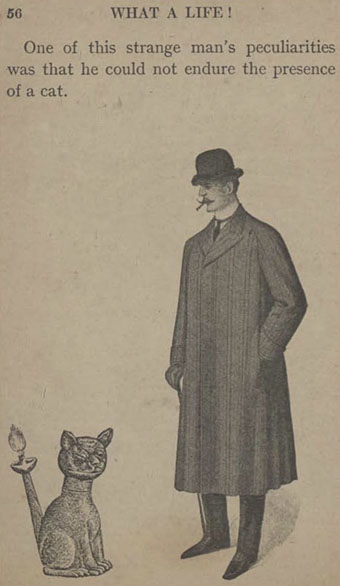
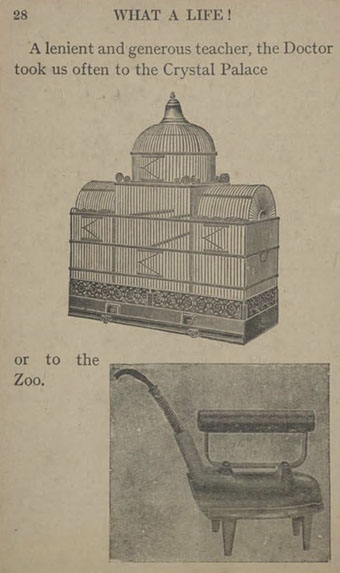
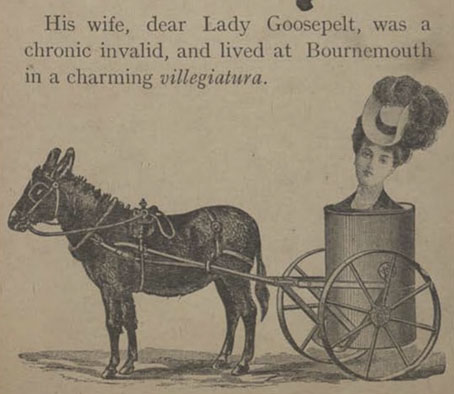
In last week’s post about Norman Rubington/Akbar Del Piombo I said that Rubington’s collages “were probably the first to use the form developed by Max Ernst for explicitly humorous purposes.” That “probably” was well-placed since it turns out that Rubington wasn’t quite the first to reuse engraved illustrations to comic effect, something I was unaware of until a few days ago. What A Life! An Autobiography (1911) is a short book credited to “EVL & GM”, or Edward Verrall Lucas and George Morrow, in which Lucas wrote captions for illustrations selected by Morrow from a catalogue for Whiteley’s, one of the first London department stores. The “autobiography” recounts the upbringing and adulthood of an English aristocrat, Baron Dropmore, with much of the humour being derived not from the text itself but from the mislabelling of various household items. Lucas and Morrow both worked for Punch magazine, and the humour is very much in the older Punch mode but given a fresh twist by the use of pre-existing illustrations.

whatalife2.jpg

In addition to the mislabelling there’s also some rudimentary collage work from Morrow which is easy to overlook after a century of similar examples. Whiteley’s catalogue seems to have been a more fertile source for this than the publications produced by the store’s rivals. I have a facsimile reprint of the 1895 catalogue for Harrod’s, a literal doorstop of 1000 pages. It’s a useful reference if you want to know how much the upper classes were paying for their goods in the Victorian era but it’s never been very good for collage purposes. This smaller Whiteley’s catalogue has many more illustrations plus a number of those florid title designs festooned with combination ornaments that you often find in 19th-century books.

whatalife3.jpg

The pages here are taken from a scan at the Internet Archive but What A Life! has been reprinted several times, including an edition published by Dover in 1975 for which John Ashbery provided an introduction. Ashbery enjoyed this kind of pictorial eccentricity; one of his art essays is The Joys and Enigmas of a Strange Hour, an appraisal of A Glove (1881) by Max Klinger, a series of etchings that prefigure the Surrealists in their dreamlike strangeness. Ashbery also made collages of his own, one of which, Summer Dream (2008), contains a detail borrowed from What A Life!

(Thanks to Allan and Andrew for the tip!)

Previously on { feuilleton }
Fuzz Against Junk & The Hero Maker
Nathaniel Krill at the Time Node
Initiations in the Abyss: A Surrealist Apocalypse
Wilfried Sätty: Artist of the occult
Illustrating Poe #4: Wilfried Sätty
Metamorphosis Victorianus
Max (The Birdman) Ernst
The art of Stephen Aldrich

Weekend links 638

feherlofia.jpg

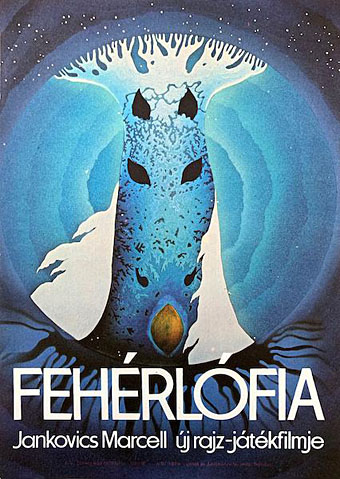
• After writing about Hungarian animator Marcell Jankovics back in January, I left a comment expressing the hope that Arrow or Eureka might give us a Region B blu-ray of Son of the White Mare (aka Fehérlófia), Jankovics’s “psychedelic” animated feature from 1982. Fast-forward nine months to Eureka’s announcement that they’ll be doing exactly this in November. Watch the trailer. The release will include some of the director’s short films plus his first feature, Johnny Corncob (1973), a historical tale presented in the “groovy” style (previously) popularised by Yellow Submarine. If idle wishes can be granted so easily then I’ll hope again that Eureka might do the same for René Laloux’s second and third animated features, the Moebius-designed Time Masters (1982) (made in the same studio as Son of the White Mare) and the Caza-designed Gandahar (1987). Fingers crossed.

• “I don’t think anybody copies me, but Harmony Korine, Todd Solondz, Bruno Dumont, Gaspar Noé, I like those kinds of directors. They’re sometimes not funny at all. They’re very serious and eerily melodramatic. I just like movies that surprise me.” John Waters (yet again) talking to Conor Williams about films, writing and a prayer for Pasolini.

• “There is something profoundly haunting about a master artist’s last painting left unfinished upon its easel…” Kevin Dann on The Mermaid (1910) by Howard Pyle.

• At Bandcamp: Navigating the Nurse With Wound List: A Gateway to Far-Flung Sounds.

• “Juicy With Meaning”: Alex Denney chooses five essential films by David Cronenberg.

• Mix of the week: Discovering 1970s jazz fusion with Kerri Chandler.

• Coming soon from Strange Attractor: Purgatory by Ken Hollings.

• Steven Heller’s font(s) of the month: Farandole & Lustik.

Dennis Cooper’s favourite albums.

• RIP Peter Straub.

White Horses (1968) by Jacky | Five White Horses (1968) by Sun Dragon | Ride A White Horse (2006) by Goldfrapp

Fuzz Against Junk & The Hero Maker

rubington1.jpg

This is another of those posts in which I brag about finding an old book in a charity shop for a lot less than you’d have to pay for it online. But it does give me the opportunity to say something about American writer/artist Norman Rubington and his alter ego Akbar Del Piombo, something I was sure I’d done already. One of the weekend posts linked to an article about Rubington’s work but my discussion of his collages is in the essay I wrote about Wilfried Sätty for the Strange Attractor Journal, a piece which isn’t available here.

rubington8.jpg

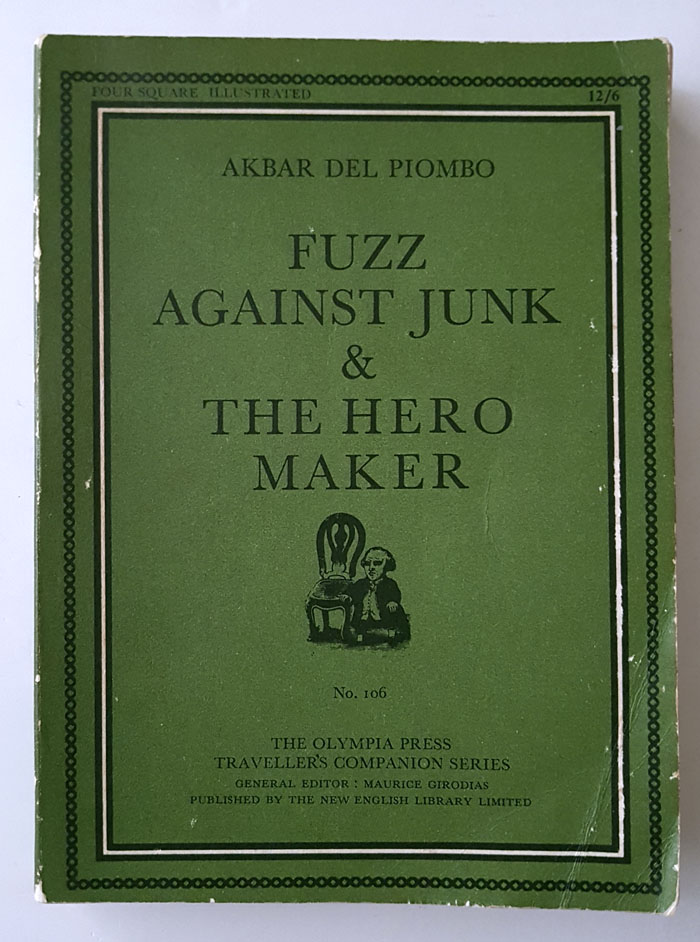
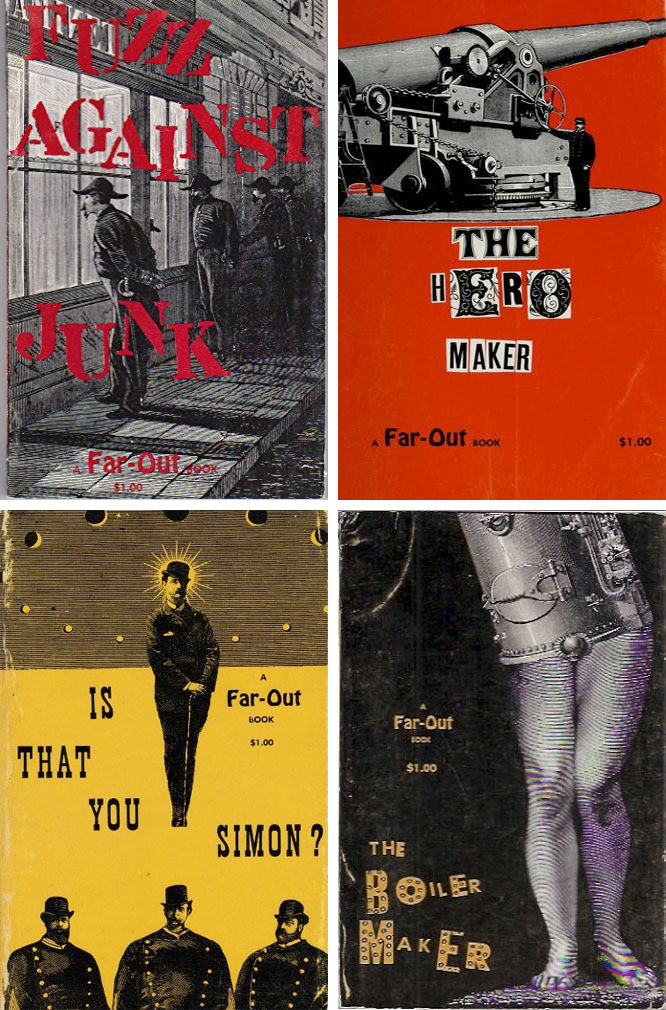
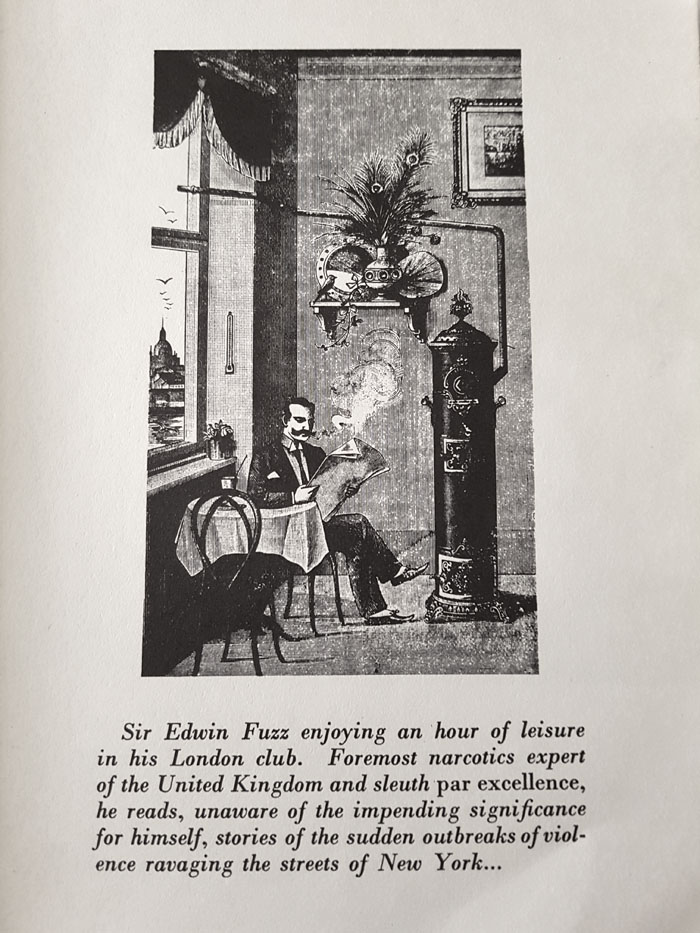
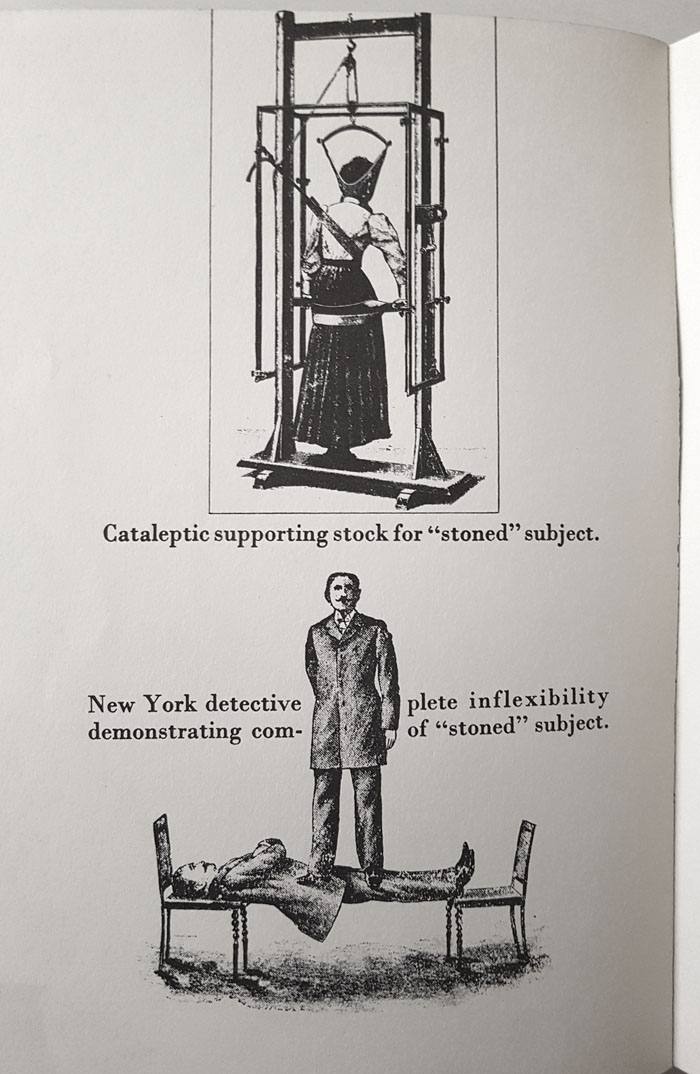
The engraving collages of Norman Rubington (1921–1991) were probably the first to use the form developed by Max Ernst for explicitly humorous purposes. They’re certainly among the earliest to take the lead from Ernst while aiming themselves at an audience outside the art world. There is humour in some of Ernst’s collages, of course, but it tends to be the black variety favoured by the Surrealists (and actually defined by them; André Breton’s 1940 Anthology of Black Humour was a pioneering study). Rubington’s small books exploit the comic potential of antique illustrations by repurposing them as the primary content in a series of absurd narratives; these aren’t “graphic novels”, they’re more like heavily-illustrated comedy routines. There were four books in the original series—Fuzz Against Junk (1959), The Hero Maker (1959), Is That You Simon? (1961) and The Boiler Maker (1961)—with a fifth title, Moonglow, appearing in 1969. Olympia Press published the books in France, with US editions appearing around the same time under the Far-Out imprint used by Citadel Press. My charity purchase is the 1966 New English Library reprint of an Olympia Press collection of the first two volumes. The olive-green Olympia covers always provoke a Pavlovian grab response when I see one on a shelf although I’ve yet to find a copy that wasn’t an NEL reprint.

rubington2.jpg

rubington3.jpg

rubington4.jpg

Continue reading “Fuzz Against Junk & The Hero Maker”

The Secret World of Odilon Redon

redon.jpg

Documentaries about French artist Odilon Redon aren’t very common at all so it’s a shame this one isn’t better quality. The Secret World of Odilon Redon is another introductory film from the Arts Council of Great Britain, made in 1973, the same year as Magritte: The False Mirror. The print is in even worse condition than the Magritte, with washed-out colour and a quavering score that sounds like it was taken from a mispressed record; but the voiceover by Richard Hurndall makes it worthwhile, a series of quotes from Redon’s memoirs, in which the artist discusses his work and his philosophy. The accompanying visuals, which include views of places where he lived and worked, do nothing for the vivid colours of his pastel drawings but if you want those there are plenty of other resources elsewhere.

For a more Surrealist approach there’s Guy Maddin’s Odilon Redon, or The Eye Like a Strange Balloon Mounts Toward Infinity, a dreamlike excursion into the strange world of the artist’s etchings.

Previously on { feuilleton }
Odilon Redon’s Temptations
More chimeras
Odilon Redon’s musical afterlife
Odilon Redon and Magazine
Odilon Redon lithographs
The eyes of Odilon Redon