Weekend links 185

rondelli.jpg

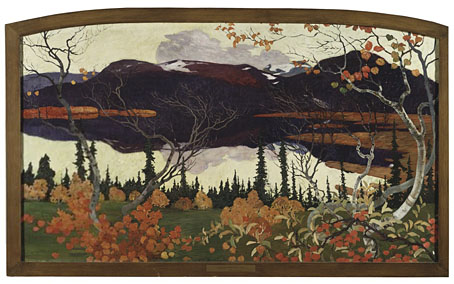
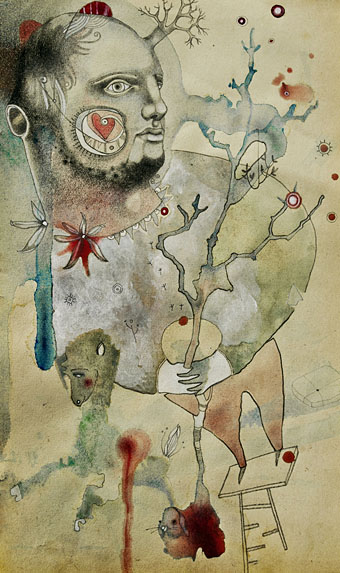
L’uomo che piantava gli alberi (2013) by Sofia Rondelli. Via Form Is Void.

• I’m looking forward to hearing the new album by Chrome Hoof, a band whose ambition and attitude makes many of their contemporaries seem lukewarm at best. Mick Middles gets to grips with Chrome Black Gold here. John Doran interviewed the group in 2010, a piece which includes a Chrome Hoof mix of tracks by other artists.

Jay Roberts: “I was a young Marine scout sniper, definitely his type. And for a single, unforgettable afternoon, Orange County’s most notorious serial killer coaxed me into a place from which many didn’t escape.”

Jonathan Meades: “Why I went postal … and turned my snaps into postcards.” “Meades isn’t your average architectural fanboy,” says Rachel Cooke who went to talk to him at his home in Marseille.

“Faced with a Nabokov novel,” Zadie Smith writes, “it’s impossible to rid yourself of the feeling that you’ve been set a problem, as a chess master sets a problem in a newspaper.” Certainly, while Humbert asks the reader “not to mock me and my mental daze”, the suspicion is that the power dynamic in his tale is a little different.

Tim Groenland on the difficulties of writing, publishing and reading Lolita.

Cosmic Machine is a double-disc collection of French electronic music from the 1970s & 1980s. Justice enthuse about the music here where you can also preview the tracks.

The Midnight Channel, Evan J. Peterson’s horror-poetry homage to the VHS era, is available now from Babel/Salvage. There’s a trailer here.

• “Our age reveres the specialist but humans are natural polymaths, at our best when we turn our minds to many things,” says Robert Twigger.

• Another musical Chrome: Richard Metzger on newly resurrected recordings by one of my long-time cult bands.

• Hermes Trismegistus and Hermeticism: An interview with Gary Lachman.

• A stunning set of photos of London in the sweltering summer of 1976.

Pye Corner Audio live at The Outer Church, Madrid, November 2013.

Judee Sill, the shockingly talented occult folk singer time forgot.

• Designer Jonathan Barnbrook answers twenty questions.

• Don’t trust the painting: Morgan Meis on René Magritte.

Laurie Anderson’s farewell to Lou Reed.

Philippe Druillet at Pinterest.

• The Chrome Plated Megaphone Of Destiny (1968) by The Mothers of Invention | March Of The Chrome Police (1979) by Chrome | Chrome (1981) by Debbie Harry
Ignacio Goitia interviewed

goitia.jpg

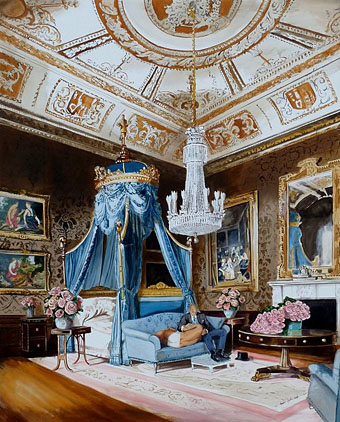
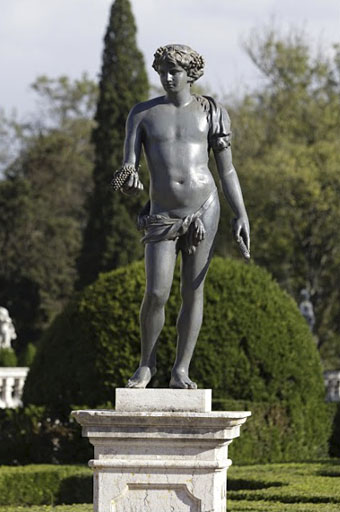
Acrílico sobre tela (My Other Self, 2009).

Back in 2010 I wrote the following about Ignacio Goitia:

Ignacio Goitia is a Spanish artist whose depictions of opulent aristocracy manage to be subversively homoerotic thanks to the addition of figures we can interpret as boyfriends, sex slaves or wish-fulfilling phantasms; Ludwig II would no doubt approve of the sentiment even if he disagreed with some of the decor.

Earlier this year John Wisniewski sent me a short interview he’d done with Mr Goitia which I’m ashamed to say it’s taken me this long to post. My apologies to John and Ignacio. (I’d have been tempted to ask what’s with all the giraffes?)

*

John Wisniewski: When did you begin drawing and painting?

Ignacio Goitia: I have always, since I can recall, loved drawing and painting. When I was a child, I would spend endless hours with my colour paints, and as soon as I was able, I enrolled myself to different art schools and academies.

Later on I got accepted in the Superior Beaux Art faculty at the University of the Basque Country in Bilbao. Since I finished those five years of University, this is all I have been doing, paint.

JW: When was your first art exhibition? What was the reaction to your work?

IG: Since my first exhibition, the public reaction to my work, has been in general, very positive, although, there is always the sceptics, that relate modernity with abstraction and minimalism, conceptualism… Despite this, with the passing of the years, my work has gained many followers in those circles. In all my exhibits the amount of people that has made an effort to visit them, its been quite large.

JW: What inspires you to paint or draw? How do you choose a subject?

IG: My first source of inspiration are my travels. I find it photographing the buildings, monuments, streets and people that catch my attention. I am passionate about architecture, and love discovering in it, the evolution of human thought.

Once in my studio, I select the sceneries that better adapt to the concept that I wish to express. After that, I start introducing the people and subjects, distributing them in the different spaces, until I get the adequate composition that better express my thought. This work of preparation and distribution, is a process that takes several days.

JW: Do you hope to exhibit your work in the USA at sometime? What do you think the reception will be for your work in the USA?

IG: I have exhibited during Art Basel Week in the HACS gallery in Miami in the Year 2007 and 2008. The reception was very good.

I am also participating with a good chance in the Creatives Rising project with See Me and will be featured in the digital projections over facades in NYC next October. We are in the process for an exhibit in Miami and NYC in the near future. Most of the people that I have been dealing in the USA are having a very positive and enthusiastic response.

JW: How is your painting uniquely Spanish and how is it universal?

IG: I think being born in Spain and specifically in the Basque Country has influenced in some of my work, but is something that is not in the back of my mind, and it is not a source of thought when I paint. The scenarios that I create are inspired in many places around the world, and the subjects could belong to different nationalities.

It’s also true, that I have also use as backdrop, cities like Bilbao or Madrid, and there are blinks of folklore and culture belonging to the Basque country or Spain, and I introduce them in some of my work, but not often. I consider my paintings something less related to a particular culture, or universal, there are something more personal and an individual thought on how I see the world, as a result of my own interests and ideas. •

Elsewhere on { feuilleton }
The gay artists archive

Witches

witches02.jpg

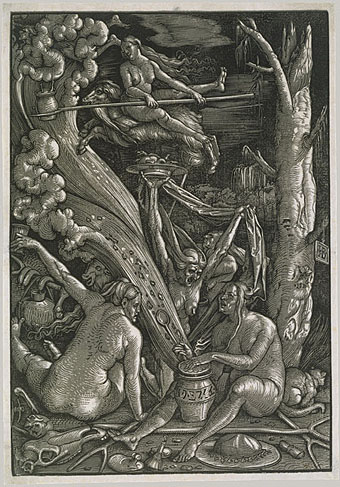
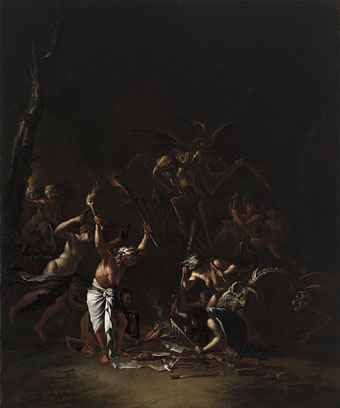
Scene of Witchcraft (1510) by Hans Baldung Grien.

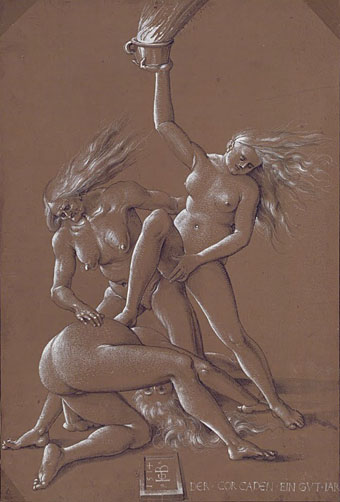
Earlier this year Pam Grossman declared 2013 to be the Year of the Witch, so in honour of that (and the season) here’s a handful of sorceresses through the ages. Most can be found in higher quality at the Google Art Project but a couple are from other sources. I’ve taken the liberty of attributing the drawing below to Hans Baldung Grien, not Albrecht Dürer as Google has it. Not only is this the attribution I’ve always seen for this picture but Baldung’s “HBG” monogram is clearly visible beneath the sprawling woman.

witches01.jpg

New Year’s Greeting with Three Witches (1514) by Hans Baldung Grien.

witches03.jpg

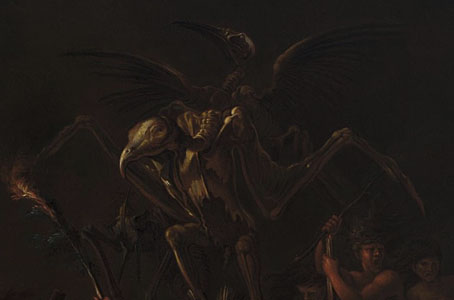
The Witches’ Sabbath (c.1640–1649) by Salvator Rosa.

Salvator Rosa specialised in lurid depictions of bandits, executions and—as here—witches. The excessive imagery appealed to later generations, especially the Romantics. This painting is even more grotesque than usual with its flayed-bird abominations (below) looming out of the shadows.

witches04.jpg

Continue reading “Witches”

Weekend links 183

doisneau.jpg

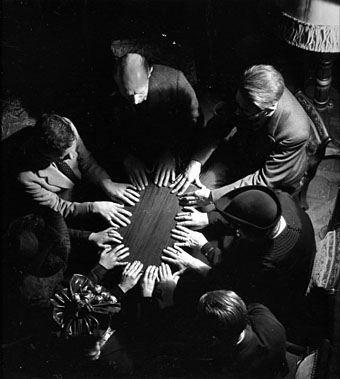
La table qui tourne (1943) by Robert Doisneau.

In [Gödel, Escher, Bach], Hofstadter was calling for an approach to AI concerned less with solving human problems intelligently than with understanding human intelligence—at precisely the moment that such an approach, having borne so little fruit, was being abandoned. His star faded quickly. He would increasingly find himself out of a mainstream that had embraced a new imperative: to make machines perform in any way possible, with little regard for psychological plausibility.

The Man Who Would Teach Machines to Think by James Somers.

Whenever the latest pronouncements about the imminent arrival of artificial intelligence are being trotted out I wonder what Douglas Hofstadter would have to say on the matter. You don’t hear much about Hofstadter despite his having been involved for decades in artificial intelligence research. One reason is that he’s always been concerned with the deep and difficult problems posed by intelligence and consciousness, subjects which don’t make for sensational, Kurzweilian headlines. Hofstadter’s essays on AI (and many other topics) in Metamagical Themas: Questing for the Essence of Mind and Pattern (1985) are essential reading. James Somers’ lengthy profile for The Atlantic is a welcome reappraisal.

• The end of October brings the spooky links: When Edward Gorey illustrated Dracula | Paula Marantz Cohen on Edgar Allan Poe | Yasmeen Khan revisits Werner Herzog’s Nosferatu | Roger Luckhurst on horror from the Gothics to the present day, and Michael Newton on Gothic cinema.

•  Magic Words: The Extraordinary Life of Alan Moore is a biography of the Northampton magus by Lance Parkin. The author talks about his book here, and also here where if you look carefully you can see my Lovecraft book on his shelf.

• A crop of Halloween mixes: Boo, Forever by Jescie | Samhain Seance 2: Hex with a Daemon by The Ephemeral Man | Wizards Tell Lies & The Temple of Doom by The Curiosity Pipe | Radio Belbury’s Programme 11.

The Book of the Lost is an album by Emily Jones & The Rowan Amber Mill presenting music from imaginary British horror films. Release is set for Halloween. More details here.

Laura Allsop on Derek Jarman’s sketchbooks. Jarman’s Black Paintings are currently showing at the Wilkinson Gallery, London.

Magick is Freedom! Existence Is Unhappiness: Barney Bubbles vs. Graham Wood.

• Soho Dives, Soho Divas: Rian Hughes on sketching London’s burlesque artists.

Jenny Diski on the perennial problem of owning too many books.

Equus through the years by Clive Hicks-Jenkins.

Virgin Records: 40 Years of Disruptions

• At BibliOdyssey: Chromatic Wood Type

Witches at Pinterest

The Witch (1964) by The Sonics | My Girlfriend Is A Witch (1968) by October Country | You Must Be A Witch (1968) by The Lollipop Shoppe