Edward Whittemore

whittemore.jpg

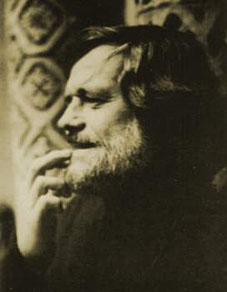
A decade after his death, with all his books back in print, Edward Whittemore remains pretty much off the literary radar.

Whittemore was an ex-CIA agent who made the people, history and landscapes of the Middle East the subject matter of a series of remarkable novels. His books aren’t always fantasy (although they were often marketed as such) yet they contain fantastical elements; they’re frequently comic yet contain moments of pure horror; they’re witty, sexy, incredibly inventive and quite unique. They also provide another example of genre readers and writers nurturing the memory and reputation of an author the wider literary world has never heard of. Michael Moorcock and Jeff VanderMeer have both spoken highly of Whittemore in recent years and with the republication of his books in 2002 he now has access to a new generation of readers.

Anne Sydenham’s Whittemore site, Jerusalem Dreaming, has just moved to a new location and is an excellent source of information about the man and his work.

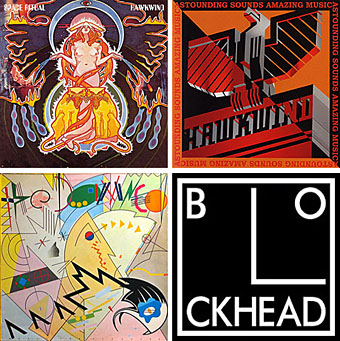
Barney Bubbles: artist and designer

barney1.jpg

Image-heavy post! Please be patient.

Four designs for three bands, all by the same designer, the versatile and brilliant Barney Bubbles. A recent reference over at Ace Jet 170 to the sleeve for In Search of Space by Hawkwind made me realise that Barney Bubbles receives little posthumous attention outside the histories of his former employers. Since he was a major influence on my career I thought it time to give him at least part of the appraisal he deserves. His work has grown in relevance to my own even though I stopped working for Hawkwind myself in 1985, not least because I’ve made a similar transition away from derivative space art towards pure design. Barney Bubbles was equally adept at design as he was at illustration, unlike contemporaries in the album cover field such as Roger Dean (mainly an illustrator although he did create lettering designs) and Hipgnosis (who were more designers and photographers who drafted in illustrators when required).

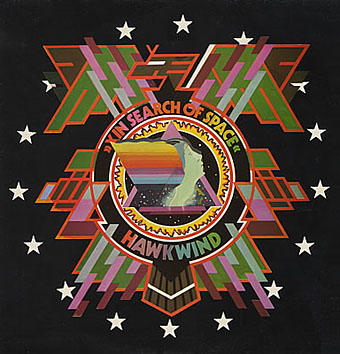
Colin Fulcher became Barney Bubbles sometime in the late sixties, probably when he was working either part-time or full-time with the underground magazines such as Oz and later Friends/Frendz. He enjoyed pseudonyms and was still using them in the 1980s; Barney Bubbles must have been one that stuck. The Friends documentary website mentions that he may have worked in San Francisco for a while with Stanley Mouse, something I can easily believe since his early artwork has the same direct, high-impact quality as the best of the American psychedelic posters. Barney brought that sensibility to album cover design. His first work for Hawkwind, In Search of Space, is a classic of inventive packaging.

Update: BB didn’t work with Mouse in SF, I’ve now been told.
in_search_of_space.jpg

Hawkwind: In Search of Space (1971).

It’s fair to say that Hawkwind were very lucky to find Barney Bubbles, he immediately gave their music—which was often rambling and semi-improvised at the time—a compelling visual dimension that exaggerated their science fiction image while still presenting different aspects of the band’s persona. In Search of Space is an emblematic design that opens out to reveal a poster layout inside. One of the things that distinguishes Barney Bubbles’ designs from other illustrators of this period is a frequent use of hard graphical elements, something that’s here right at the outset of his work for Hawkwind.

This album also included a Bubbles-designed “Hawklog”, a booklet purporting to be the logbook of the crew of the Hawkwind spacecraft. I scanned my copy some time ago and converted it to a PDF; you can download it here.

Continue reading “Barney Bubbles: artist and designer”
City of Spades

city_of_spades.jpg

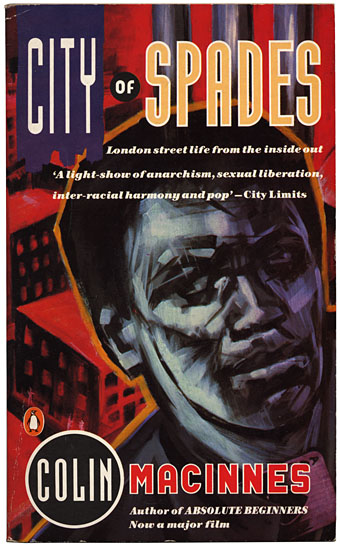
Today’s book purchase is a secondhand copy of the first novel in Colin MacInnes’ London trilogy (Absolute Beginners and Mr Love and Justice were the others). City of Spades was first published in 1957 but this is the 1985 reissue with a cover by Neville Brody which is the main reason for my picking it up. The books were reprinted in the mid-Eighties to coincide with the release of Julien Temple’s dreadful musical adaptation of Absolute Beginners, a film that must have done a lot to drive people away from MacInnes’ books; it certainly had that effect on me. Brody supplied all the faux-pulp covers for the reissued series.

MacInnes is remembered now by contemporary writers like Iain Sinclair for his pungent documenting of London lowlife. He was also something of a pioneer in writing about the Fifties’ gay scene in a matter-of-fact manner. You can read more about his works here.

Elsewhere on { feuilleton }
The book covers archive

Further back and faster

jagger_beaton.jpg

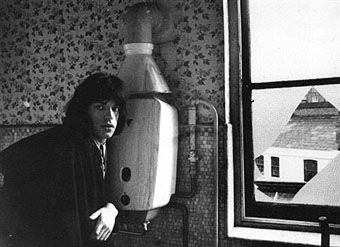
Mick Jagger by Cecil Beaton (1968).

Donald Cammell thought Mick Jagger to be a more provocative rock star than Elvis Presley because Jagger was willing to experiment with his masculinity. Elvis, although extraordinarily erotic to a generation of young women, never did. What this difference suggests, among other things, is that Mick Jagger’s appeal is not Elvis’s—and never was. Critic Greil Marcus has argued that what Elvis did was to purge the Sunday morning sobriety from folk and country music and to purge the dread from blues; in doing so, he transformed a regional music into a national music, and invented party music. Elvis popularized an amalgam of musical forms and styles into “rock’n’roll,” a black American euphemism for sexual intercourse. What the Rolling Stones did to rock music, some years after Elvis made sex an integral part of its appeal, was to infuse rock with a bohemian theatricality, at first through Brian Jones, who was the first British pop star to cultivate actively a flamboyant, androgynous image. For a time, Brian even found his female double in Anita Pallenberg. Brian Jones and the Stones thus re-introduced into rock music its erotic allure, and hence made it threatening (again).

From an excellent piece by Sam Umland for PERFORMANCE: A Photographic Exhibition featuring the work of Donald Cammell and Nicolas Roeg at the Drkrm. Gallery, Los Angeles, opening on January 20th. Umland wrote the recent biography of Donald Cammell with Rebecca Umland (published by Fab Press) for which I designed the cover. Featured in the exhibition are prints from the Del Valle Archive, including eleven photographs of Mick Jagger taken by Cecil Beaton when Performance was being filmed.

performance.jpg

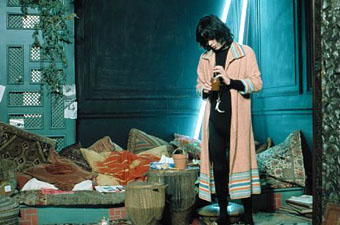
“When are Warner Brothers going to do the right thing and release Performance on DVD?” I asked in April last year. Well now they are, although it remains to be seen which version of the film has been used; several exist, some of them shorter than others. Release is scheduled for February 13th in the US and March 12th in the UK.

PERFORMANCE: A Photographic Exhibition
featuring the work of Donald Cammell and Nicolas Roeg

January 20-February 24, 2007
Drkrm. Gallery
2121 San Fernando Road
Suite 3
Los Angeles
CA 90065

Previously on { feuilleton }
Quite a performance
Borges in Performance