The Metropolis of Tomorrow by Hugh Ferriss

ferriss01.jpg

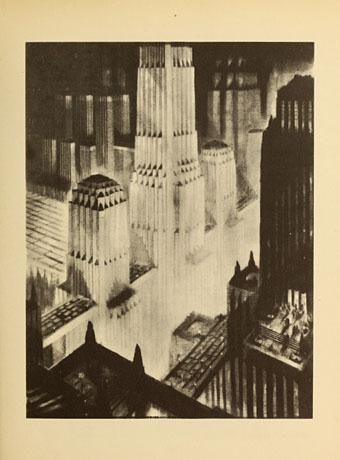
Crowding Towers.

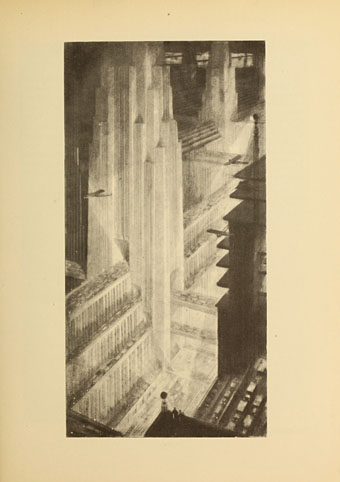
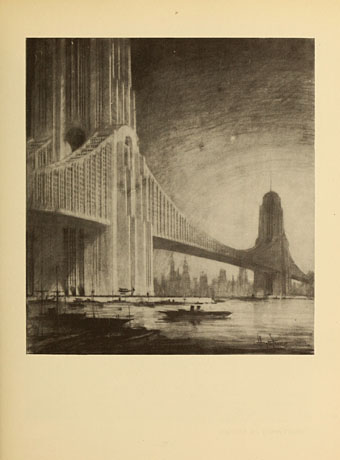
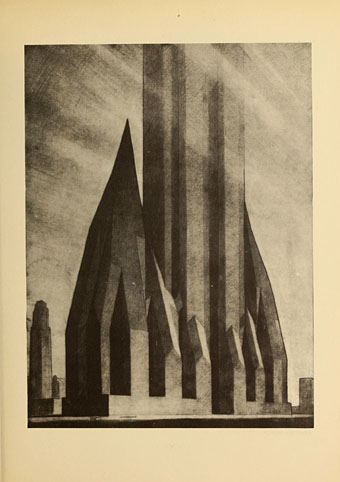
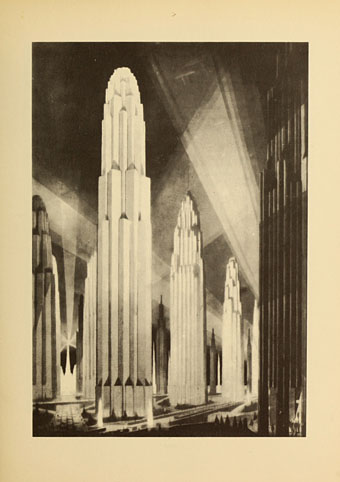
The work of architectural renderer Hugh Ferriss (1889–1962) has appeared here before. The Metropolis of Tomorrow (1929) was a major influence on the architectural style I deployed in the Reverbstorm series, together with Berenice Abbott’s photographs of New York City in the 1930s. Ferriss’s hazy proposals for cities of the future are more visible today than they used to be thanks to the popularity of those sites that enjoy outmoded visions of the future.

Flickr has been a good source of Ferriss’s drawings in the past but the Internet Archive recently posted the entirety of The Metropolis of Tomorrow, pages as well as pictures. The book appeared a couple of years after Fritz Lang’s Metropolis, and shares that film’s idea of the future city as a kind of superannuated New York. Skyscrapers were still a relatively new idea so this seemed a natural development at the time, as did the concept of super-highways and rooftop aerodromes. Human beings in Ferriss’s future are either ant-like specks or they’ve vanished altogether among the massed ranks of towers which often look more like less like buildings and more like Art Deco spacecraft. Lang’s vision was dystopian only in the way it relegated its workers to the underworld, while Ferriss’s proposals were wholly optimistic. Looking back we’re more aware of the shortcomings of such ideas, and from my perspective it wasn’t so difficult to bring out the latent menace inherent in these megastructures. Ferriss’s metropolis, like that of Fritz Lang, is a fun place to visit but you wouldn’t necessarily want to live there.

Browse the rest of the book here or download it here.

ferriss02.jpg

Overhead traffic-ways.

ferriss03.jpg

Apartments on bridges.

ferriss04.jpg

Evolution of the set-back building: second stage.

ferriss05.jpg

Verticals on wide avenues.

Continue reading “The Metropolis of Tomorrow by Hugh Ferriss”

Magicians

magic01.jpg

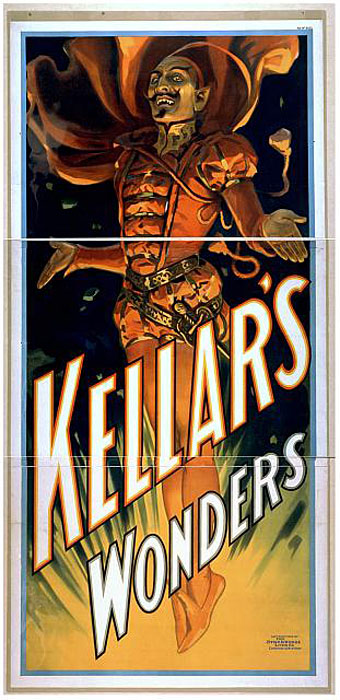
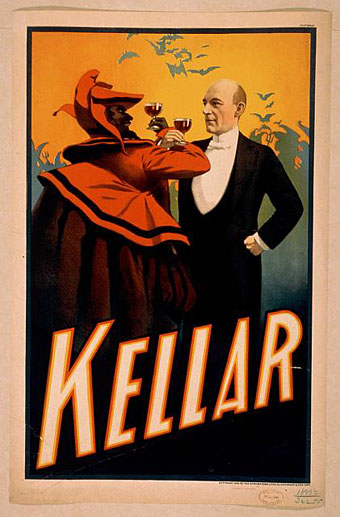
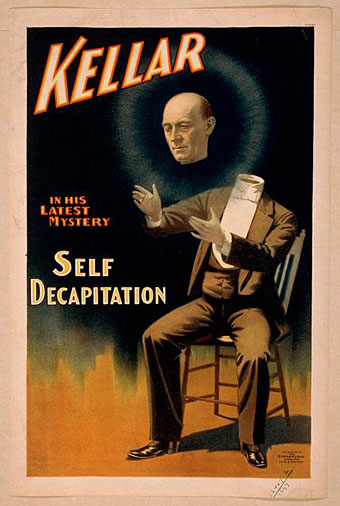
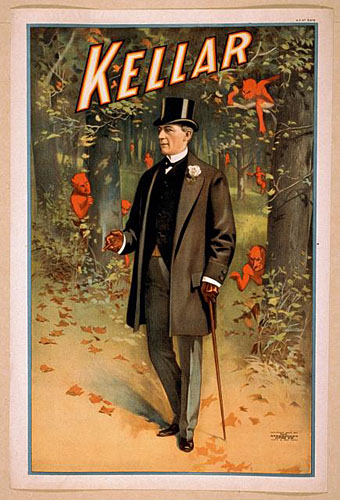
The stage variety rather than occult practitioners. The levitating Mephistopheles above is the one I borrowed earlier this year for the Alas Vegas Tarot designs. “Kellar” was Harry Kellar (1849–1922), a popular American magician blessed with some talented poster designers who stripped away the superfluous text to concentrate on his name and the recurrent motif of a red devil. Considering their age (they date from around 1900) these posters are surprisingly elusive, with no indication on some of them that Kellar is a stage performer at all. He retired in 1908 so by this time his name alone was evidently enough of an audience draw.

Howard Thurston was Kellar’s appointed successor, hence the continuity of the red devils and type design. Devils and imps weren’t the sole property of the pair as the other examples here demonstrate. “Miss Baldwin” is a rare example of a woman achieving parity with her male colleagues, at least in the poster department. All these posters are from the collection at the Library of Congress where many more examples may be seen. A detail from the horizontal Kellar poster below appears on the cover of the recent lavish Taschen volume Magic: 1400s–1950s by Mike Caveney, Jim Steinmeyer, Ricky Jay and Noel Daniel.

magic02.jpg

magic03.jpg

magic04.jpg

Continue reading “Magicians”

Words and pictures

ghosts.jpg

This one has been a long while gestating. Evan J. Peterson asked me late last year to contribute a cover to a new edition of Seattle’s Gay City anthology which he was editing with Vincent Kovar. In May this year the anthology successfully covered some of its production costs with a Kickstarter fund, and the anthology will have its official launch next month (although the book is on sale now). Ghosts in Gaslight, Monsters in Steam combines a loose take on steampunk themes with spectral or horror material, and adds a queer twist. The contents are as follows:

Cover art by John Coulthart
Illustrations by M S Corley and Levi Hastings
Graphic story: Paper Lantern by Jon Macy

Poetry:
from Preternatural Conversations and Oblivious Imperialism is the Worst Kind by CAConrad
Dear Dr. Frankenstein by Jericho Brown
Anaphora as Coping Mechanism and American Dreams by Ocean Vuong
Orpheus on the 74 and The Resurrection Spell by Oscar McNary
Zombie Autopsy by Janie Miller
Moon Goddess by Imani Sims

Hybrid/Flash Fiction/Prose Poetry:
Psychopomp by Lydia Swartz
Thangs by Imani Sims
The Door, Casualties of War, and The Worst is that You Can’t Even Ask Him to Use Protection by Jeremy Halinen

Short Stories:
Demon Lover by Dorothy Allison
Monster Movie by Rebecca Brown
B.E.M.s by Gregory L. Norris
Feeding Desire by Steve Berman
Medium Méchanique by Catherine Lundoff
Study in Blue, Green, and Gold by John Coulthart
A Captive Audience by Ryan Keawekane
Splinter by Ryan Crawford
The Difference Men by Kat Smalley
Alexander’s Wrath by J L Smither
Quota by Amy Shepherd
Heart of the Labyrinth by Tony Rella

This isn’t the first occasion when I’ve produced the cover for an anthology and also contributed some fiction inside—The Thackery T. Lambshead Pocket Guide to Eccentric and Discredited Diseases included a short fiction piece—but the Gay City anthology marks the first appearance in print of anything from my ongoing Axiom project. This is a long-term endeavour which I began in March 2001 but haven’t referred to much in public, mainly because the bulk of the project to date has been written fiction. There are few words more dismaying to hear than the dread phrase “I’m writing a novel”, especially today when the activity of fiction writing seems to have undergone an exponential increase. I tend to believe that unless you’re an established author there’s little to be gained by discussing your own literary labours in public until you have some results to offer. Well, now I have.

I know some people have been curious about the Axiom project so—keeping things brief—I can say it’s two novels, one finished, the second one nearly finished. Axiom was written from 2001 to 2007, and concerns a year in the life of an invented city. It’s fantasy of a sort but closer to the world of Reverbstorm than anything you’ll find on the swords-and-dragons shelves. The idea began in the late 1990s when I was working on Reverbstorm with David Britton and realised I could easily shift the city in that book a few degrees sideways to provide a setting for my own obsessions. I’d been writing a lot of fiction in the 1980s—short stories and two unfinished novels—and wanted to return to this seriously having tired of collaborations and illustrating the work of other people. Axiom marked out some territory I wanted to explore; the new novel, Vitriol, uses the territory to stage a “psychedelic apocalypse”. The project as a whole is loose enough to evolve into other media, and eventually there should be some Axiom-related art. I’ve been working on Vitriol since August 2006 (there was some overlap while finishing the first book); my contribution to the Gay City anthology, Study in Blue, Green, and Gold, is an extract from the work-in-progress which happened to function quite well as a self-contained piece. Despite the anthology theme it’s not quite a steampunk affair but there are some steam locomotives present so it has the required flavour.

Whilst working on the new book I’ve had an agent (Leslie Gardner at Artellus) trying to sell Axiom. This would have been in print by now if the London publisher who agreed to take it 18 months ago hadn’t gone bust after they’d sent us a contract. I’ve been considering putting out a limited hardback edition of the novel, although I’m busy enough as it is, and don’t relish having to self-distribute even a small number of books. For now it’s an option that remains open.

Gay City’s own site points to Amazon for sales of Ghosts in Gaslight, Monsters in Steam so on this occasion I’ll do that too. If you’re in the Seattle area there’s a launch party on September 27th. Details here.

Update: I’ve belatedly noticed that Evan is interviewed about the anthology here.

Weekend links 174

ikuma.jpg

Dress (2012) by Nao Ikuma.

• Two of my Cthulhu artworks can currently be seen in the Ars Necronomica exhibition at the Cohen Gallery, Brown University, Providence, RI. The exhibition is part of NecronomiCon, and runs to September 13th. In related news, my steampunk illustration has been nominated in the Visual category of this year’s Airship Awards. Winners will be announced at Steamcon V in October.

• “…the story of how a small cabal of British jazz obsessives conducting a besotted affair with the style arcana of Europe and America somehow became an army of scooter-borne rock fans…” Ian Penman looks back at the culture of Mod for the LRB.

• “What is it about the writer in the First World that wants the Third World writer to be nakedly political, a blunt instrument bludgeoning his world’s ills?” Gina Apostol on Borges, Politics, and the Postcolonial.

If someone had designed a work regime perfectly suited to maintaining the power of finance capital, it’s hard to see how they could have done a better job. Real, productive workers are relentlessly squeezed and exploited. The remainder are divided between a terrorised stratum of the, universally reviled, unemployed and a larger stratum who are basically paid to do nothing, in positions designed to make them identify with the perspectives and sensibilities of the ruling class (managers, administrators, etc) – and particularly its financial avatars – but, at the same time, foster a simmering resentment against anyone whose work has clear and undeniable social value. Clearly, the system was never consciously designed. It emerged from almost a century of trial and error. But it is the only explanation for why, despite our technological capacities, we are not all working 3–4 hour days.

On the Phenomenon of Bullshit Jobs by David Graeber

Ron Rosenbaum talks to Al Pacino about all the usual stuff, and reveals some detail about the actor’s obsessive interest in Oscar Wilde’s Salomé.

• More queer history: The Brixton Fairies and the South London Gay Community Centre, Brixton 1974–6.

• At Dangerous Minds: Anthony Burgess and the Top Secret Code in A Clockwork Orange

• Every day for 100 days, Jessica Svendsen redesigned a Josef Müller-Brockmann poster.

LondonTypographica: Mapping the typographic landscape of London.

• Mix of the week: Secret Thirteen Mix 083 by Demdike Stare.

• At Strange Flowers: Alfred Kubin the writer.

Derek Jarman’s sketchbooks.

Rick Poynor on Collage Now.

• Thomas Leer: Private Plane (1978) | Tight As A Drum (1981) | Heartbeat (1985)

Elric 1: Le trône de rubis

elric1.jpg

The closest I ever got to illustrating Michael Moorcock’s Elric character was the sleeve for The Chronicle of the Black Sword in 1985, a Hawkwind concept album based on the first couple of Elric books. That design favoured a decorative approach over anything illustrative, however. At the time I felt too intimidated by the renderings of Elric’s first illustrator, James Cawthorn, and subsequent depictions by book cover artists such as Michael Whelan, to attempt my own version of the character. These days I pay little attention to heroic fantasy of any kind but I do look out for new depictions of Moorcock’s anti-hero. Earlier this year the French bande dessinée publisher, Glénat, released the first album in a planned series of five comic-strip adaptations of the Elric books. Many creditable Elric comics have appeared since the 1970s, not least the Cawthorn version of Stormbringer, one of the earliest and best, and Philippe Druillet’s own somewhat eccentric production. Mike Moorcock very generously sent me a copy of the Glénat volume this week, and I’d say this is now the one to beat.

elric2.jpg

Writer Julien Blondel has adapted the books with the art duties being taken by Didier Poli and Robin Recht. Jean Bastide is the colourist. I’ve always preferred the French and Belgian approach to comic art over the American style so I’m naturally biased towards a book such as this. That said, the art is marvellous, and so many of the details feel just right. Moorcock portrays the Melnibonéans as decadent and cruel, something that Poli and Recht portray with scenes of naked slaves being bled, butchered, and even used as human torches for the blithe amusement of their masters. The general atmosphere in the opening pages is like something from Flaubert’s Salammbô with its combination of antique depravity and the massing of great armies prior to battle. They don’t slouch with the monstrosities, either, there’s a spot of Lovecraftian weirdness when Elric is rescued by Straasha, the Sea King. I look forward to seeing how they deal with Arioch (who puts in an appearance at the end) and the other Chaos Lords. The dialogue is all in French, of course, but if you know the books it’s easy to follow even with French as limited as mine.

elric3.jpg

The Glénat site has a few more page samples. Moorcock has been watching these books being adapated and re-adapted for decades, and he says this is among the very best. For anyone with more than a passing interest in the brooding albino prince it’s well worth seeking out.

Previously on { feuilleton }
Salammbô illustrated
Jim Cawthorn, 1929–2008