Bruges-la-Morte, 1978

blm1.jpg

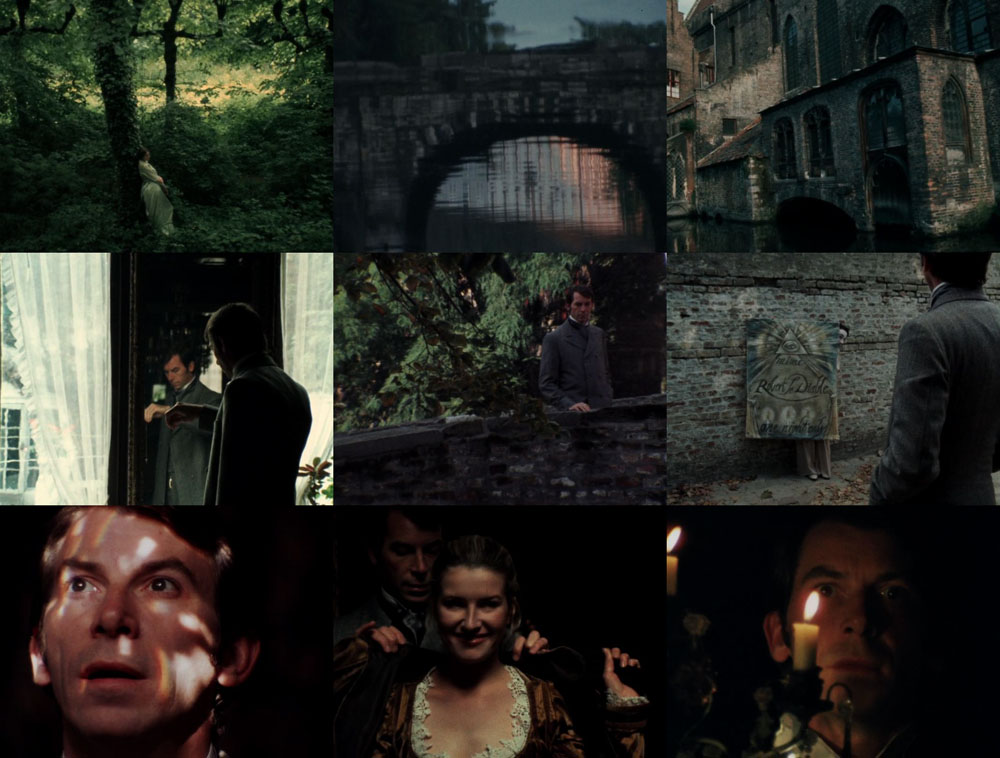
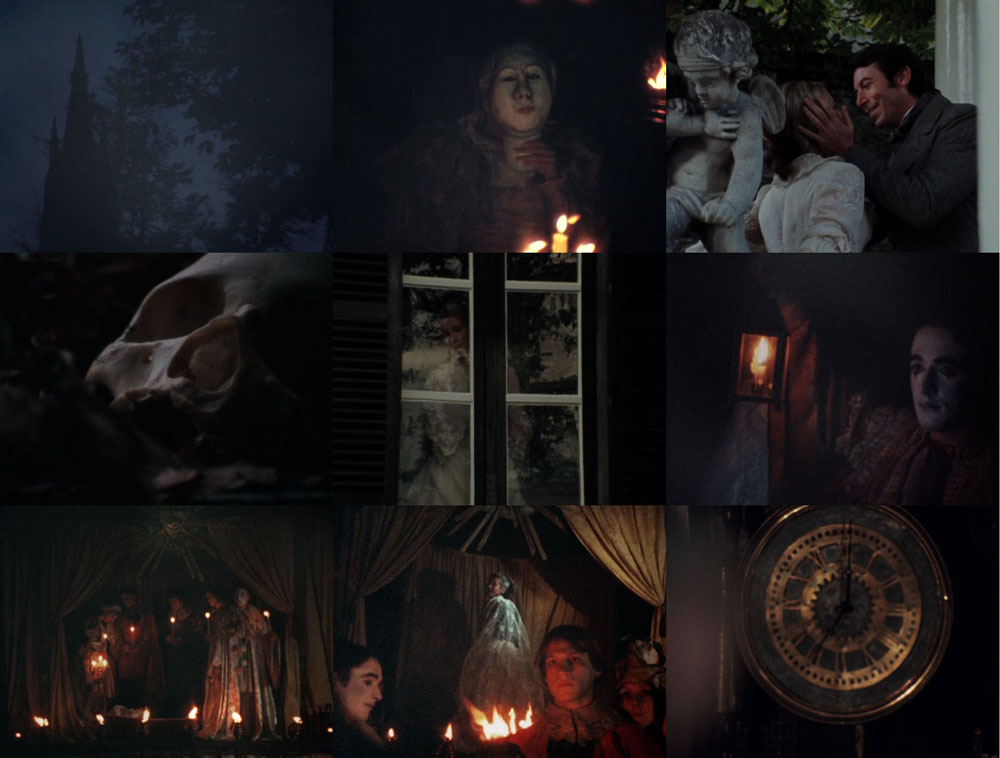
What we have here is a very creditable 67-minute film adaptation of the Symbolist novel by Georges Rodenbach. Ronald Chase directed, co-wrote the screenplay with Pier Luigi Farri, and also photographed the production with a small company of English actors in the city of Bruges. The film has recently been given a high-definition restoration and made available on the director’s Vimeo page. Chase describes his adaptation as a low-budget affair, the footage being originally intended for screening during performances of Die Tode Stadt by Eric Korngold, but it doesn’t come across as cheap or amateurish thanks to a professional cast and authentic locations. Rodenbach’s novel is distinguished by its early use of photographic illustrations, most of which are views of the canals of Bruges. Here we get to see the church steeples and crow-step gables from the viewpoint of a camera drifting along the same swan-filled waterways.

It’s a long time since I read Rodenbach’s novel so I can’t judge this version in any detail although my memories are of a dreamier narrative than the one the film delivers. Chase credits the story as being “suggested” by the novel but the broad outline follows Rodenbach, with a grieving widower (Richard Easton, whose character is unnamed in the film) meeting a dancer (Kristin Milward) who seems to be the double of his recently deceased wife. The dancer works with a troupe of performers who stage a nocturnal masque for the tormented man, an event which fails to alleviate his confusion or his anguish.
blm2.jpg

Chase’s film resembles one of the literary adaptations the BBC used to make throughout 1970s and 80s, modest and serious, and certainly of a quality that it could have been broadcast as a part of the Omnibus arts strand or in a late slot on BBC 2. Among the performers are a Pierrot character played by Anthony Daniels, an actor most people will know for his role as a gold robot in a space opera, and Nickolas Grace, who appeared as Oscar Wilde a decade later in Ken Russell’s Salomé’s Last Dance. There’s a touch of the diabolical Russell (and James Ensor) in the later masque scenes when the performers don papier-mâché masks, and a nun gets chased around a church. The mask-making is credited–very surprisingly–to Winston Tong, an artist and musician best known for his association with Tuxedomoon. I was hoping we might see more of the gloomy canals and equally gloomy architecture but the buildings and bridges that we do see look just as they would have done in Rodenbach’s day. If you want more there’s always the paintings and drawings of Fernand Khopff and Lucien Lévy-Dhurmer, or the photographs in the novel itself.

Previously on { feuilleton }
Bruges in photochrom
Bruges panoramas
Bruges-la-Morte

The art of Pinckney Marcius-Simons, 1867–1909

marcius-simons13.jpg

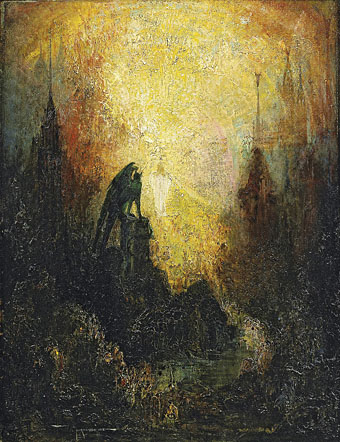
Vision of the Demon.

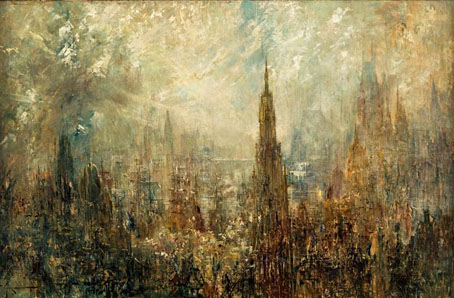
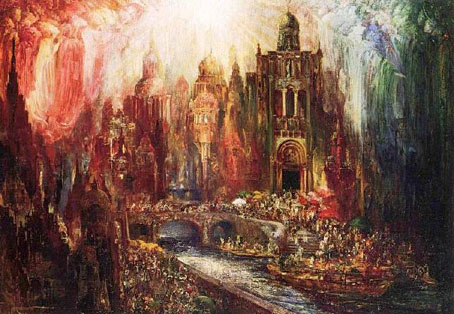
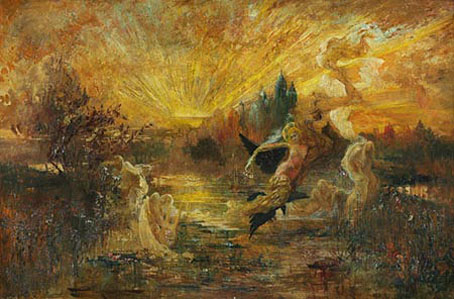
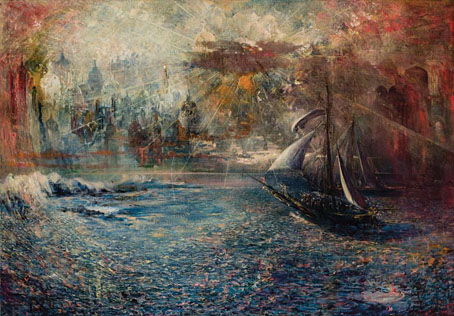
The Symbolist movement in painting never really took hold in America the way it did in Europe so it’s a surprise to find a new name to add to the very small list of American Symbolists. Pinckney Marcius-Simons painted his share of 19th-century genre pictures but these give way in his later career to canvases that show a distinct Gustave Moreau influence, or perhaps Turner in those nebulous volumes of illuminated vapour. Marcius-Simons was born in New York but lived in Europe for most of his life; he studied in Paris so he would have been able to see Moreau’s work first-hand. A few of his later pictures are rather vague fantasies but his real obsession was with Wagner’s operas, and he spent the last few years of his life working as a set designer at Bayreuth while also creating a series of paintings intended to illustrate the entire run of Wagner’s Ring Cycle. His most remarkable creation isn’t a canvas, however, but a French edition of A Midsummer Night’s Dream which he painted over entirely, even decorating the binding. I’m surprised again that such a unique work isn’t more widely known. Happily the entire book is available online at the Folger Shakespeare Library.

All the usual caveats apply here with regard to the accuracy of titles and dates. There’s even some dispute about the artist’s birth year which is occasionally given as 1865. Most of these pictures have been found on auction sites where larger reproductions may be seen.

marcius-simons03.jpg

Port City.

marcius-simons04.jpg

marcius-simons05.jpg

Sunrise.

marcius-simons12.jpg

The City of Dreams.

Continue reading “The art of Pinckney Marcius-Simons, 1867–1909”

Weekend links 598

lucier.jpg

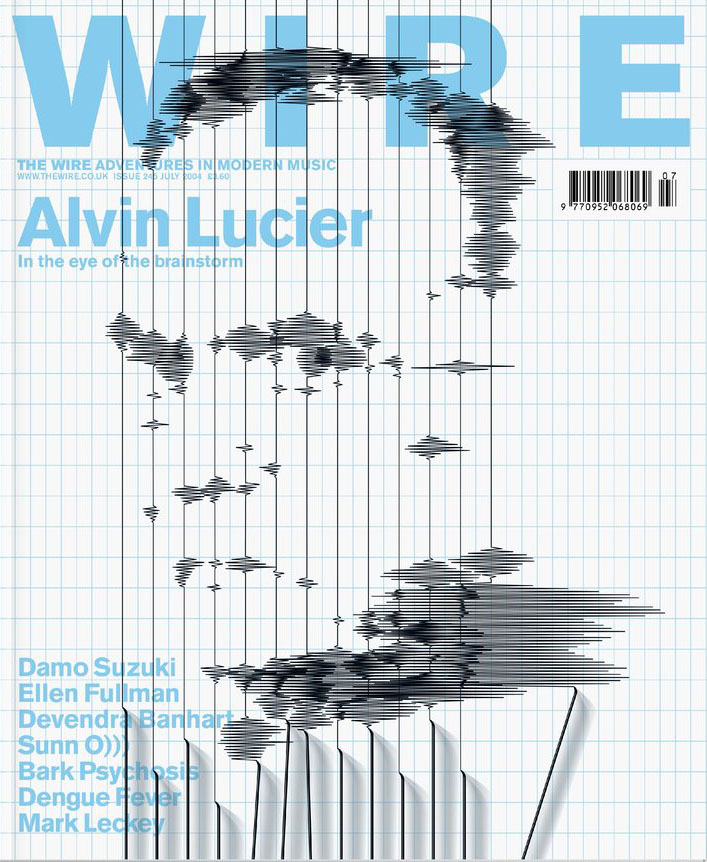
The Wire, July 2004. Illustration and design by Non-Format. Christopher Cox’s interview with Lucier is available to read here.

• “I went into experimental overdrive. Lyrical motifs became literal imagery. A hammer shattering a plate of glass. A lyrical maze of geometric tunnels and formations.” Chris Mosdell talking to Aquarium Drunkard about writing lyrics for Yellow Magic Orchestra and others (you can hear his voice on YMO’s Citizens Of Science), plus the recording of his own debut album, Equasian.

• At Public Domain Review: “…this short, odd book confronts a question that has vexed naturalists for thousands of years: how do we account for the precipitation of animals?” Odd Showers; or, An Explanation of the Rain of Insects, Fishes, and Lizards (1870) by George Duncan Gibb.

• “…few writers on our list could have functioned in the culture that, today, sees literature as a profession for which you prepare like any other: going to the right school, meeting the right people.” Francine Prose on her encounters with the literary strange.

• “Where was glass first fashioned? How was it worked and coloured, and passed around the ancient world?” Carolyn Wilke presents a brief scientific history of glass.

• RIP Antony Sher and Alvin Lucier. In 1969 Lucier was sitting in a room different to the one you are in now. Elsewhere: Alvin Lucier at Ubuweb.

• New/old music: Zeitgeist: Ambient Music from 2012 to 2020 by Marco Simioni & Mattia Saviolo.

James Balmont on five unmissable films from the Japanese New Wave movement.

• At Spoon & Tamago: Illuminated paintings of Tokyo after dark by Keita Morimoto.

• Mixes of the week: XLR8R Podcast 724 by Laura BCR, and Isolatedmix 115 by HVL.

• At Strange Flowers: part two of James Conway’s Secret Satan end-of-year list.

• “Jony Ive’s first major design since leaving Apple isn’t what you’d expect.

• At Dennis Cooper’s: Yasuzo Masumura Day.

Glass (1968) by Sagittarius | Glass (1979) by Joy Division | Glass (2009) by Bat For Lashes

Weekend links 584

crowley.jpg

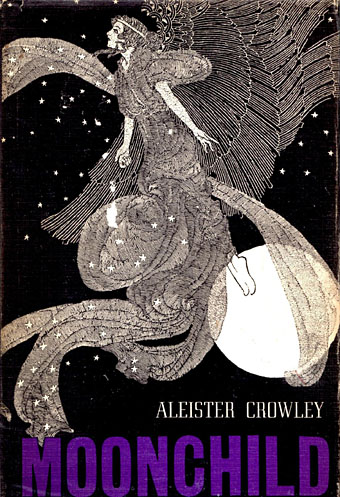
Cover for the 1970 US edition of Moonchild by Aleister Crowley. No artist credited (unless you know better…). Update: The artist is Dugald Stewart Walker, and the drawing is from a 1914 edition of Hans Christian Andersen’s fairy tales. Thanks to Mr TjZ!

• “…a very mid-Seventies cauldron of Cold War technology, ESP, sociology, black magic and white magic, experimental science and standing stones, secret radar and satanic rituals, whirring aerials and wild moors: a seething potion of Wyndham and Wheatley.” Mark Valentine on The Twelve Maidens, a novel by Stewart Farrar.

• “The line in the song ‘feed your head’ is both about reading and psychedelics. I was talking about feeding your head by paying attention: read some books, pay attention.” Grace Slick explains why those three little words have been attached to these pages since 2006.

Freddie deBoer reposted his “Planet of Cops” polemic, a piece I linked to when it first appeared in 2017, and which used to come to mind all the time before I absented myself from the poisonous sump of negativity that we call social media.

• RIP Charlie Watts. The Rolling Stones’ last moment of psychedelic strangeness is Child Of The Moon, a promo film by Michael Lindsay-Hogg featuring an uncredited Eileen Atkins and Sylvia Coleridge.

• Old music: A live performance by John Coltrane and ensemble of A Love Supreme from Seattle in 1965 that’s somehow managed to remain unreleased until now.

• A short film about Suzanne Cianni which sees her creating electronic sounds and music for the Xenon pinball machine in the early 1980s.

• “I’ll be in another world”: A rediscovered interview with Jorge Luis Borges.

Steven Heller explains why Magnat is his font of the month.

Clive Hicks-Jenkins on the allure of toy theatre.

• New music: Vexed by The Bug ft. Moor Mother.

• At Dennis Cooper’s: Nikola Tesla Festschrift.

Moon Child (1964) by The Ventures | Moonchild (1969) by King Crimson | Moonchild (1992) by Shakespears Sister

Weekend links 583

hlavacek.jpg

Faun (1897) by Karel Hlavacek.

A teaser trailer for Mad God, a stop-motion animated feature by Phil Tippett. 30 years in the making and not the usual saccharine fare. The director talks about his film here.

• For those who missed Johnny Trunk’s book about Sainsbury’s Design Studio several years ago (or would like more of the same), packaging design at the Sainsbury Archive.

• Mixes of the week: Ces Gens-Là – Avec Bart De Paepe by David Colohan, and Phased Induction Phototaxis by The Ephemeral Man.

• Smoking dope and comparing bad reviews: Stephen Sondheim and James Lapine discuss the early days of their collaboration.

• At the cat-loving Spoon & Tamago: This cat table gives your feline a seat in the table.

John Lurie‘s tales of Bohemian living with The Lounge Lizards in 1979 New York.

• Luxury assortment: the British artists behind Cadbury’s chocolate boxes.

Kevin Richard Martin’s favourite albums.

• At Dennis Cooper’s: Skeletons 2.

Hymn To Pan (2008) by Blood Ceremony | The Great God Pan (2011) by Blood Ceremony | Faunus (2013) by Blood Ceremony