Weekend links 440

roeg.jpg

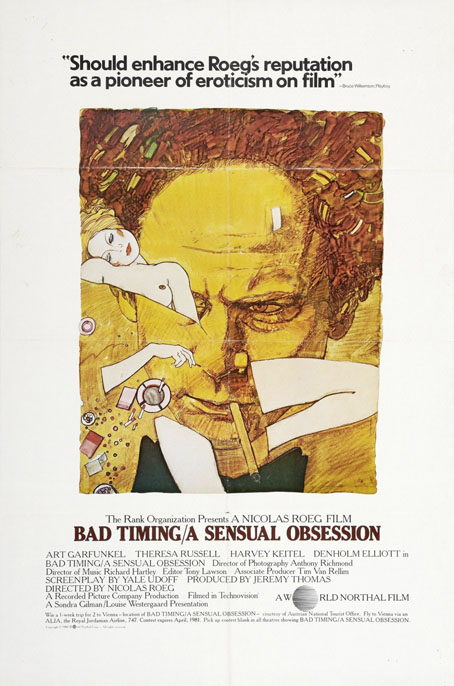
The title of that film was originally different [Illusions]… I woke up one day and thought of Bad Timing which sounds exactly like the right title—for my career. Now there was a film I really thought was one to which there would be a different response. Whilst filming I felt sure that this was one for the streets, one that people would really want to see. — Nicolas Roeg

So long to the great Nicolas Roeg, always one of my favourite film-makers. Roeg’s works were naturally attractive when I was a teenager because he’d made a horror film and a science-fiction film; when these eventually turned up on TV it was evident that this was a director working on a level that had more in common with Continental Europe than Hollywood. Beyond the generic content it was his approach to directing that made his films essential: a fragmented editing style derived from Alain Resnais via Richard Lester (see below), a cosmic perspective almost entirely absent from the parochial concerns of British cinema, and a seemingly effortless ability to find visual rhymes in anything. Despite the “bad timing” comment above Roeg was fortunate to be working throughout the 1970s when having an approach that ran counter to the prevailing trends wasn’t an obstacle to maintaining a career; as with Ken Russell, you watch some of the films today and are amazed and grateful that they were made at all. When reading the forthcoming plaudits it would be worth remembering that even the films regarded now as Roeg’s best struggled for acceptance: Pauline Kael dismissed Don’t Look Now as “trash”, US screenings of The Man Who Fell To Earth provided explanatory notes for the hard-of-thinking, Bad Timing was described by its own distributors as “a sick film made by sick people for sick people”, while the distributors of Eureka hated the film so much that for a time it could only be screened in the UK if the director was also present.

• Related: Where to begin with Nicolas Roeg, and Nicolas Roeg: It’s About Time (2015), a 59-minute documentary for the BBC directed by David Thompson. Previous Roeg-related postings on this site include: The Nicolas Roeg Guardian Lecture, 1983 (Roeg discusses Eureka and other films with Philip Strick); Beyond the Fragile Geometry of Space (charting the recurrence of a book title from Don’t Look Now); Canal view (using Google Street View to find the church in Don’t Look Now); and Petulia film posters (designs for a Richard Lester film from 1968 that was photographed by Roeg, and whose fragmentary editing style prefigures the familiar Roeg technique).

• Edward Woodward’s greatest screen role wasn’t a prudish policeman or a mysterious vigilante but was David Callan, a conflicted assassin working for a division of the British Secret Service. Joseph Oldham explains.

• Mixes of the week: A mix for The Wire by Jing, FACT Mix 681 by Kelly Moran, and Crépuscules d’Automne, a seasonal mix by Stephen O’Malley.

• More Gorey: in 1978 Jeremy Brett was playing Dracula in the touring version of the Edward Gorey-designed play.

• Liberated from the LRB paywall for a brief time: George Melly writing in 1992 about René Magritte.

• Welcome to the witch capital of Norway: Chelsea G. Summers investigates.

Space colony artwork from the 1970s.

• At I Love Typography: Magic printed.

Memo From Turner (1970) by Mick Jagger | Wild Hearts (1985) by Roy Orbison | Be Kind To My Mistakes (1987) by Kate Bush
The Cardinal and the Corpse

cardinalcorpse.jpg

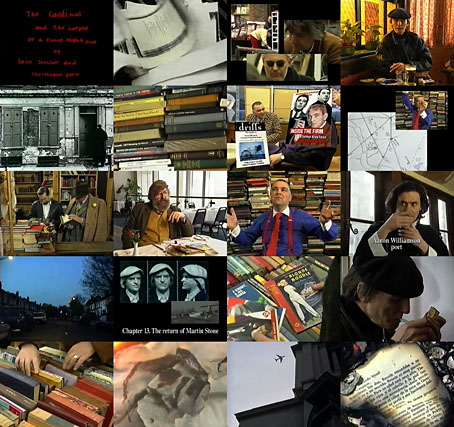
Appearing at last on YouTube (although I think it may have been there once before) is the curious TV film that Iain Sinclair (writer & “freak wrangler”) and Chris Petit (director) made for Channel 4’s Without Walls series in 1992. This is a must for enthusiasts of Sinclair’s early novels since it features the real-life models for several of his characters—guitarist/bookdealer Martin Stone, artist/author Brian Catling, crazed bookdealer Driffield—plus Sinclair’s friends Michael Moorcock and Alan Moore. The latter is seen searching for a copy of Francis Barrett’s grimoire, The Magus (1801), a year before he attached the magus label to himself; I still don’t know whether this quest was Alan’s suggestion or Sinclair’s.

Elsewhere there are fleeting portraits of crime writer Robin Cook (aka Derek Raymond), and Kray gang member Tony Lambrianou. Other notable appearances include poet Aaron Williamson, artist John Latham and David Seabrook, a writer whose Jack of Jumps book I designed a cover for in 2006. The narrative, such as it is, is a series of quests and meetings, threaded together with anecdotes about the various personalities who are the real subject of the film. It’s all very hermetic, and what sense it makes to the uninitiated I can’t say, but it holds the attention for 40 minutes. These obscurities have a way of vanishing, so if you’re interested watch it now or download it for later.

Previously on { feuilleton }
Terror and Magnificence
Mister Jarman, Mister Moore and Doctor Dee
Compass Road by Iain Sinclair

Leonor Fini

fini1.jpg

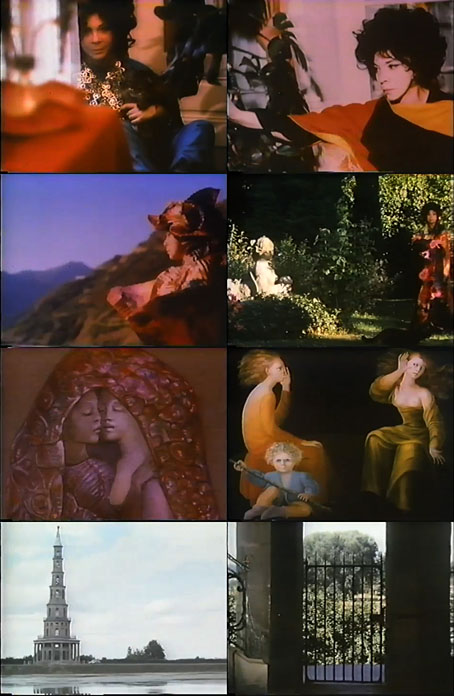
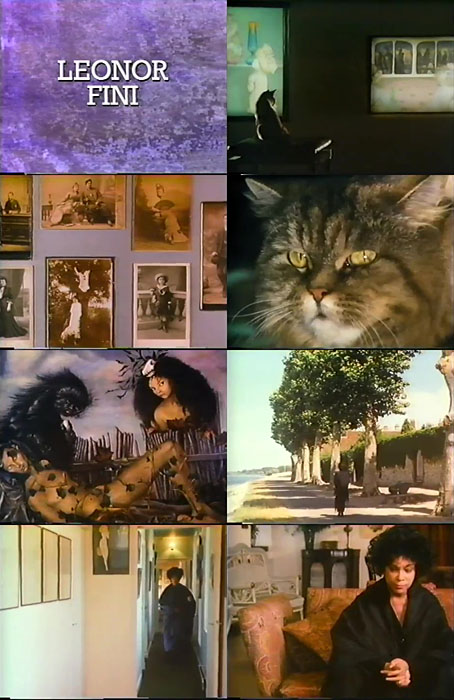
I’ve been hoping for years that a proper documentary about the enigmatic Argentinian artist might surface, and here one is at last. Leonor Fini (1987) was directed by Chris Vermorcken, and as a portrait of an artist it’s almost as good as the films the BBC used to produce for the Arena arts strand. I say “almost” because the Arena template tended to blend a biographical sketch with the life of the artist or writer at the present moment. Vermorcken encourages Fini to tell us about her early years in Trieste up to her meeting with the Surrealists in Paris, after which the discussion meanders to her vast company of Persian cats and the various forms of her painting and drawing.

fini2.jpg

Unlike most other films about Fini, this one is subtitled throughout so we can enjoy her reading from some of the stories that accompany her drawings, and also find out which films she liked. (Fellini’s Casanova was a favourite.) There’s also an appearance by Konstanty Jelenski, one of the points of the bisexual ménage à trois formed by Jelenski, Fini and Count Stanislas Lepri, all of whom lived together in the cat-infested house. Essential viewing here.

Previously on { feuilleton }
Leonor Fini: comment vivre sans chat
Angels of Anarchy: Women Artists and Surrealism
The art of Leonor Fini, 1907–1996
Surrealist women

Weekend links 431

eckman-lawn.jpg

Postcard collage by Alex Eckman-Lawn.

• “He deserves to be a major figure not only in the history of Japanese music, but in popular music writ large.” Geeta Dayal on Haruomi Hosono, a musician whose solo albums from the 1970s are reissued this month by Light In The Attic.

Erica X Eisen reviews Black Light: Secret Traditions in Art since the 1950s, an exhibition of occult art at the Barcelona Contemporary Culture Centre. Related: Gary Lachman‘s talk from the same exhibition.

• Mixes of the week: Jesús Bacalão’s Light Entertainment Programme 2, Secret Thirteen Mix 265 by Alexander Tucker, and FACT Mix 672 by Rian Treanor.

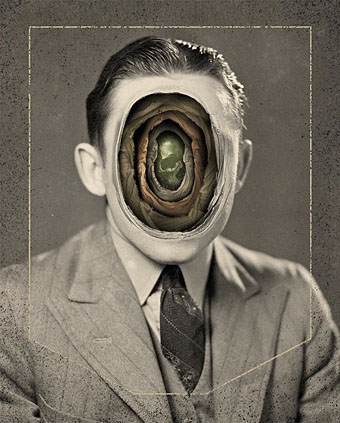
Whenever horror is criticised, it is criticised for staging a dark carnival of physicality. Perhaps the only sort of media we moralise more than we do horror is that other mainliner of bodily response, pornography.

Horror’s historical ghettoisation has meant that weightier, smarter horror reliably gets labelled as something else. The finest films of our current golden age have been dubbed “elevated horror” and “post-horror”. In literary circles, works of horror seen as sufficiently cerebral get relabelled “Gothic”. It’s certainly true that great horror is always about more than gore. But we should be careful not to gentrify the genre by cleansing it of everything but the philosophy.

MM Owen on the perennial attractions of a perennially despised genre

• “Netflix is a woeful service,” says Jeremy Allen who prefers DVD/Blu-ray to streaming video (as do I). Related: The problem with film aspect ratio on Netflix.

• The Thought Gang album, a Twin Peaks-related collaboration between David Lynch & Angelo Badalamenti from 1993, will be released next month.

Tangerine Dream: Sound From Another World: a TV documentary from 2016. In German but with auto-translated subtitles.

The Thing’s Incredible! The Secret Origins of Weird Tales by John Locke.

Haute Macabre Staff Favorites: Tarot Decks

First Light (1980) by Harold Budd & Brian Eno | Blue Light (1993) by Mazzy Star | Black Light (1994) by Material

Weekend links 430

fiochi.jpg

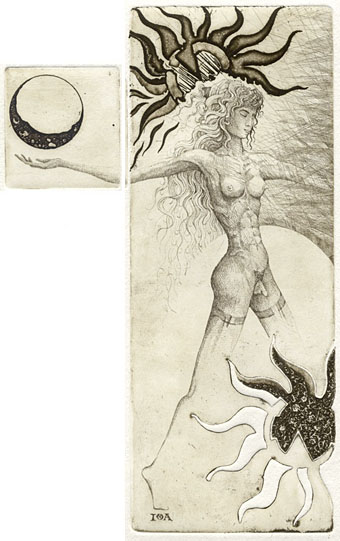
Il Mago from the IONA Tarot by Giona Fiochi.

• “Russia’s answer to James Bond: did he trigger Putin’s rise to power?” Andrew Male on Max Otto von Stierlitz and Seventeen Moments of Spring. The whole series is on YouTube (with subtitles).

Geeta Dayal reviews High Static, Dead Lines: Sonic Spectres and the Object Hereafter by Kristen Gallerneaux, a new book about the eeriness of sound technology.

• Published next month: Strange Frequencies: The Extraordinary Story of the Technological Quest for the Supernatural by Peter Bebergal.

Let me first introduce an aside: I hate the word “queer” and all its new iterations. “Gay” was awful enough. “‘Gays’ makes us sound like bliss ninnies,” Christopher Isherwood said once. “Queer” will always be for men of my generation a word of violence and hatred, and it separates generations. And while I’m digressing, let me commit blasphemy: the over-emphasis on the Stonewall riots depletes and distorts our history of resistance and the art produced, which is determinedly referred to as “pre-Stonewall.” Resistance occurred years before Stonewall (but there were lots of writers in New York at the time to write about those riots), in San Francisco, Los Angeles, other cities, powerful confrontations with the police, powerful demonstrations. “Pre-Stonewall” writers include William Burroughs, Allen Ginsberg, strong radical voices confronting the grave dangers of the time, violence, prison.

John Rechy talking to Eric Newman about his latest novel, Pablo!, written in 1948 but only now seeing publication

Tangerine Dream performing Identity Proven Matrix, one of the standout pieces from recent album Quantum Gate, live in the studio.

Beloved is the debut solo album by Randall Dunn, record producer and member of the masterful Master Musicians of Bukkake.

• “How will police solve murders on Mars?” Geoff Manaugh on the new frontier of interplanetary law enforcement.

Milly Burroughs on how Verner Panton changed the way the world sees furniture design.

Tim Martin on the new science of psychedelics.

Werner’s Nomenclature of Colours

Next Stop Mars (1966) by Sun Ra & His Arkestra | Mars, The Bringer Of War (1976) by Isao Tomita | Mars Garden (2013) by Juan Atkins & Moritz Von Oswald