Grandville’s Un Autre Monde

grandville1.jpg

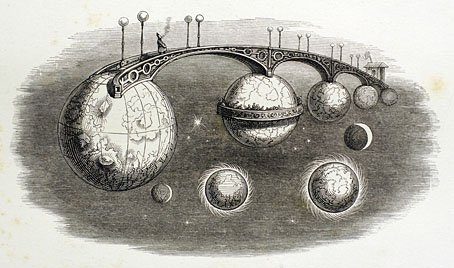
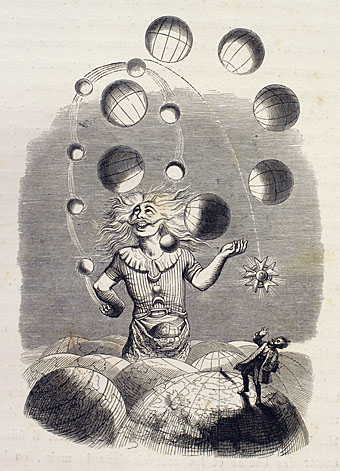
Un Autre Monde by JJ Grandville is a satire from 1844 whose wittily inventive illustrations were among that select group of prior works which received praise from the Surrealists. Some of them also act as early examples of humorous science fiction, and the two pieces shown here have been reprinted endlessly, they even turn up in histories of astronomy. The other illustrations are rarely seen, however, so it’s good to find a Flickr set with scans of the entire book. Comic artist Philippe Druillet took the bridge between worlds as the inspiration for his Lone Sloane story Torquedara Varenkor: The Bridge Over the Stars in 1970, turning the already unlikely construction into a galaxy-spanning edifice.

grandville2.jpg

Elsewhere on { feuilleton }
The etching and engraving archive

Previously on { feuilleton }
Druillet meets Hodgson

Dalí in Wonderland

dali1.jpg

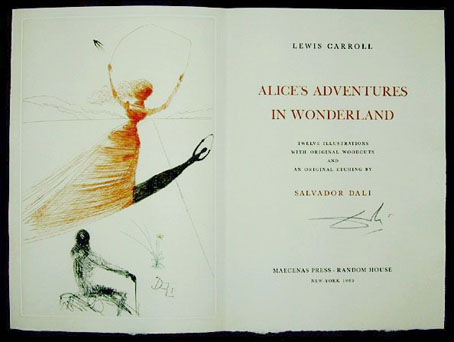
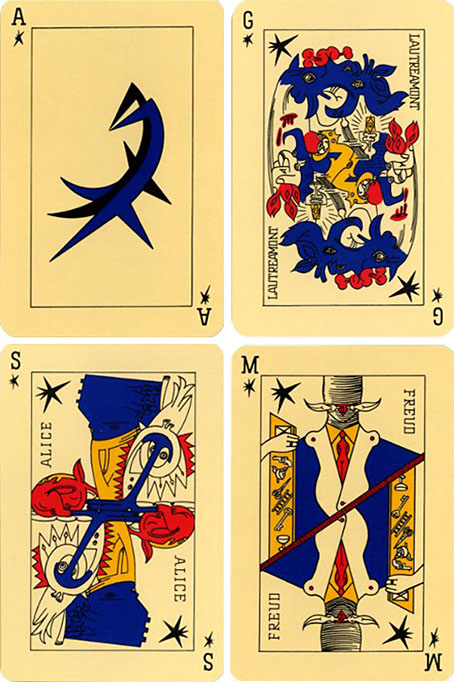
I’d only seen one or two of Salvador Dalí’s illustrations for Alice’s Adventures in Wonderland before but you can see the complete (?) set here. These date from 1969 when Dalí was well past his prime as an artist but they’re still worth a look to see how he tackled each chapter, using the skipping girl motif from earlier paintings as his Alice figure. The attraction of the Alice books for the Surrealists is no surprise; Max Ernst produced a rather enigmatic series of Alice-themed lithographs while André Breton had earlier made Alice the “Siren of Stars” in the set of Surrealist playing cards he designed in the 1940 (below). I’d imagine there are other connections I’ve missed; leave a comment if you know of any. (Thanks to Charity for the tip!)

For more Dalí, here’s something I neglected to link to a while ago, the legendary Dalí meets Disney short, Destino.

stars.jpg

Elsewhere on { feuilleton }
The illustrators archive

Previously on { feuilleton }
Virtual Alice
Psychedelic Wonderland: the 2010 calendar
Charles Robinson’s Alice’s Adventures in Wonderland
Humpty Dumpty variations
Alice in Wonderland by Jonathan Miller
Dalí and Film
The Illustrators of Alice
Surrealist cartomancy

Angels of Anarchy: Women Artists and Surrealism

fini.jpg

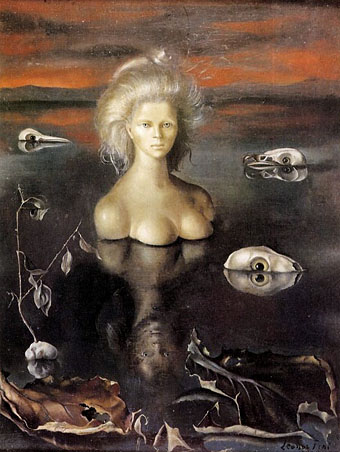
Le Bout du monde by Leonor Fini (1948).

Yes, I’ll definitely be going to see this one.

The first major exhibition of women artists and Surrealism to be held in Europe, Angels of Anarchy, opens this autumn at Manchester Art Gallery.

Featuring over 150 artworks by 32 women artists, the exhibition is a celebration of the crucial, but at the time not fully recognised, role that women artists have played within Surrealism. Paintings, prints, photographs, surreal objects and sculptures by well-known international artists including Frida Kahlo, Meret Oppenheim, Leonora Carrington and Lee Miller will be exhibited alongside works by artists less well-known in the UK, such as Emila Medková, Jane Graverol, Mimi Parent, Kay Sage and Francesca Woodman. Manchester Art Gallery is the only venue for this exhibition, making it a once-in-a-lifetime opportunity to see the works of so many significant women artists displayed together, with many of the works on loan from international public and private collections.

Angels of Anarchy runs from 26 September 2009–10 January 2010 at Manchester Art Gallery, and it’s a paying event with tickets at £6 (concessions £4, free entry for under 18s and Manchester Art Gallery Friends).

Elsewhere on { feuilleton }
The fantastic art archive

Previously on { feuilleton }
The art of Leonor Fini, 1907–1996
Surrealist women

Design as virus 10: Victor Moscoso

india.jpg

Continuing an occasional series.

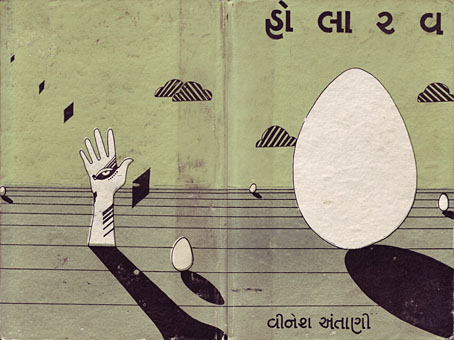
A recent post at A Journey Round My Skull is a stylish series of Indian book jackets from 1964 to 1984. These impress partly for the way they rework western design approaches, and they consequently look very different from the florid visuals one might (lazily) expect of Indian cover design. Western culture borrowed more than enough from India in the 1960s, from clothes to music, so it only seems right that the sub-continent should be free to take something back.
luna.jpg

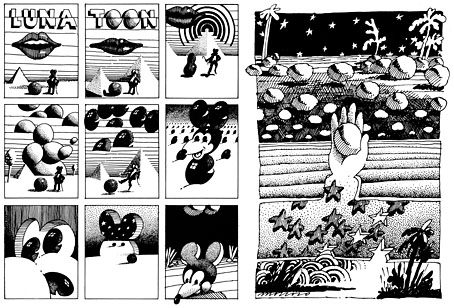
Luna Toon by Victor Moscoso (1968).

Will at A Journey Round My Skull mentions the above cover design as reminding him of this Krautrock bible, The Crack in the Cosmic Egg, a book which happens to be a favourite repository of musical obsession. The cover reminded me more of the weirdly abstract comic strips created by artist and graphic designer Victor Moscoso for the early run of Zap Comix in the late Sixties. Moscoso was one of the most graphically revolutionary of the West Coast poster artists, and his approach to comics looks surprisingly fresh today next to the work of fellow artists like Robert Crumb. Those limitless vistas go back to Giorgio de Chirico but it was Salvador Dalí who made deserts raked by evening shadows reflect interior landscapes of his own, and it was Dalí’s immense popularity that in turn popularised that endless plane as a stage for surreal events. Moscoso borrows from the Surrealists and comic artists like George Herriman as much as he borrows from Disney; in his posters he was one of many artists taking motifs or whole designs from Art Nouveau. Our Indian egg may well be an original work but the first example in Will’s post is a very Saul Bass-like hand, so I’m guessing that the designers of these books were looking around for inspiration. And that eye-in-a-hand? Moscoso had done that as well.
neon.jpg

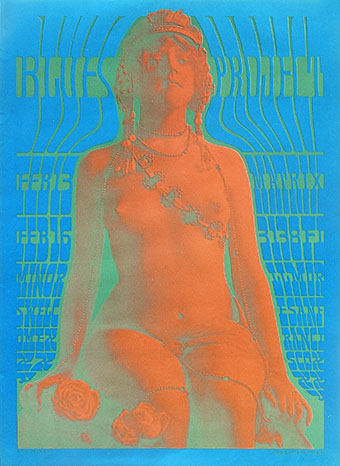
Blues Project Poster by Victor Moscoso (1967).

While we’re discussing Victor Moscoso, it’s convenient to draw attention to a slight mystery connecting his poster art and the great album cover designer, Barney Bubbles. The poster above was one of a number that Moscoso made incorporating Victorian or Edwardian photographs, and two at least of these use antique erotica as their central image.
ritual.jpg

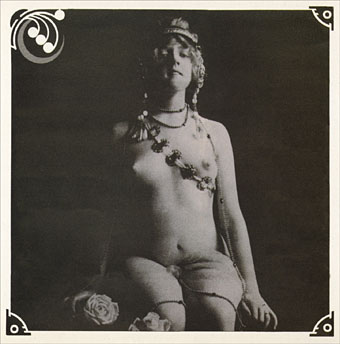
Space Ritual interior, design by Barney Bubbles (1973).

This particular photo always stands out for me. The woman is familiar to anyone who’s seen the interior of the fold-out sleeve Barney Bubbles created for Hawkwind’s Space Ritual album in 1973. Barney spent some time in San Francisco in the late Sixties and was undoubtedly familiar with Moscoso’s work, as he was with all the great designs coming from the West Coast at that time. What surprises me is that he should have somehow found the same image to use as Moscoso did. Was there a popular book of Edwardian erotica which everyone was familiar with? Did he ask Moscoso where he’d found the photo? Did he find it by chance? Barney Bubbles experts don’t know the answer (I’ve asked) and the question is in any case a rather trivial one. But I’m still curious… As early porn photos go it’s a particularly fine one and I’d like to know whether there are more like it and where it came from. Needless to say, if anyone knows more about this, please leave a comment.

Previously on { feuilleton }
Design as virus 9: Mondrian fashions
Design as virus 8: Keep Calm and Carry On
Design as virus 7: eyes and triangles
Design as virus 6: Cassandre
Design as virus 5: Gideon Glaser
Design as virus 4: Metamorphoses
Design as virus 3: the sincerest form of flattery
Design as virus 2: album covers
Design as virus 1: Victorian borders
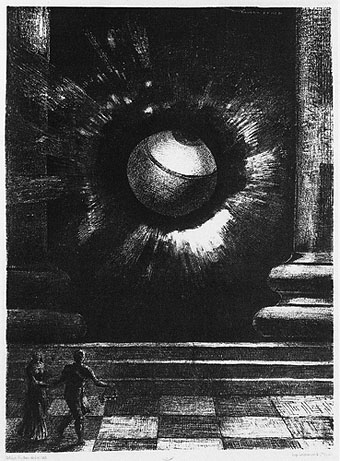
The eyes of Odilon Redon

redon1.jpg

L’Oeil, comme un ballon bizarre se dirige vers l’infini from A Edgar Poe (1882).

Another decently thorough Symbolist website covers the life and work of Odilon Redon (1840–1916), an artist whose pastels and prints were strange even by the standards of his contemporaries. His giant eyeballs and other floating figures are always startling and point the way inevitably to Surrealism, especially in dream lithographs like the one below.

redon2.jpg

Vision from Dans le Rêve (1879).

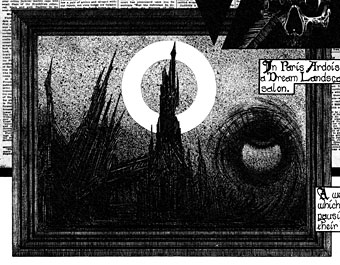
I compounded that Symbolist/Surrealist association when I was drawing The Call of Cthulhu in 1987 by showing Ardois-Boonot’s Dream Landscape (which Lovecraft doesn’t describe beyond the word “blasphemous”) as being a Max Ernst-style frottage canvas with a Redon eye rising from the murk. Cthulhu’s presence reduced to a single ocular motif like the eye of Sauron.

call.jpg

The Call of Cthulhu (1988).

And while we’re on the subject there’s Guy Maddin’s typically phantasmic short, Odilon Redon or The Eye Like a Strange Balloon Mounts Toward Infinity made for the BBC in 1995. Ostensibly based on the balloon picture above, this manages to reference a host of other Redon lithographs and charcoal drawings in the space of four-and-a-half minutes. Sublimely weird and weirdly sublime.

Elsewhere on { feuilleton }
The fantastic art archive

Previously on { feuilleton }
Arthur Zaidenberg’s À Rebours
The Heart of the World