Art on film: The Dark Corner

dark1.jpg

Continuing an occasional series about artworks in feature films with a post that suits a week where Surrealism has been a dominant theme.

I’ve been watching a lot of film noir recently, and I do mean a lot. Since August last year I’ve watched almost 100 films that warrant the label (I’ve been keeping a written record to avoid losing track), with more of them still to come. Many of these have been first-time viewings, an experience that’s been enlightening and mostly positive. I’ll have more to say on the subject in the future but for now here’s a discovery from The Dark Corner (1946), a detective drama directed by Henry Hathaway, and one I hadn’t seen before.
dark2.jpg

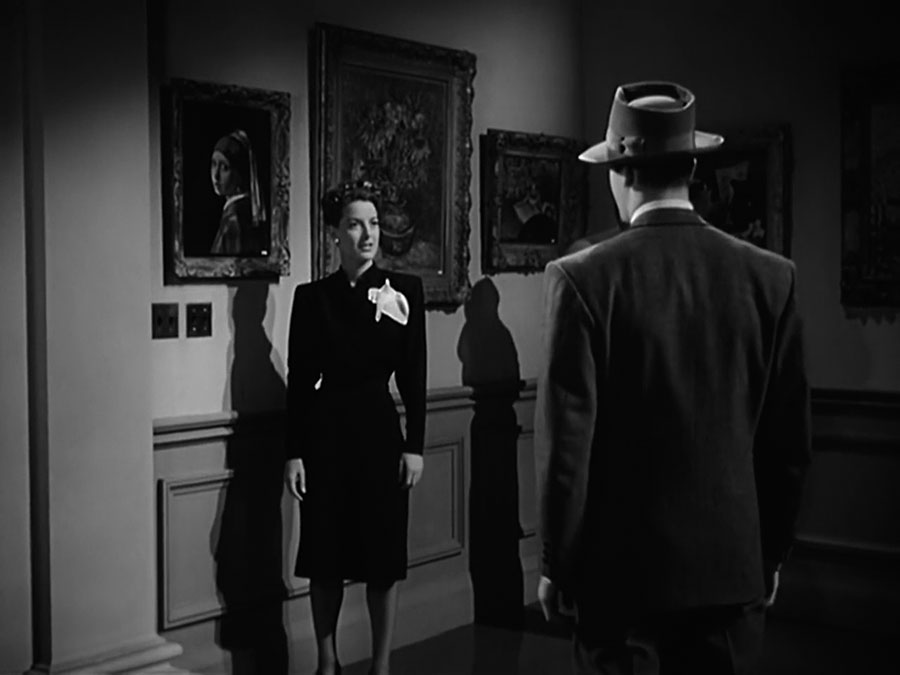
A Vermeer in a dark corner.

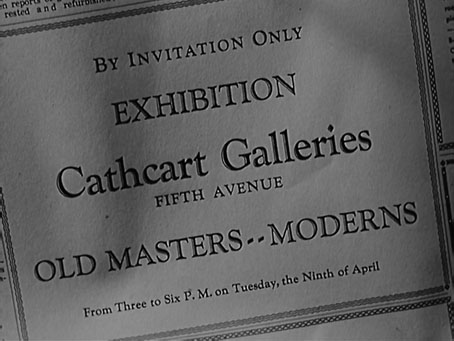
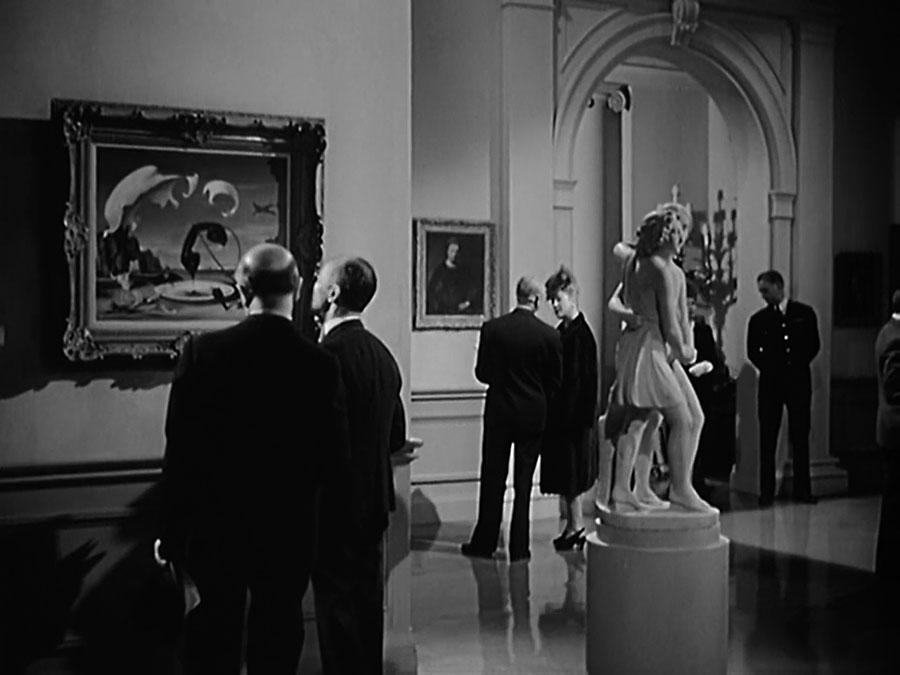
The story concerns a New York private eye, Bradford Galt (Mark Stevens), who’s being framed by parties unknown. When Galt investigates the mystery with his secretary, Kathleen (Lucille Ball in a straight role), their researches lead them to a Fifth Avenue art gallery run by Hardy Cathcart (Clifton Webb playing the same waspish aesthete as he did in Laura). Many of the art details can’t help but seem amusing or bizarre today, such as when someone brings home a genuine Vincent van Gogh painting and leaves it propped in a chair. There’s also a painting that we’re told is a rare Raphael but since this has to resemble Cathcart’s wife it looks nothing like a Renaissance picture. Elsewhere, a Donatello statue is priced at a mere $40,000, while Cathcart has Vermeer’s Girl with a Pearl Earring on sale despite the real painting having been in the collection of the Mauritshuis in The Hague since 1902.
dark3.jpg

As to the Surrealism, a scene inside the gallery features a blink-and-you-miss-it moment when a pair of would-be purchasers are seen peering at this Salvador Dalí painting, one of the few pieces of contemporary art on display. Before the camera pans away we see the man on the right shaking his head. I think this painting was also created for the film but unlike the alleged Raphael it looks genuine, and resembles several pictures that Dalí painted in the 1930s (eg: this one), all of which feature telephone receivers. The choice of imagery is apt. Two years earlier Dalí had created a seven-picture sequence illustrating “The Seven Lively Arts”. The Art of Cinema is represented by a figure whose head is a giant eyeball positioned between two huge ears, and with eyelashes that are cords leading to yet more telephone receivers.

Imitation or not, the painting in The Dark Corner did at least end up on the screen. In 1946 Dalí was working with Disney’s animators on the Destino project but the results of this wouldn’t be seen for another 50 years. I’ve been wondering what other Dalínean references might be hiding in American feature films from this time. (Don’t say Spellbound, everybody knows that one…)

Previously on { feuilleton }
Art on film: Je t’aime, Je t’aime
Art on film: Space is the Place
Art on film: Providence
Art on film: The Beast

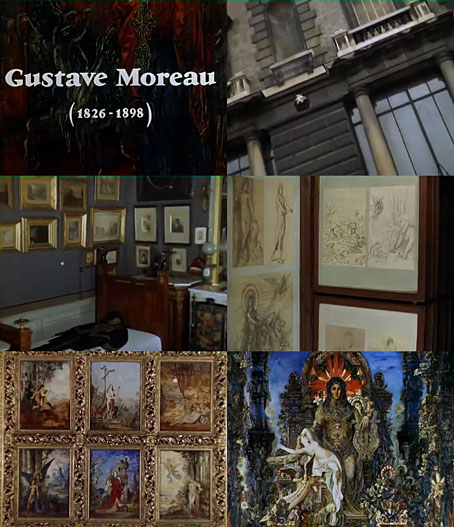
Gustave Moreau (1826–1898), a film by Nelly Kaplan

moreau1.jpg

André Breton has acknowledged that his personal ideal of female beauty was established in his adolescence when he visited the Gustave Moreau museum in Paris; like Joris-Karl Huysmans’s protagonist, Des Esseintes, Breton was enthralled by Moreau’s depiction of figures such as Salomé.

Keith Aspley, Historical Dictionary of Surrealism

André Breton happens to be one of four narrators whose voices may be heard (all speaking French) in this short study of Gustave Moreau’s paintings and drawings made in 1961. Director Nelly Kaplan was an Argentinian writer and film-maker who moved to Paris in the 1950s where she became creatively involved with Abel Gance, and with what was left of the original Surrealist movement based around the autocratic Breton. I’ve often drawn attention to Breton’s pettiness, especially his penchant for excommunicating from his circle anyone he disagreed with, but he deserves credit for championing Gustave Moreau during the decades when the artist was resolutely beyond the critical pale. A lesson I learned from the Surrealists early on is that you don’t let other people dictate the limits of your cultural tastes.

moreau2.jpg

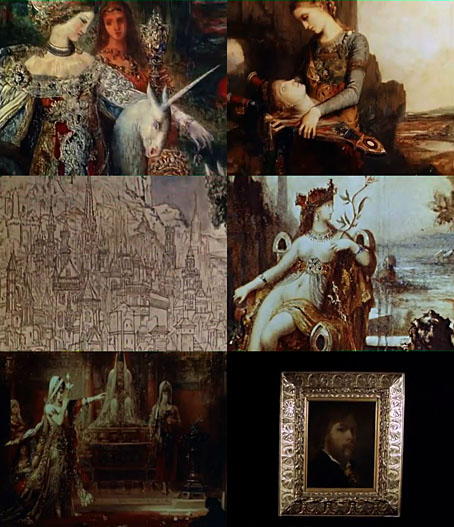
Moreau was still beyond the pale in 1961 so Kaplan’s film was in the vanguard of the reappraisals that were to take place later in the decade, culminating in major exhibitions in the early 1970s. One of the curators of the Hayward exhibition of 1972, Philippe Jullian, made an unfinished Moreau painting, The Chimeras, a key reference in his landmark study of Symbolist art, Dreamers of Decadence (1971). You see a few details from this picture in Kaplan’s film when the camera is roaming the walls of the Moreau Museum, formerly the artist’s residence in the rue de la Rochefoucauld, Paris. The years of neglect had their advantages, one of them being that the house/museum hasn’t had to change very much in order to accommodate visitors; the same goes for Moreau’s art which didn’t get scattered around the world like the works of his contemporaries. The upper floors of the museum are filled with original paintings, together with preliminary sketches which you see here in their hinged frames which allow you to leaf through them like pages of a book. No film or book does justice to the jewelled splendour of the finished paintings, however, especially the detailed works like Jupiter and Semele. You really have to see these things in person if you can.

Previously on { feuilleton }
New Life for the Decadents by Philippe Jullian
More chimeras
Philippe Jullian, connoisseur of the exotic
Ballard and the painters

Echoes of de Chirico

dechirico01.jpg

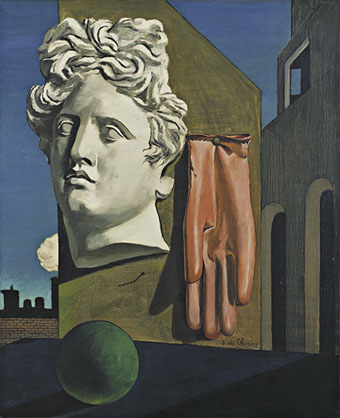
The Song of Love (1914) by Giorgio de Chirico.

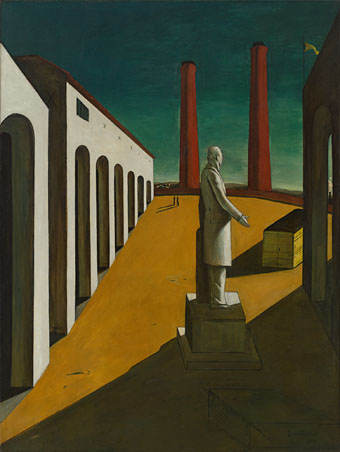
His art studies, begun in Athens, were continued in Munich where he discovered the work of Max Klinger and Arnold Böcklin, not to mention the writings of Friedrich Nietzsche and Arthur Schopenhauer, whose influence is perceptible in the paintings he went on to produce in Florence and Turin. In addition, his melancholy temperament lay behind the works that Guillaume Apollinaire labelled “metaphysical,” works in which elements from the real world (deserted squares and arcades, factory chimneys, trains, clocks, gloves, artichokes) were imbued with a sense of strangeness.

Keith Aspley, Historical Dictionary of Surrealism


dechirico02.jpg

The Enigma of a Day (1914) by Giorgio de Chirico.


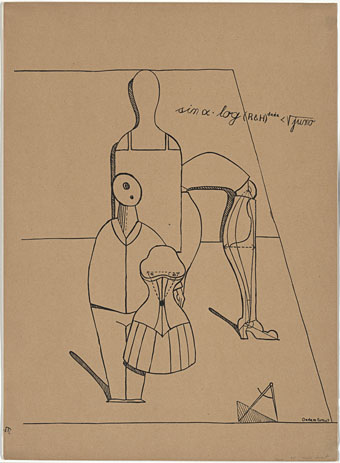
ernst.jpg

Plate II from Let There Be Fashion, Down With Art (Fiat modes pereat ars) (1920) by “Dadamax Ernst”.


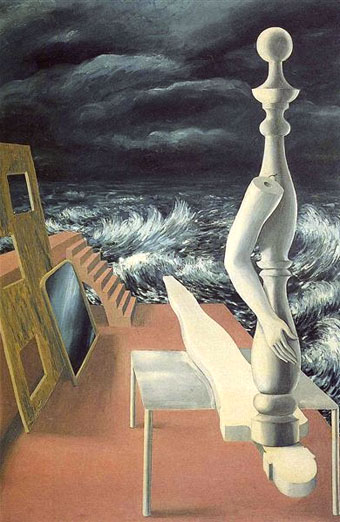
magritte.jpg

The Birth of an Idol (1926) by René Magritte.

Some time during the latter part of 1923 [Magritte] came face-to-face with his destiny, in the form of a painting by Giorgio de Chirico, who was one of the painters most admired by the Paris Surrealists: Le Chant d’amour (The Song of Love, 1914); to be more precise, a black-and-white reproduction of that painting in the review Les Feuilles libres, a very contrasty reproduction, as Sylvester has it, which only heightened the drama of the outsize objects suspended in the foreground of one of de Chirico’s “metaphysical landscapes”… He was shown it by Lecomte, or Mesens, or both. He was overwhelmed. […] Magritte always spoke of de Chirico as his one and only master. As a rule, he was exceedingly parsimonious in his assessment of other artists, past and present. In his own time, de Chirico (1888–1978) and Ernst (1891–1976) appear as the only two he admired, more or less unconditionally.

Magritte: A Life by Alex Danchev


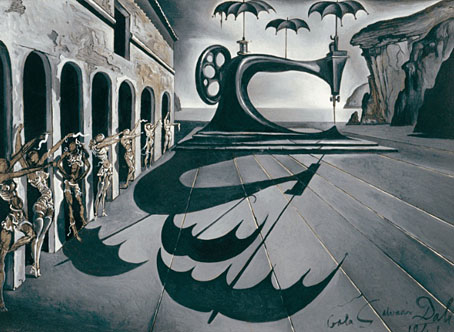
dali4.jpg

Sewing Machine with Umbrellas in a Surrealist Landscape (1941) by Salvador Dalí.

Continue reading “Echoes of de Chirico”

René Magritte, Cinéaste

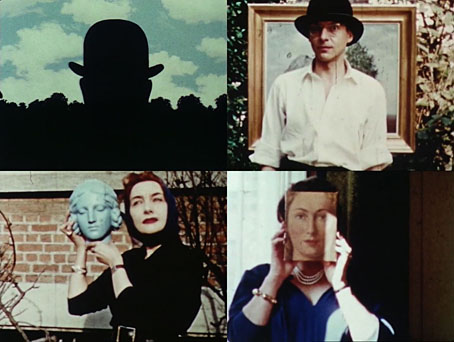
magritte1.jpg

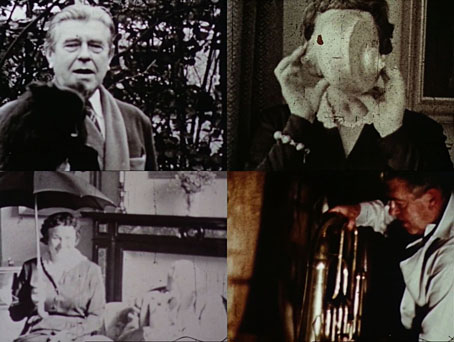
The title at the Internet Archive has this one as “Magritte Home Movies” which is a more accurate description than the title of the film itself. René Magritte, Cinéaste was apparently made in 1975 (although the print bears a copyright date for 1989), being a compilation of films from the late 1950s made in and around the Magritte household by René and wife Georgette (plus LouLou the Pomeranian) with contributions from friends in the Brussels art world: ELT Mesens (an artist who was later a member of the British Surrealist Group), Paul Colinet (artist), Louis Scutenaire (poet), Irène Hamoir (writer), Marcel Lecomte (writer), and others.

magritte2.jpg

The film opens with some contextual narration in French but the rest of the footage is soundless with a simple musical accompaniment. As with many home movies there’s a lot of mugging and dressing-up for the camera. What you don’t get in similar films is the setups that involve either quotes of Magritte’s paintings or the paintings themselves. If you’re familiar with the art then some of the props are also familiar, such as the plaster head (or heads) from the various versions of La Mèmoire, and the euphonium which in its painted form Magritte often showed in flames. The most Surrealist sequence is Le Dessert des Antilles, a Cocteau-like experiment with reverse-motion. Where Cocteau preferred to show a flower being pieced together from its constituent parts, Magritte has Irène Hamoir regurgitating a banana, bite by bite, which is then presented unpeeled to her husband, Louis Scutenaire. (This sequence has been flipped horizontally. A duplicate copy here shows the original title card.)

Elsewhere on { feuilleton }
The Surrealism archive

Previously on { feuilleton }
Magritte: The False Mirror
Magritte, ou la lecon de chose
René Magritte album covers
Monsieur René Magritte, a film by Adrian Maben
George Melly’s Memoirs of a Self-Confessed Surrealist
The Secret Life of Edward James
René Magritte by David Wheatley

Weekend links 663

wt.jpg

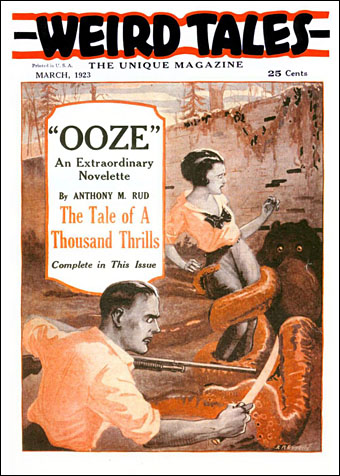
Weird Tales celebrates its centenary this month (although the first issue was on the shelves in February, 1923). Thirty years later, one of the last issues from the initial run had Slime by Joseph Payne Brennan as the story featured on its cover. The magazine maintained a viscous consistency if nothing else. Tentacular art by RR Epperly.

• A big surprise in yesterday’s Bandcamp Friday was the announcement of Singularity, a new album by synth ensemble Node. Or new-ish since the previously unreleased recording is almost 30 years old:

Singularity is the legendary “lost” Node album. Recorded at the same time as their original sessions in 1994 this has DiN stalwart Dave Bessell join Buller & Flood alongside original member Gary Stout who was later replaced by Mel Wesson for the two DiN releases. Presented here for the first time, mastered to modern standards but otherwise untouched and in its original form and recorded to two track with no overdubs.

Node have never been very prolific—two decades separate their first album from their second—so this was very welcome. The new release includes a bonus addition of the 16-minute version of Terminus, one of their best pieces which has only been available previously on a scarce CD-single.

• Steven Watson at Print Mag on skeuomorphic magazine design that turns print into play. Now I want to design a book that fits inside a cassette box.

• RIP jazz giant Wayne Shorter, and David Lindley, co-founder of one of my favourite psychedelic groups, the incredible Kaleidoscope.

• S. Elizabeth at Unquiet Things on The Sensitive Plant, a poem by Percy Shelley illustrated by Charles Robinson.

• Christopher Parker at Smithsonian Magazine asks “Did Salvador Dalí paint this enigmatic artwork?” Yes, he did.

Tangerine Dream in 1973 playing Atem live (with pre-recorded drums) on Spotlight, an Austrian TV show.

• New music: Mohanam by Shakti, and Area Code 601 by William Tyler & The Impossible Truth.

• At Spoon & Tamago: Bento boxes inspired by notable Japanese architecture.

• At Tentaclii: Ian Miller cover art for metal albums.

Northern lights seen across the UK.

New Blue Ooze (1970) by Kaleidoscope | Ooze Out And Away, Onehow (1986) by Harold Budd/Simon Raymonde/Robin Guthrie/Elizabeth Fraser | Ooze (1986) by 23 Skidoo