Echoes of de Chirico

dechirico01.jpg

The Song of Love (1914) by Giorgio de Chirico.

His art studies, begun in Athens, were continued in Munich where he discovered the work of Max Klinger and Arnold Böcklin, not to mention the writings of Friedrich Nietzsche and Arthur Schopenhauer, whose influence is perceptible in the paintings he went on to produce in Florence and Turin. In addition, his melancholy temperament lay behind the works that Guillaume Apollinaire labelled “metaphysical,” works in which elements from the real world (deserted squares and arcades, factory chimneys, trains, clocks, gloves, artichokes) were imbued with a sense of strangeness.

Keith Aspley, Historical Dictionary of Surrealism


dechirico02.jpg

The Enigma of a Day (1914) by Giorgio de Chirico.


ernst.jpg

Plate II from Let There Be Fashion, Down With Art (Fiat modes pereat ars) (1920) by “Dadamax Ernst”.


magritte.jpg

The Birth of an Idol (1926) by René Magritte.

Some time during the latter part of 1923 [Magritte] came face-to-face with his destiny, in the form of a painting by Giorgio de Chirico, who was one of the painters most admired by the Paris Surrealists: Le Chant d’amour (The Song of Love, 1914); to be more precise, a black-and-white reproduction of that painting in the review Les Feuilles libres, a very contrasty reproduction, as Sylvester has it, which only heightened the drama of the outsize objects suspended in the foreground of one of de Chirico’s “metaphysical landscapes”… He was shown it by Lecomte, or Mesens, or both. He was overwhelmed. […] Magritte always spoke of de Chirico as his one and only master. As a rule, he was exceedingly parsimonious in his assessment of other artists, past and present. In his own time, de Chirico (1888–1978) and Ernst (1891–1976) appear as the only two he admired, more or less unconditionally.

Magritte: A Life by Alex Danchev


dali4.jpg

Sewing Machine with Umbrellas in a Surrealist Landscape (1941) by Salvador Dalí.

Continue reading “Echoes of de Chirico”

René Magritte, Cinéaste

magritte1.jpg

The title at the Internet Archive has this one as “Magritte Home Movies” which is a more accurate description than the title of the film itself. René Magritte, Cinéaste was apparently made in 1975 (although the print bears a copyright date for 1989), being a compilation of films from the late 1950s made in and around the Magritte household by René and wife Georgette (plus LouLou the Pomeranian) with contributions from friends in the Brussels art world: ELT Mesens (an artist who was later a member of the British Surrealist Group), Paul Colinet (artist), Louis Scutenaire (poet), Irène Hamoir (writer), Marcel Lecomte (writer), and others.

magritte2.jpg

The film opens with some contextual narration in French but the rest of the footage is soundless with a simple musical accompaniment. As with many home movies there’s a lot of mugging and dressing-up for the camera. What you don’t get in similar films is the setups that involve either quotes of Magritte’s paintings or the paintings themselves. If you’re familiar with the art then some of the props are also familiar, such as the plaster head (or heads) from the various versions of La Mèmoire, and the euphonium which in its painted form Magritte often showed in flames. The most Surrealist sequence is Le Dessert des Antilles, a Cocteau-like experiment with reverse-motion. Where Cocteau preferred to show a flower being pieced together from its constituent parts, Magritte has Irène Hamoir regurgitating a banana, bite by bite, which is then presented unpeeled to her husband, Louis Scutenaire. (This sequence has been flipped horizontally. A duplicate copy here shows the original title card.)

Elsewhere on { feuilleton }
The Surrealism archive

Previously on { feuilleton }
Magritte: The False Mirror
Magritte, ou la lecon de chose
René Magritte album covers
Monsieur René Magritte, a film by Adrian Maben
George Melly’s Memoirs of a Self-Confessed Surrealist
The Secret Life of Edward James
René Magritte by David Wheatley

Weekend links 663

wt.jpg

Weird Tales celebrates its centenary this month (although the first issue was on the shelves in February, 1923). Thirty years later, one of the last issues from the initial run had Slime by Joseph Payne Brennan as the story featured on its cover. The magazine maintained a viscous consistency if nothing else. Tentacular art by RR Epperly.

• A big surprise in yesterday’s Bandcamp Friday was the announcement of Singularity, a new album by synth ensemble Node. Or new-ish since the previously unreleased recording is almost 30 years old:

Singularity is the legendary “lost” Node album. Recorded at the same time as their original sessions in 1994 this has DiN stalwart Dave Bessell join Buller & Flood alongside original member Gary Stout who was later replaced by Mel Wesson for the two DiN releases. Presented here for the first time, mastered to modern standards but otherwise untouched and in its original form and recorded to two track with no overdubs.

Node have never been very prolific—two decades separate their first album from their second—so this was very welcome. The new release includes a bonus addition of the 16-minute version of Terminus, one of their best pieces which has only been available previously on a scarce CD-single.

• Steven Watson at Print Mag on skeuomorphic magazine design that turns print into play. Now I want to design a book that fits inside a cassette box.

• RIP jazz giant Wayne Shorter, and David Lindley, co-founder of one of my favourite psychedelic groups, the incredible Kaleidoscope.

• S. Elizabeth at Unquiet Things on The Sensitive Plant, a poem by Percy Shelley illustrated by Charles Robinson.

• Christopher Parker at Smithsonian Magazine asks “Did Salvador Dalí paint this enigmatic artwork?” Yes, he did.

Tangerine Dream in 1973 playing Atem live (with pre-recorded drums) on Spotlight, an Austrian TV show.

• New music: Mohanam by Shakti, and Area Code 601 by William Tyler & The Impossible Truth.

• At Spoon & Tamago: Bento boxes inspired by notable Japanese architecture.

• At Tentaclii: Ian Miller cover art for metal albums.

Northern lights seen across the UK.

New Blue Ooze (1970) by Kaleidoscope | Ooze Out And Away, Onehow (1986) by Harold Budd/Simon Raymonde/Robin Guthrie/Elizabeth Fraser | Ooze (1986) by 23 Skidoo

Miró: Theatre of Dreams

miro1.jpg

More old TV, and something you might call Portrait of the Artist as an Old Man. Miró: Theatre of Dreams is a documentary about the Spanish (or as he might have preferred, Catalan) artist Joan Miró. This was broadcast by the BBC in 1978, and again in 1984, but it’s one I hadn’t seen until now. Robin Lough’s film was the first television profile of the artist in which Miró talks at length with his British friend, Roland Penrose, an artist and writer who did much to champion Surrealism in its early years. Penrose also narrates the film, describing Miró, who he’d known since the 1930s, as “the last of the great Surrealists”. I can imagine another Catalonian artist, Salvador Dalí, who was still very much alive in 1978, having something to say about this opinion. Between the conversations we see rehearsals for a Miró-designed theatrical performance centred around a monstrous Ubu-like tyrant whose character is part folk-figure, part analogue for Francisco Franco. The latter had only been dead for three years after being in power since the 1930s so performances like these were acts of exorcism as much as entertainment.

miro2.jpg

Penrose was a good writer who enjoyed demystifying modern art; I always recommend his book on Picasso as the one to go for if you’re only going to read a single account of Picasso’s life and work. The observations he makes here about Miró’s early love of the amorphous constructions that Antoni Gaudí created for the Parque Güell in Barcelona are reinforced later when Penrose and Miró are examining some of the objects in the artist’s studio. Miró suggests that the spiral form of an eroded seashell might be used as a model for skyscrapers to replace what he calls the matchboxes of New York City, a proposal which doesn’t seem as fanciful today as it did in 1978. We also see Miró painting on the rough side of a sheet of hardboard while enthusing about the textured surface of the material. This is unusual—most artists, if they use hardboard at all, paint on the smooth side—and, for me, a little surprising. There’s no such thing as right or wrong when it comes to art materials, but I’ve painted on the rough side of hardboard on a couple of occasions, and felt guilty about doing so when it always seemed like a cheap and rather crude alternative to using primed canvas. This is the first example I’ve seen of another artist doing the same. That it happens to be Joan Miró makes me feel better about the whole business.

Elsewhere on { feuilleton }
The Surrealism archive

Previously on { feuilleton }
Televisual art
Max Ernst by Peter Schamoni
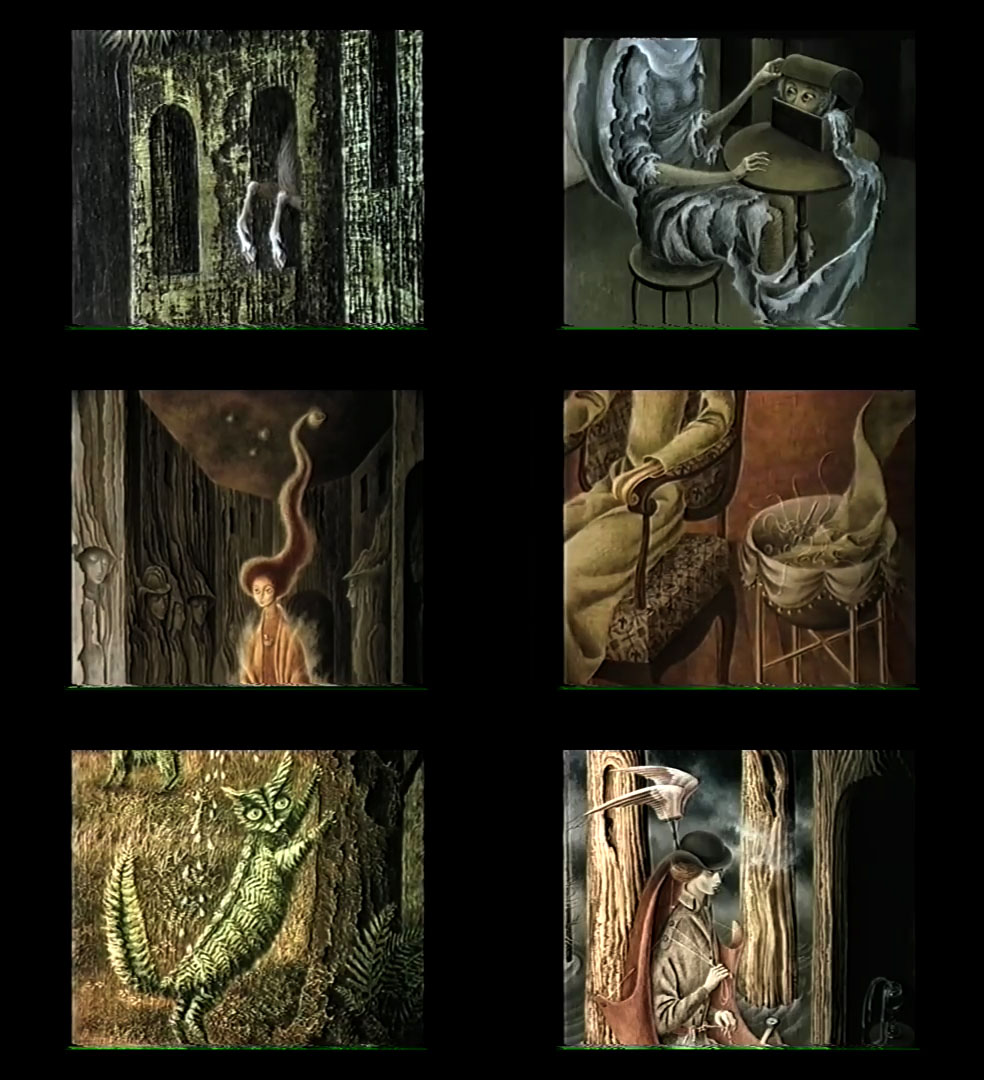
Leonora Carrington and the House of Fear

The Magic Art of Jan Švankmajer

svankmajer1.jpg

Three years ago I binged on all the Jan Švankmajer feature films after buying the box of blu-rays released by the director’s Athanor company. Once I’d worked my way through that lot, and rewatched the BFI collection of Švankmajer’s short films, I went through all the documentaries I’ve managed to accumulate, including this two-part BBC study which I taped when it was first broadcast in 1992. It’s likely that Švankmajer’s approach to film and to Surrealism no longer requires the kind of introduction that seemed necessary in the 1990s, but for those who do need such a thing this is a good place to start.

svankmajer2.jpg

Ben Fox’s documentary was made to coincide with an exhibition of Švankmajer’s films and artworks being shown at an animation festival in Cardiff. The two installments examine a different aspect of Švankmajer’s cinematic works: “Memories of Mysterious Beings” concerns the films that deal with childhood dreams and fears, while “The Naming of Demons” concentrates on his use of Surrealism as a tool for satire or social critique. In between lengthy extracts from the films the camera prowls around some of the director’s artworks while an actor reads statements Švankmajer has made about his interests and intentions. This last feature isn’t something I enjoy very much, not when the actor’s nasal delivery is so different from Švankmajer’s own voice. It’s a common ploy in documentaries, having someone impersonate an interviewee to avoid using subtitles, but it’s one I find distracting when done like this.

eva.jpg

Eva liked statues.

At this point I would have directed your attention once again to Jan Švankmajer, Director, a documentary about Czech cinema which featured the man himself talking at length about his activities in the 1960s, but this has now been removed from YouTube. In its place, however, there’s a more recent upload, Les Chimères des Švankmajer, an 80-minute documentary for French TV by Bertrand Schmitt and Michel Leclerc which is included among the extras on the BFI’s collection of Švankmajer’s short films. The only trouble here is that the YT copy has no subtitles, you’ll need to be a French speaker to understand the voice-overs which run throughout. This is one of the best of all the Švankmajer documentaries since it shows the range of activities conducted by Švankmajer and his late wife, Eva Švankmajerová, as artists and foremost members of the Prague Surrealist Group; film-making, as Švankmajer has often stressed in interviews, was only one outlet for his creativity. (It was also one he was forbidden to practice for several years when the Communist authorities took exception to his work.) In addition to seeing the Švankmajers preparing an exhibition of their creations, Schmidt and Leclerc show us something of their home outside Prague, an artwork in itself that combines the sculpture park and Wunderkammer. Eva Švankmajerová was the creator of many of those sculptures, a celebrated artist in her own right whose contribution to her husband’s films has often been overlooked.

Elsewhere on { feuilleton }
The Surrealism archive

Previously on { feuilleton }
Švankmajer’s cats
Jan Švankmajer: The Animator of Prague
Jan Švankmajer, Director
Don Juan, a film by Jan Švankmajer
The Pendulum, the Pit and Hope
Two sides of Liška