Alexander McQueen, 1969–2010

mcqueen1.jpg

“He was a Brothers Grimm of fashion, enchanting and captivating the audience with the most incredibly beautiful clothes, only to make their stomachs lurch with the underlying menace that shot through his work. Because every show contained outfits designed to thrill, shock – and catch the eye of picture editors – many people never realised that much of McQueen’s work was, quite simply, heart-stoppingly gorgeous: exquisite tailoring, beautifully sculpted dresses and glorious print.”
Jess Cartner-Morley. (More.)

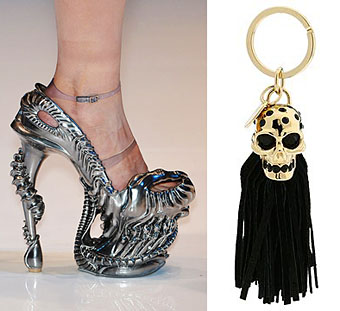
Butterfly-print dresses (how fitting for Darwin Day), Giger-style shoe designs, skull key chains… Yes, Alexander McQueen was something special.

Guardian obituary | Independent obituary

mcqueen2.jpg

Strange Attractions

squid.jpg

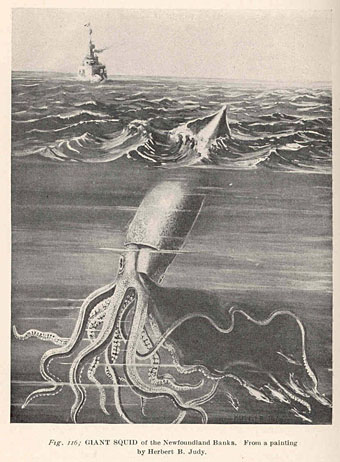
Giant Squid of the Newfoundland Banks. From a painting by Herbert B Judy.

Today’s Giant Squid comes to you courtesy of the University of Washington’s Digital Collection and their Freshwater and Marine Image Bank. This book plate is from Sea-shore Life; The Invertebrates of the New York Coast and the Adjacent Coast Region (1905) by Alfred Goldsborough Mayor, and the Internet Archive happens to have copies of the entire book.

sasalon.jpg

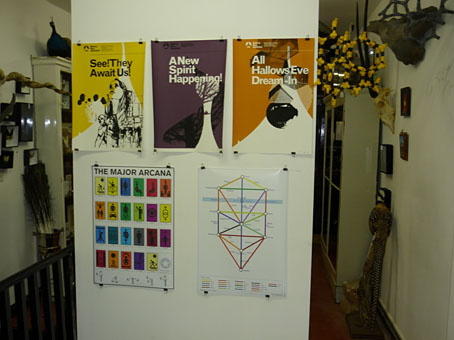
Which facts have nothing whatsoever to do with Ken Hollings’ photos of the Strange Attractor Salon which is in its final week at Viktor Wynd Fine Art, London. I was pleased to see the picture above which shows my pieces on the same wall as work by Julian House whose covers for the Ghost Box CDs I’ve enthused over in the past. Strange Attractor curator Mark Pilkington has posted further photos on his Flickr pages as has artist Ali Hutchinson whose beautiful work is also featured there.

Previously on { feuilleton }
• Strange Attractor Salon
• Readouts
• Welcome to Mars
• The Séance at Hobs Lane
• SAJ again
• Strange Attractor Journal Three
• Ghost Box
• The Major Arcana

Schott’s Physica Curiosa

schott1.jpg

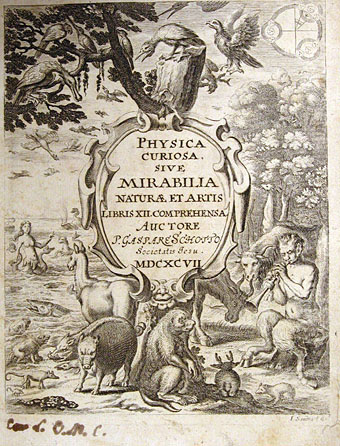
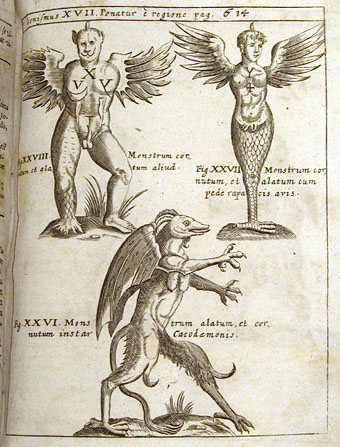
Pages from Physica Curiosa (1697) by Gaspar Schott, a collection of natural anomalies and the usual debatable creatures which belong in a fantastic bestiary. Some of these are similar to illustrations from the same period which I’ve used in Ann & Jeff VanderMeer’s Kosher Guide to Imaginary Animals, due for publication soon by Tachyon.

schott2.jpg

Elsewhere on { feuilleton }
• The etching and engraving archive

Alice in Acidland

acidland.jpg

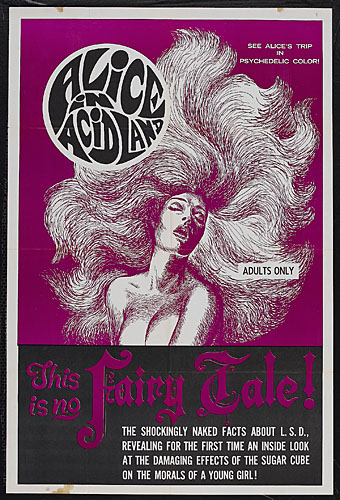
No idea how this piece of exploitation from 1968 evaded my attention for so long but going by the IMDB reviews it’s probably safe to say that any obscurity is well-deserved:

this movie is very accurate, as every girl i have met that smokes weed instantly becomes a bisexual nymphomaniac. scientific studies have actual proved this many times over. the accuracy is phenomenal and i think i speak for every man out there when i say i leave my boxers on while having sex. the parties look like any other raging party in the 60’s where people sit together in a well lit room smoking weed and immediate have sex with everyone as soon as they walk in.

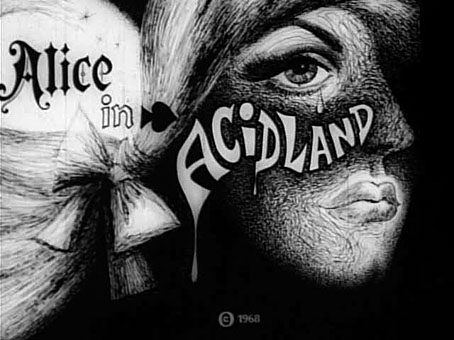
The director and writer were evidently embarrassed enough to use pseudonyms (Gertrude Steen…yeah, right) so the poster and title card (below) are probably as good as it gets unless tepid soft porn is something that really turns you on (baby).

Another fabulous Chateau Thombeau tip.
acidland2.jpg

Alice has been in the news again this week with a new trailer turning up for Tim Burton’s forthcoming film and also this lengthy article in New Scientist which looks at the Alice books through an interpretative lens of algebra and geometry. While it’s nice to play with a fresh interpretation of the stories, essays like this are invariably subject to considerable strain as they attempt to wring hidden meanings from every quirk of the text.

The trouble with the Alice books is that their origin is almost as famous as the stories themselves, and it’s well-known that Dodgson wrote down Alice’s Adventures Under Ground as a present for Alice Liddell with no intention of seeing it published. Aside from the addition of extra scenes, the published book doesn’t radically differ from the handwritten original so you have to stretch your credulity to accept that Dodgson managed to improvise an entertaining story for a child whilst simultaneously authoring a critique of developments in contemporary mathematics. As usual in cases such as these it helps to refer to an earlier logician, William of Ockham, whose famous declaration that “Entities should not be multiplied unnecessarily” is given on this mathematician’s page as “when you have two competing theories that make exactly the same predictions, the simpler one is the better.”

Previously on { feuilleton }
• Return to Wonderland
• Dalí in Wonderland
• Virtual Alice
• Psychedelic Wonderland: the 2010 calendar
• Charles Robinson’s Alice’s Adventures in Wonderland
• Humpty Dumpty variations
• Alice in Wonderland by Jonathan Miller
• The Illustrators of Alice

Haeckel fractals

haeckel.jpg

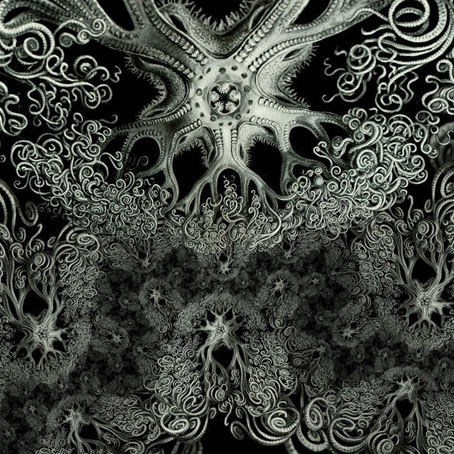
In which Ernst Haeckel’s Art Forms in Nature are given the Mandelbrot treatment. The example above is one of a number of variations created using the splendid Gorgon-headed Starfish, a creature I’ve messed with myself a couple of times.

These fractal images have been created by the Subblue people using their Fractal Explorer plug-in for Adobe’s Pixel Bender Toolkit, both of which are free downloads. I’ve not had chance to play around properly with Pixel Bender but the results here make it seem worth spending time getting to grips with its rather primitive interface.

Previously on { feuilleton }
• Ernst Haeckel, Christmas card artist