Weekend links 670

mutzel.jpg

An octopus catching a lobster (1894) by Gustav Mützel.

• RIP Barry Humphries. He emailed me a couple of years ago in his capacity as a collector of fin-de-siècle art, hoping I might answer a question about a very obscure artist. If you require justifications for the blogging habit then add this to the list. Humphries’ first book, Bizarre (1965), is a more cerebral counterpart to Charles Addams’ Dear Dead Days, and a compendium of oddities that I’d buy if I ever saw it in a secondhand shop. RIP also to incendiary singer Mark Stewart.

• “Schulz gets compared to Kafka because of his dreamy, disconcerting stories, but in Balint’s book, a version of Schulz emerges that is closer to one of Kafka’s characters—a man on the run who can’t get past the city walls; an artist exiled by a shape-shifting, unknowable tormentor—than to Franz himself.” Leo Lasdun reviewing a new biography of Bruno Schulz by Benjamin Balint.

• “Instead of asking whether an octopus shows aspects of human intelligence, perhaps the better question is whether humans can show aspects of octopus intelligence.” David Borkenhagen on octopuses and what they might teach us about the perception of time.

• “Uproar was my element, I wanted to get people moving, the more they roared, the bolder I became.” The pioneering theatrical performances of Valeska Gert are explored at Strange Flowers.

• Digital copies of albums by the mighty Earth may currently be purchased at the group’s Bandcamp page for $1 each. I’ve got everything already but you may wish to sample something.

Charles Drazin on the director who dared to tell uncomfortable truths: Lindsay Anderson at 100.

Steven Heller on Commercial Art, a magazine from the 1920s that chronicled UK design.

• At Unquiet Things: The luminous drama of Frants Diderik Bøe’s bejewelled floral still lifes.

• New music: This Vibrating Earth by Field Lines Cartographer, and Draw/Orb by Extra.

• Mix of the week: XLR8R podcast 796 by Gold Panda.

• The Strange World of…Andrzej Korzynski.

The Jewel In The Lotus (1974) by Bennie Maupin | Jewel (1985) by Propaganda | Black Jewelled Serpent Of Sound (1985) by The Dukes Of Stratosphear

Weekend links 667

kamekura.jpg

Design by Yusaku Kamekura.

• “Music and intoxication have gone hand in hand since prehistory, but the relationship of music and cannabis is particularly strong and complex, says Jono Podmore, a former habitual smoker, as he investigates a groundbreaking new study which may get us closer to understanding these links.”

• “[There] have been many instances of persons, who thought themselves metamorphosed into lanterns, and who complained of having lost their thighs.” Public Domain Review offers words to the wise from An Essay on Diseases Incidental to Literary and Sedentary Persons (1768).

• “Mathematicians have finally discovered an elusive ‘einstein’ tile.” Emily Conover explains. I thought Roger Penrose had already discovered these but none of his aperiodic patterns are created by a single tile.

Wes Anderson does science fiction…maybe. After watching The French Dispatch last month I’d caught up with the Anderson oeuvre so it’s good to have something new to look forward to.

20th century Japanese poster art. Related: Jason Booher on creating a cover for a book by Carlo Rovelli.

The Winners of Smithsonian Magazine’s 20th Annual Photo Contest.

• New music: Ghost Town Burning by The Lonely Bell.

Anthony “Surgeon” Child’s favourite music.

• RIP Raoul Servais, animator.

East Of Asteroid (1976) by 801 | Asteroide (1978) by Joël Fajerman & Jan Yrssen | Asteroid Witch (2022) by Ghost Power

Weekend links 666

solar.jpg

Muy Mago (Portrait of Aleister Crowley) (1961) by Xul Solar.

• “…snails amaze with their capacity to move so far, to spread so widely, while doing so little. This, it seems to me, is one of the real marvels of snail biogeography. Individuals do not need to exert great effort because natural selection has acted for them, acted on them, acted with them, to produce these beings that are so unexpectedly but uniquely suited to a particular form of deep time travel, drifting. From such a perspective, rather than being any kind of deficiency, the highly successful passivity of snails might be seen as a remarkable evolutionary achievement.” Thom van Dooren on how snails cross vast oceans.

• “Slow art has layers. And this is why it requires time and effort. We should see this as a good and necessary thing. If this is a kind of obstacle in the way of easy assimilation then it is an obstacle that is integral to the value of the thing itself. The mind is calmed, or disturbed, or made exultant by the art that rewards us for our goodwill and our capacity to take our time.” In Praise of Slow Art by Chris Horner.

• “I have set naturalism and the supernatural in binary opposition but perhaps there is a third way. Let’s call it the supranatural stance…” Paul Broks explores the roots of coincidence.

• At Unquiet Things: The art of Hector Garrido, an illustrator who specialised in the Gothic staple of women in gowns fleeing at night from sinister mansions.

• “The writer Jorge Luis Borges once referred to his friend the artist Xul Solar as ‘one of the most singular events of our era’,” writes Miriam Basilio.

• At Spoon & Tamago: Japanese craftsmanship meets Pokemon at Kanazawa’s National Crafts Museum.

• At Public Domain Review: Martin Frobenius Ledermüller’s Microscopic Delights (1759–63).

• New music: Rest Of Life by Steve Roach.

The Four Horsemen (1972) by Aphrodite’s Child | Supper’s Ready (1972) by Genesis | Six Six Sixties (1979) by Throbbing Gristle

Weekend links 664

warburton.jpg

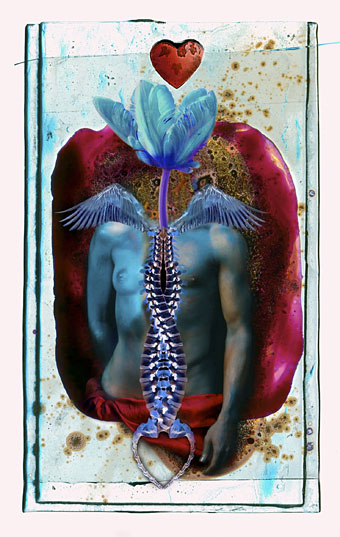
Caduceus: Tarot Card Study – Love by Holly Warburton.

• The week in stage magic: Ken Carbone, writing about playing cards and graphic design, points the way to an hour of Ricky Jay demonstrating his miraculous abilities with a pack of cards. Elsewhere, Erik Ofgang asks “Who was Mr. Electrico, the sideshow magician who inspired Ray Bradbury—then vanished?”

The 1980 Floor Show – Uncut / Unedited: 8 Hours of David Bowie in Ziggy Stardust guise performing for American TV cameras at The Marquee, London, in October 1973. That’s more Bowie than most people would want—there’s a lot of repetition—but it’s good to know things like this can still surface.

• “A supernova has gone out,” says David Grundy about the late Wayne Shorter. Also this: “Sci-fi fan Shorter suggested the title to [Weather Report’s] second album I Sing The Body Electric, taken from Walt Whitman via Ray Bradbury.”

• “We need to get away from thinking of ourselves as machines… That metaphor is getting in the way of understanding living, wild cognition.” A long read by Amanda Gefter about the secret life of plants, and “4E” cognitive science.

• “…why take a soft approach to safety when you can scare the sensible into the next generation with some of the most effective horror shorts of all time?” Ryan Finnegan on the notorious PIFs (public information films) of the 1970s.

• “I am increasingly of the Lynchian mindset of ‘never explain’…” Lynda E. Rucker talking to Steven Duffy about her latest story collection, Now It’s Dark.

• James Balmont presents a brief introduction to the mind-altering cinema of Sogo Ishii.

• At Spoon & Tamago: Hidari: An epic wooden puppet samurai stop-motion film.

• Old music: Musique De Notre Temps (1976) by Éliane Radigue.

• Steven Heller’s font of the month is Juma.

Body Electric (1982) by The Sisters Of Mercy | Super-Electric (1991) by Stereolab | Electric Garden (Deep Jazz In The Garden Mix) (2013) by Juan Atkins & Moritz von Oswald

Weekend links 661

rubin.jpg

Zephyr (1970), a blacklight poster by Jupiter Rubin. Via.

• I wouldn’t usually expect Clark Ashton Smith’s Zothique to be mentioned at Literary Hub for any reason, but there it is. Emily Temple recommends some of the best stories from a century of Weird Tales that you can read online.

• Mixes of the week: A mix for The Wire by Gamut Inc, and The Last of Us, “a non-stop mix of ambient soundscapes, experimental electronics and modern classical music”.

• “…Yaggy believed that wonder was the helpmate of learning.” Sasha Archibald on Levi Walter Yaggy’s Geographical Maps and Charts (1887/93).

Stylistically, Beardsley’s pictures for Salome are among his most derivative and original. In the sharpness of their lines and great swaths of black and white, we see the well-documented influences of Japanese woodcuts and Ancient Greek vase-painting. And yet, Beardsley’s work bridges these grand traditions of East and West with such fresh dynamism and taboo as to be undeniably, and ultimately definitionally, Nouveau.

Mirror and Window Both: The Brief Superabundance of Aubrey Beardsley by A. Natasha Joukovsky

• New music: Rhinog Fawr by Somatic Responses, and Sargo/Posidonia by Sleep Research Facility/Llyn Y Cwn.

• “Why is there such a voracious consumer appetite for miniature things?” asks Steven Heller.

• At Dennis Cooper’s: Spotlight on…Julio Cortázar Blow Up and other Stories (1967).

• At Unquiet Things: The Prolific Pioneering Pulp Art Of Ed Emshwiller.

Random images from DJ Food’s desktop.

Miniature Sun (1989) by XTC | Adventures In A Miniature Landscape (2009) by Belbury Poly | Miniature Magic (2020) by Plone